Passing Safely on a Narrow Cut
A narrow cut can turn an easy New Brunswick ATV ride into a tense few seconds: limited sightlines, soft shoulders, and another machine coming straight toward you. This guide explains how to slow down, communicate, make room, and pass safely on a tight trail without pushing your quad or side-by-side into a ditch, brush, or unstable ground.
Prepare Before You Reach a Narrow Cut
Read the trail before riding into it
A narrow cut is often a trail corridor squeezed between banks, trees, rock, or brush. It may look wide enough from a distance, then pinch down around a bend or become uneven where water has worn the trail. Before entering, reduce speed and look beyond the immediate opening. Check for blind corners, loose gravel, deep ruts, branches, and places where the trail edges drop away.
A cut can also hide another trail user. You may not see an approaching rider until you are already committed to the narrow section. If you cannot see far enough ahead to stop comfortably, treat the unseen stretch as occupied. Avoid charging in just because the first few metres look clear. A slower approach leaves you more room to brake, choose a line, and respond if someone appears.
Trail conditions matter, too. A surface that is firm on a dry day may be slippery after rain, while spring thaw can leave ruts and soft shoulders that will not support the weight of a machine. Check New Brunswick Trail Conditions Before You Go and respect posted closures. Riding around a wet patch to find more space can widen the trail and damage its edges; Why Riding Around a Wet Section Makes It Worse explains why staying on the marked corridor matters.
Choose a safe stopping place before you need one
If the trail narrows ahead, look for a wider, stable spot where you could stop without blocking the entire passage. That might be a broad approach before the cut, a firm turnout, or a level section with room to pull aside. Do not assume the shoulder is safe: it may be soft, sloped, undercut, or hiding rocks and roots beneath brush.
If you are riding with others, leave enough space between machines that each rider has time to react. A group packed tightly together can be difficult to stop as a unit, especially on a descent or loose surface. Let the lead rider slow early, and have everyone behind follow suit rather than trying to close the gap.
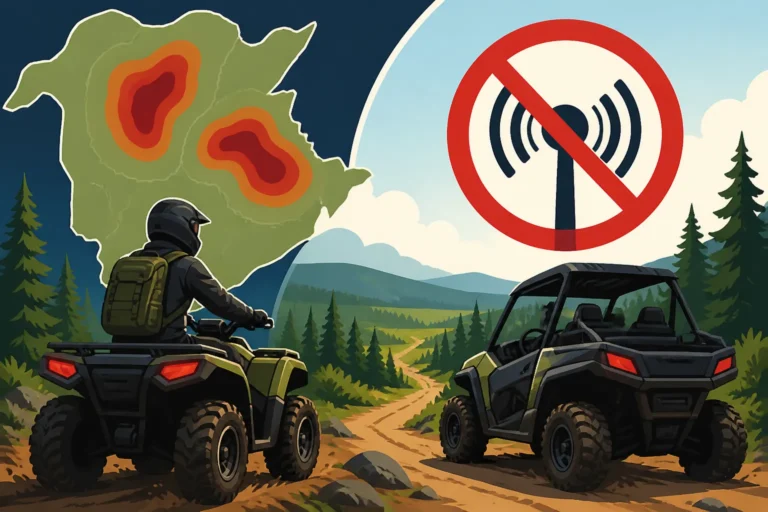
A navigation app such as onX Offroad may help you review a route before setting out, but a digital map cannot tell you whether a specific cut is passable right now or whether a safe turnout is available around the next bend. Check the map alongside local trail information, signs, and what you can see on the ground. Keep following the marked corridor, as explained in Staying on a Marked New Brunswick Corridor.
What to Do When Another Machine Is Coming
Slow down and make your presence clear
The safest response to an oncoming machine is usually to slow early and avoid sudden moves. Keep your machine controlled, stay on the established riding surface, and do not assume the other rider can see you around a bend or through thick brush. If you can stop safely before the tightest point, do so. A controlled stop is much easier to manage than a last-second brake or swerve.
Use clear, calm communication. A brief wave or agreed hand signal can help the other rider understand that you have seen them and are preparing to stop or make room. Avoid gestures that could be misread, and do not rely on a signal alone if dust, terrain, or distance makes it hard to see. Hand Signals on a New Brunswick Trail is useful background for communicating when riders are sharing a route.
Do not accelerate to “get through first” when there is not enough room to pass. That choice can leave both machines trying to occupy the same narrow section. It can also send you into loose material at the edge, where a wheel may slide or drop into a rut. Slow, make eye contact if practical, and coordinate before either machine moves into the tightest part.
Decide who should wait and where
There is no benefit in turning a passing situation into a contest. The safest place to wait is the nearest stable area that leaves a clear path for the other machine. If you are already at a wider spot, stop there and let the approaching rider pass. If neither rider has reached the constriction, communicate and agree which machine will back up or move to a turnout.
Avoid reversing blindly around a bend or down a steep, uneven section. If backing up is necessary, do it slowly, with a spotter when available, and only along a route you can see. A side-by-side may need more room to turn or reverse than a quad, so do not assume a manoeuvre that works for one machine will work for another.
Trail etiquette helps everyone make these decisions without confusion. Read New Brunswick Trail Etiquette Locals Expect and Yielding at Every Meeting before heading out, particularly if you are new to club trails. Posted signs and local direction should guide your choices; if a trail is busy or visibility is poor, patience is safer than trying to squeeze past.
| Situation | Safer response | Avoid |
|---|---|---|
| You see an oncoming machine before the cut | Slow down and stop at a stable, wider spot if available | Entering the cut quickly to claim the space |
| You meet at a blind bend | Stop, communicate, and coordinate movement | Reversing quickly without checking the route |
| One machine is larger or harder to manoeuvre | Choose the option that gives both riders a controlled path | Assuming the smaller machine must always move |
| The shoulder looks soft or steep | Stay on firm ground and use a safer turnout | Dropping a wheel into brush or an unstable edge |
| Dust or brush blocks visibility | Reduce speed and proceed only when the path is clear | Relying on a signal the other rider may not see |
How to Pass Without Leaving the Trail
Keep both machines on firm, established ground
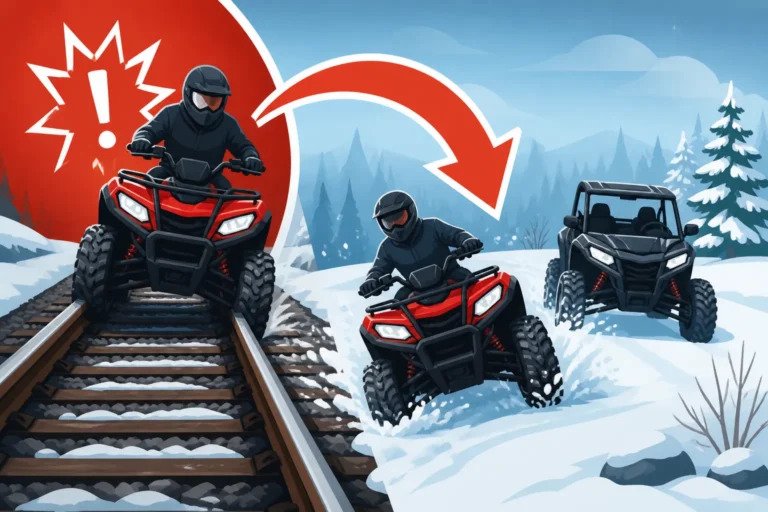
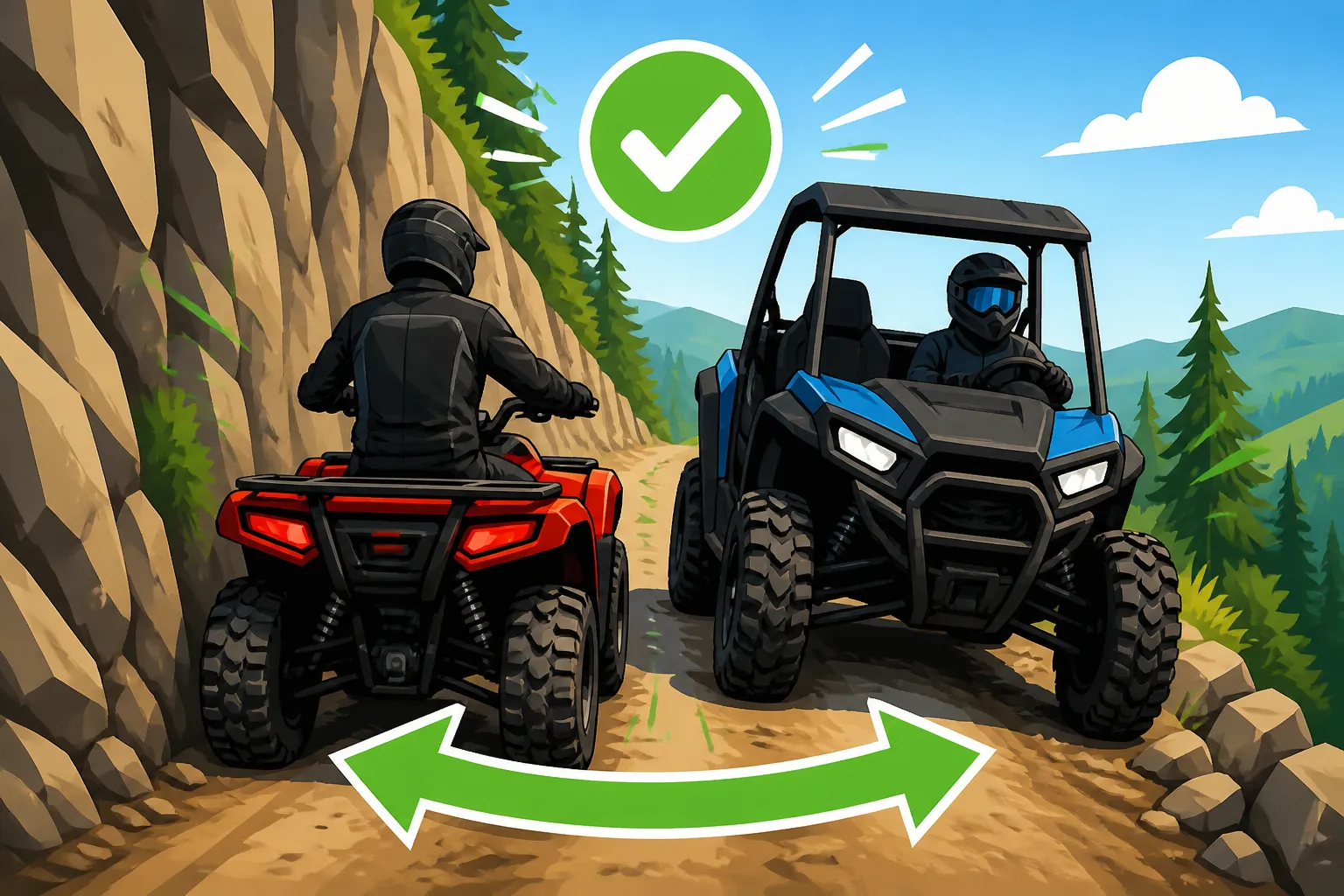
Once you have agreed who will move, make the pass slowly and predictably. Keep your wheels on the firmest part of the established trail, maintain enough room from the other machine, and avoid sharp steering inputs. On a cut with a bank on one side, a shallow ditch on the other, or roots across the surface, even a small sideways correction can destabilize a machine.
If there is not enough width for two machines to pass safely, do not force it. One rider should wait at a suitable turnout or back up to a wider section if that can be done safely. A few minutes of coordination is better than scraping bodywork, damaging a trail edge, or risking a rollover.
Do not create a new passing lane by pushing into brush or driving around the marked route. The shoulder may be soft, and repeated detours can widen a narrow trail or disturb drainage. New Brunswick Trail Signage Explained can help riders understand why signs and marked routes matter, while New Brunswick Bridges on Club Trails offers a reminder to take extra care at other confined trail features where there may be limited room to stop or turn.
Give the other rider room to regain a normal line
A pass is not finished just because the machines have cleared one another. Continue at a controlled speed until both riders are safely beyond the tightest point, then allow enough distance before accelerating. Dust, loose stones, or a bump can affect the rider who is following, so avoid pulling away abruptly.
If you are travelling as a group, let the oncoming machine pass the group in a controlled sequence rather than having every rider surge forward at once. Group members should wait for clear instructions or a visible signal from the lead rider, keep their spacing, and avoid blocking a turnout. A rider who is still stopped or manoeuvring should not be pressured to hurry.
An app such as onX Offroad can support route planning, but do not stop in a blind or narrow section to check a screen. Review navigation when you are safely off the trail or at a suitable stopping place. Map information can help you understand where you are going; it does not replace attention to the actual surface, trail signs, or approaching traffic.
Special Situations and Common Mistakes
Riding in dust, after rain, or near work activity
Dust can erase the sightline that made a cut seem manageable a moment earlier. In dry conditions, leave more space between machines and reduce speed where dust hangs in the air. If you cannot see the trail surface or an approaching rider, stop at a safe place rather than continuing into a blind stretch. A narrow cut is not the place to ride close to the machine ahead.
After rain, watch for slick roots, loose gravel, and shoulders softened by runoff. The edge that looked firm on the way in may not support a heavy machine on the way out. Avoid abrupt braking or steering on a slope, and never assume the other rider can move aside simply because the trail looks passable from your position.
If you encounter logging or maintenance activity, give workers and equipment plenty of space and follow signs or directions. Large vehicles may need the full width of a trail or woods road and may have limited visibility. Meeting a Logging Operation on Trail covers this situation in more detail. When in doubt, wait in a safe place rather than trying to pass active equipment in a confined area.
Mistakes that make a close call more likely
One common mistake is assuming that the rider who arrives first automatically gets to proceed. In practice, the safer choice depends on visibility, surface, machine size, and access to a stable turnout. Another is pulling onto the edge without checking it. Brush can conceal a drop, deep rut, loose rock, or wet ground that makes a stopped machine difficult to control.
Riders also get into trouble by making several decisions at once: braking hard, turning sharply, waving, and reversing while the other machine is still moving. Separate the steps. Slow down, stop where the ground is stable, communicate, agree on a plan, and move only when both riders understand what is happening.
Finally, do not treat a navigation app as a real-time safety guarantee. You can use onX Offroad to help plan a route, but confirm trail access and conditions through appropriate local information before riding. Carry essential equipment and know how to use it; New Brunswick Equipment a Rider Must Carry is a helpful companion read. For longer or remote rides, also consider Carrying a Satellite Messenger on a Long Ride and First Aid on a Remote Woods Loop.
Disclaimer
This article is for general informational purposes only and does not constitute professional advice. Laws, prices and regulations vary by location and change over time. Consult a qualified professional for guidance on your specific situation.