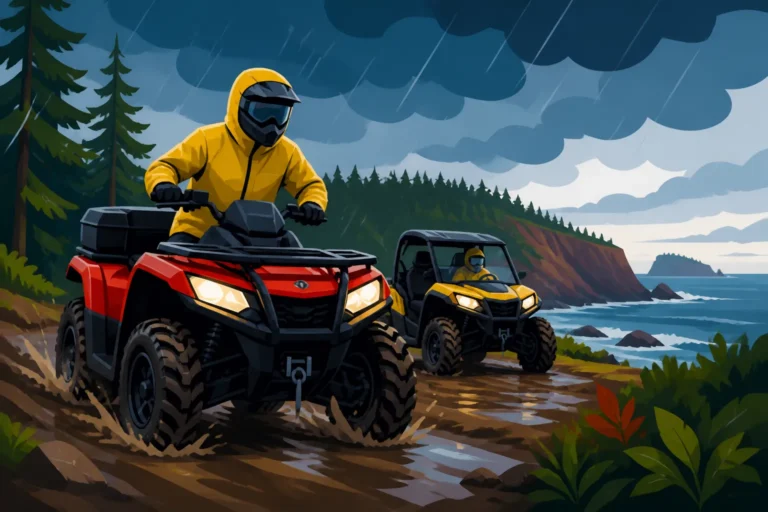
What a Three-Season Trail Means in Practice
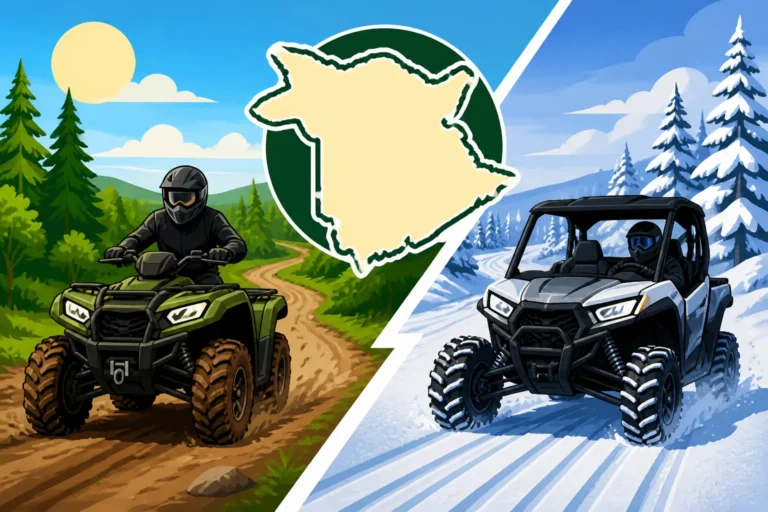
A three-season ATV trail in New Brunswick is generally available for riding in spring, summer, and fall, but not maintained as a winter route. That distinction affects when you can ride, what conditions to expect, and how to plan your route. Here’s what the label means in practice—and what to check before heading out.
What a Three-Season Trail Means
It describes the trail’s riding season, not a guaranteed opening date
“Three-season” is a useful shorthand: the trail is intended for riding during the warmer parts of the year rather than being groomed and maintained for winter use. It does not mean every section opens on the same spring date or stays open until the same fall date. Weather, trail conditions, maintenance work, land access, and local closures can all affect when a route is passable.
That matters in New Brunswick, where a sunny stretch of weather in one area does not necessarily mean every trail is ready. A low-lying section near a brook may still be wet, while a higher gravel route is firm enough to ride. Around Miramichi, Bathurst, Woodstock, or the Restigouche region, conditions can vary from one part of the network to another.
Treat the label as a general description of the intended season, not a real-time trail report. Before setting out, check current information from the relevant club or trail organization. [New Brunswick Non-Groomed Trails Run Three Seasons] explains the seasonal distinction, while [New Brunswick Trail Conditions Before You Go] is a useful reminder to check conditions close to your ride date.
It does not mean a trail is open every day in those seasons
A three-season designation does not promise uninterrupted access from spring through fall. Trails can be closed temporarily for repairs, washouts, unsafe surfaces, maintenance, or other access concerns. Spring thaw is a particularly important time to pay attention: a route that was fine late in the previous fall may be vulnerable when the ground is soft and saturated.
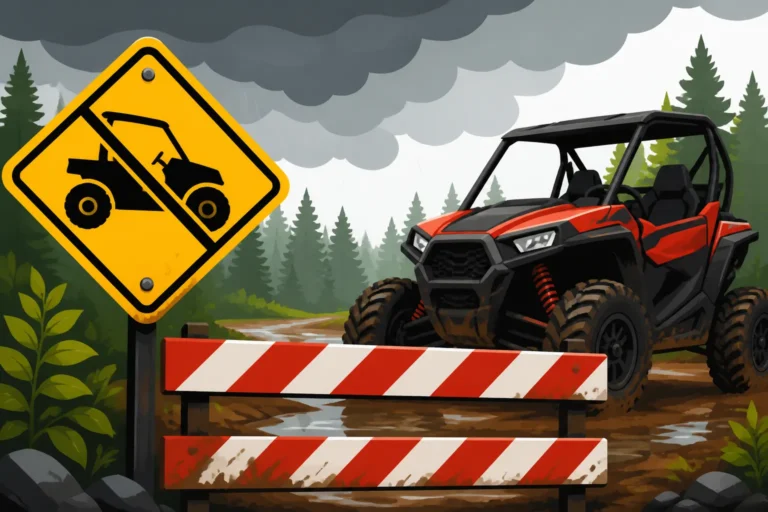
A closure is not just an inconvenience to route around. Riding through a closed or muddy section can deepen ruts, damage drainage, and make repairs more difficult. If a marked corridor is closed, choose another legal route rather than trying to skirt the closure through the woods or onto private land. [New Brunswick Trail Closures in Spring Thaw] and [Mud Season and Club Closures] offer helpful context for why clubs may restrict access during this period.
A practical rule is to confirm the trail status on the day you plan to ride, especially after heavy rain or during seasonal transitions. If you cannot find a clear update, contact the local club or choose a route with reliable status information instead of assuming it is open.
Three-season and four-season describe different use expectations
The main difference is winter operation. A four-season trail may be available for riding across more of the year, while a three-season route is not intended to provide the same winter riding opportunity. The terms describe a broad seasonal category; they do not guarantee identical conditions, grooming, or access along every kilometre.
In New Brunswick, some corridors may have different users or maintenance arrangements in winter. A trail that is available to quads in warmer months may be used or managed differently when snow conditions arrive. Do not assume that a summer route remains available to ATV or UTV riders simply because it appears on a map.
| Trail description | What it generally suggests | What it does not guarantee |
|---|---|---|
| Three-season | Intended primarily for spring, summer, and fall riding | A fixed opening date, uninterrupted access, or winter availability |
| Four-season | May provide a broader riding season, including winter access where authorized | That every segment is open, groomed, or suitable in all conditions |
| Temporarily closed | Access is restricted for a specific period or concern | Permission to ride around the closure on nearby land |
When choosing a permit or planning winter use, check the current rules and trail information rather than relying on the label alone. [What a Three-Season Trail Means in Practice] and [Choosing Between a Four-Season and Three-Season Sticker] can help you understand how seasonal access and permit choices relate.
How the Seasons Change the Ride
Spring brings soft ground and changing access
Spring riding can be appealing after a long winter, but it is also when a trail is most likely to be fragile. Snowmelt and rain can leave low areas saturated. Tires may sink into soft ground, and a short detour around a puddle can widen the trail and harm the edges.
If you see deep standing water, fresh ruts, a barrier, or a closure notice, do not treat it as a challenge to overcome. Turn back or use a confirmed open alternative. A route that looks manageable for a large side-by-side may still be damaged by repeated passes from multiple machines.
Check for club updates and seasonal restrictions before you leave, and be willing to change plans. [New Brunswick Trail Closures After Rain] and [Why Riding Around a Wet Section Makes It Worse] explain why a cautious decision helps protect the trail for everyone.
Summer usually offers more predictable travel, but not uniform conditions
Once surfaces dry, many routes become easier to assess and travel. Summer still brings its own considerations: dust on dry roads, heavy rain that changes conditions quickly, and increased use on popular corridors. Narrow sections may require extra care when meeting another rider, and visibility can be limited by bends, vegetation, or terrain.
Plan for the kind of ride you are taking, not just the distance. A short outing near a trailhead is different from a long day heading into a remote area. Carry water, basic tools, and enough fuel for your planned route, and leave room in the schedule for a slower pace or an unexpected turn-back.
For navigation, an app such as onX Offroad can be one tool for reviewing and organizing a route. It should not replace current local trail information, posted signs, or permission to ride. If a digital line appears to continue through a closure or onto land without confirmed access, follow the official information on the ground.
Fall can bring changing weather and shorter daylight
Fall riding may offer crisp temperatures and colourful scenery, but conditions can shift quickly. Rain can make clay or leaf-covered surfaces slippery, while fallen leaves may hide rocks, ruts, or drainage features. Later in the season, colder mornings and earlier sunsets make it important to plan a conservative turnaround time.
Before a longer ride, check the forecast, daylight, and trail status. Pack a warm layer and rain gear, even if the day starts clear. A route that felt straightforward in August may take longer in wet conditions or when visibility drops.
A route-planning app such as onX Offroad can help you keep track of your intended path, but download or save essential route details before entering areas with weak reception. Use a club map or official trail information as your main reference, and remember that a mapped route is not proof that access is currently open.
How to Plan a Three-Season Ride in New Brunswick
Verify the route and its status before you unload
Start with the trail network or local club information for the area you intend to ride. Confirm that the trail is open to your type of machine, that access is allowed for the planned date, and that no seasonal closure or reroute affects your route. A map can show where a corridor runs, but current status information tells you whether it is usable now.
This is especially important if your plan crosses several communities or trail sections. A route leaving Woodstock or heading toward the Miramichi may include different surface types and local updates. Confirm the full route rather than checking only the first trailhead or the destination.
Use onX Offroad or another navigation app as a planning aid, not as the final authority on access. Compare the route with official trail information, and pay attention to signs once you are riding. [New Brunswick Trail Maps and the MapGear App] covers a local mapping option, and [Zooming In on the QuadNB Federation Trail Map] is useful when you need to examine route details before setting out.
Match your machine and equipment to the ground
A three-season trail is not one uniform surface. You may encounter gravel, packed earth, rocky stretches, wet crossings, or narrow wooded sections on the same outing. Tire condition, ground clearance, and the machine’s size can all affect how comfortably you handle the route.
For a UTV, think about width and turning space as well as traction. A wide machine may be awkward on a narrow trail or at a tight turn. For an ATV, consider whether you have the tools and recovery gear for the route’s remoteness. In either case, avoid using speed to compensate for uncertainty; slow down when visibility or footing changes.
Carry a first-aid kit, water, food, a charged phone, and a way to communicate if you are travelling beyond dependable cell service. A map or route saved for offline use can be useful, but it should complement—not replace—basic ride planning. [Packing for a Full Day in the Woods] and [Checking Cell Reception Before a Remote Ride] cover preparation that becomes especially valuable on longer routes.
Respect closures, signs, and land access
A three-season trail designation does not authorize riding everywhere nearby. Stay on marked, permitted corridors and follow posted signs. If a route approaches a gate, private woodlot, or closed section, do not assume there is an alternate path through adjacent land.
This is easy to get wrong when a trail appears on a GPS app or when a familiar woods road seems to lead in the right direction. A line on a screen cannot tell you whether a landowner has granted access, whether the corridor is currently closed, or whether a temporary reroute is in place. If permission or access is unclear, stop and verify rather than continuing.
Leave gates as you found them, avoid riding around barriers, and report significant damage or hazards to the appropriate club. [Staying on a Marked New Brunswick Corridor] and [New Brunswick Trails That Cross Private Woodlots] are useful reminders that access depends on respecting the route and the people who maintain or own the land.
Common Misunderstandings About Three-Season Trails
“Three-season” does not mean the trail is maintained all year
The phrase is about the intended riding season, not a promise that crews will maintain the route continuously. Clubs and trail organizations may carry out work when weather and access allow. A storm, washout, or drainage problem can change conditions between visits, so an old report may no longer reflect what you will encounter.
Do not assume a trail is suitable just because someone rode it earlier in the season. Recent rain, thaw, or maintenance can change the surface quickly. Check for new updates and signs, especially before a long ride or a trip into a less-populated area.
A trail on a map is not automatically open
Digital mapping makes it easier to plan, but it can also create false confidence. A route shown in an app may be out of date, may not show a temporary closure, or may not establish that a rider has permission to use it. This applies whether you use onX Offroad, a club map, or a GPS file shared by another rider.
Use mapping tools to understand geography and prepare a route, then verify access through the organization responsible for the trail. Keep a backup plan in case a section is closed. If signs on the trail conflict with what your screen shows, follow the signs and check with the local club before proceeding.
Three-season access is not a substitute for permit and safety requirements
Seasonal access is only one part of being ready to ride. You may also need the appropriate trail permit, registration, insurance, and required safety equipment. The details depend on the machine and the kind of riding you plan to do, so check the rules that apply to your situation before leaving home.
Keep required documents accessible and make sure your machine is prepared for the route. [Four Things to Carry on a New Brunswick Trail] is a useful checklist, while [New Brunswick's Groomed and Non-Groomed Trail Permit] can help clarify permit categories. When in doubt, confirm requirements with the relevant organization or service provider before your ride.
A good three-season ride is not just one where the trail is technically open. It is one where you have checked conditions, chosen a suitable route, packed for the day, and left yourself enough flexibility to turn around. That approach helps protect New Brunswick’s trail network and makes the ride more enjoyable for the next person, too.
Disclaimer
This article is for general informational purposes only and does not constitute professional advice. Laws, prices and regulations vary by location and change over time. Consult a qualified professional for guidance on your specific situation.