New Brunswick Trail Etiquette Locals Expect
A ride can turn sour quickly when someone spins up mud, blocks a narrow trail, or leaves a gate open behind them. New Brunswick locals expect riders to share club corridors thoughtfully, respect private land and work activity, and leave the route in good shape for the next person. This guide covers the habits that make a ride safer and more welcome.
Respect the trail and the people who maintain it
Stay on the marked route
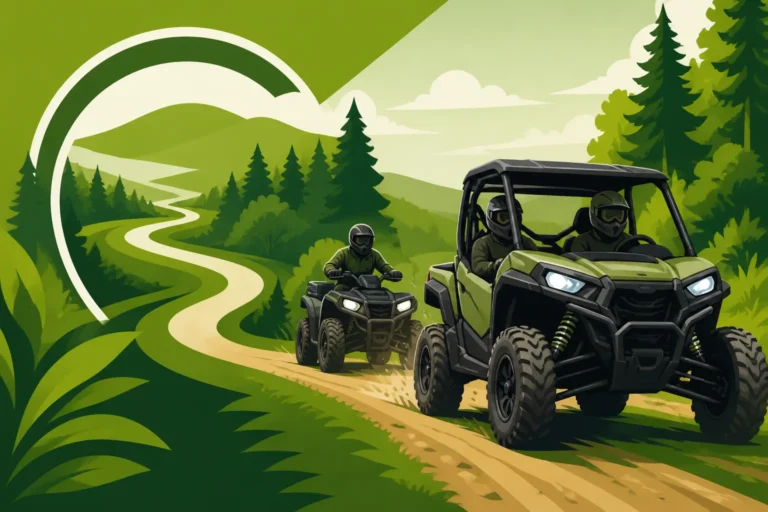
New Brunswick’s trail network passes through a mix of club-managed corridors, private woodlots, Crown land, and areas with seasonal or local access restrictions. A trail on a map is not an invitation to make your own shortcut beside it. Riding around a muddy section, widening a corner, or cutting through a field can damage land and create conflict for the club or landowner responsible for access.
Follow posted signs and stay on the designated route, even when a detour looks inconvenient. If a section is blocked, wet, or signed as closed, turn around or follow an official reroute rather than making a new one. [Staying on a Marked New Brunswick Corridor] is a useful reminder that the trail itself—not just the destination—is part of what riders are expected to protect.
It can be tempting to trust a phone map when a marked trail seems to disappear. Use navigation tools to help you understand where you are, but treat local signs and official trail information as the authority on where you may ride. Riders who use onX Offroad can check their position and plan a route, while still confirming that the corridor is open and permitted through the appropriate local trail information. [New Brunswick Trail Maps and the MapGear App] covers another mapping option riders may want to understand.
Treat gates, signs, and closures as instructions
A gate may be there because of livestock, forestry work, private property, or a temporary access issue. If it is open when you arrive, do not assume it should stay open: pass through and leave it as you found it. If it is closed, do not squeeze around it or move it to get through. [Leaving a Gate the Way You Found It] is a simple principle that prevents a small decision from becoming a bigger problem for a landowner or the club.
Trail closures can be frustrating, especially when you have driven a long way to ride or are already partway through a loop. Still, riding past a closure can put other riders at risk and make it harder for clubs to keep access. Closures after heavy rain or spring thaw can protect soft ground from deep ruts and erosion; a route that looks passable to one machine may become badly damaged after repeated traffic. Check [New Brunswick Trail Closures After Rain] and [New Brunswick Trail Conditions Before You Go] when planning, and be ready to adjust your route if conditions change.
Signs can tell you more than whether a route is open. Pay attention to direction markers, warnings, trail boundaries, and notices about work or shared use. If you are unsure whether a sign applies to your machine or the route ahead, stop in a safe place and check before continuing. [New Brunswick Trail Signage Explained] can help you get familiar with the kinds of information signs provide.
Remember that a trail corridor is shared space
A club trail is not a private racetrack. Other riders, hikers, work vehicles, property users, and emergency responders may be using or crossing the corridor. Keep your machine under control, avoid aggressive acceleration near homes or trailheads, and leave room for others to pass. A slower pace is especially considerate where visibility is limited or the trail passes close to residences.
Local trail clubs also rely on volunteers to clear brush, repair signs, check structures, and maintain the route. If you see a damaged sign, washout, fallen tree, or unsafe obstruction, report it to the relevant club or trail organization rather than trying to create a new route around it. [New Brunswick Club Trail Maintenance] explains why those ordinary-looking trail features take ongoing work to keep usable.
Share the route safely
Slow down when you cannot see what is ahead
A tight turn, crest, or narrow wooded cut can hide another rider, a stopped machine, or a work vehicle. Reduce speed before a blind area, keep enough room to stop, and stay to the appropriate side of the trail where the route allows. Avoid accelerating hard out of corners, where loose gravel or mud can surprise someone coming the other way.
On narrow sections, be patient and use a safe, visible place to let another group pass. Don’t force a meeting by edging onto a soft shoulder, steep bank, or wet ground that could give way. If one rider needs to stop, the rest of the group should stop where they can do so without blocking the entire route. [Passing Safely on a Narrow Cut] offers more detail on handling these close encounters.
Group rides need a little extra care. Leave enough distance between machines to react if the rider ahead slows suddenly, and avoid bunching up at intersections or trail entrances. Agree on a regrouping spot before setting out, especially if riders have different experience levels or machines with different speeds. A group that stays orderly is easier for others to pass and less likely to lose someone at a junction.
Yield carefully and communicate clearly
When you meet another user, ease off the throttle and make your intentions clear. A friendly wave or a brief pause can prevent confusion, but gestures should never replace a safe speed and a clear view of the trail. If dust, brush, or a bend limits visibility, assume someone could be just beyond it.
Passing a stopped machine also takes judgment. Give the rider enough space to work, avoid spraying them with dirt, and don’t crowd the edge of the trail. If the other person appears to need help, ask before approaching or touching their machine. They may be dealing with a mechanical issue, checking a map, or waiting for someone in their group.
Keep your riding predictable around other users. Sudden swerves, sharp acceleration, and revving close to people can feel threatening even if you do not intend harm. This matters most near trailheads, intersections, homes, and places where a route crosses or approaches a public road. Being courteous in these short shared sections helps preserve goodwill for the rest of the ride.
Give work crews and larger vehicles room
New Brunswick trails can meet forestry operations and other work activity. If you encounter a logging truck, loader, or crew, slow down early and follow any directions or signs. Work vehicles may have limited visibility, need extra room to turn, or be moving material across the route. Never assume the operator has seen you just because you can see the cab.
If a work area blocks the trail, stop at a safe distance and wait for instructions. Do not ride around equipment, enter an active work zone, or pass under a raised load. A few minutes of patience is a much better trade than putting yourself or a worker in danger. [Meeting a Logging Operation on Trail] is worth reviewing before riding in areas where forestry activity may be present.
| Situation | Considerate response | Avoid |
|---|---|---|
| A muddy or damaged section | Stay on the marked route and follow an official detour | Cutting a new bypass around the soft ground |
| A closed gate | Stop and respect the closure | Moving it or squeezing around the side |
| A blind corner | Slow down before entering and keep room to stop | Accelerating through without visibility |
| A narrow trail encounter | Yield at a safe, firm spot and communicate | Forcing another rider onto a soft shoulder |
| An active work area | Follow signs and crew directions | Riding around equipment or through the work zone |
| A nearby home or trailhead | Keep speed and noise controlled | Revving hard or accelerating aggressively |
Keep the ride considerate off the trail too
Control noise, dust, and speed near people
A machine that sounds manageable in the woods can be intrusive near a home, campground, or trailhead. Avoid unnecessary revving, especially when stopped or riding slowly through a populated area. If you are travelling with a group, keep the line moving smoothly rather than repeatedly accelerating and braking in a way that creates extra noise and dust.
Dust can make a shared route uncomfortable and can reduce visibility for the rider behind you. Leave a reasonable gap, ease off on loose surfaces, and avoid roosting dirt toward other users. In dry conditions, passing a house or a group on foot at a controlled pace is a small courtesy that can have an outsized effect on how welcome riders feel.
Speed should match the actual conditions, not just the machine’s ability. A clear, familiar stretch may feel easy to ride quickly, but trail surfaces and visibility can change within a short distance. Mud, gravel, leaves, frost, washouts, and unexpected traffic all affect stopping distance. If the route narrows or the surface becomes unpredictable, slow down before you reach the hazard.
Respect property and ask before entering
A route may pass near private land without giving riders permission to leave the marked corridor. Do not enter a driveway, field, yard, or unmarked woods road simply because it looks like a convenient connection. If you want to ride on private land outside an authorized trail, get permission from the owner first and make sure everyone in your group understands the boundaries.
Be especially careful around posted signs, gates, homes, and farm or forestry activity. A landowner may have good reason to restrict access at a particular time, even if the trail was open on a previous ride. If you are uncertain whether a route crosses private property or where the authorized corridor runs, stop and check rather than guessing. A navigation app such as onX Offroad may help you orient yourself, but it should not be treated as proof that you have permission to ride.
Leave the area as tidy as you found it. Pack out food wrappers, drink containers, broken straps, and any other rubbish. Don’t leave a machine blocking an entrance or turnaround area, and avoid stopping in a spot where emergency or work vehicles may need access. These details seem minor until someone else has to deal with the mess or obstruction.
Plan for changing trail conditions and limited reception
A route that was firm on your last ride may be muddy or damaged after rain. Spring thaw, washouts, and changing forestry activity can all affect how a trail feels on the ground. Check the local trail information before leaving, carry a backup plan, and be prepared to turn around if conditions are not suitable. It is better to cut a loop short than to damage a trail or strand a machine in a difficult spot.
Do not rely on a live phone connection for every decision. Some remote sections have weak or no cellular reception, so download or save the information you need before heading out. onX Offroad can be one part of a navigation setup, but also carry a charged phone, keep track of your group, and know where you are well enough to explain your location if you need help. [New Brunswick Cellular Reception Maps] can help riders think through coverage gaps before they set out.
Before riding, confirm that each person knows the planned route, the expected regrouping points, and what to do if the group gets separated. Tell someone who is not riding where you expect to be and when you plan to return. For a longer or remote ride, bring basic supplies suited to the route and conditions, and do not assume another group will be close by if you need assistance. [Packing for a Full Day in the Woods] has more ideas for preparing for a longer outing.
Make local etiquette part of every ride
Do a quick check before starting
A few minutes of preparation can prevent the most common trail-day problems. Confirm that your route is open, that your group understands the signs and boundaries, and that everyone has a way to navigate if the phone signal disappears. Check that your machine is in good working order and that you have the documents or equipment required for your ride. [New Brunswick Equipment Checks by Officers] is helpful background for riders who want to understand what they may need to have ready.
Talk through practical expectations with your group before you start: ride at the pace of the least experienced person, keep a safe following distance, stop only where the group can pull clear, and do not leave anyone behind at a junction. These agreements are especially useful when riders are visiting from outside the area or joining a group for the first time.
Be the rider locals are glad to see again
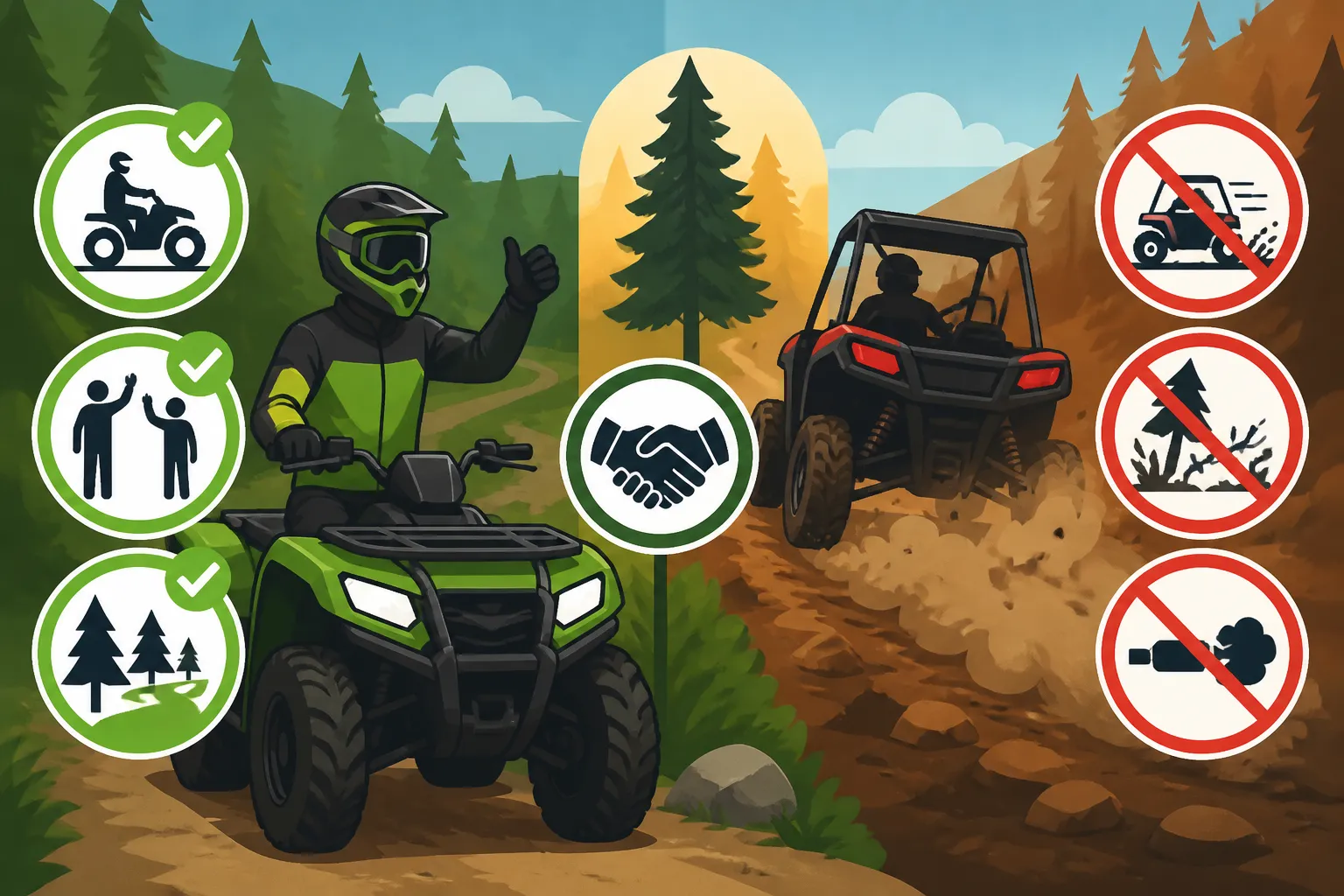
Good trail etiquette is mostly a series of small choices: staying on the marked route, slowing down near people, closing a gate as you found it, giving workers room, and taking rubbish home. None of these habits makes a ride less enjoyable. They make it more likely that the trail remains in good shape and that landowners, clubs, and other users continue to see riders as considerate neighbours.
If you are unsure what is expected on a particular section, pause and ask the local club or trail organization rather than relying on a guess. Conditions and access can vary from one area to another, and a courteous question is better than an avoidable mistake. The best measure of a successful ride is not only the distance covered, but whether the next rider can enjoy the same trail without inheriting damage or conflict.
Disclaimer
This article is for general informational purposes only and does not constitute professional advice. Laws, prices and regulations vary by location and change over time. Consult a qualified professional for guidance on your specific situation.