What a Half-Day Quad Safety Course Covers
A half-day quad safety course can feel like a small box to check before riding, but it should leave you with practical skills and a clearer sense of New Brunswick’s rules. Here’s what the course commonly covers, how to prepare, what to ask the organizer, and why passing it is not the same as buying a trail permit.
What to expect from a half-day course
A half-day course is a compact introduction to riding safely and legally, not a substitute for extensive experience. The exact schedule, teaching methods and assessment can vary by course provider. Some sessions emphasize classroom instruction; others include a practical component. Before registering, ask the organizer what the session includes and whether you will ride a machine during it.
The aim is to help riders understand their machine, make sensible decisions and recognize when conditions or their own skill level make a ride unsafe. A well-run course connects those ideas to real situations: preparing to set out, managing a turn, approaching an obstacle, sharing a trail and responding if something goes wrong.
The course may be relevant to young riders and to adults who want structured instruction. However, taking a course does not automatically establish that you meet every age, licence, supervision or trail-access rule. Those requirements depend on the circumstances of the ride. For a broader look at what applies to different ages, see New Brunswick ATV Age Requirements and New Brunswick Quad Safety Course Explained.
Classroom and practical time may be different
“Half-day” describes the general time commitment, but it does not tell you how that time is divided. A provider may include an introductory talk, demonstrations, individual practice, a knowledge check or some combination of these. A course may also have a specific machine, clothing or parent-attendance requirement.
Confirm the details before you arrive, particularly if the rider is a minor. Ask whether the provider supplies the quad or expects participants to bring one, what protective equipment is required, and whether there is any preparation or form to complete in advance. Do not assume that every course is a ride-along session simply because it is about quad safety.
A useful course should give participants a chance to ask questions. If a rule, procedure or safety point is unclear, ask the instructor to explain it in the context of a trail ride. The practical value is not just remembering a phrase; it is being able to apply it when you are tired, distracted or facing unfamiliar terrain.
Course completion is not a riding pass for every situation
A course certificate can document that a rider completed instruction, but it does not replace other requirements that may apply. It does not by itself authorize riding on a road, provide access to a club trail, replace insurance or make an unsuitable machine appropriate for a young rider.
Keep the distinctions clear:
| Item | What it generally addresses | What it does not replace |
|---|---|---|
| Safety course | Instruction in safe riding and relevant rules | Age, licence, supervision, insurance or access requirements |
| Registration | The machine’s registration status | A trail permit or proof of insurance |
| Trail permit | Permission to use the applicable managed trail network, subject to its rules | Registration, insurance or rider training |
| Insurance | Coverage required for the ride or location | A course certificate or trail permit |
The details can depend on where you plan to ride and who is riding. Check the rules that apply to the specific rider, machine and route before treating any certificate as proof that everything else is in order.
The safety skills and topics commonly covered
Course content can differ, so treat the points below as a helpful preview rather than a guaranteed lesson plan. Ask the provider for its current outline if you need to know whether a specific topic or practical exercise is included.
Understanding the machine
Instruction commonly begins with basic familiarity: where the controls are, how the machine responds, and how to use it without sudden or careless inputs. A rider should be able to identify the controls and understand that a quad is not simply a car without doors. Its balance and handling depend on the rider’s position, speed, surface and movements.
The instructor may discuss how to mount and dismount safely, how to start and stop, and how to maintain control at a manageable pace. If there is hands-on practice, it may involve basic manoeuvres rather than advanced trail riding. The point is to build control gradually, not to encourage speed or demonstrate difficult stunts.
Riders should also learn to pay attention to the machine’s condition. A pre-ride check can help identify problems before they become emergencies. The course organizer can explain which checks are covered, but a sensible routine includes looking for visible damage, checking that controls and safety equipment are in usable condition, and making sure the machine is suitable for the rider.
Protective equipment and fit
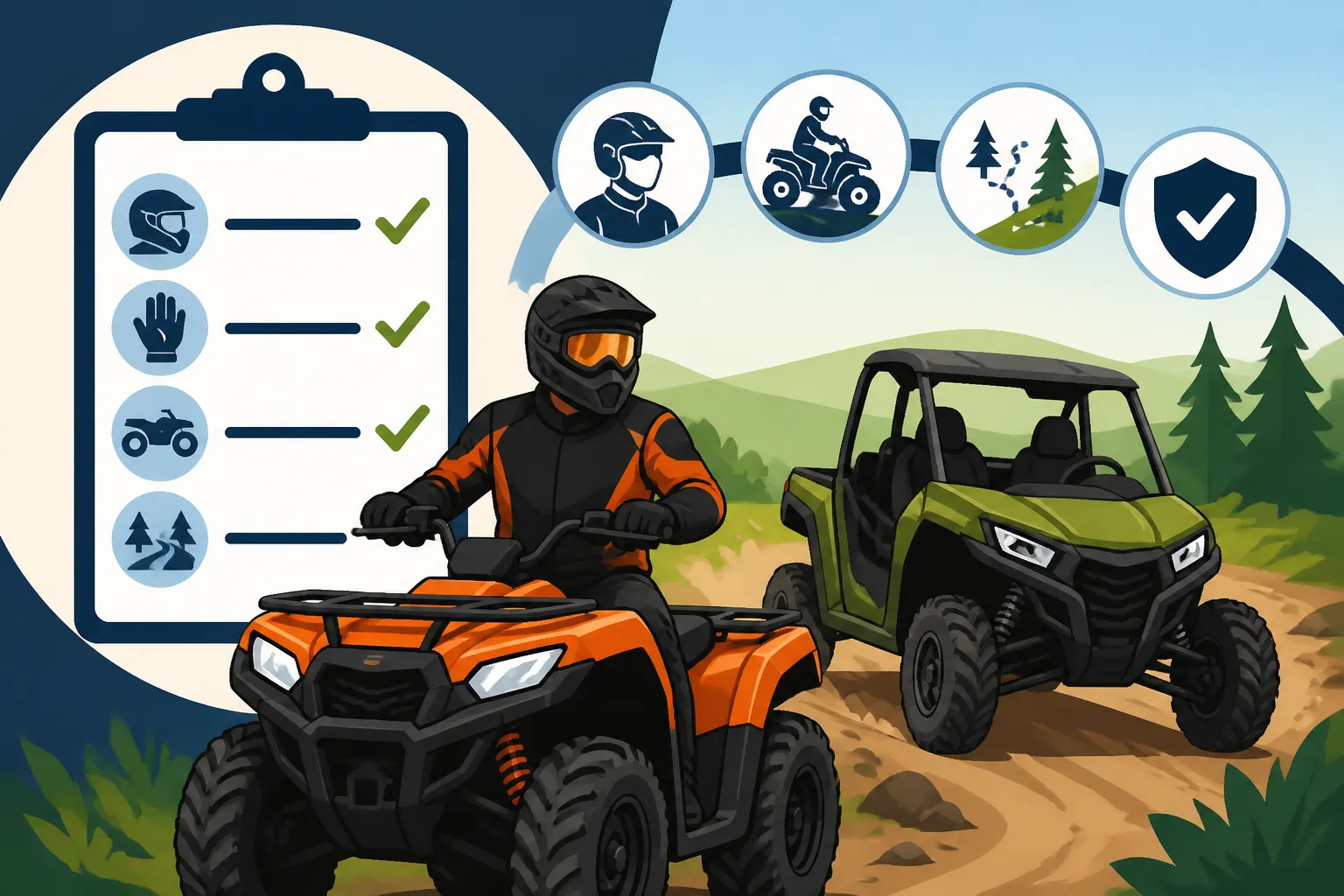
Protective equipment is useful only if it fits properly and meets the applicable standard. A course may discuss helmets, eye protection, gloves, clothing and footwear, as well as why ordinary casual gear may not provide adequate protection in a fall or collision.
Ask what equipment the course requires. If you are arranging gear yourself, check the product’s certification information and fit rather than relying on a short listing description or a photo. A helmet that shifts, blocks vision or cannot be fastened securely is a poor choice regardless of how it looks. For helmet requirements and accepted standards, see New Brunswick Helmet Standards Accepted and New Brunswick ATV Helmet Law.
Clothing is part of the safety discussion, not just a comfort issue. Long sleeves, durable pants, gloves and sturdy footwear can help protect against branches, debris, heat and abrasion. Eye protection helps keep dust and insects out of a rider’s eyes. Conditions change, so what is comfortable on a short practice loop may not be enough for a longer ride in rain, cold or thick brush.
The course may also cover passenger safety. A passenger changes a machine’s balance and handling, and not every quad is designed or approved to carry one. Do not assume that a passenger can ride just because there is room to sit. Check the machine’s design and the rules that apply to the rider and passenger. New Brunswick Rules for Two Riders on a Quad explains the issue in more detail.
Balance, speed and terrain
A quad can feel stable on flat ground but behave differently on a slope, loose surface or uneven trail. A safety lesson may cover body position, controlled speed and the need to adjust riding to the terrain. The important idea is to avoid abrupt inputs and to make decisions early, rather than waiting until the machine is already difficult to control.
A rider should learn to look ahead, leave space and avoid riding faster than visibility and conditions allow. Mud, gravel, wet roots, ruts and changes in slope can all affect traction. A route that seems easy in dry weather can become more demanding after rain or during a thaw. If the trail becomes difficult, slowing down or turning back is a reasonable decision, not a failure.
The instructor may explain how to approach obstacles and why a rider should not attempt a manoeuvre beyond their ability. Ask whether the course includes practice on slopes or uneven ground, and whether those exercises are optional or supervised. A short introductory course cannot prepare someone for every trail condition; new riders should continue building experience on appropriate terrain with responsible supervision where required.
Trail awareness and other users
Safe riding includes sharing space. A course may discuss watching for other trail users, giving them room, maintaining control and following signs or instructions. Riders should be ready for changing conditions, including blind corners, narrow sections, wildlife, logging activity or a stopped machine.
The safest approach is to ride at a pace that allows a response to what is visible ahead. Avoid assuming that a familiar trail is clear or that another user has seen you. A machine’s sound does not guarantee that someone around a bend knows you are approaching.
Rules also differ by location. A route may be a club trail, a woods road, a public road or private land, and the permission or restrictions for one do not automatically apply to another. The course can help introduce responsible conduct, but riders should check the rules for the specific route. What New Brunswick’s Off-Road Vehicle Act Covers is a useful starting point for understanding the legal framework.
What to do when a ride goes wrong
A safety course may discuss risk awareness and what to do if a rider is injured, a machine breaks down or a group becomes separated. The exact emergency instruction will depend on the provider and course outline, but it is worth asking how the session handles these situations.
Before a ride, make sure someone knows where you are going and when you expect to return. Carry the equipment and documents required for the trip, and consider the limits of mobile reception on remote routes. If a machine cannot be ridden safely, do not press on just to complete the planned route.
A course is also a good place to discuss how to respond to an incident without creating another hazard. Follow the instructor’s guidance, avoid moving an injured person unless there is an immediate danger, and contact emergency services when needed. For longer or remote rides, preparation matters as much as knowing the machine. Packing for a Full Day in the Woods covers practical planning for a day away from easy assistance.
How the course relates to permits and New Brunswick rules
The course, machine registration, insurance and trail permit serve different purposes. Confusing them can leave a rider prepared in one respect but not legally ready to ride.
A safety course teaches skills and rules. Registration identifies the machine under the applicable registration system. Insurance addresses financial protection and may be required for the type of riding involved. A trail permit is tied to access to the relevant trail network and its conditions. A rider should confirm each requirement separately.
Check the rules for the rider, not just the machine
Age can affect what a rider may do, where they may ride and whether supervision or other qualifications are needed. The rules for a young rider should not be inferred from an adult’s requirements, and a course certificate should not be treated as a general exemption.
If you are booking a course for a 14- or 15-year-old, ask the provider which certificate it issues and whether it is accepted for the rider’s intended use. Then confirm any related requirements, such as supervision, licence or route restrictions, with the relevant official source. New Brunswick Safety Course for a 14-Year-Old and New Brunswick Rules for a 14-Year-Old Rider address questions that are specific to that age group.
Parents and guardians should make sure the machine is appropriate for the young rider’s size, strength and ability, as well as checking the legal requirements. A rider who has completed a course may still need more practice before joining a group or attempting a demanding route. Judging Whether a Child Fits the Machine can help frame that decision.
A certificate does not replace a trail permit
If the planned ride is on a managed trail, check which permit applies, when it is valid and where it must be displayed. A course certificate does not substitute for the trail sticker or other access requirements. Permit categories and arrangements can vary, so use current information from the trail organization before setting out. For a broader overview, see How to Buy a New Brunswick Trail Permit and [New Brunswick Groomed vs Non-Groomed Permits].
A rider visiting from another province should not assume that a safety certificate, registration or trail sticker automatically carries across the border. Reciprocity arrangements can be specific to permits and jurisdictions, and they may change. Confirm the current arrangement for the rider’s home province and the trails they plan to use. The article New Brunswick Reciprocity With Nova Scotia is a useful starting point for one common visitor question, while the general details of permit recognition are covered in New Brunswick Permit Questions Clubs Hear.
Registration and insurance deserve separate checks, too. A machine can have a valid trail permit and still have an issue with registration or required insurance. Review New Brunswick Documents You Must Carry and New Brunswick Requires Insurance on Trails before riding, especially if the machine has recently been bought, borrowed or moved from another province.
Ask the organizer specific questions
A few questions before booking can prevent a wasted trip or an unpleasant surprise:
- How long is the session, and how much time is spent on instruction versus practical exercises?
- Does the course include riding practice, or is it classroom-only?
- Does the rider need to bring a machine, helmet or other equipment?
- What clothing and footwear are required?
- Is there a written or practical assessment?
- What certificate or proof of completion will the rider receive?
- Are parents or guardians expected to attend for a minor?
- What happens if weather or other conditions affect the practical portion?
- Is there any age or experience requirement to register?
- Does the course certificate meet the requirement for the rider’s intended activity?
Do not rely on a friend’s recollection of a course from another year or a different provider. Confirm the current details with the organizer, and keep the certificate somewhere it can be found after the session. If you are unsure what proof may be requested on a trail, see Producing Your Safety Certificate When an Officer Asks.
Getting ready and making the course count
A little preparation helps participants focus on the instruction instead of scrambling to meet basic requirements. Start by reading the provider’s registration information carefully. Follow its directions on arrival time, clothing, equipment, forms and payment. Course arrangements are provider-specific, so do not assume that one organizer’s requirements apply to another.
Before the session
Help the rider arrive rested, dressed for the conditions and ready to listen. If the course includes outdoor instruction, layers and weather-appropriate clothing can make it easier to concentrate. Bring any required identification, consent forms or equipment, but do not bring a machine unless the organizer has confirmed that participants should supply one.
It may help to talk through the rider’s experience beforehand. Has the rider used the machine before? Are there specific concerns about braking, balance or riding with others? Share those concerns with the instructor so they can be addressed where the course allows.
For a young participant, a parent or guardian should understand the session’s expectations and the rider’s next steps. Completing a course does not mean the rider is ready to ride independently, join a fast group or handle every trail. Set practical limits that match the rider’s skills and the route.
During the session
Encourage questions, particularly about local rules and real-world decisions. If an instruction is unclear, ask for a demonstration or a simpler explanation. Participants should not feel pressured to attempt a manoeuvre that seems beyond their ability. Safe training builds confidence through control, not through showing off.
Pay attention to the reasons behind the rules. For example, wearing the right gear is not only about meeting a requirement; it can reduce exposure to common riding hazards. Keeping a controlled speed is not just about avoiding a ticket; it gives the rider more time to see and respond to changes. Understanding the reason makes it easier to use the lesson on a trail.
If practical exercises are offered, treat them as supervised practice rather than a measure of how quickly someone can ride. A slower, controlled manoeuvre is more useful than a fast attempt that leaves the rider unsure what happened.
After the session
Review the certificate or completion information and make sure the rider’s name and other details are correct. Ask the provider how to replace proof of completion if it is misplaced. Keep the record with other riding documents, but do not carry a certificate as a substitute for required registration, insurance or permit documents.
Before the first ride, make a simple plan:
- Choose a route appropriate to the rider’s experience.
- Confirm that the machine is registered and insured as required.
- Check that the correct trail permit is valid for the route and machine.
- Review age, supervision and road-use restrictions.
- Inspect the machine and protective equipment.
- Tell someone the route and expected return time.
- Agree on a group pace and a plan for stops or separation.
A first ride after training should be straightforward and supervised where appropriate. Shorter routes provide room to practise starting, stopping, turning and communicating without adding the pressure of distance or unfamiliar terrain. Build up gradually, and stop when a rider is tired or conditions become uncomfortable.
A half-day course is valuable when treated as a foundation. It can introduce sound habits, improve awareness and help riders recognize the limits of their knowledge. It cannot replace practice, suitable equipment, route planning or checking current rules. The best measure of a successful course is not simply receiving a certificate; it is making safer choices on every ride.
Frequently Asked Questions
Is the course exactly four hours long?
Not necessarily. “Half-day” gives a general sense of the commitment, but schedules differ by provider. Confirm the start and finish times and ask whether the session includes practical instruction.
Will the course provide a quad and helmet?
That depends on the organizer. Ask what equipment is supplied and what participants must bring before registering. Do not assume that a machine or protective gear will be available.
Does completing the course give me a New Brunswick trail permit?
No. A safety course and a trail permit serve different purposes. Check the permit and access requirements for the trail you plan to ride.
Is a course certificate enough for a young rider to ride anywhere?
No. Age-related rules, supervision, licence requirements and location restrictions may still apply. Confirm the requirements for the rider and intended route.
What should I do if I lose the certificate?
Contact the course provider to ask whether it can confirm completion or issue replacement proof. Keep the provider’s contact details and store the certificate with the rider’s other important records.
Disclaimer
This article is for general informational purposes only and does not constitute professional advice. Laws, prices and regulations vary by location and change over time. Consult a qualified professional for guidance on your specific situation.