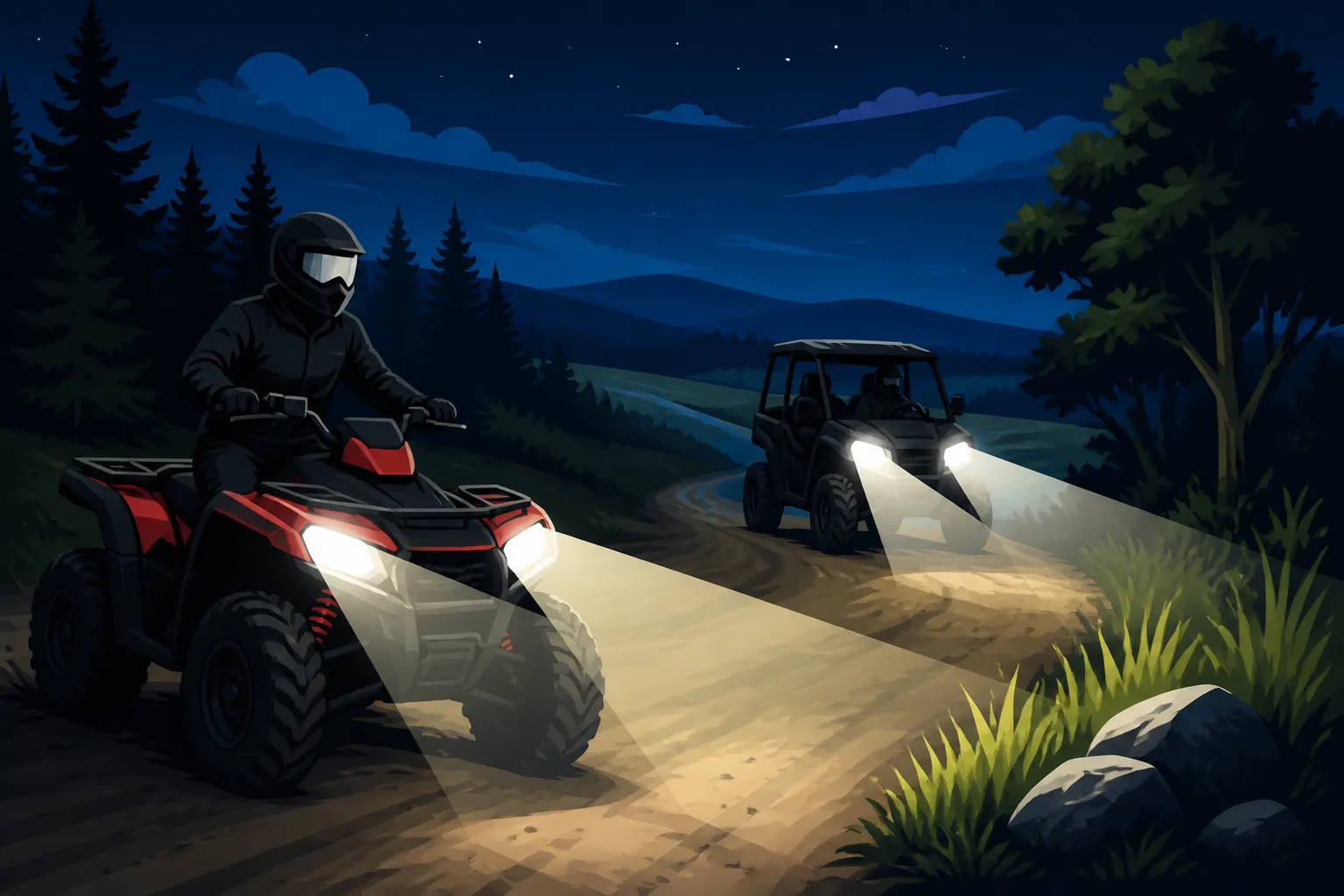
Night Visibility on a Country Road
Venturing out on your ATV or UTV after the sun dips below the New Brunswick horizon can be an exhilarating experience, but it comes with a unique set of challenges and dangers, especially when you find yourself on a country road. The stark reality is that what’s perfectly safe on a well-lit urban street becomes a high-stakes gamble on a dark, winding rural route. This guide is dedicated to shedding light on the critical aspects of night visibility for your off-road vehicle, ensuring you meet legal requirements and, more importantly, stay safe when riding New Brunswick's country roads after dark.
The Harsh Reality of Night Riding in New Brunswick
Riding your ATV or UTV in New Brunswick during the day offers a certain level of freedom and visibility. The sun is up, you can see far ahead, and other drivers can spot you relatively easily. But when twilight fades into deep night, especially on those quieter, often unlit country roads, the whole dynamic shifts dramatically. Many riders underestimate just how quickly the landscape transforms from familiar to utterly treacherous, not just for you, but for anyone else sharing the road. It's not just about seeing where you're going; it's crucially about being seen by everyone else.
Why Country Roads Are Particularly Tricky
Country roads, by their very nature, present a different beast compared to designated trails or even main provincial highways. First off, lighting is often non-existent. You might be accustomed to streetlights guiding your way in town, but out past the last farmhouse, you're often plunged into pitch blackness. This means your machine's lights are doing all the heavy lifting, and if they're not up to par, you're essentially fumbling in the dark.
Then there's the wildlife. New Brunswick is home to an abundance of deer, moose, and other animals that become incredibly active and harder to spot after dusk. A sudden encounter with a moose on a country road at 60 km/h is a scenario no rider wants to face. Furthermore, the road surfaces themselves can be less than ideal. Potholes, gravel patches, frost heaves, and other irregularities that are easily navigated in daylight can become hidden hazards at night, potentially leading to loss of control. Dust can also be a massive issue, especially if you're following another vehicle. That cloud of dust, while annoying during the day, can completely blind you and anyone behind you at night, turning a simple ride into a white-knuckle experience. Drivers of passenger vehicles might not expect an ATV or UTV to be on these roads, especially after dark, and their perception of your speed and distance can be dangerously off.
Legal Requirements You Absolutely Must Meet
Navigating New Brunswick's country roads at night isn't just about common sense safety; it's also about adhering to the letter of the law. The province's Off-Road Vehicle Act is quite clear about what’s expected of riders, particularly concerning lighting. While specific provincial statutes always supersede general advice, the spirit of the law aims to ensure you and your machine are adequately visible to prevent accidents. You absolutely need working headlights, taillights, and brake lights. These aren't suggestions; they are mandatory safety features designed to prevent collisions.
Beyond the basics, your ATV or UTV must have reflectors, typically red at the rear and amber on the sides, to enhance passive visibility even if your lights fail or aren't seen immediately. A properly illuminated license plate is also a non-negotiable requirement, ensuring that your registration can be identified by law enforcement or in case of an incident. Failure to meet these basic lighting standards can not only result in hefty fines, but more importantly, it puts you and others at severe risk. Before you even think about hitting a country road after sunset, take a moment to review [New Brunswick Lighting Requirements at Night] and ensure your machine is compliant. Remember, ignorance of the law is no excuse, and a quick check of your lighting system could save you a lot of trouble – and potentially your life. If you're on a road designated for ATV use, you might even need to consider specific requirements for [New Brunswick Highway Usage Permits].
Essential Upgrades for Boosting Your Machine's Visibility
Even if your ATV or UTV meets the minimum legal requirements for night riding, "minimum" doesn't always translate to "safe" or "effective," especially on unlit New Brunswick country roads. Stock lighting on many machines is often designed for basic trail use, not for interacting safely with highway traffic or spotting a deer on a completely dark rural stretch. Upgrading your lighting system is one of the most impactful investments you can make for night riding safety, allowing you to see further, react quicker, and be seen sooner by others.
Illuminating the Path Ahead: Headlights and Light Bars
Your stock headlights, while adequate for some situations, can often leave you wanting more when faced with the inky blackness of a New Brunswick country road at night. They might cast a weak, narrow beam that barely illuminates the immediate path, leaving everything beyond a few metres shrouded in shadow. This is where upgrading to brighter, more powerful headlights or integrating additional light bars makes a world of difference. LED headlights are a popular choice, offering a much brighter, whiter light that consumes less power than traditional halogen bulbs. They cast a broader and longer beam, helping you spot potential hazards like wildlife, potholes, or unseen turns far earlier.
For serious night riders, a high-quality LED light bar is often the next step. These bars come in various sizes and configurations, offering incredible illumination. You'll often see options like "spot" beams, which focus light far down the road, perfect for maintaining speed on straight stretches, or "flood" beams, which spread light wide, ideal for navigating tighter, winding roads or spotting hazards to the side. Many riders opt for a combination, using a spot beam light bar for distance and relying on their upgraded headlights for a broader, closer view. Companies like SuperATV offer a fantastic range of aftermarket lighting solutions, from direct-fit LED headlight replacements to powerful light bars that can be mounted on your bumper, roof, or roll cage. When installing, always ensure your light bars are properly aimed to avoid blinding oncoming traffic; some jurisdictions have rules about using off-road lights on public roads, so it's wise to check local bylaws if you're using them on a designated highway usage section.
Being Seen from Behind and the Sides
While seeing where you're going is paramount, ensuring other drivers can see you is equally, if not more, critical when sharing a country road at night. Many rear-end collisions involving ATVs and UTVs happen because the trailing driver simply didn't see the off-road vehicle in time. Upgrading your taillights and brake lights to brighter LED versions significantly improves your visibility from the rear. Standard bulbs can be dim and slow to illuminate, whereas LEDs are instant-on and emit a much more intense light, clearly signaling your presence and intentions.
Beyond the standard lights, consider adding auxiliary side marker lights, especially if your machine is wide, like a side-by-side. These help define your vehicle's overall footprint, preventing other drivers from misjudging your width. Reflective tape is another incredibly effective, yet often overlooked, enhancement. Strategically placed reflective tape, particularly on the sides, rear, and even on your helmet, catches and bounces back light from other vehicles, making you visible even if your own lights momentarily fail or are obscured. You can find high-quality reflective tape at most automotive or powersports stores. For an added layer of safety and style, some riders install illuminated whip lights on the rear of their machine, especially on UTVs. These tall, flexible poles with embedded LEDs are highly visible and can significantly increase your presence, particularly in dusty conditions or varied terrain where a lower taillight might be hidden. SuperATV also carries a selection of accessories that can enhance your visibility, including different types of reflective decals and marker lights designed to integrate seamlessly with your machine. For more details on passive visibility, check out [Reflective Tape Worth Adding to a Quad].
Auxiliary Lighting for Specific Situations
While headlights and taillights cover the primary visibility needs, there are several auxiliary lighting options that can dramatically improve safety and utility in specific night riding scenarios on and off country roads. These aren't always about seeing far down the road, but rather about enhancing your immediate environment or preparing for unexpected situations.
One such option is "rock lights" or "underglow" kits. While often associated with aesthetic customization, these small LED pods mounted underneath your machine serve a practical purpose: illuminating the ground directly beneath and around your tires. This is invaluable when navigating extremely technical, rocky, or uneven terrain at night, allowing you to clearly see obstacles that might otherwise be hidden in the shadow cast by your main headlights. They can also be incredibly useful if you need to pull off a country road onto an unfamiliar shoulder or ditch in the dark, helping you assess the immediate ground before putting a foot down or making a repair.
Another practical addition is dedicated reverse lights. Many stock ATVs and UTVs have weak or non-existent reverse lighting, making backing up in the dark a real challenge. Aftermarket LED reverse lights significantly brighten the area behind you, not only aiding your vision but also clearly signaling to anyone behind you that you're backing up. For UTV owners, interior cab lights are a game-changer. Fumbling for a map, checking gauges, or trying to find something in your glove box in complete darkness is frustrating and distracting. A small, subtle LED cab light provides just enough illumination without compromising your night vision outside the vehicle. These auxiliary lights, while not always legally required for road use, contribute significantly to the overall safety and convenience of night riding, especially when you encounter unexpected stops or need to perform tasks in low-light conditions.
Rider and Environmental Factors for Enhanced Night Safety
While outfitting your ATV or UTV with top-notch lighting is paramount, it's only one piece of the night riding safety puzzle. Your personal gear, riding habits, and meticulous planning play an equally crucial role in ensuring a safe journey on New Brunswick's country roads after dark. A well-lit machine won't protect you if you're riding recklessly or haven't prepared for the conditions.
Your Gear: Making Yourself Visible
It’s easy to focus solely on the machine's lights, but don't forget the most important part of the equation: you. Even with the brightest lights on your quad, if you or your passenger tumble off (heaven forbid!), you need to be visible. High-visibility clothing isn't just for construction workers; it's a critical safety item for any night rider. A fluorescent vest, jacket, or even accents on your riding gear in bright yellows, oranges, or lime greens are designed to stand out, even in dim conditions. Furthermore, reflective elements integrated into your helmet, jacket, or gloves will catch the beam of other vehicles’ headlights, making you a much more noticeable presence.
Think of your helmet, for instance. While [New Brunswick Helmet Law for Every Occupant] focuses on impact protection, a helmet with reflective strips or a brightly coloured shell dramatically increases your head's visibility. Consider a headlamp as part of your essential kit. If you have to stop on the side of a dark road to check your machine, read a map, or deal with a flat tire, a headlamp frees up your hands and provides immediate, directed light. It also makes you a moving beacon when you're off the machine, an important consideration if you're trying to retrieve something from your cargo box or walk a short distance from the vehicle. Every little bit of extra visibility, both passive and active, contributes to your overall safety profile when riding after dark.
Adapting Your Riding Style
Having all the latest lighting technology is fantastic, but it's only truly effective if you adjust your riding style to match the reduced visibility of night-time conditions. The biggest and most crucial adjustment is slowing down. Your stopping distance at night needs to account for your lights' effective range, your reaction time, and the condition of the road surface. What seems like a reasonable speed during the day can be dangerously fast when your vision is limited to the cone of your headlights. An unseen pothole, a deer jumping out, or an unexpected turn in the road can become catastrophic if you're traveling too quickly to react.
Increase your following distance significantly, especially if you're riding with others or if there's any dust in the air. That dust, illuminated by your headlights, turns into an impenetrable wall, and losing sight of the machine ahead, even for a second, can lead to a collision. Always be extra cautious at intersections, driveways, and any place where other vehicles might enter or cross your path. Even if you have the right of way, assume other drivers might not see you. Making eye contact (if possible) or at least seeing that they've looked in your direction before proceeding is a good habit. Also, be mindful of your headlights on turns and hills; they only illuminate what's directly in front, so slow down even more until you can clearly see around the bend or over the crest. Remember, [New Brunswick Quads Yield to Motor Vehicles] is a rule that becomes even more critical when visibility is compromised.
Pre-Ride Checks and Planning
Before you even think about putting a key in the ignition for a night ride on a New Brunswick country road, a thorough pre-ride check is absolutely non-negotiable. This goes beyond the usual quick glance. Systematically check every single light: headlights (high and low beam), taillights, brake lights, turn signals (if equipped), and any auxiliary lighting you've installed. Ensure they are clean, fully functional, and properly aimed. A dirty lens can reduce light output by a surprising amount. Also, check your battery and charging system; night riding puts a higher demand on your electrical system, and you don't want to lose power unexpectedly.
Planning your route is equally important. Try to minimize sections of unlit country road, if possible, and opt for routes you're familiar with during the day. If you must use dark roads, know the terrain, curves, and potential hazards in advance. Check the weather forecast for fog, heavy rain, or snow, as these conditions drastically reduce visibility even further, making night riding extremely hazardous. It's often better to postpone a ride or find an alternative route than to risk it in poor weather after dark. Carrying basic tools, a fully charged phone, and a means of emergency light (like a powerful flashlight) are also smart precautions. Officers conduct [New Brunswick Equipment Checks by Officers] on trails and roads, and not having your lights in order for night conditions can lead to fines, so being prepared is essential. Always prioritize safety over convenience when it comes to [New Brunswick Rules for Riding After Dark].
| Visibility Component | Stock Performance (Typical) | Upgraded Performance (Typical) | Key Benefits |
|---|---|---|---|
| Headlights | Dim, narrow beam; yellow-ish light; limited distance | Bright, wide beam; crisp white light; extended distance | See further ahead, spot hazards earlier, better peripheral vision |
| Light Bars | Not usually stock on ATVs/UTVs for road use | Powerful, focused (spot) or wide (flood) illumination | Massive light output for open stretches or wide-angle coverage for turns |
| Taillights/Brake Lights | Dim red light; slower incandescent bulb response | Bright red LED light; instant-on response; more intense | Clearer signaling to trailing vehicles, reduced rear-end collision risk |
| Side Markers/Reflectors | Small, often faded passive reflectors | Brighter, larger reflectors; optional active LED side markers | Define vehicle width, passive visibility in case of power loss |
| Reflective Tape | Generally absent or minimal | High-intensity tape on vehicle body, helmet, gear | Passive visibility enhancement, especially from odd angles, low cost |
| Rider Gear | Dark clothing, no reflective elements | High-visibility colours (fluorescent), integrated reflective strips | Makes the rider visible off the machine, enhances overall vehicle profile |
Disclaimer
This article is for general informational purposes only and does not constitute professional advice. Laws, prices and regulations vary by location and change over time. Consult a qualified professional for guidance on your specific situation.