Grooming and What It Pays For
A groomed trail sticker can sound like a promise of smooth, open riding, but “groomed” does not mean every kilometre is perfectly flat or maintained every day. In New Brunswick, grooming is one part of keeping a trail network usable, safe, and easier to follow. Here’s what trail grooming involves, what permit support helps pay for, and what to check before heading out.
What trail grooming means in New Brunswick
Grooming is more than smoothing a trail
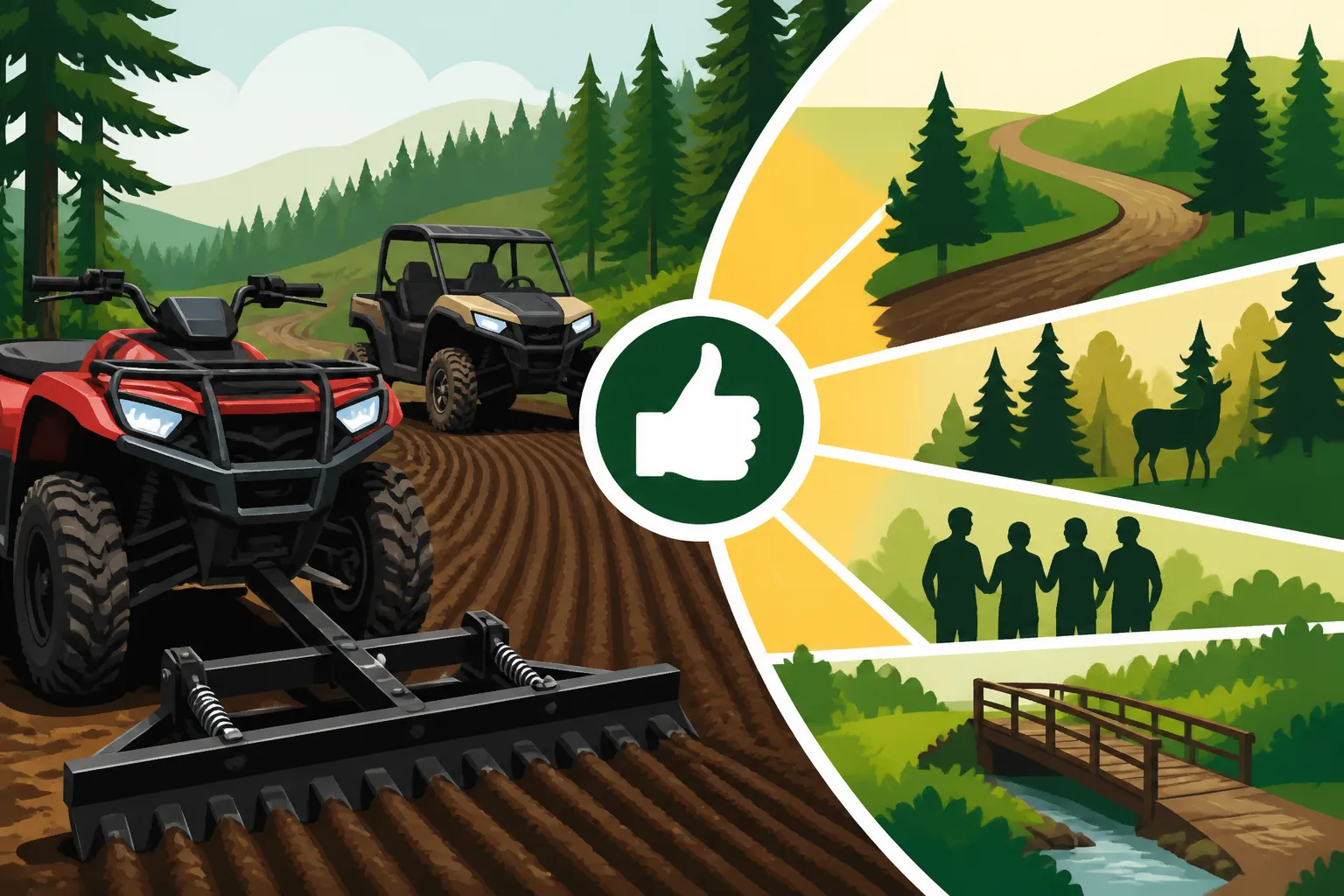
Trail grooming is work that helps keep a marked route passable and rideable. Depending on the trail and the season, that can mean smoothing rough sections, managing vegetation, clearing small obstructions, improving drainage, or maintaining the trail surface. The exact work varies: a wide, well-used corridor may need different attention from a narrow wooded route with uneven ground.
The word “groomed” can also bring to mind a snowmobile-style groomer making a smooth track. That image does not capture every kind of ATV trail maintenance. A club may use equipment suited to a particular trail, but it may also rely on hand tools, volunteer labour, and smaller machines to address problems a large piece of equipment cannot safely reach.
Grooming is not a guarantee that a trail will feel like a road. Rocks, roots, ruts, soft ground, washouts, and changing weather are part of riding in the woods. Even a route that received maintenance recently can change after heavy rain, thawing, or a busy weekend.
Groomed does not mean open in every condition
A trail can be maintained and still be temporarily closed. Spring thaw, saturated soil, a damaged bridge, fallen trees, or work on a nearby corridor may make riding unsafe or harmful to the trail. Clubs may close a section to prevent further damage while the ground is soft or repairs are underway. Checking [New Brunswick Trail Conditions Before You Go] and [New Brunswick Trail Closures After Rain] can help you avoid arriving at a route that is closed or unsuitable.
It is also useful to distinguish trail grooming from trail access. A permit or sticker does not give riders permission to travel anywhere they choose. Stay on marked, authorized corridors, follow posted signs, and respect gates and reroutes. If a track appears on a navigation app, that alone does not establish that it is an open club trail.
For a planning layer, some riders use onX Offroad to review routes and save navigation information before heading into areas with weak cell service. Use it as a planning aid, not as a substitute for current local trail information or posted closures. A line on a map cannot tell you whether a bridge has just been damaged or whether a club has closed a muddy section.
What grooming and trail permits help pay for
Trail work takes people, equipment, and planning
Keeping a trail network usable is an ongoing job, not a one-time project. Work can include brushing vegetation back from the corridor, repairing erosion, clearing debris, checking structures, maintaining signs, and arranging equipment or materials for difficult sections. The work may be visible, such as fresh brushing, or less obvious, such as monitoring a drainage problem before it becomes a washout.
There are also practical costs around the work itself. Equipment needs fuel, maintenance, and transport. Clubs need people who can operate machinery safely, coordinate volunteers, and identify which repairs are most urgent. Materials may be needed for repairs, signs, or drainage improvements. Permit and membership support contributes to the wider system that makes organized trail access possible, alongside club work and other sources of support.
That does not mean every dollar from a particular permit is spent on grooming the exact trail you ride that day. A trail network has shared needs, and maintenance priorities shift with weather, damage, use, and available resources. For a closer look at the work clubs take on, see [New Brunswick Club Trail Maintenance].
Groomed and non-groomed permits reflect different trail experiences
A groomed permit is intended for riders using trails included in the groomed network. A non-groomed option is associated with a different trail experience and level of service. Neither label means every section will have identical conditions, and neither removes a rider’s responsibility to check where a permit is valid and which trails are open.
| Trail feature | Groomed trail experience | Non-groomed trail experience |
|---|---|---|
| Surface work | May receive more active surface grooming where conditions and equipment allow | May receive less surface smoothing or a different maintenance approach |
| Ride feel | Can be more predictable in maintained areas, but still rough or variable | Often feels more natural and may have uneven or changing terrain |
| Conditions | Weather and use can quickly affect the surface | Weather and use can quickly affect the surface |
| Planning | Confirm that the route is included and open | Confirm that the route is included and open |
| Rider responsibility | Follow signs, closures, and trail etiquette | Follow signs, closures, and trail etiquette |
For details on the two permit types, review [New Brunswick's Groomed Trail Permit] and [New Brunswick's Non-Groomed Trail Permit]. It is worth checking the permit terms for the route and riding period you have in mind rather than assuming that “groomed” describes every trail in a region.
Grooming also cannot replace routine maintenance. A groomed surface may still need brushing, drainage work, signage, or a repair after a storm. In spring, thawing ground can be especially vulnerable; [Frost Heaves on a Spring Trail] explains why conditions can feel rough even after maintenance.
How trail grooming affects your ride
Expect changing conditions from one section to the next
On a long ride, conditions can shift more than you expect. A firm, well-travelled stretch near a community may lead into a shaded section where water sits longer. A low area might be muddy while a nearby ridge remains dry. A corridor that felt smooth on the way out can feel rutted on the return after several machines have passed through.
This is why grooming should be understood as ongoing care, not a fixed condition. Trail crews address problems when they can, but a maintenance visit cannot prevent every new rut or fallen branch. If a section is soft or damaged, riding around it can widen the corridor and create new trouble. Slow down, stay on the marked route, and turn back if the trail is unsafe or closed.
Signs and markers matter, too. Crews may mark a reroute around a repair or identify a hazard that is not obvious at speed. Follow those directions even if the detour seems inconvenient. The short way around a closure can damage the area being protected or put riders in a place that was not intended for traffic.
Be a useful guest on a maintained trail
Riders help protect the work that clubs and volunteers have already done. Keep to the established trail, avoid spinning tires in soft areas, and do not widen a route to get around mud. If you see a closure, respect it rather than treating it as a suggestion. Leave gates as you found them, and give maintenance crews room to work.
A navigation app can help with route awareness, particularly when cell service is unreliable, but it should not be the only source you rely on. onX Offroad can be useful for saving route information before a ride, while local trail updates and signs are better suited to confirming closures or recent conditions. Download or save what you need before leaving reliable reception, and make sure your group knows the planned route.
If you notice a damaged bridge, blocked trail, or unsafe washout, report it through the appropriate local club or trail contact when possible. Be specific: describe the location, the direction you were travelling, and what you observed. A photo can help, as long as you stop somewhere safe before taking it. Reporting a problem is more useful than trying to repair a structure or clear a major obstruction yourself.
How to plan around grooming and closures
Check the route before you unload
A little preparation can save a long drive to a closed trailhead. Before leaving, check local trail updates, permit requirements, and any posted seasonal restrictions. If you are heading out near Fredericton, Miramichi, Bathurst, or another riding area, do not assume conditions match those in a different part of the province. Rain, shade, elevation, and trail use can make conditions vary over relatively short distances.
A practical pre-ride check includes:
- Confirm that your permit is valid for the trails you plan to use.
- Check for closures, reroutes, and trail-condition notices.
- Review your route and save useful navigation information before entering a dead zone.
- Tell someone where you are going and when you expect to return.
- Carry the basic equipment and documents required for your ride.
- Be ready to turn around if conditions are unsafe or a corridor is closed.
If you are riding after heavy rain or during spring thaw, take extra care to confirm that the trail is open. A route that was passable last weekend may be too soft today. For information on spring work and vegetation management, see [Brushing a Club Corridor in Spring].
Read “groomed” as a service, not a guarantee
The most useful way to think about grooming is as part of a broader trail-maintenance effort. It supports a better riding experience, but it cannot make every trail smooth, prevent weather damage, or ensure that every section is open whenever you arrive. Conditions change, maintenance takes time, and club resources have to be directed where they are needed most.
That perspective helps set realistic expectations. You may encounter rough ground on a groomed route, or find that a trail you planned to ride has been closed to protect it. Those moments can be frustrating, especially after a long drive, but respecting closures and reporting damage helps preserve access for the next ride. Check conditions, ride within your ability, and leave the corridor in a state that crews can continue maintaining.
Disclaimer
This article is for general informational purposes only and does not constitute professional advice. Laws, prices and regulations vary by location and change over time. Consult a qualified professional for guidance on your specific situation.