New Brunswick Group Ride Planning
A New Brunswick group ride can unravel quickly when riders arrive with different machines, outdated maps, unclear permit details, or no plan for a breakdown. A little coordination before leaving the trailhead makes the day safer and much less stressful. This guide covers route planning, group communication, permits, supplies, and what to do when the ride does not go to plan.
Choose a route that fits the whole group
Match the trail to your riders and machines
Before choosing a route, find out who is coming and what they will be riding. A group with experienced riders on capable ATVs may be comfortable with a longer back-country loop, while a family group or a mix of first-timers and experienced riders may be happier with a shorter, familiar route and easy places to stop.
Ask about more than experience. Find out whether anyone has a passenger, a machine with limited fuel range, or a physical need that could affect how long they can comfortably ride. A UTV may have different dimensions and handling from a quad, and a rider who is new to the woods may need more time at turns, intersections, and rough sections. Planning around the slowest or least experienced rider is not a nuisance; it is how you keep the group together.
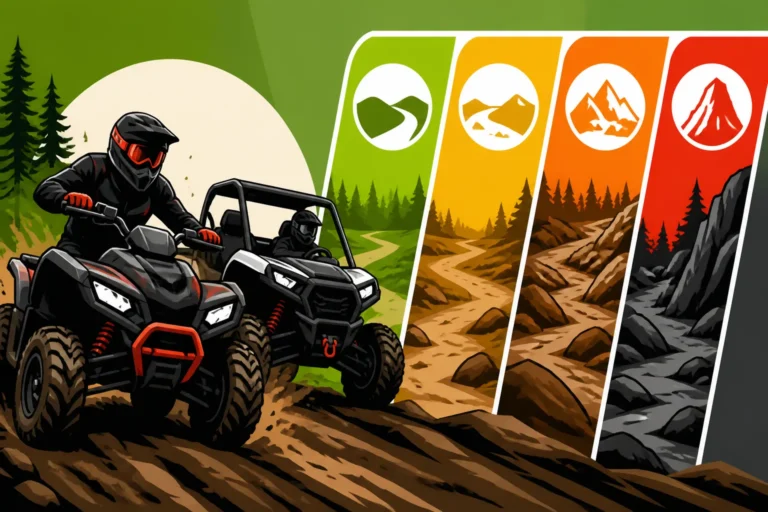
Start by exploring the official trail information and the route options for your area. The [New Brunswick Trail Maps and the MapGear App] can help you think through the mapped network, while [New Brunswick Trail Difficulty Ratings] is a useful topic to review before committing a mixed-ability group to a challenging ride. Treat any map as a planning aid, not a guarantee that every trail segment is open or suitable on the day you ride.
A route that looks short on a screen can take much longer once you account for stops, muddy stretches, navigation checks, and a rider who needs to turn around or make a repair. Build a realistic plan with a clear turnaround point rather than choosing the longest loop everyone can barely manage.
Check access, conditions, and seasonal changes
A mapped line does not automatically mean a trail is open, maintained, or appropriate for your group. Check the latest information available from the relevant trail organization or local club before you set out, particularly after heavy rain, spring thaw, or a storm. Closures and washouts can turn a straightforward route into a poor choice, and riding around a wet or damaged section can make trail conditions worse.
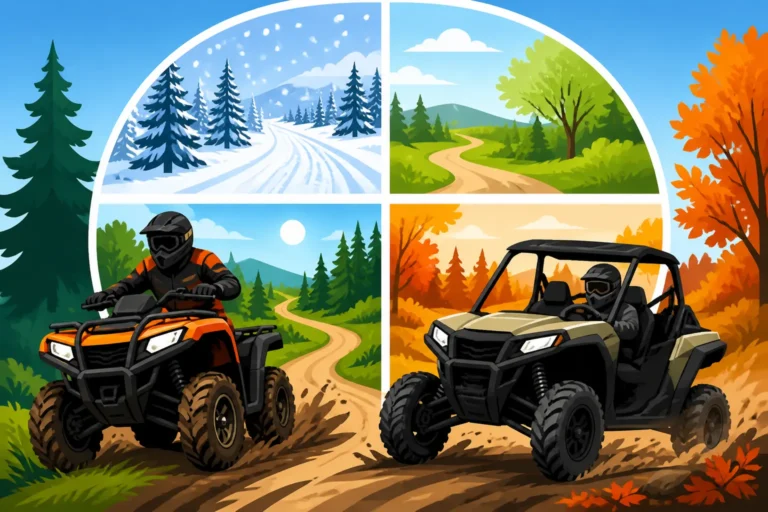
Season matters in New Brunswick. A corridor may be managed differently at different times of year, and some rail beds have seasonal uses or restrictions. Confirm that the trail you intend to use is open to your type of machine and that your group has the necessary access and permits. The guides to [New Brunswick Trail Closures After Rain] and [New Brunswick Winter Trail Sharing] can help you think about how weather and seasonal use affect route planning.
If you are riding around Woodstock, Miramichi, Bathurst, or another community, do not assume all nearby routes connect in the way a phone map suggests. Check the marked trail network and ask a local club when a connection, trailhead, or reroute is unclear. A short call before the ride can save the group from reaching a closed gate or an unfamiliar junction with fading daylight.
| Planning question | What to confirm before the ride |
|---|---|
| Is the route open? | Check current club or trail-network notices |
| Does it suit the group? | Consider experience, machine type, passengers, and pace |
| How long will it take? | Allow time for stops, navigation, and mechanical issues |
| Are permits and documents ready? | Confirm requirements for every rider and machine |
| Is there a backup route? | Choose a shorter option or turnaround point in advance |
| Can the group navigate offline? | Save route information and carry a backup plan |
Build a route with simple decision points
A good group route is easy to explain. Pick a starting point everyone can find, identify major junctions or landmarks, and agree on where the group will stop. Do not rely only on directions such as “take the next left after the big woods road.” When several similar tracks meet, people can interpret that instruction differently, especially if they are spread out.
Choose one person to lead and another to act as the sweep rider at the back. The leader sets a manageable pace and watches for turns; the sweep makes sure no one is left behind. At confusing intersections, the lead rider can wait until the next rider has seen the turn, or the group can use a pre-agreed method for marking the route without leaving anything behind or creating a hazard.
Apps such as onX Offroad can be useful as a supplementary navigation tool, especially when a group wants to review its intended route together. Do not make one app the only source of truth. Compare the planned line with official trail information, check whether the route is currently open, and make sure riders know how to use their own navigation setup before leaving.
Get the group ready before departure
Confirm permits, insurance, and required documents
A group ride is much easier when paperwork is sorted out before the machines are unloaded. Ask each participant to confirm that their machine is properly registered and insured for the ride they plan to do, and that any required trail permit is in place. A permit or sticker on one machine does not automatically cover every other machine in the group, so check each rider’s situation individually.
Rules and requirements can depend on the machine, the trail, and the rider. Riders should review [New Brunswick's Groomed Trail Permit] and [New Brunswick's Non-Groomed Trail Permit] when deciding what kind of riding they plan to do. For a mixed group or a ride that crosses different trail types, verify the details rather than guessing that one permit covers every part of the route.
Have riders organize the documents they may need before the day begins. The guide to [Four Things to Carry on a New Brunswick Trail] can help the group prepare a shared checklist, but each rider should know where their own documents are and be able to produce them if asked. Keeping paperwork in a waterproof pouch or another secure place can prevent a damp saddlebag from becoming a problem.
A simple message in the group chat a day or two before the ride can prevent awkward surprises at the trailhead. Ask everyone to reply that their machine is ready, their documents are on hand, and they understand the planned route and meeting time.
Set expectations and communication rules
Agree on the pace before anyone starts the engine. Make it clear that riders should not race ahead, pressure someone to take a difficult section, or leave the group without telling the leader. A relaxed pace makes the ride more enjoyable and gives the group a better chance of noticing a mechanical problem, a hazard, or a missing rider.
Establish a few straightforward rules:
- The lead rider sets the pace and does not disappear around blind turns.
- The sweep rider stays behind the last participant.
- Everyone stops at agreed regrouping points.
- A rider who needs to stop signals the group and waits in a safe location.
- Nobody changes the route or leaves the group without telling the leader.
Decide how the group will communicate if riders become separated. Mobile service can be unreliable in remote areas, so do not assume a call or message will always go through. Before leaving, identify the last known meeting point, the next planned stop, and what the group will do if someone does not arrive. The article [Checking Cell Reception Before a Remote Ride] is a useful reminder to think about coverage before heading into a less familiar area.
If some riders use onX Offroad or another navigation app, do not assume everyone can see the same screen or route. Compare maps before the ride, share the essential route details in a form everyone can access, and agree that riders will stop at a junction if they are unsure. A shared plan matters more than using the same app.
Prepare for different experience levels
A group ride can include very different comfort levels, even when everyone owns a machine. Someone who rides regularly on familiar trails may not realize how stressful a steep, rocky, or muddy section feels to a newer rider. Check in before the ride and give people a chance to say what they are comfortable with without feeling they have to prove themselves.
For a mixed group, plan optional shorter sections or a clear turnaround point. If a rider decides a section is not right for them, the group should already know what happens next. Avoid splitting the group casually; if a split is necessary, make sure both groups have capable leaders, clear routes, and a way to reunite.
Talk about machine basics, too. Confirm that each person knows how to stop safely, use their lights and signals where fitted, and respond to a breakdown without standing in a dangerous spot. A brief conversation in the parking area is often enough to uncover a concern that would otherwise appear at the worst possible moment.
Pack for a full day in the woods
Bring practical essentials for people and machines
What you carry depends on the length and remoteness of the route, but every group should plan for more than the ideal ride. A small repair issue can take time to solve in the woods, and cold rain, bugs, or an unexpected delay can make an otherwise pleasant trip uncomfortable. Each rider should bring water, food, suitable layers, and any personal medication they may need.
For the machines, consider carrying basic tools and supplies that match the group’s equipment and experience. A tire repair kit, tow strap, gloves, and a compact first-aid kit may be useful, but only if someone knows how to use them. Riders should also check their machines before departure: tires, brakes, lights, fuel, and any obvious leaks or loose parts.
The detailed checklist in [Packing for a Full Day in the Woods] can help you tailor your load to the trip. For a longer or more remote route, review [First Aid on a Remote Woods Loop] and [Carrying a Satellite Messenger on a Long Ride]. These are especially relevant when the group expects to be beyond easy road access or cell coverage.
Do not overload a machine just because there is room to carry more. Secure loose items, keep essential gear accessible, and make sure added cargo does not interfere with safe handling or a passenger’s space. If a rider is carrying shared equipment, agree ahead of time who has it so the group does not discover the first-aid kit is still in someone’s truck.
Plan fuel, stops, and daylight
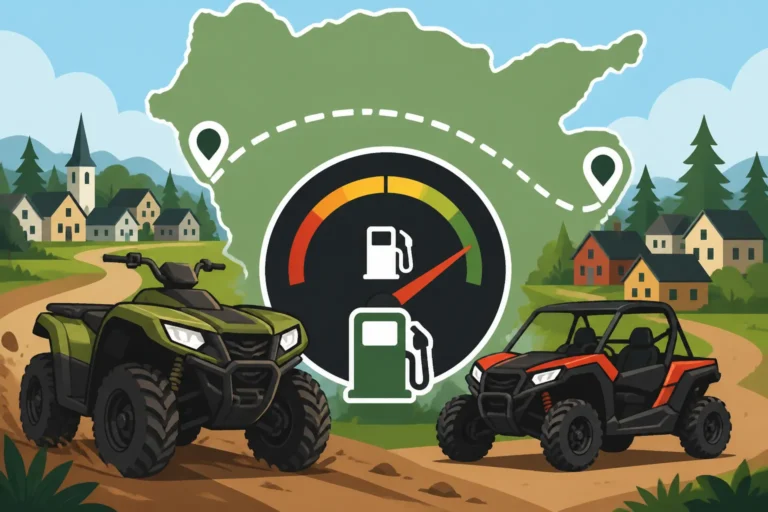
Estimate fuel needs conservatively. A machine’s range can change with terrain, load, riding style, and conditions, so do not plan to reach a fuel stop with nearly empty tanks. If the route passes near a community or service point, verify that it is accessible and suitable for your group rather than assuming fuel will be available exactly when needed.
Set a turnaround time that leaves a comfortable margin before dark. This is particularly important when the group includes newer riders, when the route is unfamiliar, or when a section is known to be slow. A ride that begins late can become stressful if the group tries to squeeze in an ambitious loop instead of shortening the plan.
Use planned breaks to check on everyone, not just to take photos. Ask whether riders are comfortable, whether anyone is low on water or fuel, and whether the group is keeping to the expected schedule. A five-minute check-in can help you decide to continue, shorten the route, or turn back while there is still time.
Leave a clear plan with someone at home
Before leaving, give a trusted person the route area, expected return time, and a way to contact the group. Tell them what to do if you are significantly overdue, and remember to message them when the ride is finished. For privacy and safety, share only the information they need to know.
If the route changes, update the person at home when possible. A detour around a closure or a decision to stop early can otherwise make a normal delay look like an emergency. The group should also have a written or saved version of the basic plan in case the person leading the ride has a phone or machine problem.
Navigation tools can help with orientation, but they are not a substitute for preparation. If you use onX Offroad, review the route before departure and make sure the people relying on it understand where the group is going. Keep official trail information available as well, and carry a backup method of identifying your location.
Handle trail problems calmly and responsibly
Respond to a breakdown or separated rider
If a machine breaks down, move the group to a safe place and keep other riders out of the travel line. The leader should check whether the rider is injured, whether the machine can be repaired safely, and whether continuing would put anyone at risk. Do not rush into a repair that requires tools or knowledge the group does not have.
If the group is separated, follow the meeting plan instead of scattering to search randomly. The lead and sweep roles help, but riders should still stop at agreed points and avoid making the separation worse by taking different routes. If there is a serious safety concern, seek appropriate help rather than attempting a risky recovery.
A tow strap can be handy, but recovery work should be approached carefully. A machine stuck in mud or positioned on a slope can shift unexpectedly. If nobody in the group is confident about the recovery, pause and choose the safest available option rather than turning a stuck machine into an injury.
Respect closures, land, and other trail users
Stay on the marked route and follow posted signs. Do not bypass a gate or ride around a closure because the detour looks inconvenient. A closure may protect a damaged trail, an active work area, private property, or a section that is unsafe to use.
Keep noise and speed under control near homes, road crossings, and other trail users. Slow down where visibility is limited, give people space, and follow local requirements for the area. If you encounter logging equipment or a work crew, stop in a safe location and follow their instructions rather than assuming they have seen you.
When a route crosses property or a less familiar corridor, make sure the group understands where access is permitted. [New Brunswick Trails That Cross Private Woodlots] is a useful topic to review when planning a ride through areas where access depends on a marked corridor or permission. Leaving gates as you found them and staying on the designated route helps preserve access for future riders.
Finish with a quick group check
At the end of the ride, confirm that every rider and machine is accounted for before people head home. Check whether anyone has damage, lost gear, or a concern that should be addressed before the next outing. If you encountered a washout, fallen tree, or damaged sign, report it through the appropriate local club or trail organization.
A short debrief makes the next ride better. Ask what worked, where the group lost time, whether the pace felt comfortable, and whether the route matched everyone’s expectations. Update the plan for next time: perhaps the group needs an earlier start, more frequent regrouping points, a shorter loop, or a different route for newer riders.
Good planning does not remove every surprise from a New Brunswick trail day. It gives the group a way to respond without panic, keeps small problems from becoming bigger ones, and makes the ride more enjoyable for everyone from the confident lead rider to the person trying a new route for the first time.
Disclaimer
This article is for general informational purposes only and does not constitute professional advice. Laws, prices and regulations vary by location and change over time. Consult a qualified professional for guidance on your specific situation.