New Brunswick Trailheads With Parking
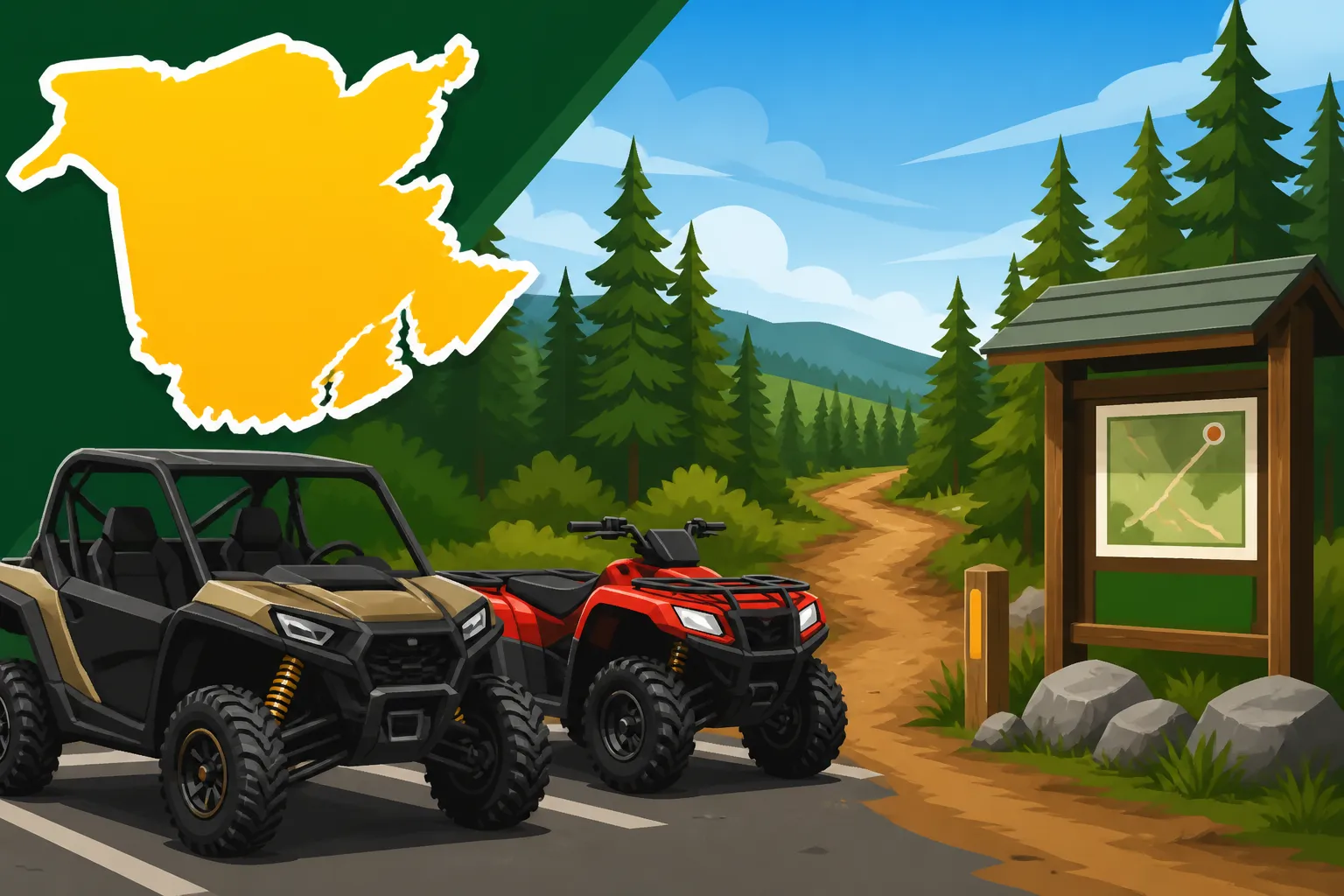
Finding a New Brunswick ATV trailhead with parking can be harder than choosing a route. A mapped trail entrance may have room for a pickup but not a long trailer, or may sit beside a road where parking is restricted. This guide explains how to plan a legal, practical starting point, what to confirm before unloading, and how to avoid leaving your vehicle somewhere it may block access.
How to choose a New Brunswick ATV trailhead with parking
Start with the route, then check the parking
A trailhead is only useful if it connects to a route you’re allowed to ride. In New Brunswick, trail corridors, seasonal access and local rules can vary. A marker on a general map does not necessarily mean there is a public parking lot, a permitted place to unload, or an open route for your machine.
Start by choosing the riding area and checking the trail information available through the relevant local club or trail organization. The [New Brunswick ATV Trails: The QuadNB Network] guide can help you understand the broader managed trail system. Then confirm the specific access point with current local information rather than relying on an old pin, a social media photo or directions passed along by another rider.
Pay attention to the difference between a trail entrance and a trailhead with parking. A trail may cross a road or run near a settlement without offering a designated place to leave a truck and trailer. If you arrive and see a narrow shoulder, a private driveway, a gate or a plowed area that appears to belong to a nearby business, don’t assume it is available for parking.
This matters especially when you’re hauling a side-by-side on a long trailer. A spot that works for one pickup may not have enough room to turn around, unload safely and leave the access lane clear. Before you set off, try to confirm three things: that the trail is open, that your machine and permit are appropriate for it, and that the parking location is permitted and large enough for your vehicle.
Look for a suitable starting point in the region you plan to ride
New Brunswick has riding areas around communities such as Woodstock, Hartland, Miramichi, Bathurst, Edmundston, Fredericton and Moncton. Those place names are useful starting points for planning, but they do not guarantee a particular parking lot or public access point. Local clubs, trail operators and land managers are better sources for the exact entrance and current conditions.
For example, a rider planning to head out from the Woodstock or Hartland area may be looking for access to a long day’s ride, while someone near Miramichi may be starting from a camp or arranging a trip around a particular trail corridor. In both cases, “near the trail” is not the same as “parking provided.” Ask where riders are expected to unload and whether that location is suitable for a truck, trailer or multiple vehicles.
It’s also worth checking whether your chosen access point is intended for day use, club events or another purpose. A parking area used during an organized ride might not be open for general use every day. Similarly, a place that was accessible in dry weather may become difficult to use after heavy rain, snow or spring thaw.
Use trail maps as a planning tool, not as proof of parking access. Services such as onX Offroad can help you review terrain and organize route information, but check how well the specific area is represented and confirm the legal route and parking details with local sources. The [New Brunswick Trail Maps and the MapGear App] guide provides another starting point for thinking about trail maps and navigation.
Compare parking options before you commit
Use this checklist when comparing possible starting points. If an important detail is unclear, contact a local club, land manager or the business associated with the access point before loading up.
| Parking option | What may work well | What to confirm |
|---|---|---|
| Designated trailhead area | May offer a clear place to unload and meet other riders | Whether it is open to the public, suitable for trailers and available on your planned day |
| Club or event parking | Can be convenient when a club has arranged access | Whether parking is limited to registered event participants or specific hours |
| Campground or lodge access | May suit an overnight trip or a ride starting near your accommodation | Whether vehicle and trailer parking is included, and where machines may be unloaded |
| Roadside turnout | May be close to a route entrance | Whether parking is legal, safe and wide enough without obstructing traffic or maintenance |
| Private business lot | May appear convenient, particularly near a community | Whether the owner permits trail users to park there and whether the lot has a time limit |
| Private camp or cottage access | Can be practical for the property owner or invited guests | Whether you have permission and whether the route beyond the property is open to your machine |
The best option is not necessarily the closest one. A slightly longer drive to a suitable, permitted parking area is usually less stressful than squeezing a trailer onto a shoulder or discovering that a gate is locked after you arrive.
What to confirm before you unload
Verify permission and parking conditions
Parking permission is separate from permission to ride. A landowner may allow riders to cross or use a route but not leave a truck on the property. A business may welcome customers but not intend to provide trailhead parking. If the location is private, ask directly and respect any limits the owner gives you.
For a possible club access point, check whether the club has posted instructions or a designated lot. If you’re unsure, contact the club before your trip. The [Finding a New Brunswick Club Near Your Town] guide can help you identify a local organization to ask. A quick call can clarify whether the access is open, whether parking is permitted and whether a nearby route has a closure or detour.
Don’t treat an unmarked patch of gravel as an invitation. It may be a logging access, a maintenance area, a snow-clearing space or a private entrance. Parking in the wrong place can block equipment, interfere with residents or create a safety problem for road users. If you can’t confirm permission, choose another access point.
Ask about overnight parking separately. A place that is fine for a few hours may not allow a vehicle or trailer to remain after dark. If you’re staying at a campground, lodge or camp, confirm where your truck, trailer and ATV or UTV can be kept, and whether the machine can be parked there overnight.
Check trail access, permits and seasonal conditions
A parking spot does not establish that the trail is open or that you’re ready to ride. Check the trail status for the date you plan to go. Seasonal closures, thaw-related restrictions, washouts, logging activity and local reroutes can change which routes are usable. The [New Brunswick Trail Conditions Before You Go] guide is useful context for checking conditions rather than assuming a route is passable because it appears on a map.
Confirm the permit requirements for your machine and planned route. Also check that your registration and insurance are in order. The [New Brunswick ATV Registration Before Your First Ride] guide covers the registration side of preparing for a first outing, while [New Brunswick Insurance Requirements for Riders] addresses insurance considerations. A trailhead parking plan should be part of that same preparation, not a substitute for it.
If you’re using a phone map, download or save what you need before leaving an area with reliable service. Do not assume you’ll have a signal at the parking area or along the trail. onX Offroad may be one layer in your planning toolkit, but verify that its displayed route information matches the authorized local trail information and current closures. A map app can help with orientation; it cannot grant permission to ride or park.
Parking and unloading safely
Make room for other vehicles and trail users
At a busy access point, think beyond your own truck. Park so another vehicle can enter or leave, keep gates and trail entrances clear, and leave room for emergency or maintenance vehicles. Avoid blocking a turnaround, roadside sightline, driveway or sign. If several people are meeting, agree on where to park before the group arrives so the first vehicle doesn’t occupy the only space needed by a trailer.
Unloading takes more room than parking. Before backing in, look for soft ground, drainage ditches, overhead branches and the swing of the trailer. A long trailer may need a wider turning area than it first appears. If the lot is cramped, don’t try to force a maneuver that puts people, machines or nearby traffic at risk. Find a more suitable place or ask the site contact for instructions.
Keep the area tidy. Pack out food wrappers, straps, cans and anything else you brought in. Don’t leave a trailer, fuel container or equipment where it can obstruct access. A clean, unobstructed parking area helps preserve goodwill with local residents and landowners, which matters in communities where trails pass near homes and working lands.
If there are posted parking signs, follow them even if another vehicle is parked differently. Someone else’s choice does not tell you whether a location is permitted. When signs are absent and permission is unclear, don’t assume the area is public.
Plan for the return, not just the start
A parking plan should account for what happens when the ride ends. If your route is longer than expected, you may return near dusk, in rain or after other riders have left. Make sure your vehicle is parked somewhere you can legally access at that time, and avoid relying on a business lot that may close or a gate that may be locked.
Share your route and expected return time with someone who isn’t riding with you. Keep your phone charged, but don’t count on continuous cellular coverage. For remote outings, consider carrying a suitable backup communication device and basic recovery and first-aid supplies. The [New Brunswick Cellular Reception Maps] guide can help frame why signal planning belongs in your trip preparation.
Before leaving home, save the parking location and a backup access point. If the first lot is full, muddy, closed or unsuitable for your trailer, you’ll have another option instead of searching from the driver’s seat. onX Offroad or another mapping app may help you keep your planned locations organized, but confirm that your backup is also permitted and connected to a route you can legally ride.
At the end of the day, check that you haven’t left gear behind and that your group hasn’t parked in a way that blocks someone else. If the access point has a gate, follow any posted instructions about opening and closing it. The [Leaving a Gate the Way You Found It] guide is a helpful reminder that small habits can protect continued access for everyone.
A practical pre-trip checklist
Before you leave, run through these questions:
- Is the trail open for the day and season? Check for closures, reroutes and conditions that could affect your route.
- Is the parking location authorized? Confirm permission, especially when the area appears private or is connected to a business, camp or club event.
- Can your vehicle and trailer fit safely? Consider turning space, unloading room, ground conditions and access for other vehicles.
- Are your machine and paperwork ready? Check registration, insurance and any trail permit requirements that apply.
- Have you saved your route and parking location? Download useful map information before heading into an area with limited reception.
- Do you have a backup plan? Identify another permitted access point in case the first one is closed, full or unsuitable.
- Does someone know your plan? Share your intended route and approximate return time with a person who is not on the ride.
If you’re organizing a group trip, send these details to everyone in advance. A clear meeting location, parking plan and backup option can prevent several vehicles from arriving at different entrances and blocking a narrow access road. For a larger outing, check with the local club about any event or group-use requirements before inviting riders.
A little confirmation before departure saves a lot of frustration on arrival. The right trailhead is not simply the one closest to the route; it’s one where you’re permitted to park, can unload safely, and can begin on an open, authorized trail.
Disclaimer
This article is for general informational purposes only and does not constitute professional advice. Laws, prices and regulations vary by location and change over time. Consult a qualified professional for guidance on your specific situation.