New Brunswick Visitors From Maine
Maine riders planning an ATV trip into New Brunswick need to sort out more than the border crossing. The two jurisdictions have a trail agreement, but reciprocity does not automatically settle every question about permits, registration, insurance or riding rules. Here’s how to check whether your permit qualifies, what to carry, and what to confirm before unloading at a New Brunswick trailhead.
How Maine and New Brunswick trail reciprocity works
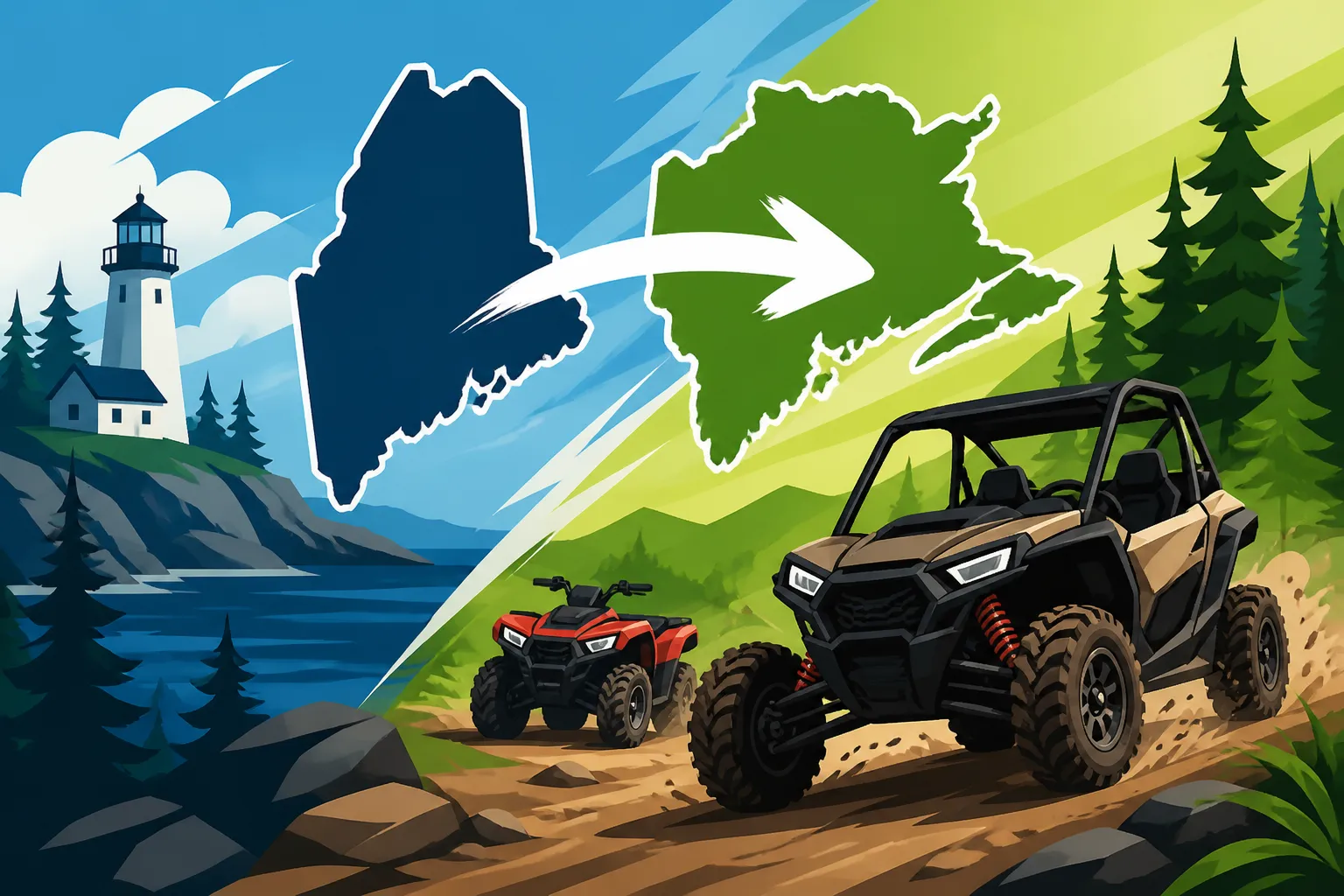
New Brunswick and Maine have an agreement intended to let eligible riders use a connected trail network across the border without buying a second trail permit in every situation. The practical benefit depends on the agreement’s current terms and on the permit you hold. Don’t assume that any sticker, membership card or registration from Maine gives you access to every New Brunswick trail.
A trail permit and vehicle registration are different things. A trail permit gives access to designated trails under the applicable conditions. Registration identifies the machine for legal use and is separate from the permission to ride a managed trail. Insurance is another separate requirement. Reciprocity in one category does not automatically replace the others.
Before travelling, check with the organization that issued your Maine permit and with the New Brunswick trail organization or local club responsible for your planned route. Ask whether your exact permit is recognized, whether your machine type qualifies, and whether the agreement covers the trails you intend to ride. The key is confirmation for your specific trip, not a general assumption based on the fact that an agreement exists.
| What you have or need | What to confirm before riding in New Brunswick |
|---|---|
| Maine trail permit | Whether it is accepted under the current Maine–New Brunswick agreement |
| ATV or UTV registration | Whether your home registration is acceptable for the planned riding |
| Insurance | Whether your policy covers the machine and the activity in New Brunswick |
| Trail access | Whether your route is open to your machine and permit type |
| Rider documents | Which records you must carry and be ready to show |
| Local route information | Closures, seasonal restrictions, club rules and any permitted road connections |
The agreement is useful, but it is not a blanket exemption from local requirements. A recognized permit does not make a closed trail open, authorize riding on private land without permission, or give you permission to use a road that is not open to off-road vehicles.
For more background on the agreement and how its coverage can work, see New Brunswick and the Maine Agreement. If you want a focused overview of what a Maine visitor should check, New Brunswick Visitors From Maine is also relevant. When you cannot get a clear answer about your particular sticker, machine or route, ask the permit issuer or a local club before setting out.
What to check about your machine, registration and insurance
Treat the border trip as a paperwork check as well as a trail trip. Bring the documents that show who owns or controls the machine, that it is registered where required, and that it is insured for the use you plan to make of it. Keep the original documents secure and make sure the copies or digital records you carry are readable and accessible. If you are unsure what an officer can ask to see, review What an Officer Can Ask to See on a Trail and New Brunswick Documents You Must Carry.
Registration is not the same as a trail permit
A Maine trail permit should not be treated as vehicle registration. Likewise, a registration document does not by itself grant access to a New Brunswick club trail. Confirm that the machine’s registration is accepted for the intended use, and have the supporting record available if asked.
If you are travelling with a borrowed ATV or UTV, bring evidence that you have the owner’s permission to use it. For a rental machine, ask the rental company who is responsible for registration, insurance and the trail permit. Do not assume that the rental operator has handled every requirement just because the machine is delivered ready to ride.
The rules can depend on the machine type and where it will be ridden. A standard quad, side-by-side, dirt bike and snowmobile may not be treated identically. If you are bringing a UTV, check the vehicle category and equipment requirements rather than assuming that the rules for a two-up ATV apply. Does a Side-by-Side Register the Same Way? explains why it is worth checking the details for a side-by-side.
Confirm insurance coverage directly
Before the trip, contact your insurer and ask whether your policy covers riding in New Brunswick, including use on the trails you plan to ride. Confirm that the coverage applies to the specific machine and riders, and ask whether there are restrictions that could affect a cross-border outing. Keep proof of insurance with the machine or in a secure place where you can produce it.
Do not rely only on a verbal assurance that the policy is “good in Canada.” Ask about off-road riding, trail use, passenger use and any exclusions. New Brunswick requires insurance for trail riding in circumstances where an exemption does not apply, and visitors should not assume their home policy is automatically sufficient. See New Brunswick Requires Insurance on Trails and New Brunswick Insurance Requirements for Riders for related details.
If you are borrowing someone else’s ATV, make sure the policy covers you as a rider. If the machine is rented, read the rental paperwork carefully and ask what the operator’s policy does and does not cover. Insurance for damage to the rental machine may be separate from liability coverage. A trail permit is not insurance, and proof of insurance is not a substitute for a permit.
Keep the documents easy to produce
Documents that are packed at the bottom of a trailer or left in a vehicle far from the group can slow down a roadside check. Make a simple document plan before leaving home. Each rider should know where the registration and insurance records are, and the group should agree on who carries any shared records.
Useful items to have available include:
- The machine’s registration record or other documentation accepted for its use
- Proof of insurance that applies to the machine and riding activity
- Your Maine trail permit or other proof of eligibility under the agreement
- Permission from the owner if the machine is borrowed
- Rental documents, if the machine is rented
- A contact number for the permit issuer, insurer or rental operator
Carry only what is needed on the machine, but protect paper records from water and damage. A phone copy can be a helpful backup; it should not be the only copy unless you have confirmed that an electronic record is accepted. Remote trails may also have weak or no cellular service, so download anything you may need before leaving coverage. For practical ways to keep records together, see Carrying Four Documents at Once.
New Brunswick riding rules still apply
Reciprocity concerns trail access. Once you are riding in New Brunswick, you still need to follow New Brunswick’s laws and any local restrictions. A Maine permit does not carry Maine’s rules across the border, and a familiar-looking trail does not mean the road, land or route is open to an ATV.
Check the rules for helmets, passengers, age, road crossings, equipment and any road sections on your planned route. Riders can run into trouble by assuming that a legal practice at home is allowed in the neighbouring jurisdiction. For a broader overview, read What New Brunswick’s Off-Road Vehicle Act Covers and New Brunswick ATV Road Rules Explained.
Road access is limited and route-specific
Some trail routes may connect to or cross roads, but that does not mean ATVs and UTVs can ride on any public road. Road access can depend on the specific road, local authorization and other conditions. A navigation app showing a road between two trail sections is not proof that off-road vehicles may use it.
Plan the route using current trail information, not just a general map. Check whether any road connection is permitted and whether a local bylaw or other authorization applies. The province’s distance and road-use rules can matter even when a rider is only trying to reach the next section of trail. See Can You Ride an ATV on the Road in New Brunswick? and New Brunswick Municipal Bylaws That Open Roads before relying on a road link.
The same caution applies to woods roads, rail beds, beaches, private property and Crown land. A visible track or an unlocked gate is not permission to ride there. Stay on marked, authorized corridors and respect signs, gates and closures. If your route leaves a managed trail, establish who controls the land and what permission is required before riding onto it.
Follow the conditions of the trail system
A recognized permit does not guarantee that every trail is open on the day you arrive. Sections may close because of maintenance, weather, seasonal conditions, land access or safety concerns. A trail marked on an older map may have been rerouted or temporarily closed.
Check current trail conditions shortly before departure and again when you reach the area. Follow signs on the ground, and do not ride around a barrier or closure to keep a planned route intact. If conditions change, turn around or use a confirmed open alternative. New Brunswick Trail Conditions Before You Go and New Brunswick Trail Closures After Rain can help you plan with changing conditions in mind.
Respecting local restrictions matters beyond avoiding a ticket. Club trails may pass through working forests and private land. Riding outside the marked corridor can damage the trail, create conflicts with land users and threaten future access. Keep noise down near homes, yield carefully to other trail users and leave gates as you find them.
A practical checklist for a Maine-to-New Brunswick ride
A little preparation can prevent a long drive from ending at a trailhead with a permit or paperwork problem. Work through these steps before crossing the border.
- Choose the New Brunswick riding area. Identify the trailhead, planned route and any road connections. Check that the route is open to your machine and suitable for your group.
- Verify permit reciprocity. Ask the Maine permit issuer and the New Brunswick trail organization whether your exact permit is recognized for that route. Confirm any restrictions on permit type, machine or season.
- Check registration and insurance. Contact the relevant provider or official service to confirm that the machine’s documents and insurance apply to the planned New Brunswick use.
- Gather supporting documents. Bring registration and insurance records, proof of permit eligibility, and permission or rental paperwork when relevant.
- Review the riding rules. Check helmet, passenger, age, road-use and equipment requirements. Do not assume that your home-jurisdiction rules are the same.
- Check trail status close to departure. Look for closures, reroutes, seasonal restrictions and local notices. Save maps and contact details for use when cellular reception is limited.
- Make a backup plan. If the permit is not accepted or a route is closed, know whether another eligible trail or riding day is available before unloading.
| Before leaving Maine | At the New Brunswick trailhead |
|---|---|
| Confirm the agreement covers your permit and route | Check posted notices and trail markers |
| Verify registration and insurance | Keep documents accessible |
| Review New Brunswick rules | Stay on the authorized corridor |
| Download maps and current information | Turn back at closures or barriers |
| Confirm borrowed or rental machine permissions | Follow local instructions and conditions |
If you cannot confirm whether your permit qualifies, do not rely on an old sticker, a friend’s recollection or a social media post. Contact the issuing organization or a local club and ask a specific question: “Does this permit, for this machine, cover these New Brunswick trails on these dates?” That answer is much more useful than a broad yes-or-no statement about reciprocity.
Maine riders can make a straightforward visit to New Brunswick when the permit arrangement applies and the rest of the requirements are in order. The safest approach is to treat reciprocity as one piece of the plan, then separately confirm registration, insurance, local riding rules and trail status. That way, a permit agreement helps you enjoy the trip instead of becoming an assumption that puts the ride at risk.
Disclaimer
This article is for general informational purposes only and does not constitute professional advice. Laws, prices and regulations vary by location and change over time. Consult a qualified professional for guidance on your specific situation.