New Brunswick and the Maine Agreement
A trail-permit agreement between New Brunswick and Maine can make a cross-border ATV or UTV trip simpler, but it does not mean every sticker, trail or riding rule is automatically interchangeable. The practical question is whether your permit and machine qualify for the trails you plan to use. Here’s how to check reciprocity, prepare your paperwork and avoid confusing trail access with registration, insurance or border-crossing permission.
What the New Brunswick–Maine agreement means
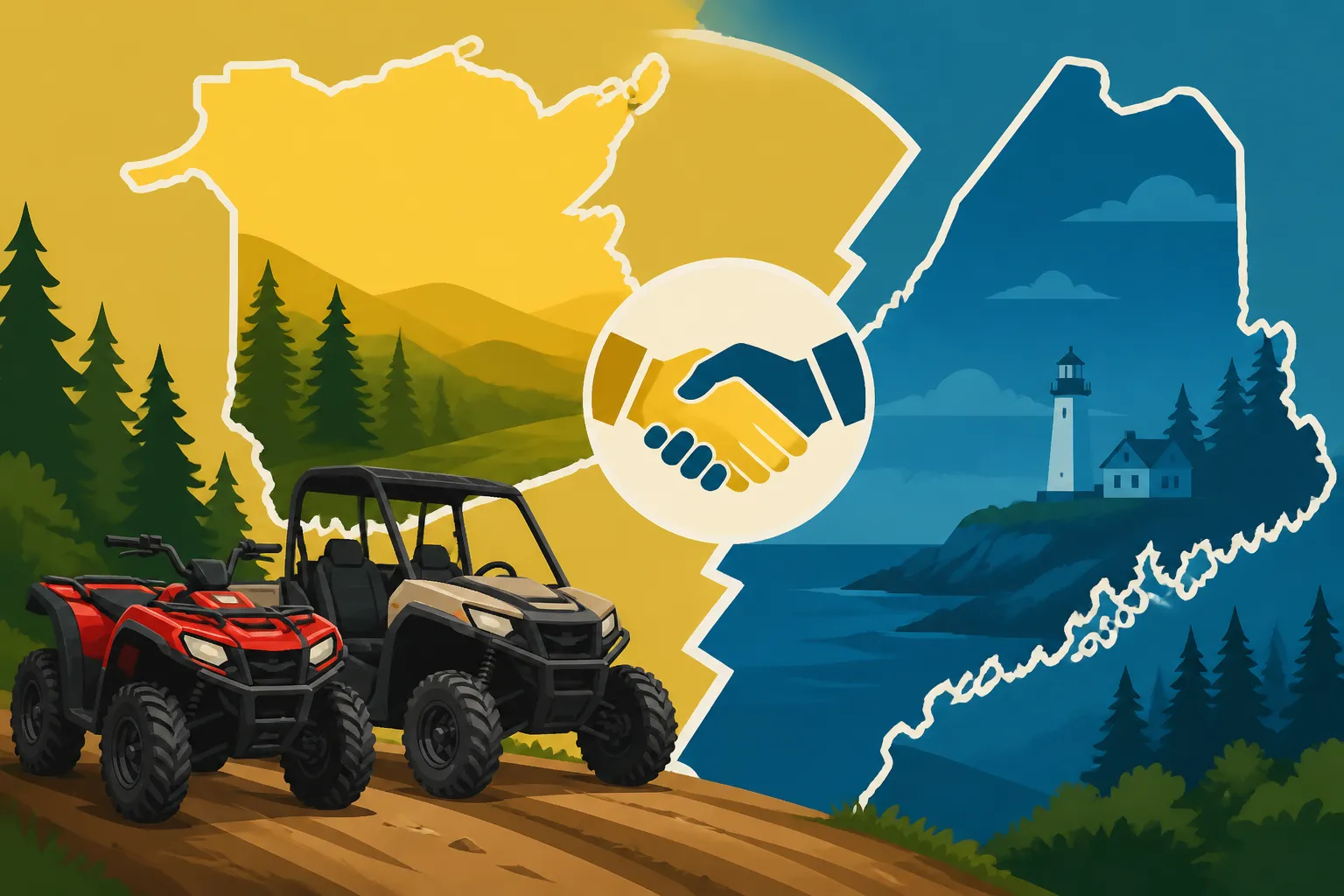
New Brunswick and Maine have an agreement intended to make eligible ATV trail riding across the border more straightforward. In practical terms, reciprocity can allow a rider with a qualifying trail permit from one side to use participating trails on the other side without buying a second permit for that same access.
That is the useful idea behind the agreement: a permit recognized through the arrangement may provide trail access in both jurisdictions. It can make a longer trip possible without treating the provincial or state boundary as the end of your permitted route. The two trail systems have been described as a combined network in A Combined Network of 19,200 Kilometres.
But reciprocity is narrower than it may sound. It is about trail access under an agreement. It does not make New Brunswick and Maine one shared jurisdiction, and it does not automatically make every trail open to every machine. The agreement does not erase local rules, membership requirements, seasonal closures, insurance obligations or equipment standards. It also does not replace registration requirements or customs and border procedures.
A good way to think about it is: reciprocity may help answer, “Can I use my existing trail permit on this participating network?” It does not, by itself, answer:
- Is my ATV or UTV registered correctly for where I am riding?
- Does my insurance cover this trip and the places I plan to ride?
- Is this particular trail open to my machine and permit?
- Do I meet the local requirements for age, helmet, passengers and equipment?
- Can I legally take the machine across the international border?
Those questions still need separate answers. A permit is not a universal pass, and a trail agreement is not an exemption from the rules where you ride.
The agreement has also been described as the first province-to-state trail agreement of its kind. That makes it especially important not to rely on an old summary, a neighbour’s experience or a sticker that worked on a past trip. Agreements can be amended, suspended or applied differently as participating organizations update their rules. Check current guidance before each trip, especially if you are planning around a specific club network or trailhead. For a focused overview of the arrangement, see New Brunswick’s First Province-to-State Trail Agreement With Maine.
Reciprocity is not the same as registration
A New Brunswick registration record and a trail permit serve different purposes. Registration identifies the machine in the applicable vehicle system; a trail permit is about access to a participating trail network. A rider may need to satisfy both requirements, even if one trail permit is recognized on both sides of the border.
That distinction matters for visiting riders. If a Maine rider brings an ATV to New Brunswick, the Maine trail credential may be relevant to trail access under the agreement, but the rider should still check what New Brunswick requires for a visiting machine. The same logic applies in the other direction. A New Brunswick sticker does not automatically settle what Maine requires for a visiting machine.
If you are bringing a machine into New Brunswick, New Brunswick Registration for a Visiting Rider is a useful companion topic. For trail access, confirm the current agreement and the permit type separately.
Reciprocity does not mean every trail participates
Even where an agreement is in force, it should not be treated as permission to ride anywhere in either region. Access may depend on the participating trail system, the permit category, the machine, the season and the trail’s current status. Some trails may be closed, restricted or managed under different arrangements.
Before setting out, confirm that the route you want is part of the participating network and that your permit meets the conditions for it. Do not assume that an open-looking woods road, private access road or unmarked connector is included. Trail permission depends on the land and the route, not just on the fact that your sticker is recognized somewhere in the region.
Check your permit and trip eligibility before you leave
The first practical step is to identify exactly what permit you have. Look at the permit itself, the current purchase or renewal record, and any instructions that came with it. Note the jurisdiction that issued it, the permit category, the machine it is attached to and the period for which it is valid.
Do not rely only on a photo of an old sticker or a receipt from a previous season. A permit may have a particular season, machine or placement requirement. If you have changed machines, bought a used ATV or transferred a sticker, confirm that the permit is still valid for the machine you intend to ride. A transferable arrangement should never be assumed without checking the current terms.
Then check the reciprocity terms with the organizations responsible for the trail systems. For a New Brunswick permit, that means checking current guidance from the provincial trail organization or federation and the relevant local club. For a Maine permit, check the current information from the issuing organization and the trail network you plan to use. If the information on two pages seems inconsistent, ask the organization that manages the trail you intend to ride rather than guessing.
Use Checking Whether an Agreement Is Live as a reminder to verify the agreement’s status and scope, not just its history. The fact that a reciprocal arrangement existed when someone you know crossed the border does not guarantee the same terms apply to your upcoming trip.
Match the permit to the trail and the machine
A permit can be valid while a particular route is not available to you. Before you travel, confirm each of these points:
- Permit status: Is the permit current and paid for the relevant riding period?
- Permit category: Does the type of permit you hold qualify for reciprocal access?
- Machine: Does the agreement cover your ATV or UTV, including its class or configuration?
- Trail system: Is the route managed by a participating organization?
- Season: Is that trail open at the time of your trip?
- Local conditions: Are there temporary closures, detours or restrictions?
- Display requirements: Is the sticker or other proof required to be visible in a specified location?
- Additional obligations: Does the organization require membership, proof of insurance or another document?
That last point can be easy to miss. Some permit arrangements are closely tied to membership or other benefits. If a permit is bundled with membership in one system, verify which benefits travel with it and which do not. Do not assume that reciprocal trail use also transfers insurance discounts, lodging offers, member services or voting rights. Those are separate benefits with their own terms.
If you are choosing a New Brunswick permit for the trip, review New Brunswick’s Groomed Trail Permit and New Brunswick’s Non-Groomed Trail Permit. The important question is not which label sounds better in general; it is whether the permit category matches the trails, season and activities in your itinerary. If you need the basic purchase process, see How to Buy a New Brunswick Trail Permit.
Ask a specific question, not just “Does my sticker work?”
A vague question can produce a vague answer. When you contact a club or permit provider, explain where you are riding, what permit you hold, which machine you have and when the trip is planned. Ask whether the exact trail system recognizes the permit and whether there are any additional conditions.
For example, instead of asking, “Can I ride in Maine with my New Brunswick sticker?” ask, “I have this current New Brunswick permit category, and I plan to ride these named trail sections on these dates with this registered UTV. Is that permit recognized there, and what else must I carry?” The same approach works for Maine riders coming north.
Keep a note of the answer and the date you received it. If you are told to check a map, form or club notice, save that information for the trip. A saved answer is not a substitute for a valid permit, but it can help you resolve confusion at a trailhead or when plans change.
Separate trail access from registration, insurance and border rules
A cross-border ride brings together several kinds of paperwork that are easy to mix up. It helps to treat each as a separate check rather than hoping one document covers everything.
| What you are checking | What it is for | What reciprocity may change | What to verify separately |
|---|---|---|---|
| Trail permit | Access to participating trails | A qualifying permit may be recognized across the agreement | Current status, permit category, trail participation and display rules |
| Machine registration | Identifies the vehicle under applicable registration rules | Usually not the purpose of trail-permit reciprocity | Visiting-machine requirements in each jurisdiction |
| Insurance | Financial protection and any mandatory coverage | Do not assume the agreement changes insurance rules | Coverage territory, permitted uses, exclusions and proof requirements |
| Border procedures | Moving a machine and people between countries | Trail reciprocity does not grant border permission | Current customs and border requirements for your route |
| Local riding rules | Safe and lawful operation on a specific trail or road | The agreement does not make rules identical | Age, helmet, passenger, equipment, speed and road-use rules |
Registration remains a separate question
A permit sticker is not necessarily proof that the machine is registered. Keep the registration certificate or other accepted registration document with you and confirm the rules for a machine visiting the other jurisdiction.
If you are a Maine rider heading into New Brunswick, do not infer that your home-state registration alone settles every requirement. If you are a New Brunswick rider heading into Maine, do not assume a New Brunswick plate or registration document automatically meets all local obligations. Check the visiting-rider rules before loading up, and ask the relevant agency or trail organization when the wording is unclear.
The registration rules can also depend on how the machine was acquired or who owns it. If it is borrowed, rented, newly purchased or registered to a business, make sure the paperwork accurately connects you to the machine. For New Brunswick-specific visitor questions, New Brunswick Registration for a Visiting Rider can help you identify what to check.
Insurance must be confirmed for both the machine and the trip
An insurance policy may be tied to a territory, use, vehicle type or named operator. Do not assume that having a policy at home means you are covered on every trail in another jurisdiction. Call the insurer or review the policy documents, and ask directly whether coverage applies to your machine and planned riding locations.
Ask about more than the word “covered.” Confirm whether liability protection applies, whether the policy recognizes the machine as it is configured, who is allowed to operate it and whether any trail, competition or commercial-use exclusions apply. If the ATV is borrowed or rented, clarify which policy is primary and what the rider is responsible for.
Carry proof of insurance if required, and keep it accessible. A phone image can be useful, but it may not replace an original or other accepted proof where one is required. If you are riding in New Brunswick, New Brunswick Insurance Requirements for Riders gives you a starting point for the local side of the question.
Trail reciprocity does not let you ride across the international border
The agreement is about access to participating trails; it should not be read as permission to cross the international boundary on an ATV or UTV wherever a trail or road appears to continue. Plan to transport the machine through an authorized border crossing and confirm the current requirements that apply to the people and vehicle involved.
Border procedures are separate from trail permits. Requirements can depend on where you cross, whether the machine is being temporarily brought in or moved permanently, who owns it and what documents are available. Check current information with the appropriate Canadian and U.S. border authorities before travel. If the machine belongs to someone else, carry clear written authorization and confirm whether additional documents are needed.
For most riders, the uncomplicated plan is to haul the machine on a suitable trailer through the proper border crossing, complete any required procedures, then ride only on trails where you have confirmed access. Do not treat a map line, old rail corridor or remote woods road as a border crossing.
Plan the route as a cross-border trip, not just a long trail ride
A reciprocal permit can make a route more flexible, but a good trip still depends on detailed planning. Trail networks are not always continuous, and a gap between two marked routes may involve a public road, private land, a seasonal closure or a section that does not allow your machine. The route should be lawful from the trailhead to the final destination, not merely on the sections shown as open.
Start with the official trail maps and notices for both sides of the trip. Identify the exact trailheads, connectors and return route. Check whether the route passes through a town, along a public road, beside a logging operation or near land where access is limited. If a route depends on a connecting road, verify that ATV or UTV use is allowed there; a trail permit alone does not make a public road open to off-road vehicles.
Use the map to build a route with realistic stopping points. Consider fuel range, weather, daylight, group experience and the availability of help if a machine breaks down. On a remote trail, a short distance on the map can take much longer than expected because of rough surfaces, washouts, detours or slow travel through busy sections.
Check for closures and changing conditions
Trail status is not static. A route that is ordinarily open may be closed because of weather, maintenance, land access, fire risk, a damaged bridge or another temporary issue. Check close to departure and again before you enter a remote section. If the club has posted a reroute, follow it rather than trying to reconnect with the original corridor across unmarked land.
Mud and spring thaw deserve particular care. Riding around a wet spot can widen the trail and damage the shoulder, while a route that looks firm at one end may become soft farther along. Respect closure signs and barriers. If you encounter a closure that is not shown on your saved map, turn around and contact the responsible club when practical.
Cell service can be unreliable in forested or remote areas. Save maps for offline use and share your route and expected return time with someone who is not riding with you. A phone app can help with navigation, but it should not be your only plan. Bring a charged phone, a power source and a backup way to find your location.
A phone mount or waterproof pouch from a retailer such as Amazon may be useful for carrying navigation gear, but test it before the trip. Check that the mount stays secure over rough ground and that your device remains usable in rain, dust and cold. Keep your paper or downloaded route information protected too.
Leave room for a change of plan
For a cross-border trip, the planned route may not be the route you ride. A club may close a segment, a trailhead may be full, a machine may need repair, or weather may make a long section unsafe. Build in a legal way to turn back or shorten the ride. Do not make the whole trip depend on a single narrow connector that has not been confirmed.
Give each rider a clear copy of the itinerary, not just the person leading the group. Include the trailhead, planned route, fuel stops, expected return time and a contact person. Agree on what to do if the group separates. If you are riding with people who do not know the area, set a conservative pace and decide in advance where everyone will regroup.
For an extended ride, bring basic repair and recovery gear suited to your machine and the terrain. A tow strap, tire repair supplies, tool kit, first-aid kit, water and weather-appropriate layers are more useful when each rider knows where they are and how to use them. Pack gear so it stays secure and does not interfere with steering, passenger seating or safe operation.
Follow the rules where you are riding
New Brunswick and Maine have separate laws and local trail requirements. Even if a permit is accepted on both sides, the operating rules do not become identical. Rules may differ for age, supervision, helmets, passengers, road use, lighting, noise, alcohol, equipment and where a machine may travel. Check the rules that apply to your exact trip, and follow the more restrictive requirement when you are uncertain until you have confirmed the local rule.
This is particularly important if your itinerary includes public roads. A connecting route on a map may not be an ATV route, and road access may depend on local permission, signage or a specific designation. Do not ride on a road simply because it is the shortest way between two trail sections. Confirm that the route is open to your vehicle and that you meet any associated conditions.
Passengers need special attention. A machine designed for one rider should not be treated as a two-person vehicle because the trail is rough or the trip is short. Confirm the machine’s intended seating, passenger requirements and local rules. For a UTV, check occupant seating and restraint requirements; for an ATV, confirm whether carrying a passenger is permitted on that machine and trail. Each person should have properly fitted protective equipment.
Make a document set for each rider
Before loading, gather documents that may be requested and make sure they match the machine and the people travelling. Depending on the trip, this may include:
- A valid trail permit and any required proof of purchase or membership.
- Machine registration documents accepted for the jurisdictions you will visit.
- Proof of insurance, if required.
- Identification and any border documents required for the people travelling.
- Written authorization if the machine is borrowed or registered to someone else.
- Safety course or operator documents, if applicable.
- Contact information for the trail organization and your insurer.
Keep paper copies in a waterproof pouch and maintain secure digital copies as a backup. A phone can be lost, damaged or out of power, so do not keep every essential document only on one device. If you plan to store copies in cloud storage, make sure you can access them without relying on a strong data connection.
The exact documents required depend on the rider, machine and route. The checklist in Four Things to Carry on a New Brunswick Trail can help with the New Brunswick portion, but it is not a substitute for checking what Maine requires for your trip.
Review rider and machine requirements before departure
If children or newer riders are in the group, check age, training, supervision and machine-size rules in each jurisdiction. A rider who may operate legally at home may not automatically meet the rules where the group is travelling. Do not leave this until the trailhead; the route and plan should be suitable for every rider in advance.
Give the machine a practical pre-trip inspection. Check tires, brakes, steering, lights, fuel, battery, belts and visible damage. Make sure the plate and permit are secure and readable, and that required equipment is in place. For a UTV, confirm that safety restraints function and that cargo is tied down. For any machine, avoid modifications or loads that impair control, visibility or safe stopping.
If you have added accessories, check their effect on the machine. A cargo rack, windshield, light bar or storage box should be secure and appropriate for the trip. A phone holder or navigation device bought through Amazon, for example, should not block controls or the rider’s view. Check mounting hardware after a short test ride before relying on it for a long route.
What Maine riders should check before riding in New Brunswick
A Maine rider planning to use New Brunswick trails should verify the current agreement from the Maine side as well as from the New Brunswick trail organization. Confirm that the specific permit held is recognized, that the planned trails participate and that the sticker or other proof is displayed as required.
Then check the New Brunswick rules that apply to visiting machines and riders. A reciprocal trail permit does not answer registration, insurance or road-use questions. If the machine is registered in Maine, ask what proof a visiting rider must carry in New Brunswick. Ask the insurer whether coverage applies while the machine is being operated in Canada, and keep the insurer’s confirmation with your travel papers.
Pay attention to the difference between riding on a managed trail and riding on a road or other land. A trail sticker does not provide permission to cross private property, leave a marked corridor or use an undesignated road. If the route touches a municipal road or another connector, confirm it is open to your vehicle.
Before leaving Maine, check the border requirements for the rider and the machine. Have ownership documents ready, and bring written permission if the ATV or UTV is not yours. Confirm that the machine can be transported through the crossing you plan to use and that you understand any required declarations or procedures. If something about the machine’s ownership or registration is unusual, such as a recent purchase or a lien, resolve the paperwork before travel.
When you reach New Brunswick, follow the local trail signs and directions even if they differ from what you are used to at home. Use the marked route, observe temporary closures and ask the local club if a junction is unclear. For more visitor-specific detail, see New Brunswick Visitors From Maine.
What New Brunswick riders should check before riding in Maine
A New Brunswick rider heading south should confirm that the current Maine trail system recognizes the permit they hold. Do not assume that every New Brunswick permit category works the same way or that recognition applies to every trail. Check the current agreement terms, the route map and any trail organization’s conditions.
Ask about machine registration and insurance on the Maine side as well. Bring your New Brunswick registration certificate and proof of insurance, and verify whether they are accepted for the type of riding you plan to do. Ask your insurer specifically about operating the machine in Maine, including whether the planned use and any passenger arrangement are covered.
If you are travelling as a group, check every machine. A permit attached to one ATV does not automatically cover a second machine, a borrowed machine or a newly purchased one. Make sure each machine has its own valid documentation and that every rider understands the trail rules. If there are rental machines involved, ask the rental operator who handles the trail permit, registration and insurance, and what each renter must carry.
Road sections deserve extra attention. Do not assume that a road is open to ATV use because it is shown near a trail or because another rider used it in the past. Check the current local rules and signs. If you are unsure whether a connecting section is legal, contact the club or leave it out of the route.
Plan for the return trip, too. A machine that travels south on a trailer needs to be secure and roadworthy for the trip home. Keep fuel, tools and spare parts appropriate to the route, and allow time for border procedures on the way back. If the itinerary changes, update the person expecting you and do not press on simply to complete a loop.
For an overview of the New Brunswick side of the trip, New Brunswick Riders Visiting Maine can help organize the questions to resolve before departure.
A practical pre-trip checklist and common mistakes
The easiest way to use reciprocity is to treat it as one item on a larger trip checklist. Work through the list before you load the trailer, then check time-sensitive details again close to departure.
- Name the route. Identify the trail system, trailheads and any connectors on both sides of the border.
- Confirm the agreement. Check that it is currently in force and that your permit type qualifies.
- Check each trail. Confirm that the specific trails participate and are open on your dates.
- Verify the machine. Check registration, ownership and any visiting-machine requirements.
- Call your insurer. Confirm territorial coverage, permitted use, operators and passengers.
- Review local rules. Check helmet, age, passenger, road, equipment and operating requirements.
- Confirm border procedures. Use the appropriate official border information for your route and circumstances.
- Prepare documents. Carry permit, registration, insurance and any required identification or authorization.
- Prepare the route. Save maps offline, note fuel and turnaround options, and share your itinerary.
- Inspect the machines. Check safety-critical parts, secure the cargo and ensure plates and permits are visible.
- Check conditions again. Look for closures, detours, weather concerns and local notices before riding.
- Set group expectations. Choose a leader, regroup points, a pace and a plan for a breakdown or separation.
Common mistakes tend to come from treating one successful part of the trip as proof that everything else is settled.
Mistake: assuming an old permit is still accepted
A rider may remember using a permit in the other jurisdiction years ago. That experience is helpful background, not current confirmation. Check the agreement’s status, permit terms and trail participation before each trip.
Mistake: assuming a sticker covers every machine
A permit is usually tied to a particular machine or permit record. Do not move a sticker or treat one machine’s permit as coverage for another unless the current terms explicitly allow it. If you have replaced or sold a machine, confirm how to handle the permit before riding.
Mistake: treating a trail permit as insurance
A trail permit does not prove that your policy covers the trip. Keep those checks separate. If you cannot confirm coverage, pause the trip until the insurer answers.
Mistake: relying on a map without checking access
A route drawn between two trail sections may pass through land or roads with different restrictions. A map helps you plan, but it does not grant permission to ride every line on it. Follow signs and verify the status of connectors.
Mistake: crossing the border on the trail
A reciprocal trail agreement does not authorize an off-road international crossing. Use an authorized border crossing and follow the current procedures for the machine and travellers.
Mistake: leaving the paperwork until the trailhead
If a document is missing or unclear, it is much easier to fix at home than at a remote trailhead. Make a document folder for the trip and check that the names, machine details and dates are consistent. If the machine is borrowed, rented or newly purchased, resolve the extra questions early.
For physical document storage, a waterproof pouch from Amazon can help keep papers together, especially when riders are exposed to rain, mud and dust. Keep the pouch secure and separate from items that may get wet or damaged. A pouch is just a storage aid; it does not make an incomplete or invalid document acceptable.
Disclaimer
This article is for general informational purposes only and does not constitute professional advice. Laws, prices and regulations vary by location and change over time. Consult a qualified professional for guidance on your specific situation.