What Counts as the Travelled Portion of a Highway
Oh, the age-old question that keeps many a New Brunswick ATV or UTV rider scratching their head and perhaps feeling a knot of anxiety in their stomach: "What exactly is the travelled portion of a highway?" It sounds simple enough, doesn't it? But when you're out there on your machine, navigating rural roads, crossing highways, or just trying to get from one trail section to another, that definition can feel like a moving target. Misunderstanding it can lead to frustrating fines, safety risks, and a whole lot of confusion. This guide is here to untangle that knot, offering a clear, empathetic look at what New Brunswick law means by "travelled portion" and how it impacts your rides.
Understanding the "Travelled Portion" from a Rider's Perspective
Let's be honest, when you're geared up and ready for a ride, the last thing you want to be doing is parsing legal definitions. But in New Brunswick, understanding what constitutes the "travelled portion of a highway" is absolutely crucial for any ATV or UTV operator. It's not just semantics; it's about staying safe, staying legal, and ultimately, enjoying our incredible trail network without unnecessary stress.
Why This Definition Matters for ATV Riders
The phrase "travelled portion of a highway" isn't just a bit of legal jargon; it's the lynchpin for many of the rules that govern where and how we can ride our off-road vehicles. New Brunswick's Off-Road Vehicle Act, and associated regulations, use this precise wording to establish boundaries. For example, there's a specific rule stating that you generally cannot operate an ORV within 7.5 metres of the travelled portion of a highway. If you misinterpret what that "travelled portion" actually is, you could easily find yourself in violation without even realizing it.
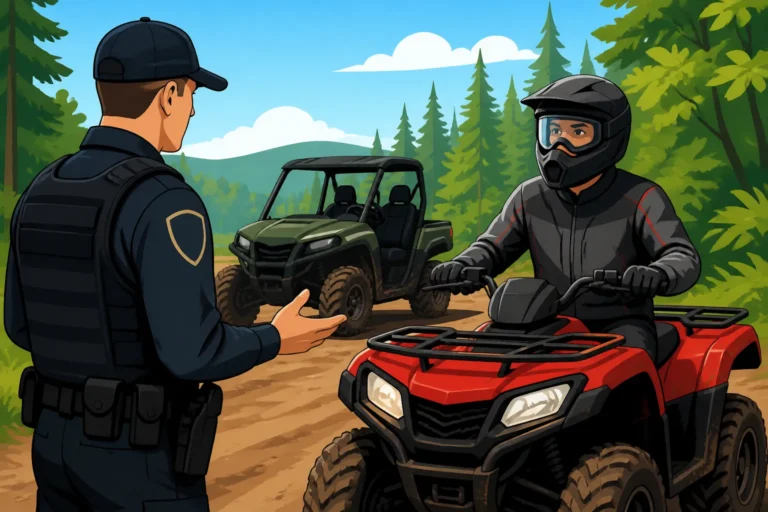
Imagine you're cruising down a gravel road, thinking you're well within the acceptable shoulder area, only to be stopped by an officer who sees things differently. Suddenly, your fun day out turns into a stressful encounter, potentially resulting in a fine that could certainly put a damper on your next ride. Beyond the financial penalty, there's the genuine safety aspect. These rules are in place to minimize conflicts between off-road vehicles and highway traffic, which moves at much higher speeds and carries significantly more mass. As much as we love our quads and side-by-sides, they are no match for a car or transport truck. Knowing exactly where you're allowed to be helps protect you and other road users. This isn't about being overly cautious; it's about being informed and responsible.
Visualizing the Boundary on Rural Roads
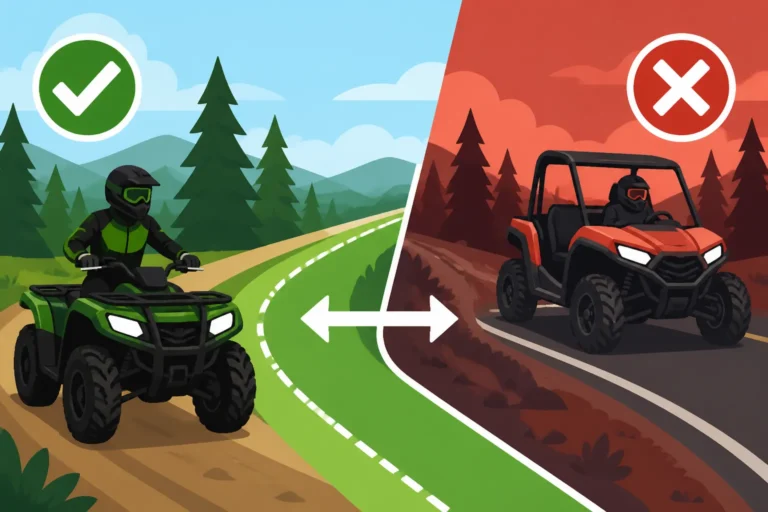
So, how do you actually see this "travelled portion" when you're out there? It's not always as clear as a painted line. On a paved highway, it's generally understood to be the asphalt or concrete surface intended for vehicle traffic, excluding the shoulder. But what about those picturesque dirt roads, logging roads, or gravel routes we all love to explore? This is where it gets a bit nuanced.
Consider a typical rural gravel road. The "travelled portion" would be the main part of the road that vehicles regularly drive on, often identifiable by tire tracks, a slightly more packed surface, or the general width that vehicles maintain. It typically doesn't include the softer edges, the gravel shoulder, or the ditch alongside. However, if that gravel shoulder is wide and firm, and constantly used by vehicles for passing or stopping, its definition can blur. For instance, sometimes the "shoulder" of a gravel road is effectively used as part of the travelled surface, especially in areas where the road itself is quite narrow. It's about function and common usage, not just the material. The important thing is to think about where a typical car or truck would normally drive, not just the absolute edge of the accessible surface. This is where personal judgment, guided by the intent of the law, becomes really important.
The Core of the New Brunswick Off-Road Vehicle Act
To really grasp "what counts as the travelled portion of a highway," we need to acknowledge the foundation it rests upon: the New Brunswick Off-Road Vehicle Act. This piece of legislation, along with its associated regulations, is designed to strike a balance between allowing enthusiasts to enjoy our province's incredible natural beauty and ensuring the safety of everyone, whether they're on an ORV, in a car, or simply walking along. The Act explicitly defines a "highway" as any road, street, lane, or place open to public use as a right of way for vehicles. This broad definition means that many of the smaller, unpaved roads we encounter are, in fact, considered highways under the Act, even if they don't look like a major thoroughfare.
The purpose of defining the "travelled portion" so precisely is to create a buffer zone. This 7.5-metre separation is intended to keep ORVs away from the higher-speed traffic lanes of conventional vehicles. It's a recognition that ORVs operate differently, have different stopping distances, and are often less visible than cars and trucks. By establishing these clear-cut distances from the actual driving surface, the Act aims to prevent collisions and ensure that all road users can coexist as safely as possible. It's not about restricting fun; it's about mitigating risk. If you want a deeper dive, check out [What New Brunswick's Off-Road Vehicle Act Covers].
Legal Interpretations and Practical Scenarios
It's one thing to read a legal definition, and another entirely to apply it in the real world when you're out on the trails or navigating a crossing. Let's break down some of the practicalities and common pitfalls that riders face when trying to adhere to the "travelled portion" rule. The law's intent is clear, but its application can sometimes feel like a puzzle.
What the Law Says (Without Quoting Verbatim)
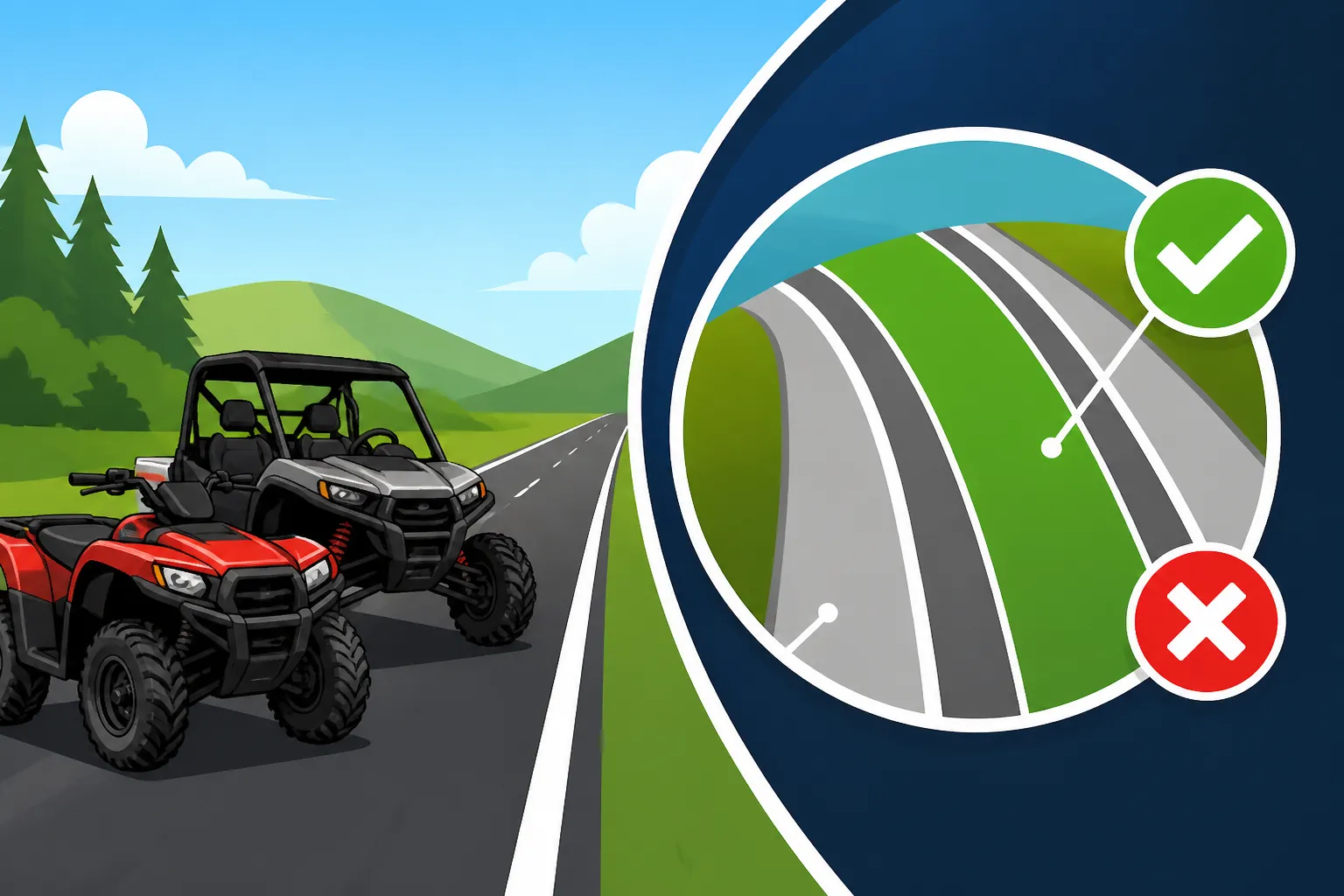
At its heart, the law defines the "travelled portion of a highway" as the part of the road normally used by vehicles for travel. This is crucial. It excludes shoulders, ditches, and anything beyond the primary path of vehicle movement. Think of it as the effective driving surface. If a highway has two lanes going one way and two lanes going the other, the travelled portion would be all four of those lanes, but not the median or the paved shoulder. On a two-lane road, it’s the two lanes themselves.
The whole point of this definition, especially in conjunction with the 7.5-metre rule, is to provide a safety margin. It acknowledges that ORVs are generally slower, have different handling characteristics, and are not designed for the same kind of traffic flow as cars and trucks. By keeping ORVs a certain distance away, it reduces the risk of sudden encounters, allows drivers more reaction time, and creates a clear delineation of space for different types of vehicles. It's a boundary designed for everyone's protection, preventing situations where an ORV might suddenly emerge too close to fast-moving traffic. This is a primary aspect of [New Brunswick ATV Road Rules Explained].
Common Mistakes Riders Make Near Highways
One of the most frequent mistakes I've seen or heard about from fellow riders is misjudging that 7.5-metre distance, especially on rural roads with wide, seemingly safe shoulders. You might think, "Oh, this shoulder is huge, I'm practically in the ditch!" But if that "huge shoulder" is still within 7.5 metres of where cars are actually driving, you're technically in violation.
Another common error happens when riders use what they perceive as an unused or unofficial "lane" alongside the main road. Maybe it's a wide gravel pull-off or an old access road running parallel. Unless that specific section is explicitly designated for ORV use by a municipal bylaw or a specific provincial exemption, it’s highly likely you’re still considered to be too close to the "travelled portion." An officer will typically look at where vehicles could be travelling safely, not just where they are travelling at that moment.
Finally, getting confused about what constitutes a "highway" itself. Many riders assume that only paved, high-speed roads are "highways." But as we discussed, many secondary, unpaved public roads are also considered highways under the Act. Riding along the edge of a quiet, scenic gravel road might feel perfectly natural and safe, but if it's a public highway, the 7.5-metre rule from its travelled portion still applies. This distinction is vital for avoiding [New Brunswick Fines for Riding Near a Highway].
Navigating Intersections and Driveways
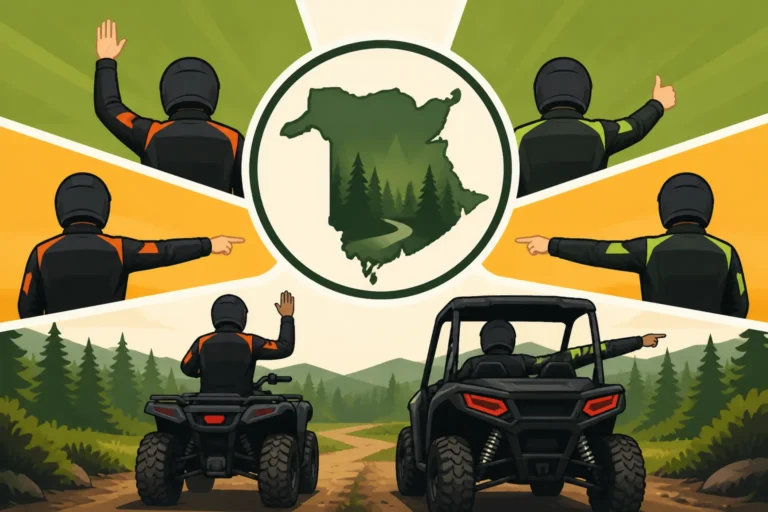
This is where the rubber meets the road, quite literally! New Brunswick law makes specific provisions for ORVs to cross highways. When you need to cross, you must do so at as close to a 90-degree angle as possible, and you must yield to all other traffic. The "travelled portion" concept is paramount here because you are briefly entering it. You’re expected to minimize your time on that travelled surface. This means no riding along the highway to find a better crossing spot further down. It's a direct route across, with maximum caution. [New Brunswick Rules for Crossing a Road] delves into this in more detail.
What about driveways? If you're accessing a private driveway that leads directly off a highway, you're again making a brief traversal of the shoulder and potentially the very edge of the travelled portion. The same principles of caution and minimizing your time in proximity to other vehicles apply. You can't use a driveway access as an excuse to ride parallel to the highway for any significant distance. The focus is always on getting off or across the "travelled portion" as quickly and safely as possible, minimizing any potential conflict with conventional vehicle traffic.
| Feature | Description | ORV Riding Generally Allowed? |
|---|---|---|
| Travelled Portion | The main area of the road used by vehicles for travel. Often paved/packed. | No (except for direct crossings or designated sections) |
| Paved Shoulder | The paved area immediately adjacent to the travelled portion, but not for regular travel. | No (still within 7.5m rule) |
| Gravel Shoulder | The unpaved area beside the travelled portion, sometimes wide. | No (still within 7.5m rule) |
| Ditch Line | The sloped area beyond the shoulder, designed for drainage. | Yes (if 7.5m from travelled portion & not private land) |
| Beyond 7.5m | Any area clearly more than 7.5 metres from the travelled portion. | Yes (if not private property or restricted land) |
Impact on Your Riding and How to Stay Compliant
Understanding the "travelled portion" is one thing; putting it into practice consistently, ride after ride, is another. It really does shape how we plan our routes and how we behave when we find ourselves near public roads. It's about developing a keen awareness of your surroundings and making smart, safe choices.
The 7.5 Metre Rule and What It Means on the Ground
This specific distance, 7.5 metres (which is roughly 24.6 feet), is your buffer zone. Imagine standing on the edge of the travelled portion of a highway. Now, take approximately 10-12 large strides away from that edge. That's roughly the minimum distance you need to maintain. It's a surprisingly large gap when you're standing still, and it can feel even larger when you're trying to gauge it from the seat of your ORV while moving. This rule is non-negotiable for general operation adjacent to a highway.
On the ground, this often means that if you're riding a utility line, an old woods road, or a field access lane that runs parallel to a public highway, you need to be very sure you are indeed outside that 7.5-metre threshold. It’s not enough to be off the paved surface; you must be a significant distance away. If you find yourself in a situation where the terrain narrows and pushes you closer to a highway than 7.5 metres, you need to either find an alternate route that maintains the distance, or dismount and walk your machine if absolutely necessary and safe to do so. This can be a real headache, especially if you haven't planned your route carefully. For more on this, look up [7.5 Metres Measured How].
When Can You Even Be Near a Highway?
So, if you can't ride within 7.5 metres of the travelled portion, when can you ever interact with a highway? Thankfully, there are specific, legally defined scenarios.
Firstly, direct crossings. As mentioned, you can cross a highway if you do so safely, yielding to all traffic, and at as close to a right angle as possible. This is a swift, deliberate manoeuvre, not a casual cruise.
Secondly, designated shared highway sections. Some municipalities, through their bylaws, have officially opened specific sections of highway for ORV use. These are typically clearly marked with signage, indicating that ORVs are permitted on that particular stretch. When riding on these designated sections, you're expected to operate your ORV in a manner similar to other vehicles, following speed limits and traffic laws, and being highly visible. This is a game-changer for connecting trails or accessing services, but it's not the norm everywhere.
Thirdly, accessing private property or fuel/services. You are permitted to ride from a trail onto a highway (or highway shoulder, where permissible) for the shortest possible distance required to access private land, or a service like a gas station, and then immediately return to the trail or private land. Again, "shortest possible distance" is key – it's not an invitation for a joyride on the shoulder. These specific exceptions are critical for practical riding, but they come with strict conditions. You'll want to check [New Brunswick Highway Usage Permits] for more information.
Essential Practices for Safe and Legal Highway Proximity
To stay on the right side of the law and prioritize your safety, here are some practical tips:
- Plan Your Route Thoroughly: Before you even leave home, consult [New Brunswick ATV Trail Maps and the MapGear App] and any local municipal bylaws. Identify designated crossings, shared highway sections, and areas where you might need to reroute to avoid close proximity to highways. Don't just wing it.
- Maintain Distance Religiously: When you're riding parallel to a highway on an adjacent trail or old road, constantly gauge your distance. If in doubt, err on the side of being further away. A simple visual check, imagining two car lengths, can help.
- Cross With Extreme Caution: When performing a highway crossing, come to a complete stop, look both ways multiple times, and only proceed when you are absolutely certain it is safe. Even then, execute the crossing quickly and efficiently. Your visibility on an ORV is not always what you think it is to drivers in larger vehicles.
- Be Highly Visible: If you anticipate even brief moments near or crossing highways, make sure your ORV is equipped with proper lighting (headlights, tail lights) and consider adding reflective tape. Wear bright, high-visibility clothing. The more you stand out, the better. This is especially true for any SuperATV accessories like light bars or reflective decals, which can significantly enhance your presence.
- Know Local Bylaws: A critical piece of the puzzle is understanding if your specific riding area has any unique local bylaws that modify provincial rules regarding ORV use on or near public roads. This takes us to the next section.
The Role of Municipal Bylaws and Designated Routes
While the provincial Off-Road Vehicle Act sets the general framework for what counts as the "travelled portion of a highway" and the associated 7.5-metre rule, it's not the complete picture. New Brunswick has a system where local municipalities can, under certain conditions, create their own bylaws that affect where and how ORVs can operate on or near roads within their jurisdiction. This local nuance is incredibly important and can drastically change your riding experience from one town to the next.
How Local Bylaws Can Change the Game
Imagine riding in one rural community where you're strictly confined to designated trails, unable to even briefly use the shoulder of a small village road to access a gas station. Then, you cross into the next municipality, and suddenly, you see signs indicating that ORVs are allowed to use specific sections of their streets or shoulders to connect to the trail network. This is the power of local bylaws. These municipal regulations can legally open up certain roads or road shoulders for ORV traffic, essentially overriding the provincial 7.5-metre rule for those specific, designated sections.
These bylaws are usually enacted after careful consideration by local councils, often in consultation with ATV clubs and residents. They aim to balance recreational opportunities with public safety and local concerns. Without these bylaws, getting from one part of a town to a trail, or even crossing town to another trail system, could be incredibly difficult, if not impossible, without breaking provincial law. So, while the "travelled portion" definition remains consistent provincially, the application of the 7.5-metre rule can be modified locally. For more insight, check out [How a Local Council Bylaw Opens a Road].
Identifying Designated ORV Roadways
So, how do you know if a particular road or street has been opened up for ORV use by a local bylaw? You can't just assume. The key is signage. Designated ORV routes on public roads will typically be clearly marked with official signs indicating that off-road vehicles are permitted. These signs might specify hours of operation, speed limits, or other conditions. If you don't see specific signage, assume the provincial 7.5-metre rule is in full effect.
Another excellent resource is the local ATV club in the area you plan to ride. Clubs are usually very well-informed about which roads have been opened by bylaws, and they often work closely with municipalities to get these designations in place. Their trail maps or online resources might highlight these routes. Always do your homework before you head out, especially if you plan to link up different trail sections via public roads. Ignoring [New Brunswick Municipal Bylaws That Open Roads] could lead to unexpected fines.
Planning Your Route to Avoid Violations
Given the complexities of provincial rules and local bylaws, route planning becomes paramount for any responsible ATV or UTV rider in New Brunswick. Simply grabbing a generic map and heading out isn't enough if you want to avoid inadvertently violating the "travelled portion" rule or any local restrictions.
Start by consulting official sources: the QuadNB trail map (which often indicates sanctioned road sections for connectors), specific municipal websites for their bylaws, and information from local ATV clubs. Look for clear indications of where ORVs are allowed on or near public roads. If you're unsure about a particular stretch, assume the most restrictive interpretation of the law. It's always better to be overly cautious than to risk a fine or, worse, an accident.
If your planned route requires you to be near a highway, identify those segments specifically. Do you have a safe, designated crossing? Is there an alternative trail that avoids the highway entirely? Are you relying on a local bylaw, and if so, is it clearly signed on the ground? Thinking through these questions before your ride allows you to make informed decisions and adjust your plans as needed. Carrying a physical map or having a GPS loaded with known trail data can be a lifesaver, especially if cell service is spotty in remote areas. A little planning goes a long way in ensuring your ride is enjoyable, legal, and safe.
Disclaimer
This article is for general informational purposes only and does not constitute professional advice. Laws, prices and regulations vary by location and change over time. Consult a qualified professional for guidance on your specific situation.