New Brunswick Rules Riders Get Wrong
It’s a common frustration in New Brunswick: you’ve got your ATV or UTV, you love hitting the trails, but navigating the rules for actually getting to those trails, or even just crossing a road, feels like trying to solve a puzzle written in a secret code. Many riders innocently misunderstand what’s allowed and what’s not, especially when it comes to road use and documentation. This guide is here to untangle those confusing threads, clarify the most frequently misunderstood regulations, and help you ride confidently and legally across our beautiful province.
The "Street Legal" Myth vs. Reality in New Brunswick
Let’s get one of the biggest misconceptions out of the way first. Many riders come from other provinces or states, or they hear stories, and assume there’s a way to make their ATV or UTV fully "street legal" in New Brunswick, meaning they can just cruise down any road like a car. This is a pervasive myth that can lead to significant fines and dangerous situations. New Brunswick does not have a broad "street legal" designation for off-road vehicles (ORVs) in the same way it does for passenger cars or trucks.
No True "Street Legal" Designation
When we talk about "street legal," what most people envision is the ability to drive their machine on any public highway, street, or road with the same rights and responsibilities as a conventional vehicle. In New Brunswick, this simply isn't the case for ATVs and UTVs. These machines are fundamentally designed and regulated as off-road vehicles. Their primary legal operating environment is designated trails, private property (with permission), and very specific, limited road sections that are explicitly opened to them under strict conditions. Adding lights, turn signals, or even a horn – while excellent safety enhancements, perhaps from a brand like SuperATV, for trail riding – does not automatically grant you carte blanche to drive on public roads. These modifications might meet certain equipment standards, but they don't override the fundamental classification of your vehicle. The province's Off-Road Vehicle Act governs where and how these machines can operate, and it treats them very differently from on-road vehicles.
The implications of this distinction are profound. If you assume your accessorized machine is "street legal" and venture onto a provincial highway or an undesignated municipal street, you could be facing fines for operating an unregistered or uninsured vehicle on a public road, in addition to fines for operating an ORV where prohibited. It’s not just about the vehicle's equipment; it’s about its legal classification and the specific regulations governing its use. Always remember that an ORV is an ORV, and a car is a car, and their legal operating environments are largely distinct here in New Brunswick.
Designated Road Sections and Permits
While there isn't a blanket "street legal" status, there are very specific and limited scenarios where ORVs are permitted on public roads. These aren't general allowances; they are targeted exceptions to facilitate trail access or connect trail networks. The most common allowances fall under two main categories: designated sections and the use of special permits.
Firstly, certain public road sections may be designated by a local municipality or the Minister of Natural Resources and Energy Development as open to ORV traffic. These are typically short stretches meant to link one trail section to another, or to allow access to a service like a gas station or restaurant. When these sections are designated, they will be clearly marked with signage indicating that ORVs are permitted and often specifying the conditions, such as speed limits or hours of operation. You cannot assume that if one road in a town is open, all roads are. Always look for official signage. This is where understanding [New Brunswick Highway Usage Permits] comes into play. These permits are crucial for legal road transit in these specific circumstances, and you need to know how and when to acquire one.
Secondly, special permits can sometimes be obtained for specific purposes, such as an event or an organized ride that temporarily uses a road section. However, these are not for individual, everyday use. For the average rider, your focus should be on understanding that the vast majority of New Brunswick's public roads and highways remain off-limits to ATVs and UTVs, unless explicitly, and often temporarily, designated otherwise. Trusting word-of-mouth about "open roads" without seeing official signage or checking with local authorities is a surefire way to run into trouble with law enforcement.
Common Misconceptions About Road Access
Beyond the "street legal" myth, there are several specific rules regarding road access that riders frequently misinterpret. These misunderstandings often stem from partial information or confusion between different provincial regulations. Getting these wrong can quickly turn a pleasant ride into an expensive interaction with law enforcement.
The 7.5 Metre Rule
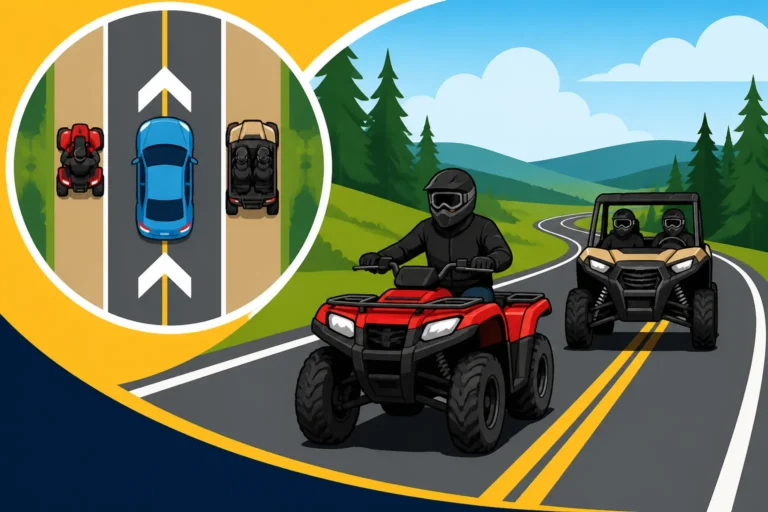
One of the most widely misunderstood rules is the "7.5 metre rule." Many riders believe this rule grants them permission to ride alongside a public highway, using the shoulder or ditch, as long as they stay 7.5 metres away from the paved or gravelled portion. This is incorrect and a dangerous interpretation. The rule actually states that an ORV is prohibited from operating within 7.5 metres of the "travelled portion" of a highway, unless they are lawfully crossing it or operating on a designated ORV trail that happens to run parallel to the road.
The intent of the 7.5 metre rule is to keep ORVs away from active traffic areas for safety reasons. It's a restriction, not an allowance for parallel travel. If you're riding in the ditch or alongside the road, assuming you're far enough away, you're likely breaking the law and putting yourself and others at risk. Police often patrol these areas, and the fines for violating this can be substantial. It's critical to understand [7.5 Metres From the Travelled Portion] and exactly [7.5 Metres Measured How] to avoid costly mistakes. This rule is designed to delineate where ORVs cannot be, rather than where they can.
For example, imagining you're riding a wide ditch beside a busy provincial highway near Sussex. You're consciously trying to stay 7.5 metres from the asphalt. A provincial officer pulls you over. Your argument that you were "far enough away" won't hold up. The rule means you generally cannot be in that ditch at all if it's within 7.5 metres of the highway's travelled portion, unless it's a designated trail. This distinction is vital for safe and legal riding, and it's a rule that is consistently enforced to prevent accidents between high-speed road traffic and slower-moving ORVs.
Crossing Roads
While riding alongside a public road is heavily restricted, crossing one is often necessary to connect trail sections or access amenities. However, even this seemingly simple act comes with specific rules that many riders fail to observe. You can't just dart across whenever you feel like it. The law dictates how you must approach, execute, and depart from a road crossing.
Generally, ORVs must cross public roads at a 90-degree angle to the flow of traffic, coming to a complete stop before entering the roadway. You must yield to all other vehicles and pedestrians, and it's imperative to cross safely and as directly as possible. You cannot drive down the road for any distance, even a short one, before or after the crossing, unless it's a provincially designated crossing or part of a municipal bylaw allowing limited travel. This applies whether you're on a trail that bisects a secondary road in rural Kent County or a smaller street in a village. The rules are clear: cross, don't travel. For a full breakdown, check out [New Brunswick Rules for Crossing a Road].
Imagine you’re on a trail near Edmundston and need to cross a paved road to continue. You approach, stop, check for traffic, and then cross directly over to the other side of the trail. What you cannot do is stop, then turn right, drive 50 metres down the road, and then turn left back onto another trail. That 50-metre stretch is considered illegal road travel. Even if it feels safe or seems like "everyone does it," it's a violation. The primary goal of these rules is to minimize the time ORVs spend in close proximity to conventional vehicle traffic, thereby enhancing safety for everyone.
Local Bylaws and Designated Streets
This is where things can get particularly confusing for riders. While provincial rules are clear on general road prohibitions, individual municipalities in New Brunswick have the authority to enact bylaws that open specific streets or sections of streets to ORV traffic. This is often done to allow riders to access gas, food, or lodging, or to connect to the main trail system. However, the crucial point here is that these bylaws are hyper-local and not universal.
What might be allowed in the village of Florenceville-Bristol for example, where a main street might be open for ORVs during certain hours, is almost certainly not allowed in Fredericton or Moncton without explicit, distinct bylaws. You cannot assume that because you saw ORVs on a street in one town, you can do the same in another. It is the rider's responsibility to know and follow the specific bylaws of the municipality they are riding in. This often means doing a little homework before you head out, especially if you're exploring new areas. For insights into this, see [New Brunswick Towns That Allow Quads] and [How a Local Council Bylaw Opens a Road].
A perfect illustration of this confusion might be a rider from Woodstock, where they know certain town roads are open to ORVs. They then trailer their machine to the Acadian Peninsula for a weekend trip. Without checking the local bylaws for villages like Caraquet or Shippagan, they might assume the same rules apply. This assumption could lead to them being stopped by local police and fined, despite their good intentions. The bylaws might specify speed limits, specific routes, or even restrict days or hours of operation. Always confirm the local rules – a quick search online for the municipal website or a call to the local town office can save you a lot of grief. Even though a specific brand like SuperATV might offer accessories that make your machine trail-ready, they don't give you a free pass on municipal roads.
What Documents You Really Need to Carry
One of the easiest ways to get into trouble on the trail or even when lawfully crossing a road is not having the correct documentation readily available. Many riders mistakenly believe that if they have their registration, they're good to go. However, New Brunswick regulations require more than just a plate.
Beyond Just Registration
When an enforcement officer stops you, whether it's a provincial police officer, a local RCMP detachment member, or a park warden, they will likely ask for several key documents. It’s not just about your [New Brunswick ORV Registration Explained] certificate. You need to be prepared to present four crucial pieces of paper (or digital copies, if permitted and accessible) to avoid fines.
Firstly, your Certificate of Registration is paramount. This proves your machine is registered with Service New Brunswick. It lists you as the owner and details about your ATV or UTV. Ensure it's current and legible. If you bought your machine from a dealer, they usually handle the initial registration. If it was a private sale, you're responsible for transferring the registration into your name.
Secondly, you absolutely must carry Proof of Insurance. In New Brunswick, liability insurance is mandatory for operating an ORV on managed trails and public lands. Many riders, especially those who primarily ride on private land, forget this critical piece of paperwork. The penalties for riding uninsured are steep, and can easily exceed [New Brunswick Uninsured ATV Fine of $604.50]. Even if you have insurance, if you can't produce proof when asked, it can still lead to complications.
Thirdly, you need your Off-Road Vehicle Trail Permit. If you are riding on any part of the designated QuadNB trail network, you are required to have a valid trail permit sticker displayed on your machine, and often the corresponding paper permit to prove purchase. This permit contributes to trail maintenance and infrastructure.
Finally, you must carry proof of a valid Off-Road Vehicle Safety Training Certificate. For certain age groups, and for all operators on designated trails, having completed an approved safety course is mandatory. This often gets overlooked, but failing to produce this certificate when requested can result in fines. These four documents are your key to riding legally and confidently. For a full checklist, consult [New Brunswick Documents You Must Carry].
Here's a quick summary of what you need:
| Document Type | Purpose | Where to get it |
|---|---|---|
| Certificate of Registration | Proves ownership and legal registration of the machine. | Service New Brunswick |
| Proof of Insurance | Confirms mandatory liability coverage for trail/public land use. | Your insurance provider |
| Trail Permit | Allows access to the QuadNB managed trail network. | Service New Brunswick, QuadNB clubs, or some dealers |
| Safety Training Certificate | Demonstrates completion of mandatory ORV safety education. | Approved ORV safety course providers |
The "Owner-Only" Private Land Exemption
Another area of frequent misunderstanding revolves around riding on private property. Many riders are aware that if they are riding exclusively on their own private land, they don't necessarily need a trail permit or liability insurance. This is true under the [New Brunswick Owner-Only Private Land Exemption]. However, the crucial detail often missed is the word "exclusively."
The moment your tire touches any land that isn't solely yours—even if it's a friend's woodlot with permission, Crown land, or a designated trail—the rules change. If you're on a neighbor's property, even with their blessing, you are no longer covered by the owner-only exemption. At that point, you become subject to the standard provincial regulations regarding registration, insurance, and trail permits. This means if you ride from your backyard onto a shared access road, or a nearby farmer’s field, you need all your paperwork in order.
A common scenario involves someone who lives on a large rural property near Grand Falls. They ride their ATV around their own land all the time, never thinking about insurance or a permit. One day, a friend invites them to ride on their adjacent woodlot. The rider thinks, "It's private land, so I'm still good." They venture onto their friend's property and encounter a conservation officer conducting checks. Because they are no longer exclusively on their own land, they are now subject to the full suite of ORV regulations, and without insurance or a permit, they could be facing significant fines for things like [New Brunswick Penalties for No Safety Course]. This scenario highlights why understanding the precise limits of the "owner-only" exemption is so vital for every rider.
Gear and Machine Requirements Many Overlook
Beyond paperwork and road rules, there are specific requirements for your gear and your machine that are often overlooked or misunderstood. These aren't just bureaucratic hurdles; they are in place for your safety and the safety of others.
Helmets and Passengers
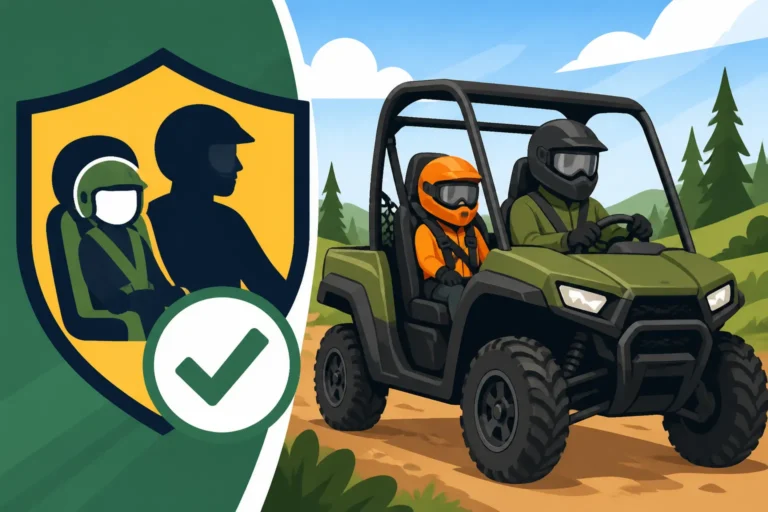
The rule regarding helmets in New Brunswick is clear and applies broadly: every person riding on an ORV must wear an approved helmet. This isn't just for the driver; it includes any passengers. Yet, it's surprisingly common to see passengers, particularly adults, riding without a helmet, mistakenly believing it's only mandatory for the operator. This is a dangerous and illegal oversight. The law, specifically [New Brunswick Helmet Law for Every Occupant], leaves no room for ambiguity.
Furthermore, passenger rules for ATVs are often misunderstood. Most ATVs are designed for a single operator. Unless your ATV is specifically designed by the manufacturer to carry a passenger, with a designated passenger seat and footrests, you are generally not permitted to carry one. Side-by-sides (UTVs) are typically designed for multiple occupants and thus fall under different passenger rules, but for many traditional ATVs, it's a solo ride. Carrying a passenger on a single-rider ATV is not only illegal but also extremely unsafe, as it can compromise the machine's balance and handling. For a deeper look, review [New Brunswick Passenger Rules on a Quad].
Consider a family outing where a parent allows their older child to ride on the back of a single-seat ATV for a short distance. Both the parent and the child might have helmets on, which is good. But the fundamental issue is that the ATV is not designed for two riders. In the event of an accident, not only is the risk of injury significantly higher, but insurance coverage could be denied due to illegal operation, and the operator could face a fine for carrying an unauthorized passenger. This is why understanding the design limits of your specific machine, and adhering to helmet laws for all occupants, is non-negotiable.
Machine Equipment and Aftermarket Additions
While New Brunswick's ORV regulations don't mandate the same extensive lighting or signal requirements as on-road vehicles for all operating environments, there are basic equipment standards that every ORV must meet. These generally include working headlights, taillights, and functional brakes. These are fundamental safety features. Many riders upgrade their machines with fantastic aftermarket parts from companies like SuperATV, adding brighter lights, winch systems, or improved suspension components. These additions are excellent for enhancing safety and capability on the trails. A robust winch from SuperATV, for example, can be a lifesaver if you get stuck deep in the woods, and upgraded skid plates can protect your machine from rough terrain.
However, it's crucial to understand that while these aftermarket upgrades improve your machine, they do not automatically qualify it for street use, nor do they exempt you from any existing equipment requirements. For instance, having a loud aftermarket exhaust, while perhaps appealing to some, could fall afoul of noise bylaws in certain areas, particularly if you are operating on designated road sections or near residential areas. Similarly, while a lift kit from SuperATV might give you superior ground clearance for tackling rugged terrain, it doesn't transform your ORV into a road-legal vehicle that can ignore the 7.5-meter rule or municipal street restrictions.
Always ensure your basic machine functions – lights, brakes, and other essential safety components – are in good working order. Before modifying your machine, it's a good practice to consider how those modifications might impact its compliance with provincial and local regulations, especially if you ever intend to use it in any grey areas near public roads or within municipal boundaries. The rule of thumb is: enhance for the trail, but don't assume those enhancements grant new road-riding privileges. The investment in quality parts from a brand like SuperATV should be seen as boosting your off-road experience and safety, not circumventing road restrictions.
Disclaimer
This article is for general informational purposes only and does not constitute professional advice. Laws, prices and regulations vary by location and change over time. Consult a qualified professional for guidance on your specific situation.