Riding a Shared Highway Stretch
It can be incredibly confusing trying to figure out exactly where you can and cannot ride your ATV or UTV on the public roads in New Brunswick. Many riders get frustrated when they see a short stretch of pavement standing between them and the next section of an amazing trail system, wondering if it's legal to just hop on the asphalt for a few minutes. This guide is here to cut through that confusion, explaining the specific rules and requirements for legally riding on those designated "shared highway stretches" that connect our fantastic trail network.
What Exactly is a "Shared Highway Stretch" in New Brunswick?
When we talk about shared highway stretches, it's crucial to understand that we're not talking about simply taking your quad for a spin down any public road. New Brunswick has very specific regulations designed to keep everyone safe, and most public highways are, quite rightly, off-limits to off-road vehicles. However, the province, in collaboration with local communities and organizations like QuadNB, recognizes the need for ATVs and UTVs to sometimes use short segments of these roads. This isn't about opening up every road for recreational riding, but rather providing vital links in the trail system.
Differentiating from "Illegal" Road Riding
Let's be crystal clear: riding your ATV or UTV on an undesignated public road is illegal, and it comes with stiff penalties. A "shared highway stretch" is a very different beast. These are specific, clearly marked sections of public roads that have been officially designated for shared use by both traditional motor vehicles and off-road vehicles. The purpose is almost always utilitarian – to connect two segments of an approved trail, to allow riders to access essential services like a gas station, a restaurant, or a local store, or to bypass an impassable section of trail. You might find yourself needing to cross a bridge on a main road, or ride a few hundred metres down a paved road to get from one section of a woods road to another. These designated sections are typically short, well-signed, and exist purely to facilitate seamless travel along the greater trail network. Without these designated sections, many incredible multi-day rides would be impossible, forcing riders to backtrack or find alternative, sometimes lengthy, routes.
It’s easy to get caught up in the excitement of a ride and think, "Oh, it's just a little bit of road," but that small stretch can make all the difference legally. Always look for official signage confirming that the section you're on is designated for ORV use. If you don't see the signs, it's best to assume it's not allowed. You'll often find these connections as part of the larger [New Brunswick ATV Trails: The QuadNB Network].
The Role of Municipal Bylaws and Ministerial Designations
So, how do these special stretches of road become legal for ORVs? It's not a free-for-all; it’s a carefully managed process. These shared highway sections are established through one of two main mechanisms: municipal bylaws or ministerial designations. Local municipal councils can pass specific bylaws that open certain roads within their jurisdiction to off-road vehicles. This is often done after consultations with local ATV clubs, residents, and provincial authorities, ensuring that safety and community concerns are addressed. These bylaws typically specify which roads, or parts of roads, are open, for what purpose, and during which hours or seasons. Knowing [New Brunswick Municipal Bylaws That Open Roads] is essential before you head out.
Alternatively, the provincial Minister responsible for the Off-Road Vehicle Act can issue a ministerial designation, directly opening specific provincial highways or sections thereof for ORV use. These designations are typically for broader, more strategic connections that link larger trail systems across municipal boundaries. In both cases, these designated sections are almost always clearly marked with specific signage indicating that off-road vehicles are permitted. These signs might specify the speed limit for ORVs, the hours of operation, or other conditions. Riders often check these designations by looking at official trail maps or contacting local clubs and Service New Brunswick. Ignoring these specific designations and riding on an undesignated road is a common mistake that can lead to [New Brunswick Penalties for Riding Unregistered] or [New Brunswick Fines for Riding Near a Highway].
Essential Requirements for Riding Shared Highway Stretches
Riding on a shared highway stretch in New Brunswick isn't like riding on your private land; it comes with a full set of responsibilities and legal requirements that mirror those for traditional motor vehicles. You can't just hop off the dirt trail onto the pavement without meeting these standards. It's about ensuring your safety and the safety of everyone else on the road, while also demonstrating that ORV riders are responsible road users.
Licensing, Age, and Safety Training
When you're on a designated shared highway stretch, you are effectively sharing the road with cars, trucks, and other licensed vehicles. Therefore, the driver of the ATV or UTV must hold a valid driver's licence. This isn't just a suggestion; it's a legal requirement. Whether it's a full Class 5 licence or a Class 9 licence for younger riders, you need to be legally qualified to operate a motor vehicle on a public road. A learner's permit typically isn't sufficient for independent operation on these shared sections. If you're wondering, [Do You Need a Licence for an ATV in New Brunswick?], the answer is a resounding yes when it comes to shared highway stretches.
Age is another critical factor. The minimum age for operating an ORV on a public road, even a designated shared stretch, is 16 years old. This aligns with the minimum age for holding a driver's licence in New Brunswick. While there are provisions for younger riders (aged 6 to 15) to operate ORVs on private land or designated closed courses, these exemptions absolutely do not apply to shared highway stretches. A 15-year-old rider, no matter how skilled or accompanied by an adult, cannot legally operate an ORV on one of these sections. This is a crucial distinction to remember when planning family rides, especially if your route involves connecting trail sections via public roads. [New Brunswick ATV Age Requirements] details these rules comprehensively. Additionally, all operators in New Brunswick are generally required to complete a provincially approved safety training course. While this is broadly applicable, it becomes even more pertinent when you're sharing space with road traffic. [New Brunswick Quad Safety Course Explained] can help you find a course.
Vehicle Equipment and Documentation
Your ATV or UTV needs to be properly equipped to be ridden on a shared highway stretch. This isn't just about looking good; it's about visibility, control, and legal compliance. Your machine must have:
- Working Headlights and Taillights: Essential for visibility, especially in changing light conditions or if you're riding near dawn or dusk.
- Brake Lights: So traffic behind you knows when you're slowing down.
- Mirrors: At least one rearview mirror is typically required to see traffic approaching from behind.
- A Horn: For alerting other road users to your presence if needed.
Many aftermarket companies, like SuperATV, offer a range of accessories that can help you meet these requirements, from upgraded LED lighting kits to durable, street-legal mirrors designed for off-road vehicles. Ensuring your machine is equipped correctly is not just about avoiding a ticket; it's about your safety.
Beyond the physical equipment, you must carry specific documentation with you whenever you're operating an ORV on a shared highway stretch. These are the "four essentials" an officer will ask for if you're stopped:
- Your valid driver's licence.
- Your current ORV registration certificate. Your machine must be properly [New Brunswick ORV Registration Explained], and display a valid license plate and annual decal.
- Proof of valid liability insurance. [New Brunswick Requires Insurance on Trails], and this is doubly true on public roads.
- Your ORV safety training certificate.
It's wise to keep these documents in a waterproof, easily accessible pouch on your machine, like in a saddlebag or a storage box. Fumbling around for papers while an officer waits is never a good look, and being unable to produce them can lead to fines. Make sure your registration isn't expired; remember, [New Brunswick Registrations Expire December 31] every year. For a full rundown, check out [New Brunswick Documents You Must Carry].
Navigating Shared Stretches Safely and Legally
Once you meet all the prerequisites, riding a shared highway stretch requires a shift in mindset from trail riding to road riding. The environment is different, the hazards are different, and the rules are more stringent. Your primary goal is to integrate safely with other traffic, not to challenge it.
Speed Limits and Traffic Rules
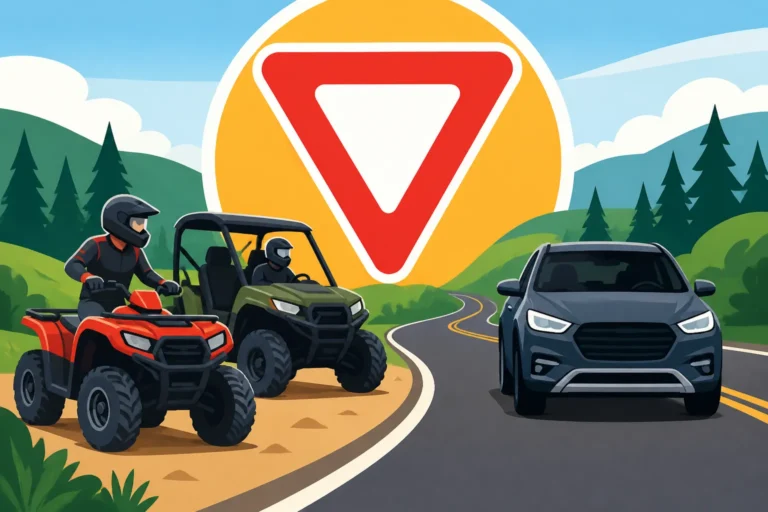
When you transition from a winding dirt trail to a paved shared highway stretch, the immediate change you'll notice should be your speed. On these sections, you are bound by the same general traffic laws as any other vehicle. This means obeying posted speed limits, which for ATVs and UTVs on these designated sections are often lower than for cars. Even if the speed limit for cars is 80 km/h, there might be specific signage indicating a lower limit, say 50 km/h, for ORVs. Always pay attention to these signs. You must also obey all traffic signals, stop signs, and yield signs. Stopping completely at a stop sign, checking for cross-traffic, and signaling turns are not suggestions; they are legal obligations.
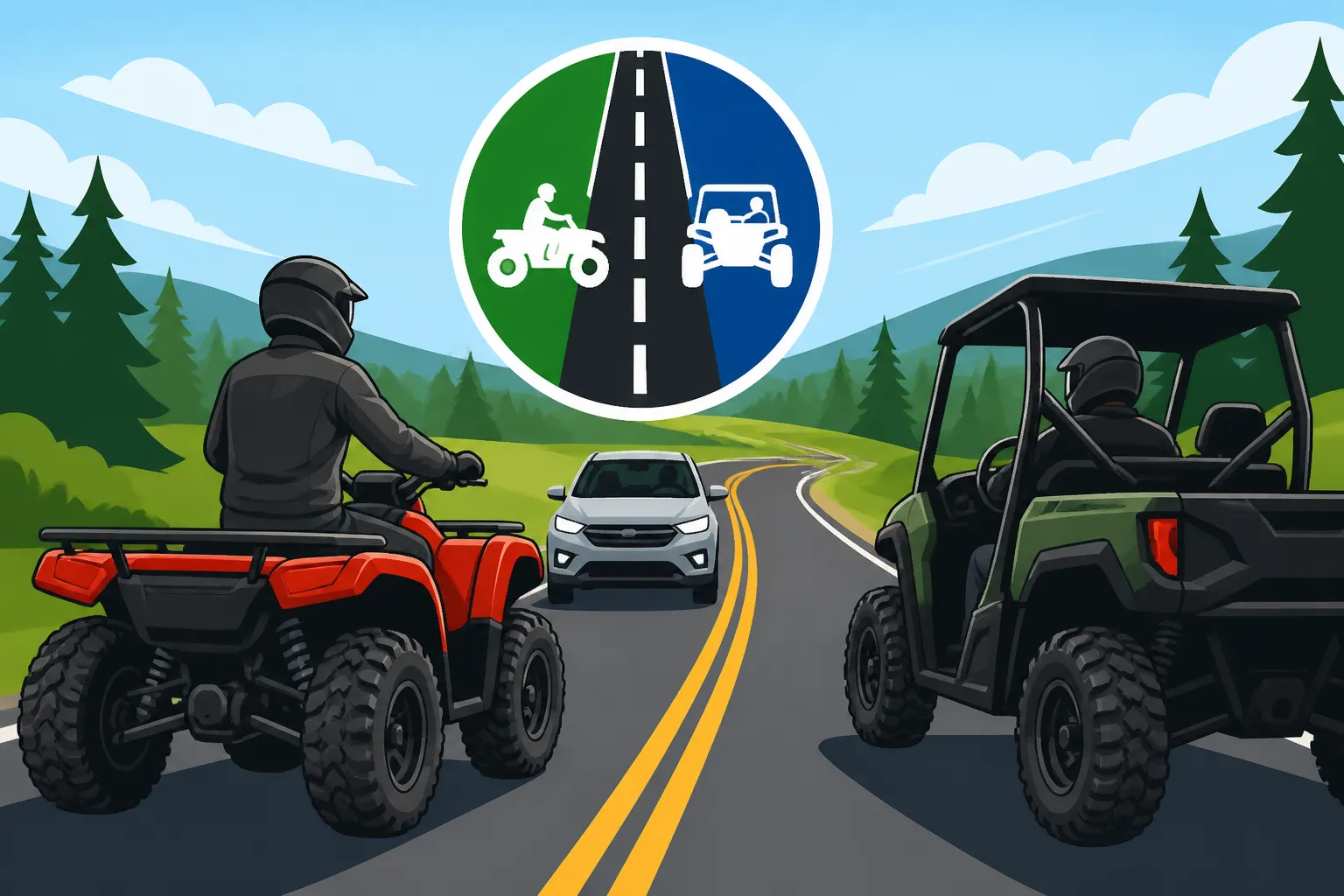
It's also crucial to remember that you must yield to motor vehicles. They generally have the right of way. [New Brunswick Quads Yield to Motor Vehicles] is a rule that applies universally. Ride on the far right-hand side of the road, in a single file if you're with a group, and maintain a safe following distance from vehicles ahead of you. Be predictable in your movements and avoid sudden changes in speed or direction. This isn't the place for aggressive riding or showing off; it's about getting from point A to point B safely and legally.
Avoiding Prohibited Areas and Maintaining a Safe Distance
The concept of a "shared highway stretch" implies very precise boundaries. It's not a free pass to ride on any shoulder or ditch beside the road. In New Brunswick, the "7.5-metre rule" is paramount: you generally cannot operate an ORV within 7.5 metres of the travelled portion of a public highway, unless it's a specifically designated crossing or shared section. The "travelled portion" refers to the part of the road used by vehicles, not the ditch or the shoulder. So, even on a road that has a designated ORV section, you must stick strictly to the marked path. Understanding [7.5 Metres From the Travelled Portion] and what that distance truly means is critical.
This also means you can't veer off the pavement onto someone's lawn, into a business parking lot (unless it's an approved stop for fuel/food), or into a field adjacent to the highway unless you have explicit permission. These actions could lead to trespassing charges or other fines. Even though you're on a paved section, your machine still benefits from robust protection. Components like heavy-duty A-arms or full skid plates from SuperATV might seem like overkill for a short road section, but they provide peace of mind for the inevitable gravel pull-offs, minor dips, or unexpected debris you might encounter. Always ride with an awareness of your surroundings, ensuring you stay within the legal confines of the designated stretch.
Interacting with Other Road Users
Sharing the road successfully boils down to courtesy, communication, and caution. Many motorists in New Brunswick are still getting accustomed to seeing ATVs and UTVs on public roads, even on designated sections. Expect some drivers to be surprised, and react accordingly with patience.
- Be Visible: Ensure your headlights and taillights are on, even during the day. Consider adding reflective tape to your machine or wearing high-visibility gear.
- Communicate Clearly: If your machine doesn't have turn signals, use clear and unambiguous [New Brunswick Hand Signals Without Lights]. Point clearly in the direction you intend to turn.
- Maintain Composure: Don't engage with aggressive drivers. Your safety is paramount. If a vehicle wants to pass, make it easy for them to do so safely by staying to the right.
- Avoid Distractions: Keep your focus entirely on the road, traffic, and your surroundings. Leave the phone calls and elaborate navigation adjustments for when you're safely pulled over.
By behaving as a responsible and predictable road user, you contribute to a positive perception of ORV riders, which is vital for the continued access to these shared highway stretches. A good experience for all road users means less friction and more opportunities for future designations.
Consequences of Non-Compliance
Riding an ATV or UTV on a shared highway stretch comes with privileges, but also serious responsibilities. Ignoring the rules isn't just a minor infraction; it can lead to significant financial penalties, legal trouble, and even the impoundment of your machine. The authorities in New Brunswick, including the RCMP and local police, regularly monitor these areas, and they are well-versed in the specific rules for ORVs.
Fines and Penalties
The financial repercussions for not adhering to the rules on shared highway stretches can be substantial. These aren't just minor slaps on the wrist; they are designed to deter unsafe and illegal riding practices. Here are some common fines you could face:
- Riding without a valid registration: [New Brunswick No-Registration Fine of $172.50]. This is for simply having an unregistered machine on a public road.
- Riding without valid liability insurance: [New Brunswick Uninsured ATV Fine of $604.50]. This is one of the most severe penalties, reflecting the high risk of operating a vehicle without coverage.
- Riding without a helmet: [New Brunswick's $172.50 Helmet Fine]. Even if you're on a designated section, the helmet law applies. [New Brunswick ATV Helmet Law] is clear on this.
- Illegal highway usage: [New Brunswick's $292.50 Highway Fine]. This applies if you're caught riding on a highway section that is not designated for ORV use, or if you violate conditions on a designated section (e.g., speed).
- Riding without a valid driver's licence: This is treated seriously, similar to operating any other vehicle without the proper licence.
- Riding without an ORV safety course certificate: Penalties can apply, especially for younger riders or if involved in an incident. [New Brunswick Penalties for No Safety Course].
These fines can quickly add up, turning a fun day of riding into a very expensive lesson. Remember, law enforcement officers are empowered to perform [New Brunswick Equipment Checks by Officers] and ask for your documents at any time.
Vehicle Impoundment and Insurance Implications
Beyond the immediate fines, there are even more serious consequences for repeated or severe non-compliance. In certain situations, particularly for operating an unregistered or uninsured vehicle, or for dangerous driving, your ATV or UTV could be impounded. This means your machine is seized by the authorities, and you would be responsible for towing fees, storage costs, and any administrative release fees, in addition to your fines. Getting your machine back can be a lengthy and costly process.
Furthermore, riding illegally can have severe repercussions for your insurance. If you're involved in an accident on a shared highway stretch while operating an unregistered, uninsured, or unlicenced machine, your insurance policy could be null and void. This means your insurance company may refuse to cover any damages to your machine, other vehicles, or property, and critically, any personal injury claims. You could be held personally liable for hundreds of thousands of dollars in damages, which could devastate your financial future. It's simply not worth the risk. Always ensure your machine is properly registered, insured, and that you and any passengers are compliant with all laws before you even think about putting a tire on a shared highway stretch. [New Brunswick Insurance Cost for an ATV] is a small price to pay for peace of mind compared to the alternative.
Here's a quick comparison of general rules:
| Feature | Private Land Riding (Owner's Property) | Shared Highway Stretch Riding (Designated) |
|---|---|---|
| Registration | Not required if never leaves private land | Required |
| Insurance | Not legally required (though highly recommended) | Required (minimum liability) |
| Driver's Licence | Not legally required | Required (minimum age 16) |
| Safety Course | Not legally required | Required |
| Helmet | Highly recommended | Required |
| Lights/Horn/Mirrors | Not legally required | Required |
| Trail Permit | Not required | May be required if connecting to club trails |
| Speed Limits | Owner's discretion | Strictly enforced (often lower for ORVs) |
| Road Rules | N/A | All traffic laws apply |
| Passenger Rules | Owner's discretion | Strict rules apply |
Disclaimer
This article is for general informational purposes only and does not constitute professional advice. Laws, prices and regulations vary by location and change over time. Consult a qualified professional for guidance on your specific situation.