Hand Signals When Your Quad Has No Indicators
Riding your ATV or UTV on New Brunswick's beautiful trails is an incredible experience, but it can get tricky when your machine doesn't have built-in turn signals or brake lights. This lack of indicators can lead to miscommunications with other riders, making group rides confusing and potentially hazardous. This guide will walk you through the essential hand signals every New Brunswick ATV rider should know, ensuring safer and smoother communication on the trails, especially when your quad lacks electronic indicators.
The Reality of Riding Without Indicators on New Brunswick Trails
It's a common scenario for many ATV and UTV enthusiasts in New Brunswick. You're geared up, your machine is running perfectly, and you're ready to hit the trails with friends. But then comes that familiar moment of hesitation when you need to make a turn or slow down in a group. Without those flashing lights, how do you clearly tell everyone else what you're doing? It’s a challenge many of us face, stemming from how these rugged machines are designed in the first place.
Why Many Quads Lack Turn Signals
Many off-road vehicles, especially older models or those designed purely for utility or aggressive trail riding, often come from the factory without turn signals or even dedicated brake lights that are easily visible. Manufacturers often skip these features to reduce cost, complexity, and potential damage in rough terrain, assuming the machine will primarily be used in environments where formal road signals aren't expected. For a long time, the focus was simply on getting power to the ground and handling the gnarliest trails, not on navigating traffic.
This is especially true for sport quads or some utility models that were never intended to share roads, even designated ATV-friendly roads. Riders acquire these machines for their power-to-weight ratio or their rugged simplicity. When you're blasting through a mud bog or climbing a rocky hill, the last thing on your mind is often whether the guy behind you knows you're about to make a sharp left. However, as New Brunswick's trail network expands and more villages open their streets to ATVs, the need for clear communication becomes paramount, highlighting this design gap.
It's a common scenario: you bought your quad used, or perhaps new several years ago, and never really thought about turn signals because you only rode on private land or isolated woods roads. Now, you're joining club rides, exploring the [New Brunswick ATV Trails: The QuadNB Network], or even using designated municipal roads where hand signals become crucial. The machine itself is fantastic, but that one missing feature can feel like a real hurdle when trying to ride responsibly with others.
The Frustration of Unclear Intentions
Imagine riding in a group along a dusty trail. The lead rider suddenly slows down, and then veers without any obvious signal. Do they see an obstacle? Are they pulling over? Are they turning? This split second of uncertainty can cause a chain reaction, leading to confusion, sudden braking, or even minor collisions within the group. It’s frustrating for everyone involved, especially for the rider behind trying to anticipate what's coming next.
This frustration isn't just about safety; it's about the flow of the ride and the enjoyment of the group. Constantly guessing what the rider in front is doing can be exhausting and diminish the camaraderie that makes group riding so appealing. It also puts an undue burden on the following riders to maintain excessive distance, which isn't always practical on winding trails or when navigating tight sections. Clear communication, even without electronic indicators, makes everyone feel more secure and allows for a more relaxed and enjoyable experience.
Beyond group dynamics, think about those instances where you're legitimately using a section of shared road or crossing a public highway in an area where [New Brunswick Rules for Crossing a Road] allow it. Without turn signals, communicating your intent to motorists can be incredibly difficult and dangerous. Hand signals bridge this gap, allowing you to clearly indicate your planned movements to drivers who are accustomed to vehicle indicators. It's about being predictable, which is the cornerstone of safe road sharing.
Essential Hand Signals for New Brunswick ATV Riders
Communicating effectively on the trails when your quad lacks indicators really boils down to using universally recognized hand signals. These aren't just for cyclists or motorcyclists; they're an essential part of responsible ATV riding, especially in New Brunswick where shared trails and road sections are becoming more common. The trick is to be clear, decisive, and consistent with your signals.
Basic Communication for Turning and Stopping
Just like in cycling or motorcycling, a few universal hand signals are crucial for communicating basic movements. These signals are simple, intuitive, and, with practice, become second nature. The key is to make them clear, decisive, and early enough for other riders or drivers to react. Don't wait until you're already halfway through your turn to stick out an arm!
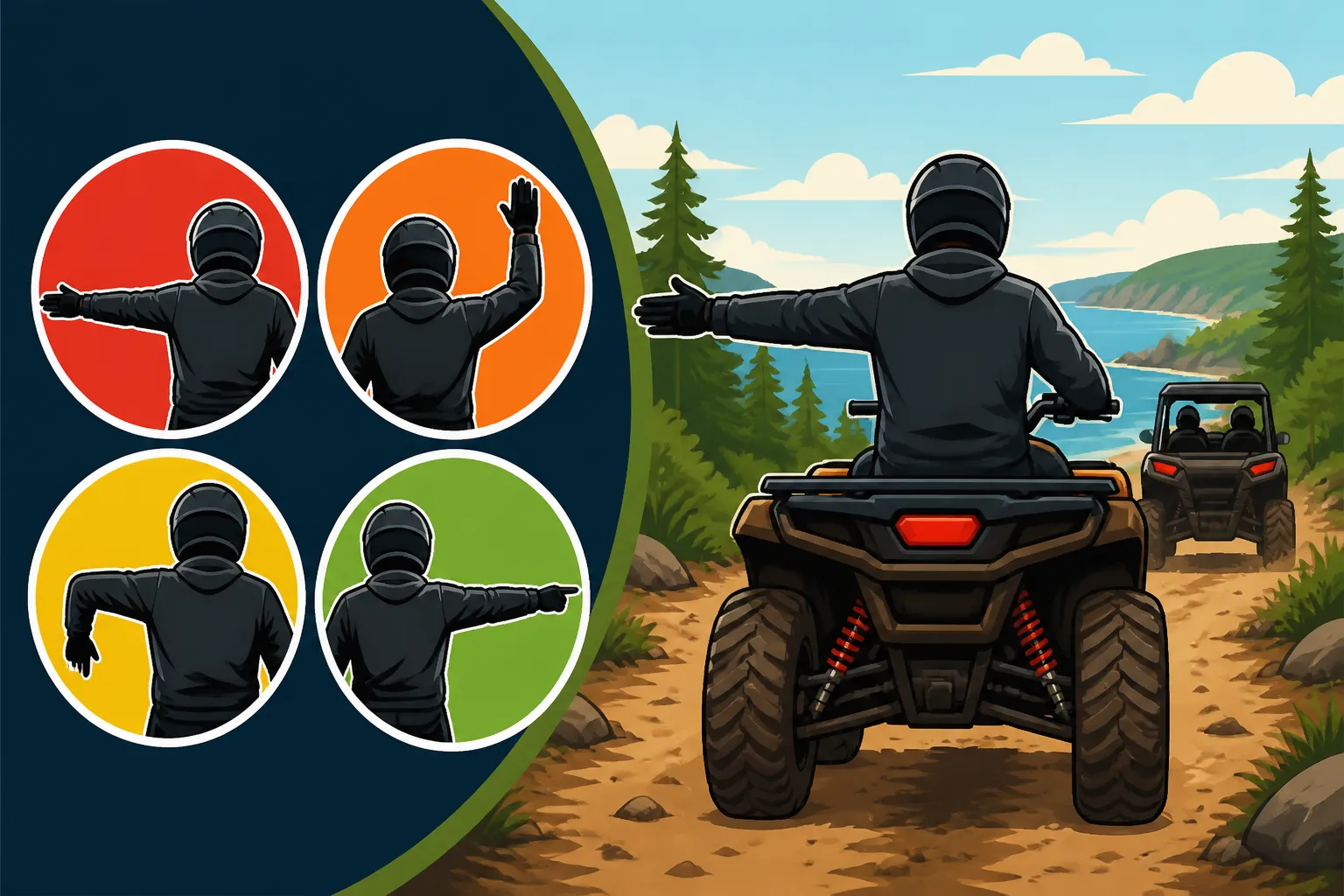
For a left turn, extend your left arm straight out horizontally from your shoulder, palm open and facing forward. Keep your arm rigid and visible. This signal is clear and unmistakable, indicating that you intend to move left. Ensure you hold it long enough for those behind you to register your intention before you begin to lean or steer into the turn.
For a right turn, there are two commonly accepted methods. The most universal is to extend your left arm out horizontally, then bend it upwards at the elbow at a 90-degree angle, with your hand open and palm facing forward. Alternatively, you can extend your right arm straight out to the right, palm open and facing forward. While the left-arm signal is widely recognized as a standard, using your right arm can sometimes be more intuitive for other ATV riders, especially if you're the last in a small group and they can clearly see your right side. Consistency within your riding group is key.
When you need to stop or slow down, extend your left arm downward, palm open and facing backward. This signal tells everyone behind you that you're reducing speed or coming to a complete halt. It's often accompanied by a gentle application of the brakes to activate any existing brake light, if your machine has one, to provide a double cue. This is critical in dusty conditions where visibility can be poor, and a quick stop could lead to trouble.
Signaling Hazards and Group Awareness
Beyond turns and stops, hand signals are invaluable for communicating hazards on the trail, ensuring the safety of your entire group. Being able to quickly point out a fallen log, a deep rut, or an unexpected patch of mud can prevent accidents and keep the ride flowing smoothly. These additional signals enhance group awareness and prevent unnecessary surprises.
To indicate a hazard on the trail, simply point with your arm and index finger towards the specific danger. If it's on your left, point left. If it's on your right, point right. For hazards directly in your path, you might point straight ahead, or tap the top of your helmet to indicate "pay attention." This is a quick, effective way to draw immediate attention to potential trouble spots that might not be visible to riders further back in the group.
"Go Faster" or "Come On": If you need the group to pick up the pace, extend your left arm forward and then sweep it back over your head, in a "come on" motion. This is useful for maintaining momentum on certain sections or when trying to regroup after a slow patch. Conversely, to indicate "Slow Down", extend your left arm out to the side with your palm down, and slowly wave it up and down.
For communicating about the group itself, such as needing to pull over for a break, you can extend your left arm, point to yourself, then point towards the side of the trail. This visually communicates "I need to stop." Also, sometimes you need to indicate that the last rider has passed a certain point or that everyone is accounted for. The last rider in a group often gives a thumbs-up to indicate that everyone is through a difficult section or has made a turn. This constant communication keeps the group cohesive and safe.
Here's a quick reference table for common hand signals:
| Signal Action | Arm Position (Typically Left Arm) | Description |
|---|---|---|
| Left Turn | Extend arm straight out horizontally, palm forward | Indicates an intention to turn left. Hold firmly. |
| Right Turn | Extend arm straight out, bend elbow upwards 90°, palm forward OR extend right arm straight out, palm forward | Indicates an intention to turn right. |
| Stop / Slow Down | Extend arm downward, palm backward | Signals that you are slowing down or coming to a complete stop. |
| Hazard Ahead | Point directly with index finger towards the hazard | Draws attention to obstacles like rocks, holes, or fallen trees. |
| Follow Me | Extend arm straight up, palm forward, waving backward | Used by the lead rider to indicate they are moving off or resuming speed. |
| Single File | Raise left arm with index finger pointing up | Signals to transition into a single-file formation, often for narrow trails. |
| Increase Speed | Extend arm forward, sweep back over head | Encourages the group to pick up the pace. |
| Decrease Speed | Extend arm out to side, palm down, wave up and down | Signals to slow down gradually. |
| All Clear / Okay | Thumb up | Confirms safety or understanding. Often used by the last rider. |
Integrating Hand Signals with Safe Riding Practices
Knowing the specific hand signals is a huge step, but the real art lies in integrating them smoothly into your overall safe riding practices. It's not just about what you signal, but when and how you do it, and how it fits into the broader picture of group dynamics and trail etiquette. Communication is a two-way street, and everyone in the group plays a part in making it effective.
When and How to Use Signals Effectively
Knowing the signals is one thing; using them effectively is another. The timing and visibility of your signals are paramount. Always signal well in advance of your intended maneuver. This gives riders behind you ample time to see, understand, and react safely. On a dusty trail, for example, your signal might be obscured for a moment, so holding it for a few extra seconds is crucial. A delayed or rushed signal is almost as bad as no signal at all, as it doesn't give anyone time to process the information.
When riding in a group, it's a good practice for every rider to "relay" the signals. If the lead rider signals a left turn, the next rider in line should repeat that signal, and so on down the line. This ensures that even the last rider in a large group receives the message clearly, minimizing confusion and maintaining cohesion. This relay system is particularly important on winding trails or through dense brush where direct line of sight to the lead rider might be intermittent. This shared responsibility makes the whole group safer and more synchronized.
Consider your visibility. If you're wearing bulky winter gear or have a large backpack, your signals might be harder to see. Try to make your arm movements exaggerated and clear. Also, think about the sun's position relative to those behind you – a hand signal directly into bright sunlight might be harder to discern. Always strive for maximum visibility. This is especially true when navigating roads where [New Brunswick ATV Road Rules Explained] apply, as you're sharing space with much larger, faster vehicles. Your small gesture needs to be unmistakable.
Other Communication Methods for Group Rides
While hand signals are excellent, they aren't the only way to communicate, especially in larger groups or on longer rides. Technology has made significant strides in off-road communication, offering supplementary methods that can greatly enhance safety and enjoyment. Relying on multiple forms of communication means that even if one method fails, another can pick up the slack.
Two-Way Radios/Intercom Systems: Many riders use dedicated two-way radio systems or helmet-mounted Bluetooth intercoms, especially when riding side-by-sides. Brands like Cardo or Sena offer systems that allow clear voice communication between riders, solving the problem of distance and noise. These are fantastic for giving real-time updates about trail conditions, navigation changes, or simply chatting without shouting over engine noise. They can be a significant investment but are invaluable for frequent group riders who want seamless, constant contact.
Pre-Ride Briefings: Before setting out, always have a quick group briefing. Discuss the day's route, expected conditions, and any specific communication protocols or hand signals your group might use. Establish a lead and sweep rider, and agree on how to handle stops, turns, and hazards. This upfront communication eliminates many potential misunderstandings and sets a safe tone for the ride. It's also a great opportunity to remind everyone about [Carrying Four Documents at Once] and other essentials, ensuring everyone is on the same page before the wheels start turning.
Visual Cues from the Machine: Even without dedicated turn signals, your machine still offers cues. A sudden lean, a shift in body weight, or even the sound of your engine changing RPMs can give hints to an experienced rider behind you. While not as explicit as hand signals, these subtle cues, combined with proper spacing, contribute to the overall communication picture. Additionally, ensuring your brake light, if present, is always working optimally is a passive but critical form of communication for slowing down, especially when your hands are busy on the handlebars.
Beyond Hand Signals: Enhancing Your Quad's Visibility and Safety
While hand signals are a fundamental skill, they don't have to be your only solution forever. For many riders, the lack of electronic indicators eventually leads to looking for ways to enhance their machine's visibility. After all, anything that makes you more noticeable to others on the trail or road is a good thing.
Aftermarket Solutions for Adding Indicators
If you find yourself frequently riding in situations where hand signals alone feel insufficient—perhaps due to heavy traffic on shared roads or very large group rides—consider adding aftermarket turn signals and brake lights to your ATV or UTV. The market offers a wide range of kits designed for easy installation, transforming your machine's signaling capabilities.
These kits typically include LED turn signals, a wiring harness, a flasher relay, and a switch. Many are universal or designed for specific machine types, making them relatively straightforward to install for the mechanically inclined. Some kits even integrate with existing brake lights or offer completely new, brighter LED replacements for enhanced rear visibility. When looking for durable options that can withstand aggressive trail use, companies like SuperATV offer a variety of lighting solutions, from simple LED whips to full signal kits designed for rugged off-road environments. They understand the demands of serious off-roading.
Adding electronic indicators provides an undeniable boost in safety and convenience. It frees up your hands for steering and throttle control, especially in challenging terrain, and ensures consistent, clear signaling regardless of your arm position or visibility limitations. For those who frequently transition from trail to road, or even just cross paved sections, this upgrade can dramatically improve your confidence and safety, helping you adhere to local regulations.
The Importance of Rider Training and Awareness
No matter how many signals you know or how many lights you add to your machine, the single most important factor in ATV safety is the rider. Participating in a recognized ATV safety course, like those available through [New Brunswick Quad Safety Course Explained], provides invaluable training on safe riding techniques, hazard perception, and effective communication. These courses equip you with skills that no aftermarket accessory can replace.
These courses don't just teach you how to operate your machine; they teach you how to anticipate situations, react appropriately, and become a more responsible rider. They often cover group riding etiquette and communication strategies in detail, reinforcing the importance of clear signals, whether electronic or manual. Such training is particularly beneficial for new riders or those looking to refresh their skills, ensuring they understand the nuances of off-road vehicle operation and how to ride safely in a variety of conditions.
Awareness extends to understanding the specific regulations in New Brunswick. Knowing [What New Brunswick's Off-Road Vehicle Act Covers] and local bylaws is just as important as knowing your hand signals. For instance, some roads might have specific speed limits or require additional permits, and being prepared for these transitions means not only knowing how to signal but also being aware of when and where those signals are most critical. Continual learning and a commitment to safe practices are the hallmarks of a truly responsible ATV rider. For specific parts or accessories, exploring reputable retailers like SuperATV can also contribute to making your machine safer and more capable for various riding conditions across New Brunswick.
Disclaimer
This article is for general informational purposes only and does not constitute professional advice. Laws, prices and regulations vary by location and change over time. Consult a qualified professional for guidance on your specific situation.