New Brunswick Moose on the Trail
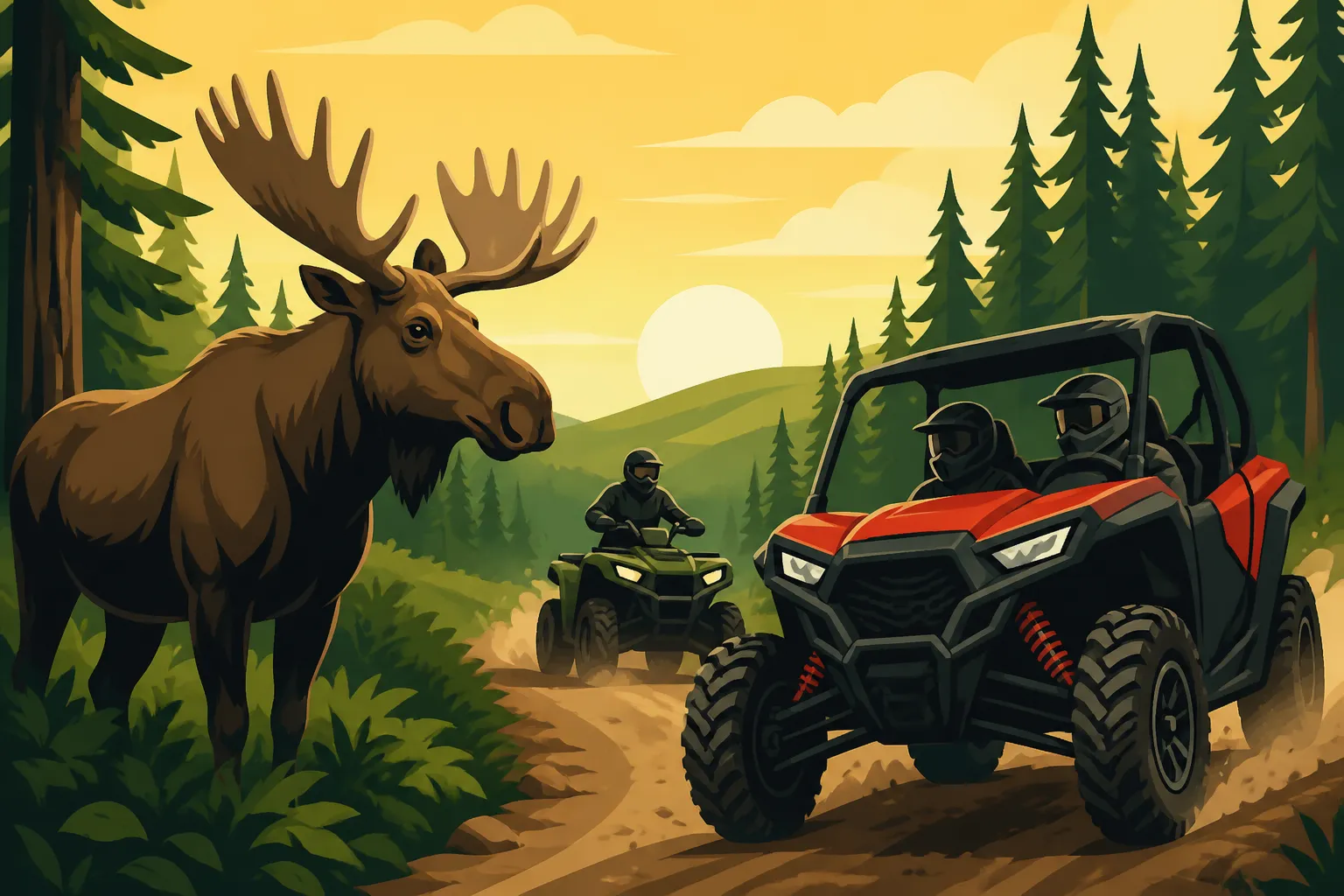
A moose can appear on a New Brunswick trail with little warning, especially where a marked route passes through thick woods, wetlands, or a quiet logging road. For ATV and UTV riders, the safest response is to slow down, give the animal room, and avoid trying to pass or drive it away. This guide explains how to prepare, what to do during an encounter, and when to turn back.
Why Moose Encounters Need Extra Care
Where and when you may encounter a moose
Moose live across New Brunswick, and their habitat can overlap with ATV routes, woods roads, and remote trail corridors. An animal may be standing near the trail, feeding in a wet area, crossing ahead, or hidden by trees until you are close. Seeing one is not necessarily a sign that the route is unsafe, but it is a reminder to ride at a speed that leaves you time to react.
Be especially alert in areas with dense brush, marshy ground, young forest, and limited sightlines. A bend, crest, or narrow opening can hide an animal until the last moment. Dawn and dusk can make it harder to spot wildlife, and shadows or changing light can reduce visibility even when your machine’s lights are on. Adjust your pace to the conditions rather than relying on the trail’s straight sections to stay clear.
A route that was quiet earlier in the day can also change. Moose may move across a corridor while riders are stopped or travelling nearby. Before heading out, review [New Brunswick Trail Conditions Before You Go] and pay attention to closures, reroutes, and local trail notices. Conditions and visibility can vary from one part of the province to another, so don’t assume a familiar trail will offer the same view every time.
Why approaching or crowding a moose is risky
A moose is a large, powerful wild animal. It may react unpredictably if it feels trapped, startled, or threatened, particularly if it has no clear path away from people. A rider who moves closer to take a photo, drives toward the animal to make it leave, or follows it along the trail can increase the risk for everyone nearby.
The danger is not limited to the animal making contact with a machine. A sudden turn, charge, or movement into brush can startle riders, lead to a collision, or cause someone to lose control on uneven ground. In a group, one person’s attempt to get a closer look can also put the riders behind them in an awkward position, especially if the trail is narrow and there is little room to turn around.
Give the moose space and keep a clear escape route open. Don’t honk repeatedly, rev the engine, throw objects, or circle the animal. These actions can agitate it rather than safely move it. The practical goal is not to control the wildlife encounter; it is to avoid making it worse and get people and machines away safely.
What to Do When You See a Moose
Stop at a safe distance and assess the situation
If you see a moose ahead, slow down smoothly and stop well back from it. Leave the engine off if you can do so safely, and keep your group together. Don’t ride closer to judge the animal’s mood or get a better view. From a distance, look for a clear route back the way you came or another safe option that does not bring you closer.
Give the animal time to move on its own. It may walk away, cross the trail, or remain in place for a while. Avoid blocking its path by spreading machines across the corridor. If the moose is between you and the way forward, waiting or turning back is usually safer than trying to squeeze past it.
Keep people and pets close to the machines and under control. Don’t let anyone approach on foot, and don’t split up to get around the animal from different sides. If the trail is too narrow to turn around without moving toward the moose, stay put at a safe distance until there is a clear opportunity to retreat. A cautious pause is better than forcing a pass.
Leave calmly if the moose stays or approaches
If the moose does not move away, or begins coming toward your group, increase distance without making a sudden approach or surrounding it. Back away slowly when you have a clear route, keeping the group together and watching the animal without riding toward it. If a safe retreat is not possible, use available cover such as a substantial tree or other solid barrier, while avoiding any move that puts you closer to the animal.
Do not count on a machine to protect you. An ATV or UTV is not a wildlife barrier, and trying to use it to push through can lead to a collision or leave a rider trapped. If a moose is showing signs of agitation, such as holding its ears back, raising its hair, or making a short advance, treat the encounter seriously and focus on getting away rather than observing it.
Once you have space, leave the area and do not return immediately to see whether the moose is still there. If the animal appears injured, is in a dangerous location, or creates an immediate threat to people, contact emergency services when appropriate. For a non-emergency wildlife concern, use the relevant provincial reporting channel. Keep your report factual: describe the location, the animal’s condition, and any immediate hazard.
Prepare Before Riding in Moose Country
Plan a route and set a group pace
Before you leave, check the trail map, confirm that the route is open, and discuss what your group will do if wildlife blocks the trail. A simple plan prevents confusion: agree that the lead rider will stop, the group will stay together, and nobody will approach an animal or pass without a clear route. On a long ride, make sure everyone knows how to signal a stop to the riders behind them.
Use a map as a planning aid, not as proof that a corridor is open or that you have permission to ride there. The official trail information and posted signs should guide your decisions. Digital tools such as onX Offroad can help riders review routes and understand their position, but check that the route matches current local trail information before setting out. [New Brunswick Trail Maps and the MapGear App] offers additional context for finding and using trail maps.
Set a conservative speed where vegetation, bends, or terrain limit what you can see. Keep enough distance between machines to avoid a rear-end collision if the lead rider brakes for wildlife. On a group ride, agree on a spacing system that leaves room to stop without allowing riders to become so spread out that they lose contact. [New Brunswick Trail Etiquette Locals Expect] is useful background for sharing corridors responsibly.
| Situation | Safer response |
|---|---|
| Moose is visible ahead | Slow down, stop well back, and keep the group together |
| Moose is crossing the trail | Wait at a distance until it has moved away and the route is clear |
| Moose stays in place | Don’t approach or attempt to squeeze past; wait or retreat |
| Moose moves toward the group | Back away if there is a clear route, and use solid cover if needed |
| Trail is blocked with no safe way through | Turn back when possible or wait for a safe opportunity to leave |
| Rider is separated from the group | Stop at a safe distance and reconnect without approaching the animal |
Pack for remote conditions and limited reception
A wildlife encounter can turn a quick ride into a longer one, particularly if the group needs to wait, turn around, or take another route. Carry water, weather-appropriate clothing, basic first aid supplies, and a charged phone. For longer or more remote trips, consider a communication device that works beyond ordinary cell coverage. Don’t assume you will be able to make a call from every section of trail; [New Brunswick Cell Coverage on Remote Trails] can help you think through reception gaps before you go.
Download or save route information in advance rather than relying on a live signal. onX Offroad may be useful for reviewing or saving mapping information, but a digital map should complement—not replace—good preparation, local trail notices, and posted signs. Tell someone who is not on the ride where you plan to go and when you expect to be back. If your route changes, update that person when you have a reliable opportunity.
Bring enough fuel and supplies to manage an unexpected delay, and make sure everyone knows how to stop and regroup safely. These preparations matter on any remote ride, not just in places where you expect to see a moose. For a broader checklist, see [Packing for a Full Day in the Woods]. If a storm, washout, or other hazard also affects the route, follow local closures and avoid creating a new path around an obstruction. [New Brunswick Trail Closures After Rain] explains why staying on the marked corridor matters.
Keep the Encounter Safe for Riders and Wildlife
Avoid chasing, feeding, or sharing images that encourage risky behaviour
Never chase a moose with an ATV or UTV, even if it appears to be moving away. Pursuit can cause the animal to run into a less safe area, and it exposes riders to sudden changes in direction. Don’t feed it or leave food behind. Feeding wildlife can encourage animals to approach people and machines, making future encounters more dangerous.
If you take a photo from a safe distance, do not move closer to improve the shot. Keep the camera pointed from where you are, and put it away if the animal’s behaviour changes or your group needs to retreat. A photograph is never worth stepping into the moose’s space or blocking its route.
It’s also helpful to avoid turning a wildlife sighting into a reason for other riders to stop close by. If you share information about a sighting, focus on the general trail hazard and any closure or official notice rather than directing people toward the animal. The safest response is to leave the area undisturbed.
Respect signs, closures, and other trail users
A marked trail is shared space. Other riders, hikers, local residents, and wildlife may be nearby, and a sudden stop can affect everyone following behind. Signal clearly, stop where approaching riders can see you when possible, and leave enough room for others to react. [New Brunswick Trail Signage Explained] can help you understand how signs guide travel along a corridor.
Do not ride around a closure or create a bypass through brush to get past a moose or another obstruction. A detour can damage the trail, put you on land where riding is not permitted, or bring you closer to the animal. If a safe route forward is unclear, turn around or wait rather than improvising a way through. Keep gates as you found them and remain on the established route.
When you encounter logging activity, other vehicles, or a group coming from the opposite direction, slow down and communicate carefully. Wildlife may be harder to see when engines, dust, or brush limit visibility. For practical advice on sharing a work route, see [Meeting a Logging Operation on Trail]. Patience and distance help protect riders, wildlife, and the trail itself.
Disclaimer
This article is for general informational purposes only and does not constitute professional advice. Laws, prices and regulations vary by location and change over time. Consult a qualified professional for guidance on your specific situation.