Riding Out of Hartland
Starting an ATV ride from Hartland can feel straightforward until you need to work out which roads are legal to use, where the managed trail begins, and whether conditions have changed. This guide explains how to plan a ride from the Hartland area, prepare your machine and group, and avoid treating a nearby woods road as an open trail.
Planning an ATV ride from Hartland
Hartland sits in the Saint John River valley in western New Brunswick, within reach of rural roads, woods routes, and managed ATV trails. That variety is part of the appeal, but it also makes a little advance planning important: a road that looks rideable on a map is not automatically open to ATVs, and a route can pass through areas with different access rules.
Think of Hartland as a place to plan and begin a ride, rather than assuming there is one simple route that starts at the town centre and leads onto every nearby trail. Confirm your starting point, legal connections, parking arrangements, and current trail conditions before unloading your machine.
Find the managed trail before choosing a route
Start with a current trail map from the organization responsible for the route you plan to ride. Check that the line shown is an ATV route, identify the nearest suitable trail access point, and look for any closures or reroutes. Regional maps and apps can help with orientation, but they should not replace current local trail information.
A mapping app such as onX Offroad may help you organize waypoints or view your planned route, especially when you are comparing roads and trail corridors. Treat any app as a planning aid, not proof that a route is open or that you have permission to ride it. Before leaving Hartland, compare your route with official trail information and any instructions from the local club.
It is also worth checking the map at a useful scale. A broad regional view may make two corridors look connected when a closer look reveals a public-road gap, a closed section, or a private access road. If you cannot confirm that a connection is legal, plan another route rather than improvising once you reach it. For a broader overview of the province’s trail network and how maps fit into trip planning, see [New Brunswick ATV Trails: The QuadNB Network] and [New Brunswick Trail Maps and the MapGear App].
Check access, parking, and local permissions
Before you choose a place to unload, confirm that parking is allowed and that your vehicle and trailer will not block a driveway, farm entrance, business, or maintenance access. A convenient roadside pull-off is not necessarily a public trailhead. If you plan to park on private property, ask the owner or business for permission and follow any posted instructions.
Do not assume that a woods road is available for recreational riding just because it appears on a map or has tire tracks. It may be private, used for forestry work, or closed to recreational traffic. Access to Crown land and private woodlots also has its own considerations; the existence of nearby public land does not mean every route across it is open to ATVs.
If your route uses a road section to connect with a trail, verify that ATVs may use that specific road. New Brunswick road access can depend on applicable designations and local bylaws, so do not rely on another rider’s old directions or a road’s appearance. The guide [New Brunswick ATV Road Rules Explained] is a useful starting point, and [New Brunswick Local Bylaws and Where to Find Them] can help you understand why checking the local rules matters.
Get your machine and paperwork ready
A smooth trail day begins before you reach Hartland. Make sure your machine is properly registered and insured for the type of riding you plan to do, and check that the trail permit and any required documents are in order. It is frustrating to arrive with a loaded trailer only to discover that a missing document or expired sticker keeps you from riding.
The basic requirements depend on your machine and circumstances. A quad, side-by-side, dirt bike, visiting machine, or privately used machine may not all follow the same details. Confirm the rules that apply to your vehicle instead of assuming one friend’s paperwork checklist covers every rider.
Confirm registration, insurance, and trail requirements
Check that the registration information matches the machine and that the plate and registration sticker are in the required condition and location. If you have recently bought the ATV, transferred ownership, or moved to New Brunswick, make sure the paperwork has been sorted out before the ride. For an overview of the province’s registration process, see [New Brunswick ORV Registration Explained].
Trail access and machine registration are separate issues. A registered machine does not automatically have permission to use every trail, and a trail permit does not replace required registration or insurance. Review [New Brunswick Requires Insurance on Trails] and [New Brunswick's Groomed Trail Permit] to understand these separate parts of preparation. Check the current requirements with the relevant organization or service before setting out.
Keep required documents together in a place where they will stay dry and be easy to reach. A small waterproof pouch can be more practical than loose papers stuffed into a jacket pocket. If you are riding in a group, each rider should know what they are expected to carry; the lead rider should not be the only person who understands the group’s paperwork.
Do a practical pre-ride inspection
A quick walk-around can catch problems before they become a long push back to the truck. Check tire condition and pressure, brakes, throttle return, lights, steering, and visible leaks. Look for loose cargo, damaged straps, or anything that might shift when you hit a rough stretch. If the machine has been sitting for months, give it more attention than you would after a routine ride.
Pack for the day you are actually planning, not just the short distance you expect to travel. New Brunswick weather can change, and a route that feels easy near town can become tiring if you are cold, wet, or delayed. Bring water, suitable layers, basic tools, a first-aid kit, and a charged phone. On a longer ride, let someone outside the group know your general plan and expected return.
| Before you leave Hartland | What to confirm | Why it matters |
|---|---|---|
| Route | The trail is open and intended for ATV use | A mapped line may be closed or unsuitable |
| Access | Road links and private-property permissions are clear | Not every woods road is open to recreational riding |
| Machine | Registration, insurance, permit, and sticker requirements are met | Registration and trail access are separate |
| Parking | Your truck and trailer can be left legally and safely | An informal pull-off may not be a designated parking area |
| Group | Riders know the route, meeting points, and basic plan | A group is easier to manage when everyone knows what to expect |
| Equipment | Machine inspection, water, layers, tools, and first aid are covered | Small problems are easier to handle when you are prepared |
Make the ride work for your group
A good ride out of Hartland is not necessarily the longest one. For a first trip, a route with a clear destination, a straightforward return plan, and manageable distance is often a better choice than trying to cover as much ground as possible. Build in time to stop, check the map, and turn around if conditions or energy levels change.
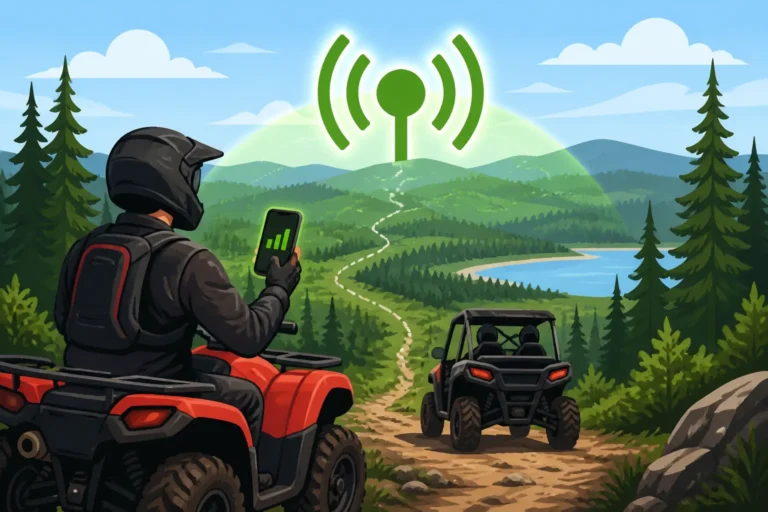
Before you leave, agree on a pace that suits the least experienced rider in the group. A wide gap between machines can turn a minor stop into a stressful search, especially where routes branch or phone service is unreliable. Set a simple regrouping rule: if someone loses sight of the machine ahead, slow down or stop somewhere safe rather than pushing on alone.
Match the route to experience and conditions
If someone in the group is new to trail riding, talk about the basics before the engines start: how to signal a stop, where to wait at a junction, how to handle a steep or rough section, and what to do if a machine has a problem. A rider who feels pressured to keep up may take unnecessary risks. Keeping the pace comfortable usually makes the day better for everyone.
Conditions can change how a route feels. A section that is manageable when dry may be slippery after rain, while spring thaw can make soft ground particularly vulnerable to damage. If a trail is closed, marked off, or visibly deteriorating, do not ride around the barrier or create a new bypass. Turn back or follow a signed reroute. For more on checking conditions before departure, see [New Brunswick Trail Conditions Before You Go] and [New Brunswick Trail Closures After Rain].
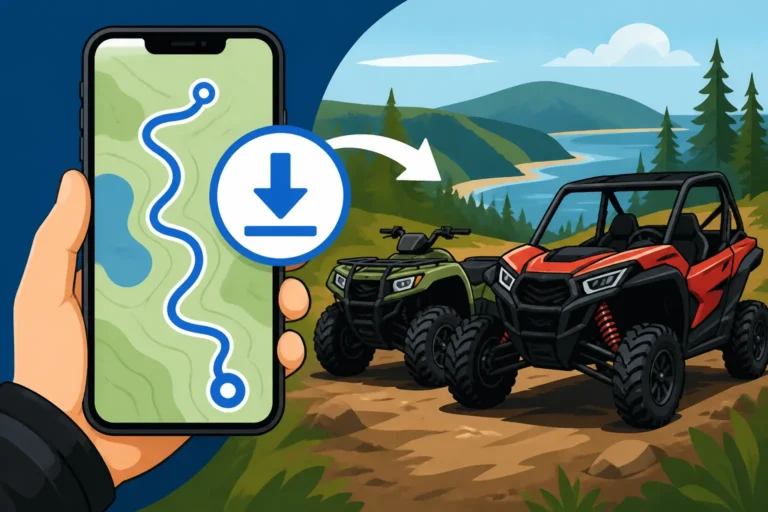
A route-planning app such as onX Offroad can help you note a meeting point or save a reference track before you lose reception. Do not count on a phone having service throughout a ride, though. Download or save the information you need in advance, and bring a paper map or another backup if the trip is remote. Use the app to support your decisions, not to override trail signs or local closure notices.
Ride considerately around Hartland
Managed trails are shared spaces. You may encounter other ATV riders, snowmobile users, walkers, maintenance crews, or work vehicles, depending on the route and season. Slow down when visibility is limited, leave room to pass safely, and follow signs and directions from trail workers. If you meet logging or other work traffic, give it space and follow any instructions or temporary controls.
Noise and dust matter, particularly near homes and rural properties. Ease off the throttle when passing residences, avoid unnecessary revving at a stop, and do not leave litter behind. If you stop for a break, choose a safe place that does not block the trail or access for other users. Treat gates and barriers as instructions, not obstacles to work around.
Be especially careful at road crossings and any section where a trail meets a public road. Stop where required, look for traffic, and follow the applicable rules; never assume drivers will see you in time. For a practical overview of what to expect during a trail stop, see [What an Officer Can Ask to See on a Trail]. A respectful ride helps protect access for the next person planning to ride from Hartland.
A simple Hartland ride-planning routine
A few checks the day before and the morning of your ride can prevent a lot of avoidable trouble. Trail access can change, paperwork can be overlooked, and a route that looked simple on a large screen may be less clear on the ground. Use a repeatable routine so that planning does not depend on remembering everything at the last minute.
The day before
- Choose a route using current trail information and confirm that the planned corridor is open to ATVs.
- Identify a lawful starting point and confirm parking or unloading arrangements.
- Check whether any road sections, private-property access, or local rules affect the route.
- Confirm that each machine and rider has the required registration, insurance, permit, and documents.
- Check the weather and trail notices, then adjust the route if conditions are poor.
- Tell someone your general plan and when you expect to return.
Before unloading
Walk around each machine and check tires, controls, brakes, lights, and cargo. Make sure everyone has water, suitable clothing, and the basic supplies for the planned ride. Review the route together, point out the expected turnaround or regrouping spots, and make sure nobody is relying on continuous cell service.
If a trail entrance is blocked, a sign conflicts with your plan, or you cannot confirm that a road is open, stop and reassess. Do not treat a downloaded track or a friend’s memory as permission to continue. A shorter ride on a confirmed route is a better outcome than an uncertain detour.
After the ride
Return gates and barriers as you found them, dispose of your rubbish properly, and report significant trail damage or hazards through the appropriate local channel. If the route was harder than expected, note the conditions while they are fresh in your mind. That information can help you choose a better route next time and share useful, responsible advice with other riders.
For many people, Hartland makes a convenient base for exploring the western New Brunswick riding area. The most reliable plan is still a modest one: verify the route, confirm legal access, carry the required paperwork, and be willing to change course when conditions call for it. A little preparation makes it easier to enjoy the ride instead of spending the day sorting out avoidable problems.
Disclaimer
This article is for general informational purposes only and does not constitute professional advice. Laws, prices and regulations vary by location and change over time. Consult a qualified professional for guidance on your specific situation.