New Brunswick Hand Signal Requirements
There's nothing quite like the freedom of exploring New Brunswick's vast trail network, whether you're on a quad or a side-by-side. But let's be honest, communicating with other riders, especially when your machine doesn't have fancy factory turn signals, can be a real headache. This guide is here to clear up the confusion, walking you through the essential hand signals you need to know and use to stay safe and courteous on the trails and roads of our beautiful province.
Why Hand Signals Matter on New Brunswick Trails
You might think that with all the bells and whistles on modern ATVs and UTVs, hand signals are a thing of the past. But that couldn't be further from the truth, especially here in New Brunswick. Our trails are a dynamic environment, filled with other riders, pedestrians, cyclists, and sometimes even logging trucks. Clear communication isn't just a nicety; it's a critical safety measure that can prevent accidents and ensure everyone has a good time.
Bridging the Communication Gap
Imagine you're leading a group ride through a dusty section of trail, the engines are humming, and the wind is whipping past. Even if you shout, your voice is likely to be lost in the noise. This is where hand signals become your best friend. They offer a silent, universal language that cuts through engine noise, helmet interference, and even the distance between machines. They allow you to warn riders behind you about upcoming hazards, indicate a change in direction, or signal a stop, all without needing to break pace or risk a misunderstanding. It's about proactive safety, letting others know your intentions before you make a move, which is especially crucial when navigating blind corners or crossing public access points.
Another common scenario where hand signals shine is when your machine's electrical system might not be up to snuff, or perhaps you're on an older model ATV that simply wasn't equipped with turn indicators from the factory. Rather than leaving other riders guessing, a clear hand signal ensures your intentions are understood. This level of clarity helps maintain a smooth, predictable flow on the trail, which is key to preventing sudden braking or swerving that could lead to a mishap.
Legal Requirements and Safety Expectations
While the New Brunswick Off-Road Vehicle Act doesn't always explicitly detail hand signals for every single scenario you might encounter on the trail, it does adopt the principles of safe operation common to all vehicles. When you're interacting with public roads, or even just riding on designated trails that mirror road-like conditions, the expectation is that you'll communicate your intentions clearly, just as you would in a car. This includes turns, stops, and slowing down. Many riders often refer to a [New Brunswick Safety Course Explained] to learn these crucial signals, among other critical riding skills.
It's about fulfilling your responsibility as a rider to contribute to the overall safety of the trail system. Think about it: if you're approaching an intersection where [New Brunswick Rules for Crossing a Road] apply, a clear hand signal for a turn might be the only way a motorist on the road or another trail user knows what you're about to do. Relying solely on brake lights, which can be obscured by dust or mud, or simply not present on some dirt bikes, isn't enough. By using hand signals, you're not just being courteous; you're actively reducing risk and adhering to the spirit of safe vehicle operation. Always remember that part of responsible riding involves being prepared, and that includes knowing and using proper communication methods, alongside carrying [New Brunswick Equipment a Rider Must Carry].
The Official New Brunswick Hand Signals You Need to Know
When it comes to official hand signals, New Brunswick generally follows the standard motor vehicle signals that are recognized across North America. These aren't just polite suggestions; they are the universally accepted methods for communicating your intentions when operating any vehicle, including your ATV or UTV. Mastering these signals is a fundamental part of responsible riding.
Stop or Slow Down
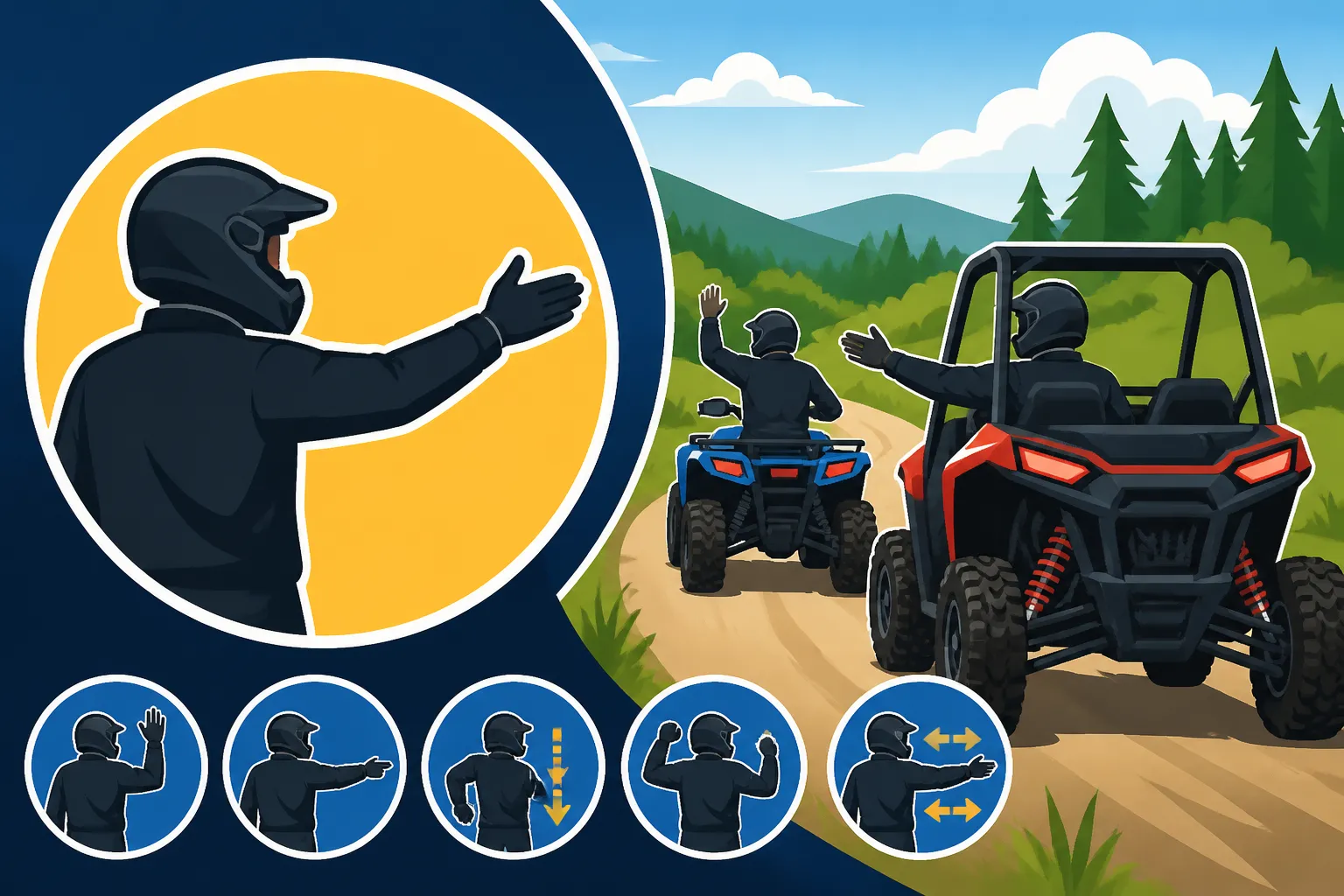
This is perhaps one of the most critical signals to master, as it directly impacts safety in a variety of situations. To signal a stop or to slow down, extend your left arm straight out and downward, with your palm facing backwards. Then, move your hand up and down in a continuous, deliberate motion.
Picture this: You're riding along a winding trail with a few buddies behind you, and suddenly, a deer darts across the path ahead. Your immediate reaction is to slow down or even come to a complete stop. If you just hit your brakes, the rider behind you might not have enough time to react, especially if dust is obscuring your brake lights or they're focused on the terrain. By executing the "stop or slow down" hand signal clearly and early, you give everyone behind you ample warning, allowing them to adjust their speed safely and avoid a pile-up. It's a simple movement, but it buys precious seconds for everyone to react responsibly. This is particularly important when navigating tight spots or unexpected obstacles, making it a cornerstone of [New Brunswick Group Ride Planning].
Left Turn
Indicating a left turn is straightforward and universally understood. To signal a left turn, extend your left arm straight out horizontally from your side, parallel to the ground, with your palm facing forward. Keep your arm and hand in this position until you've completed your turn.
Consider a scenario where your group needs to turn off a main trail onto a smaller side trail or a woods road. Without proper signals, riders might miss the turn, get separated, or even attempt to turn too late, creating a hazardous situation. By extending your arm clearly for a left turn, you provide an unmistakable visual cue. This is especially vital for machines that don't come with built-in turn signals. Even if your machine does have turn signals, using the hand signal provides an additional layer of visibility, particularly if the sun is glaring or there's thick foliage partially obscuring your lights. It's a proactive measure that ensures everyone in your group, and any other trail users, understands your intended path, contributing to safer navigation of the expansive New Brunswick trail system. This signal is essential when your [New Brunswick Hand Signals When Your Quad Has No Indicators].
Right Turn
Signaling a right turn is slightly different but just as important. To indicate a right turn, extend your left arm straight out, bending your elbow at a 90-degree angle so your forearm points upwards, and your palm faces forward. Hold this position until your turn is completed.
Imagine you're on a multi-use trail, perhaps approaching a point where a designated ATV trail branches off to the right from a snowmobile corridor. If your machine doesn't have electrical turn signals, or if the visibility is poor due to weather conditions or dense tree cover, merely slowing down won't convey your intention to turn right. Using the distinct right-turn hand signal ensures that the riders behind you know exactly what you're doing, preventing confusion and potential collisions. This is particularly useful when you're crossing or riding on [New Brunswick Shared Highway Sections] where you need to communicate clearly with road traffic. For any riders out there who might be thinking about aftermarket turn signal kits, many companies, like SuperATV, offer options that can be installed to add electrical signals to your machine, complementing your hand signal usage and boosting your overall visibility. However, hand signals remain universally understood and essential, especially as a backup.
When and Where Hand Signals Are Crucial
Knowing the official hand signals is one thing, but understanding when and where to apply them effectively is equally important. In New Brunswick, with its diverse riding environments ranging from dense forest trails to shared road sections, mastering the art of timely and visible signaling can make all the difference for a safe and enjoyable ride.
Riding in a Group
When you're out exploring with a group of friends, communication is the backbone of a successful outing. Hand signals are indispensable for maintaining cohesion and ensuring everyone stays safe and on track. The lead rider, often the most experienced and familiar with the route, acts as the eyes and ears for the entire group. It's their responsibility to signal upcoming turns, changes in speed, or potential hazards well in advance.
Think of a scenario where the lead rider suddenly encounters a large puddle or an unexpected fallen tree that requires a quick maneuver or even a complete stop. A clear "stop" or "slow down" signal, given early, allows every rider behind them enough time to react, preventing a chain reaction of sudden braking or swerving. Similarly, when navigating a complex series of turns, consistent left or right turn signals from the leader ensure that the group stays together and no one takes a wrong turn. This kind of disciplined communication makes for a much more relaxed and enjoyable group ride, preventing frustrating stops and backtracking, and is a key element of effective [New Brunswick Group Ride Planning].
Approaching Roads and Intersections
This is arguably one of the most critical times to use hand signals. New Brunswick's off-road vehicle network often intersects with, or runs parallel to, public roads and highways. When your journey takes you across a road, or onto a designated [New Brunswick Shared Highway Sections], you transition from a relatively insulated off-road environment to one with faster-moving vehicular traffic.
The rules for crossing a road with an ATV are strict, and clear communication is paramount. Before you even think about entering a roadway, you must come to a complete stop and ensure the way is clear. When you then plan to turn left or right onto the road, or even just cross straight over, your hand signal is your primary way of communicating your intentions to any oncoming or following motorists. A driver in a car might not immediately recognize your ATV's brake lights as a signal for an impending turn if your machine isn't equipped with dedicated turn signals. A strong, clear hand signal eliminates any ambiguity. This adherence to proper signaling is not just about courtesy; it's a legal requirement in many cases and essential for your safety when interacting with traffic on any part of the journey that involves [New Brunswick Highway Usage Permits] or crossing public thoroughfares.
Limited Visibility Conditions
Whether you're riding in the late afternoon as dusk settles in, on a particularly dusty section of trail, or even through light rain or fog, visibility can become severely compromised. In these conditions, electrical signals from your machine might be less effective due to glare, mud splatter, or simply being harder to distinguish against a busy background. This is precisely when well-executed hand signals truly shine.
Your arm and hand, especially if you're wearing bright gloves or reflective gear, can be much more noticeable than a small light. Imagine a situation where you're riding through a section of trail where the setting sun is directly in the eyes of the riders behind you, making it difficult to see your brake lights. A distinct "stop" hand signal becomes a lifesaver. Similarly, when kicking up a lot of dust on a dry day, your tail lights can become completely obscured. A hand signal given high and clear is much more likely to be seen. While some riders enhance their machines with aftermarket lighting and visibility accessories, like bright LED light bars or additional reflective strips from companies like SuperATV, hand signals provide a fundamental, non-electronic method of communication that can be relied upon even when technology might fail or be less effective. Always consider how you can be seen, especially when [New Brunswick Rules for Riding After Dark] come into play.
Machines Without Electrical Signals
This point cannot be stressed enough, especially for dirt bike riders or owners of older ATV models that simply don't have built-in turn indicators or even functional brake lights in some cases. For these machines, hand signals aren't just an option; they are the only way to legally and safely communicate your intentions to other trail users and motorists.
If your dirt bike or vintage quad doesn't have brake lights or turn signals, you are unequivocally required to use hand signals when slowing, stopping, or turning. Neglecting to do so can not only put yourself and others at severe risk but can also lead to fines. Law enforcement officers patrolling New Brunswick's trails are well aware of the safety requirements for all off-road vehicles. They expect riders of [New Brunswick Rules for a Machine Without Signals] to be proficient in hand signaling. Practicing these signals until they become second nature is not just a recommendation; it's a crucial part of being a responsible and law-abiding rider in New Brunswick.
Practicing and Mastering Hand Signals for Safe Riding
Knowing the signals intellectually is one thing, but being able to execute them smoothly and instinctively on the trail is another. Like any skill, mastering hand signals requires practice and a commitment to safe riding habits. It's an investment in your safety and the safety of everyone you share the trails with.
Practice Makes Perfect
Don't wait until you're in a critical situation to try out your hand signals for the first time. Take the time to practice them in a safe, open area, perhaps in your yard or an empty field. Get comfortable extending your arm fully, making your movements clear and deliberate. A great way to do this is with a riding buddy. Have them ride behind you at a safe distance while you practice each signal, asking for their feedback on clarity and visibility.
Try practicing in different scenarios:
- At various speeds: How does it feel to signal a stop when you're moving quickly versus slowly?
- While wearing your full gear: Does your jacket restrict your arm movement? Are your gloves comfortable enough for clear signaling?
- In different lighting conditions: How visible are your signals at dusk versus bright daylight?
The goal is for these movements to become muscle memory, so that when you need to react quickly on the trail, you don't have to think about how to form the signal, but rather just execute it. This readiness is a key takeaway from any good safety course, and it significantly reduces the likelihood of [New Brunswick Accident Reporting Rules] needing to be applied.
Teaching Others in Your Group
One of the most effective ways to ensure safety on group rides is to establish a shared understanding of communication before you even hit the trail. Before every group ride, especially if you have new riders or people unfamiliar with your usual group's protocols, take a few minutes for a quick "safety briefing." Review the basic hand signals, ensuring everyone knows what each signal means and when to use it.
You might even designate a "caboose" rider, typically the most experienced rider at the back, whose job it is to ensure everyone behind them has seen and understood the lead rider's signals, and to relay them further back if the group is particularly long. This ensures that the message gets passed down the line effectively. A unified approach to signaling vastly improves group safety and flow, making the riding experience more enjoyable and predictable for all involved. Many of the techniques discussed in [New Brunswick Tours for Beginners] emphasize this group cohesion.
The Role of Proper Gear and Visibility
While hand signals are effective on their own, the gear you choose can significantly enhance their visibility and your ability to execute them properly. First, ensure your riding jacket and gloves allow for a full, unrestricted range of motion. A jacket that's too tight or gloves that are too bulky can make clear signaling awkward or difficult.
Secondly, consider visibility features in your gear. Brightly coloured jackets, gloves, or even reflective strips on your sleeves can make your hand signals much more noticeable, especially in lower light conditions or when riding in dusty environments. While hand signals are a low-tech solution, pairing them with high-visibility gear creates a powerful combination for safety. Some riders also opt for aftermarket accessories like brightly coloured mirrors or even small, handlebar-mounted flags to increase their overall presence on the trail, which can indirectly help in making hand signals stand out. This often comes up when discussing how to avoid [New Brunswick Penalties for No Safety Course], as awareness and preparation are key.
| Hand Signal | Description | When to Use It |
|---|---|---|
| Stop / Slow Down | Left arm extended downward, palm backward, moving hand up and down. | Immediately warn of sudden stops, hazards, or significant speed reduction. |
| Left Turn | Left arm extended straight out horizontally, palm forward. | Indicating a left turn onto a side trail, road, or changing direction. |
| Right Turn | Left arm extended out, elbow bent 90 degrees, forearm pointing up, palm forward. | Indicating a right turn onto a side trail, road, or changing direction. |
Disclaimer
This article is for general informational purposes only and does not constitute professional advice. Laws, prices and regulations vary by location and change over time. Consult a qualified professional for guidance on your specific situation.