New Brunswick ATV Road Rules Explained
It's a common sight in New Brunswick: you're driving down a quiet rural road, and suddenly, there's an ATV or UTV. Maybe it’s crossing, maybe it’s on the shoulder, or perhaps even briefly in the main lane. This can be incredibly confusing for new riders, seasoned veterans, and even residents who don't ride. Many folks just assume ATVs are completely banned from roads, but the reality is much more nuanced. This guide is here to untangle the complexities of New Brunswick's ATV road rules, helping you understand where you can ride, under what conditions, and what consequences you face if you don't follow the rules.
Understanding the Basic Ban: Why ATVs Aren't Typically on Roads
Let's get the foundational truth out of the way first: in New Brunswick, off-road vehicles (ORVs) like ATVs and UTVs are generally not permitted to be operated on the travelled portion of a public highway. This isn't just a suggestion; it's a core principle of the Off-Road Vehicle Act. The idea behind this rule is safety – these machines are designed for off-road terrain, not for interacting with cars, trucks, and other conventional highway traffic. The sheer difference in speed, braking, visibility, and handling characteristics makes mixing the two inherently risky.
For many riders, this general prohibition is a source of constant frustration. You might live just a short distance from a trail, or need to get fuel, but feel completely cut off. It often feels like the rules are designed to keep you from enjoying your machine, rather than simply ensuring safety. However, understanding this baseline rule is crucial because every exception builds upon it. If you don't grasp that the default is "no roads," then the exceptions won't make sense, and you'll find yourself at risk of fines or, worse, an accident.
The "Travelled Portion" Defined
When the law talks about the "travelled portion" of a highway, what exactly does that mean? It's not just the paved or gravel part where cars typically drive. In New Brunswick, the travelled portion generally refers to the part of the highway that is ordinarily used for vehicle traffic, including the paved or gravel surface, shoulders, and sometimes even ditches if they're regularly traversed by vehicles. This can be a bit of a grey area, and it's where a lot of riders accidentally get into trouble. You might think riding the absolute edge of a gravel shoulder is okay, only to find out it's still considered part of the travelled portion. The intent is to keep ORVs entirely separate from the flow of traditional road traffic.
Think of it this way: if a regular car could reasonably drive there, even slowly, it's probably considered the travelled portion. This includes the area normally used by cars, trucks, and motorcycles. It's not just the white line to white line; it extends further out. This broad definition ensures that the spirit of the law, which is to keep ORVs off the main flow of traffic, is maintained. Many riders have been surprised to learn that even a quick jaunt down a ditch beside a road can lead to a ticket, because that ditch might still fall under the definition depending on local usage patterns. For more specific details, you can look up [What Counts as the Travelled Portion of a Highway].
The 7.5 Metre Rule Explained
Even if you're not on the travelled portion, there's another critical rule to consider: the 7.5 metre rule. This states that an ORV must not be operated within 7.5 metres (approximately 25 feet) of the travelled portion of a highway, unless a specific exception applies. This rule exists as a buffer zone, preventing ORVs from being too close to fast-moving traffic, reducing dust, noise, and the potential for collisions. It acknowledges that even being beside a road can be hazardous due to spray from passing vehicles, sightline issues, or the temptation to briefly veer onto the road.
This rule can be particularly tricky in rural areas where trails might run very close to roads, or where you're trying to navigate around obstacles. It essentially means you need a significant separation from the road unless you're crossing or on a designated ORV route. Imagine you're riding a beautiful wooded trail, and it suddenly parallels a highway. If you're within that 7.5-metre buffer zone, you're technically in violation. It highlights the importance of staying on clearly marked, designated trails and being aware of your surroundings, especially when near public roads. It's a key regulation that often trips up even experienced riders who aren't familiar with its precise application. You can find more information about this rule in [New Brunswick's 7.5 Metre Rule From a Highway].
When Roads Open Up: Exceptions to the General Rule
While the general rule is "no roads," New Brunswick isn't completely unreasonable. There are specific, clearly defined circumstances where an ATV or UTV is permitted to be operated on or near a public highway. These exceptions are crucial for connecting trails, accessing services, and allowing essential travel, but they come with strict conditions that riders must follow. Ignoring these conditions is a sure way to end up with a hefty fine or, worse, an accident.
It's tempting to think, "Oh, it's just a short stretch, no one will notice," but that mindset is exactly what lands people in trouble. Officers are out there, and they know these exceptions inside and out. Understanding when and how you can legally use a road is paramount for any New Brunswick rider.
Ministerial Designations and Designated Routes
One of the most common ways ATVs gain legal access to roads is through what are called "Ministerial Designations." These are specific sections of roads, or sometimes entire roads, that the Minister of Natural Resources and Energy Development (or a delegated authority) has officially opened for ORV use. These are usually short stretches connecting trail networks, allowing access to services like gas stations or restaurants, or providing a bypass around an impassable section of trail. When a road has been designated, it will usually be clearly marked with signage indicating that ORV use is permitted.
These designated routes are lifelines for riders, allowing them to complete longer trips or refuel without breaking the law. However, even on a designated route, standard road rules apply to ORVs. You're not suddenly exempt from speed limits or yielding to other vehicles. It's a privilege, not a free-for-all. Always look for the official signage; if it's not there, assume the general ban applies. Relying on "I saw someone else doing it" is not a legal defense.
Municipal Bylaws and Local Access
Another significant exception comes from municipal bylaws. Local town councils, villages, and cities in New Brunswick have the authority to pass their own bylaws that allow ORVs on certain municipal roads within their jurisdiction. This is often done to facilitate access for residents, support local businesses that cater to riders, or integrate trail networks into the community. These bylaws specify which roads are open, under what conditions, and often during which hours or seasons.
For instance, a small village might open a few streets to allow riders to access a local convenience store or restaurant from a main trail system. These bylaws can be incredibly varied; some might only open a single block, while others might open an entire network of secondary roads. If you're planning to ride through or visit a specific community, it's always a good idea to check their municipal website or call the town office to inquire about any ORV bylaws they might have. Ignorance of a local bylaw is no excuse, and fines can be just as steep. [New Brunswick Rules for Riding a Village Street] provides more context on this.
Highway Usage Permits for Specific Circumstances
Beyond designated routes and municipal bylaws, individual riders or groups can sometimes obtain a "Highway Usage Permit" from the Department of Transportation and Infrastructure for very specific, temporary circumstances. These permits are not for general recreational riding; they are typically issued for things like special events, parades, utility work, or accessing land that is otherwise unreachable. For example, a farmer might need a permit to cross a highway to access fields on the other side, or a club might get one for a charity ride that uses a short section of highway.
These permits are issued with strict conditions, including specified routes, dates, times, and often requiring escort vehicles or special flagging. They are not easily obtained and are definitely not a workaround for recreational riding between trails. If you are part of an organized event, the organizers would be responsible for securing any necessary permits. For the average recreational rider, this is likely not an avenue you'll pursue, but it's important to know it exists for those very unique situations. You can find more information on this topic in [New Brunswick Highway Usage Permits].
Who Can Ride Where: Age, Licensing, and Supervision
Even when a road section is legally open for ORV use, not just anyone can jump on and ride. New Brunswick has clear rules about who can operate an ATV or UTV, especially when it comes to age, licensing, and the need for supervision. These regulations are in place to ensure that operators have the necessary maturity, training, and knowledge to safely navigate both the machine and the environment, particularly when interacting with other traffic. Breaking these rules doesn't just put you at risk; it puts everyone else on the road at risk too.
It's common to see younger riders on trails, and while that's generally fine with proper supervision, bringing them onto a road section, even a designated one, changes everything. The stakes are higher, and the legal requirements become much stricter.
Age Requirements for Road Riding
In New Brunswick, the general rule is that you must be at least 16 years old to operate an ATV or UTV on any public highway, even those sections that are legally designated for ORV use. This aligns with the minimum age for obtaining a learner's permit for a regular motor vehicle. The logic is that if you're going to be sharing space with cars, you need to be at an age where you can hold a driver's license. [New Brunswick's Minimum Age of 16] goes into more detail.
For riders under 16, even if they're permitted to operate an ORV off-road with proper training and supervision, they are generally prohibited from operating on or crossing public highways. There might be some very limited exceptions for specific agricultural or industrial purposes, but for recreational riding, the 16-year-old minimum is a hard line. Parents and guardians need to be acutely aware of this, as they can be held responsible for violations committed by minors under their care. It's not worth the risk of a fine or, worse, an accident to let a younger rider use a road section.
Licensing for ATV Operators
Here's another point of confusion: while you don't need a full-blown driver's license to operate an ATV on an off-road trail, you absolutely do when you're operating on a public highway. If you're 16 or older and operating an ORV on a legally designated road section, you must possess a valid driver's license (at least a Class 7, Level 1 learner's permit, though a full Class 5 is ideal). This ensures that you've passed basic driving tests and understand the rules of the road.
This requirement means that just because you're old enough to ride an ATV, doesn't mean you're old enough to ride it on a road. You need to have gone through the process of getting a driver's license. For younger riders, specifically 14 and 15-year-olds, they can obtain a Class 9 ORV license, which has its own set of restrictions and training requirements. However, this Class 9 license does not permit them to operate on public highways; it's strictly for off-road use. If you're operating a "street legal" side-by-side (which is a different category altogether), then a full Class 5 license is certainly required. Check out [New Brunswick Class 9 Licence for Teens] for more information on the specific ORV license.
Supervision for Younger Riders
Even when riding legally off-road, young riders (typically under 16) require direct supervision from an adult who meets specific criteria. When it comes to roads, however, this becomes largely irrelevant because of the age and licensing restrictions. As mentioned, riders under 16 generally aren't allowed on or to cross roads, even with supervision.
If you are 16 and have a learner's permit (Class 7, Level 1), you would still need to follow the conditions of that permit, which typically includes being accompanied by a fully licensed driver. This means that even if a road is designated for ORV use, a 16-year-old with a learner's permit can't just hop on it alone. They would need a fully licensed driver (who could also be on an ORV) to accompany them. It's another layer of safety meant to ease new drivers into the complexities of road sharing. Always double-check the specific requirements of the license held by any operator.
Equipping Your Machine for Road Sections
Operating an ATV or UTV on a public road, even legally designated sections, means your machine needs to meet certain standards. These aren't just suggestions; they are legal requirements designed to ensure your visibility to other motorists and your ability to safely operate the vehicle on a harder, faster surface. Thinking your trail-ready machine is good to go for a road section without checking these specifics is a common and dangerous mistake.
It's tempting to think that since it's "just a short hop," you don't need to worry about equipment. But a short hop can quickly become a significant hazard if your lights aren't working, or your machine is simply not visible enough. Remember, cars are traveling at much higher speeds, and they expect vehicles on the road to be equipped accordingly.
Lighting Requirements for Night and Low Visibility
If you're operating an ORV on any public highway, or even crossing one, at any time between sunset and sunrise, or during periods of reduced visibility (like fog, heavy rain, or snow), your machine must have specific lighting in working order. This includes:
- At least one headlamp: White or amber, visible for at least 60 metres (200 feet). Many modern ATVs have excellent headlights, but ensure yours are functioning.
- At least one red taillamp: Visible from a distance of 150 metres (500 feet). This is crucial for being seen from behind by other vehicles.
- A white light illuminating the registration plate: So your plate is clearly readable.
Without these lights, you are not only breaking the law but also putting yourself in extreme danger. Cars simply won't see you. Imagine an unlit ATV on a dark, winding rural road—it's a recipe for disaster. This is where products from brands like SuperATV can come in handy, offering aftermarket lighting solutions to enhance visibility and ensure compliance, especially if your stock lighting feels inadequate. Always check your lights before heading out, especially if there's any chance you'll be riding near a road after dusk. For more general rules on riding after dark, see [New Brunswick Rules for Riding After Dark].
Brakes, Exhaust, and Other Essential Gear
Beyond lights, other components of your ORV must be in good working order for road use:
- Brakes: Your ATV or UTV must have a braking system that is capable of safely stopping the machine. This might seem obvious for any riding, but on paved roads, with potentially higher speeds and traffic, effective braking is non-negotiable. Worn brake pads or fluid leaks are not just annoying; they're dangerous.
- Exhaust System: Your exhaust must be securely attached and not excessively noisy. Modifying exhaust systems to be louder is a common practice for some riders, but it can lead to tickets on public roads due to noise complaints and violations of sound limits. Keep it stock or ensure any aftermarket system meets regulations.
- Reflectors: While not explicitly always required for road use beyond the taillight, having front, side, and rear reflectors can significantly increase your visibility, particularly from the sides. Adding reflective tape, for instance, can be a smart, low-cost safety measure.
- Muffler: The machine must be equipped with a muffler that is in good working order and prevents excessive or unusual noise. Removing or tampering with a muffler to make a machine louder is illegal on public roads.
Think of it this way: when you're on a road, you're expected to meet a minimum standard of safety that aligns more closely with traditional vehicles. Ensuring your machine is well-maintained is not just for preventing breakdowns; it's a legal requirement for road access. You can find more comprehensive details about the general equipment requirements in [New Brunswick Equipment a Rider Must Carry].
Helmets: A Non-Negotiable Requirement
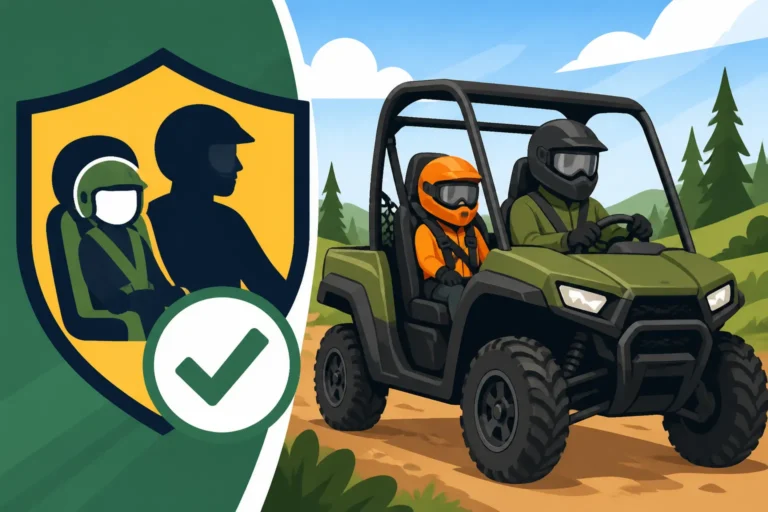
This is perhaps the most critical piece of safety equipment, and it's absolutely non-negotiable: every operator and passenger of an ATV or UTV in New Brunswick must wear an approved helmet, regardless of where they are riding – trail, road, or private land. When you're on a public road, the consequences of not wearing a helmet are even more severe, not just legally, but in terms of potential injury.
An approved helmet must meet specific safety standards, such as CSA D230, DOT FMVSS 218, or Snell M2010. Simply having "a helmet" isn't enough; it must be certified. This is to ensure it provides adequate protection in the event of an impact. There are no exceptions for short distances, low speeds, or designated road sections. If your helmet isn't on and properly fastened, you're looking at a significant fine and putting your life, or your passenger's life, at serious risk. This is covered in depth in [New Brunswick Helmet Law for Every Occupant]. It's the simplest and most vital rule to follow.
Navigating Roads: Speed Limits, Yielding, and Signals
Once you're on a legally designated road section with a properly equipped machine and the right license, you're not free to ride as if you're on a private trail. You are now sharing the road with other vehicles, and you must adhere to all the rules of the road that apply to conventional motor vehicles. This includes speed limits, yielding to traffic, and using proper signaling. Many of these rules are intuitive, but it's easy to forget them when you're used to the open freedom of a trail.
The shift in mindset from trail riding to road riding is crucial here. On a trail, you might be less concerned about strict speed limits or formal signaling. On a road, however, these become paramount for safety and legal compliance.
Posted Speed Limits and Safe Speeds
When operating an ATV or UTV on a road, you must obey all posted speed limits. If no speed limit is posted, the general maximum speed for ORVs on designated roads is often much lower than for cars. Always assume a lower limit applies to you than to the cars around you, unless explicitly stated otherwise by signage specific to ORVs. For instance, many municipal bylaws that open roads to ORVs will specify a maximum speed limit for ATVs, often 20 km/h or 30 km/h, regardless of the posted car speed limit.
It's not just about the posted limit, though; it's also about riding at a safe speed for the conditions. ATVs and UTVs handle differently on pavement than on dirt. Cornering, braking, and stability can be compromised on hard surfaces, especially at higher speeds. Wet pavement or gravel sections can drastically reduce traction. Even if you're legally allowed on the road, if you're riding too fast for your machine or the conditions, you're creating a hazard and can still be ticketed for unsafe operation. Always prioritize safety over speed.
Yielding to Other Traffic
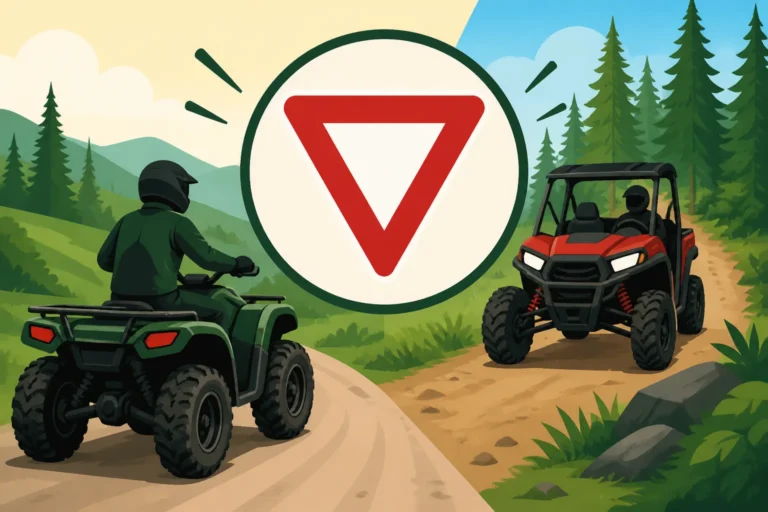
This is perhaps one of the most important rules for ORV operators on roads: you must yield the right-of-way to all other vehicles. When you're on a road, even a designated section, ORVs are considered secondary traffic. This means if a car, truck, or motorcycle is approaching, you must give way. This isn't just a courtesy; it's a legal obligation.
This applies at intersections, when merging, or when another vehicle is simply trying to pass you. You should position your machine safely to the side of the lane, slow down, or even stop if necessary, to allow other traffic to proceed unimpeded. The onus is on the ORV operator to ensure they are not causing an obstruction or hazard to conventional vehicles. A clear understanding of this rule is fundamental to safely sharing the road, and it's detailed further in [New Brunswick Quads Yield to Motor Vehicles].
Hand Signals and Turning
When making turns or changing lanes on a road, you must use proper signals. While many modern UTVs might have turn signals, most ATVs do not. In such cases, hand signals are required and must be clearly visible to other drivers. These are the same standard hand signals used by cyclists and motorcyclists:
- Left Turn: Extend your left arm straight out horizontally.
- Right Turn: Extend your left arm out, bent upwards at the elbow at a 90-degree angle (or extend your right arm straight out horizontally, if safely possible).
- Stop/Slow Down: Extend your left arm out, bent downwards at the elbow at a 90-degree angle.
It's critical that your signals are clear and unambiguous. Other drivers are relying on them to anticipate your movements. If your machine is equipped with functional turn signals, use those first, but always be prepared to use hand signals if they're not visible or if your machine lacks them. Failing to signal can lead to a ticket and, more importantly, can cause a serious collision.
Specific Maneuvers: Crossing and Sharing Roads
Beyond simply riding on designated sections, ATVs and UTVs often need to interact with roads in specific ways, such as crossing a highway to get from one trail section to another, or briefly sharing a road shoulder. These maneuvers are typically allowed under certain conditions, but they come with very strict rules to ensure the safety of all road users. Just like designated riding, these are privileges that require diligent adherence to the law.
These actions often occur in high-traffic or high-speed areas, making precision and awareness absolutely critical. A momentary lapse in judgment or a missed signal can have severe consequences.
Crossing Highways Safely
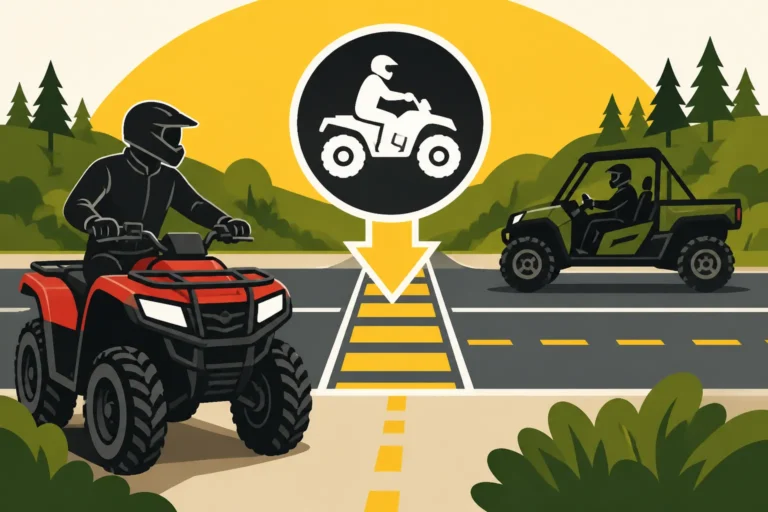
Crossing a public highway is one of the most common reasons an ORV operator will interact with a road. It's often necessary to connect two sections of a trail network. In New Brunswick, ORVs are generally permitted to cross highways, but only at a right angle (90 degrees) to the travelled portion, at a location where the crossing is safe and where visibility is good in both directions. You must come to a complete stop before entering the highway, yield to all approaching traffic, and proceed only when it is safe to do so.
- Stop Completely: Treat it like a stop sign. Come to a full, unequivocal stop.
- Look Both Ways: Scan traffic in both directions. Ensure there's ample time and distance to cross safely.
- Yield to All Traffic: Cars have the right of way. Wait until the road is clear.
- Cross at 90 Degrees: Minimize your time on the travelled portion by crossing directly across, not at an angle.
- Minimize Time on Highway: Get across efficiently and without delay.
You cannot ride along the highway to find a better crossing spot; you must cross directly from one side to the other. Furthermore, you cannot cross a multi-lane divided highway unless a specific crossing point is designated. Failing to follow these rules is extremely dangerous and will result in significant fines. Detailed information can be found in [New Brunswick Rules for Crossing a Road].
Shared Highway Sections and Rules
In some very specific instances, typically through Ministerial Designation or municipal bylaw, ORVs may be permitted to operate for a short distance along a section of a public highway. This is often done to bypass a critical piece of infrastructure, like a bridge or a section of road under construction, or to connect two trail systems. When sharing a highway section, you must:
- Stay as far to the right as safely possible: This usually means the shoulder, or if there's no shoulder, the extreme right edge of the lane.
- Obey all traffic laws: This includes speed limits (which will likely be lower for ORVs), stop signs, traffic lights, and yielding to all other vehicles.
- Be highly visible: This reinforces the need for proper lighting, and wearing bright clothing is always a good idea. Consider adding reflective elements to your machine.
- Maintain awareness: Constantly monitor traffic behind and ahead of you. Be prepared to react quickly.
These shared sections are generally designed to be as short as possible to minimize interaction with high-speed traffic. Never assume you can ride along a highway just because you see others doing it, or because it would be convenient. Always confirm it's a legally designated shared section before proceeding.
Riding to a Gas Station Legally
This is a common dilemma for riders: you're on a trail, running low on fuel, and there's a gas station just a block off the trail. Can you legally ride your ATV or UTV to it? The answer is often "yes," but only if the specific route to the gas station is covered by a Ministerial Designation or a municipal bylaw that explicitly allows ORV access to that road section.
If the road leading to the gas station is not designated or covered by a bylaw, you cannot legally ride your ATV on it. In such cases, your options are:
- Carry extra fuel: Many riders carry small jerry cans for extended trips.
- Trailer your machine: If you're close enough to your truck and trailer, you could load up and drive to the station.
- Walk: If the station is truly just a block or two away, sometimes the safest and most legal option is to walk to it with a fuel can.
Never assume that because you need fuel, it gives you a legal right to break the rules. Plan your routes and fuel stops in advance, using resources like the QuadNB trail map app, which often indicates designated road access points for services. You can learn more about this in [Riding to a Gas Station Legally].
Consequences: Fines and Penalties for Breaking Road Rules
Ignoring New Brunswick's ATV road rules isn't just about taking a risk; it's about facing very real and often expensive consequences. The penalties for operating an ORV illegally on a public highway are substantial and are designed to deter unsafe behavior. These aren't minor inconveniences; they can significantly impact your wallet, your insurance, and your ability to ride in the future.
Law enforcement officers, including RCMP and conservation officers, are trained to enforce the Off-Road Vehicle Act. They understand the nuances of the rules, and they are not hesitant to issue citations for violations, especially those related to highway use, due to the inherent danger involved.
Common Infractions and Associated Costs
Fines for illegally operating an ORV on or near a highway can be quite steep. While specific amounts can change, here are some common infractions and the types of penalties you might face:
- Operating an ORV on the travelled portion of a highway where not permitted: This is a major offense and often carries a significant fine. You could be looking at hundreds of dollars.
- Operating an ORV within 7.5 metres of the travelled portion of a highway: Even if you're not on the road itself, being too close is still a violation with a substantial fine.
- Crossing a highway improperly (not at 90 degrees, failing to stop/yield): Another serious offense with a hefty penalty, as it directly creates a collision risk.
- Operating an ORV on a highway without a valid driver's license: This is often treated similarly to operating a car without a license, with very high fines and potential impact on your driver's license status.
- Failing to wear an approved helmet: This carries its own set fine, which is typically several hundred dollars.
- Operating without required lighting (at night/low visibility): This can also result in a significant fine.
- Operating an unregistered machine on a highway: While registration is required for trail riding, it becomes even more critical when near roads. Fines for no registration are also high, often around [New Brunswick No-Registration Fine of $172.50].
Remember, these fines are "set fines," meaning the officer doesn't have much discretion in the amount. You'll also likely incur court costs if you choose to dispute the ticket and lose. The cost of a few minutes of illegal road riding can easily add up to more than the value of a new set of tires or even an entire year's worth of trail permits. The fines associated with riding near a highway are detailed in [New Brunswick Fines for Riding Near a Highway].
Officer Discretion and Enforcement
While fines are generally set, officers do have discretion in whether to issue a ticket and for which specific offense. They might issue a warning for a minor, first-time infraction, especially if it's clear you simply made a mistake and are cooperative. However, for blatant disregard of the rules, repeat offenses, or situations that clearly endangered others, they are much more likely to issue citations for every applicable offense.
Officers often patrol areas known for illegal road use or respond to complaints from the public. They look for specific indicators like proper registration, valid trail permits (if on an adjacent trail), required safety equipment, and, of course, adherence to road rules. If you're pulled over, being polite, cooperative, and honest can sometimes make a difference, but it won't magically make a clear violation disappear.
Parental Responsibility for Violations
Here's a crucial point for any parent or guardian: if a minor (under 16) operates an ORV illegally on a road, the parent or guardian can be held responsible for the infractions. This means you could receive the ticket and be on the hook for the fines, even if you weren't physically present at the time. This is why understanding age and licensing rules, and ensuring strict adherence, is so vital.
The law places the responsibility squarely on adults to ensure that young riders are not only safe but also compliant with all regulations. Allowing an underage or unlicensed rider on a road section, even for a moment, is not only dangerous for the child but also exposes the parent to significant legal and financial consequences. It underscores the importance of proper training, consistent supervision, and ensuring every rider knows the rules of the road before they ever get near one. The general penalties for not having proper safety training are outlined in [New Brunswick Penalties for No Safety Course], which applies particularly to younger riders who might illegally attempt road riding.
Comparative Table of Road Use Scenarios
To help illustrate the varying legalities, here's a quick table outlining common road interaction scenarios for ATVs and UTVs in New Brunswick:
| Scenario | Legality (Generally) | Conditions/Requirements | Potential Consequences (If Illegal) |
|---|---|---|---|
| Riding on "Travelled Portion" | Illegal (unless designated) | Only on Ministerially designated roads/bylaw sections. Must have valid driver's license, proper lighting, helmet, obey road laws. | High fines for illegal operation, potential license points/suspension. |
| Riding within 7.5m of Travelled Portion | Illegal (unless crossing or designated) | Only for direct crossing or on specific designated ORV routes. Maintain distance otherwise. | High fines for illegal operation. |
| Crossing a Public Highway | Legal (with strict conditions) | Must stop, yield to all traffic, cross at 90 degrees, only when safe. Helmet and proper machine operation always. | Fines for improper crossing, dangerous operation, potential collision. |
| Riding to a Gas Station | Legal (only if route is designated by bylaw/Minister) | Route must be officially open. All road rules apply. Check municipal bylaws or QuadNB map. | Fines for illegal highway use, even for short distances. |
| Rider under 16 on any public road | Illegal | Must be 16+ with valid driver's license. No exceptions for minors on roads. | Parental fines, endangering minor, potential for serious injury. |
| Unlicensed Rider on a designated road | Illegal | Valid driver's license (Class 7 Level 1 or higher) required for designated road sections. | High fines for operating without a license, potential license suspension. |
This article is for general informational purposes only and does not constitute professional advice. Laws, prices and regulations vary by location and change over time. Consult a qualified professional for guidance on your specific situation.