Riding Your Own Land Without Trail Insurance
It’s a common scenario: you’ve got a beautiful piece of land, maybe a woodlot out past Doaktown, a camp property near Miramichi, or simply a big backyard in rural Albert County. You love nothing more than hopping on your ATV or side-by-side to cruise your own trails, clear some brush, or just enjoy the fresh air. But then the nagging question hits you: do I really need trail insurance if I’m never leaving my own property? This guide will dive deep into New Brunswick’s Off-Road Vehicle Act to clear up the confusion, lay out the facts, and help you understand your responsibilities when riding solely on your private land.
The Core Question: Do You Need Insurance on Your Own Land?
This is perhaps the most frequent question I hear from fellow riders, and it’s a valid one. The idea of paying for trail insurance when you’re not even on a trail can feel a bit counterintuitive. You’re simply enjoying your private domain, after all. However, like many things involving laws and regulations, the answer isn’t always a simple yes or no, but rather a nuanced "it depends."
The New Brunswick Off-Road Vehicle Act and Private Land
Let's cut right to the chase: the New Brunswick Off-Road Vehicle Act does indeed have provisions that address riding on private land. Generally speaking, the Act mandates that any off-road vehicle (ORV) operated in New Brunswick must be registered and insured, especially when riding on designated trails or public lands. However, there’s a crucial exception specifically carved out for private property.
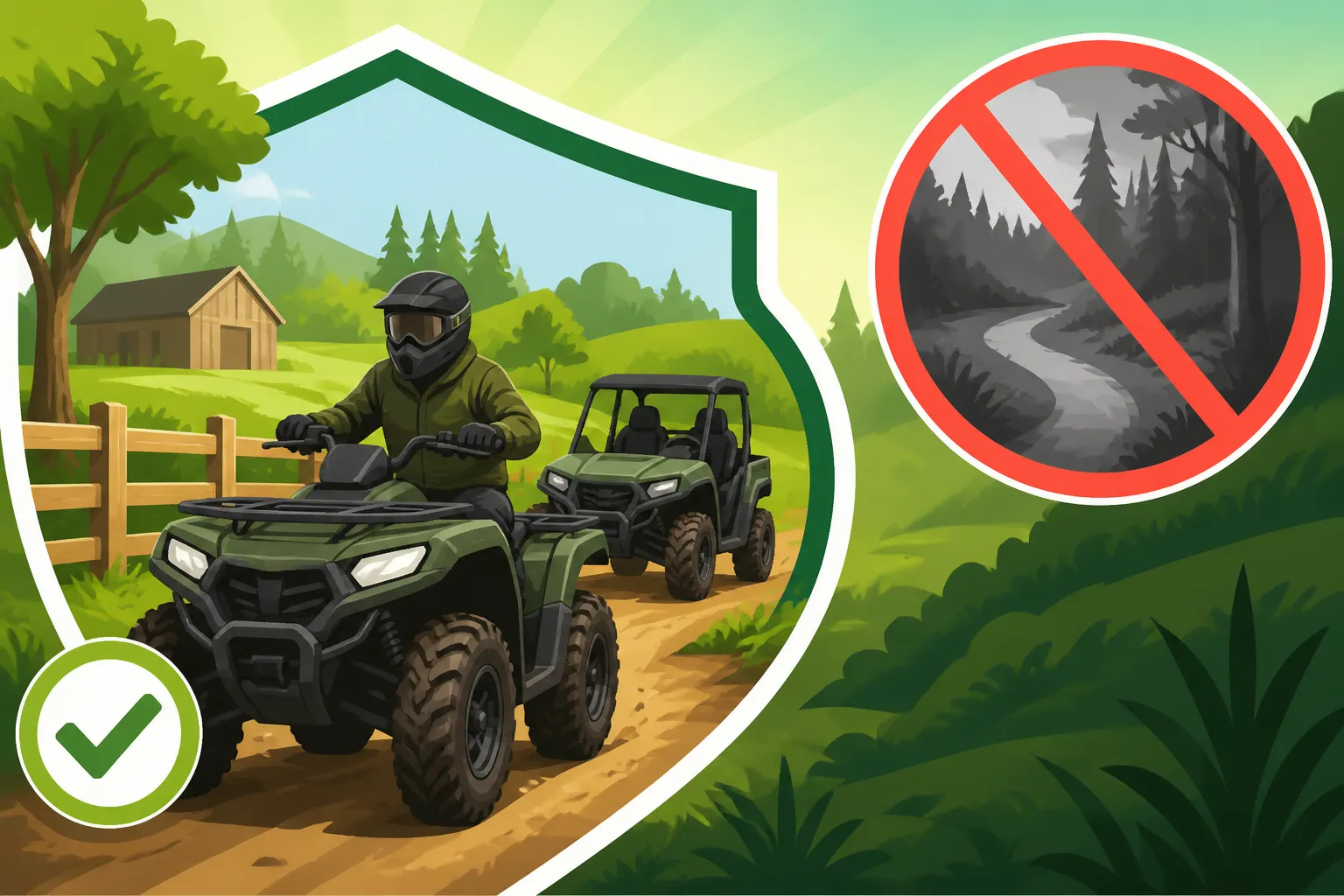
Under the Act, you are not required to carry the specific ORV trail insurance when operating your machine exclusively on land that you own or have permission to use. This is a big one, and it’s a relief for many landowners. Imagine old Joe down the road, who only uses his quad to check fences on his vast potato fields or to haul firewood from his woodlot right beside his house. For Joe, having to buy a trail permit and corresponding trail insurance when he never touches a public trail would be an unnecessary burden. The law recognizes this distinction.
It’s important to understand what "your own land" truly means in this context. We’re talking about property where you hold the deed, or where you have a clear, documented right to operate an ORV. This isn’t a grey area for, say, riding on undeveloped Crown land that just happens to be adjacent to your property. That would instantly put you back into the realm of requiring registration, insurance, and potentially a trail permit. So, if your property is a sprawling 100-acre woodlot where you’ve cut your own paths, you’re likely in the clear regarding the trail insurance requirement. If your property is a small half-acre lot in a subdivision, you might still legally qualify, but practicality and neighbour relations might dictate less riding.
What 'Insurance' Actually Covers for ORVs
When we talk about ORV insurance, it’s not just one blanket type of coverage. There are different facets, and understanding them helps clarify why trail insurance is important versus general liability. Most trail insurance policies, which are often bundled with your trail permit, are primarily focused on third-party liability.
What does third-party liability mean? It covers damages or injuries you might accidentally cause to another person or their property while you’re operating your ORV. For example, if you're on a QuadNB trail, and you accidentally collide with another rider, causing injury or damage to their machine, your liability insurance would step in to cover those costs, up to your policy limits. This is a fundamental reason why [New Brunswick Requires Insurance on Trails] – it protects everyone on the shared trail network.
When you’re riding on your own private land, the immediate concern of injuring another trail user largely vanishes. However, this doesn’t mean all insurance concerns disappear. While you might not need the specific trail liability, you still face risks. What if you flip your ATV and injure yourself? What if you accidentally crash into your own shed, causing damage to both your machine and your property? These scenarios highlight the difference between liability to others and coverage for your own person or property. Many personal ORV insurance policies offer collision coverage for your machine, or even personal injury protection for you, regardless of where the accident occurs. So, while the law might exempt you from trail insurance on private land, it's a good time to consider the broader scope of what different ORV insurance types cover.
Defining "Your Own Land" for Exemption Purposes
The key to understanding the exemption from trail insurance really hinges on a precise definition of "your own land." It’s not just a casual term; it has legal implications that dictate your responsibilities as an ORV operator in New Brunswick. Many riders assume that if they have permission to ride somewhere, it counts as "their own," but that's not always how the law sees it.
Owner-Only Private Land Exemption
The exemption from needing trail insurance typically applies when you are operating your ORV exclusively on land that you own outright. This means the name on the property deed matches your name (or your family's). This exemption is crucial for those who truly only ride on their personal property. For example, if you own a large woodlot in rural Charlotte County and you spend your weekends cutting trails, hauling timber, or exploring your own acreage, you don't need to purchase a specific trail permit or the associated insurance to do so. This is a direct application of the [New Brunswick Owner-Only Private Land Exemption].
However, the moment your wheels touch land you don't own, even briefly, the rules can change dramatically. Think about it: if you ride down your private driveway, across a ditch, and onto a public road for even a few feet to access another part of your property, you've technically entered public domain. At that point, you would need to meet the requirements for riding on a public highway or designated ORV road, which includes having proper registration and, yes, insurance.
Shared access routes or easements can be particularly tricky. If your property is accessed via a shared private road, and other people also use that road, riding your ORV on it might not always fall under the "owner-only" exemption. It introduces an element of shared space and potential liability. Always err on the side of caution and understand the specific arrangements for any shared land.
The Difference Between Your Property and a Friend's Property
This is where a lot of riders get into trouble, or at least into a grey area. A common question is, "My buddy owns a huge property, and I ride there all the time. Do I need trail insurance?" Legally, the answer is generally yes, you do. The exemption for riding on "your own land" does not automatically extend to a friend's property, even if they've given you explicit permission.
Here’s why: the exemption is primarily for the owner operating on their own land. When you ride on a friend's land, you are operating on property you do not own. Therefore, you are typically subject to the same requirements as if you were riding on a public trail: you need your ORV registered and insured. Your friend's property, while private, isn't your private property in the legal sense of the exemption.
Consider the implications if there's an accident. If you injure yourself on your friend's land without insurance, you're looking at your own medical bills. If you accidentally damage your friend's property or, worse, injure another person (perhaps another guest riding with you), without the necessary ORV liability insurance, you could be personally responsible for significant costs. Your friend's homeowner's insurance might not cover an ORV accident caused by a guest.
To protect both yourself and your friend, it's always best to have appropriate ORV insurance when riding on property you don't own. In some cases, landowners might ask guests to sign a liability waiver. Resources like LawDepot offer templates for such agreements, which can provide some peace of mind, but they don't replace the need for your own insurance coverage under the Act. It's about being responsible and ensuring you're covered for unexpected situations.
The Risks of Riding Uninsured, Even on Private Property
While the New Brunswick Off-Road Vehicle Act provides an exemption for trail insurance when you're strictly on your own land, it's absolutely crucial to understand that "no legal requirement for trail insurance" does not mean "no risk." In fact, riding any motorized vehicle carries inherent risks, and being uninsured on private property can expose you to significant financial and personal consequences that you might not have considered.
Personal Injury and Property Damage
Let's be realistic: accidents can happen anywhere, anytime. Your private land might feel safe and familiar, but it's not immune to mishaps. Imagine you're zipping along a familiar path on your own woodlot, hit an unseen root, and suddenly your ATV flips, pinning your leg. Or perhaps you're backing up your side-by-side to hook up a trailer and misjudge the distance, backing right into your prized garden shed, caving in a wall and damaging your machine.
If you don't have personal injury coverage or collision coverage as part of your overall ORV insurance policy, you'll be solely responsible for those costs. That means paying for your own ambulance ride, emergency room visit, physical therapy, and any time lost from work. On the property damage side, you'll be shelling out for repairs to your ATV or UTV, and for rebuilding that shed, entirely out of pocket. These are costs that can easily run into the thousands, turning a fun afternoon ride into a very expensive lesson. While the law might not mandate trail insurance in this specific scenario, a comprehensive ORV policy that includes personal injury and collision coverage is always a wise investment, no matter where you ride. You might want to explore options for [New Brunswick Insurance Cost for an ATV] to get a sense of what broader coverage entails.
Liability Beyond the ORV Act
Even if you're alone on your property, there's always the possibility of someone else getting injured. What if a guest you invited to your land (say, for a family picnic) wanders too close to your riding area and gets hit by a flying rock from your tires? Or, heaven forbid, what if a trespasser (an unwanted visitor) is on your property and gets injured by your ORV?
In these situations, even if you are on your own land and exempt from the specific ORV trail insurance requirement, general liability laws still apply. You could be sued for negligence, and if you are found liable, the financial repercussions could be catastrophic. Your homeowner's insurance policy might offer some general personal liability coverage, but many policies have specific exclusions for motorized vehicles like ATVs and UTVs, especially if they are not being used for typical "homeowner" activities. It is absolutely vital to check with your home insurance provider to understand the extent of your coverage for ORV incidents on your property. Don't assume you're covered; get it in writing. This is a scenario where proactive measures, like clear signage or even a signed waiver (potentially drafted using services like LawDepot), might help, but they rarely replace robust insurance coverage.
Neighbour Disputes and Trespassing
The lines between properties, especially in rural New Brunswick, aren't always crystal clear, and it's surprisingly easy to accidentally cross onto a neighbour's land. One wrong turn on a winding path, a misread boundary marker, or simply riding too close to the property line could lead to unintentional trespassing.
The moment your wheels cross that boundary, you are no longer strictly on "your own land," and suddenly, the full weight of the New Brunswick Off-Road Vehicle Act regarding public operation (and associated insurance requirements) could apply. Not only could you face fines for operating an unregistered or uninsured machine, but you could also be hit with fines for [New Brunswick Trespass Law for Riders].
Beyond legal penalties, there are neighbour relations to consider. An accidental trespass, or even excessive noise from your ORV near a neighbour's property, can quickly lead to disputes and resentment. While insurance won't prevent a dispute, having it can provide a safety net if a neighbour's property is damaged, or if they claim injury, due to an accidental venture onto their land. It’s always best to know your property lines, respect your neighbours, and ensure you have the proper paperwork, including potential insurance, for any potential excursion off your own defined boundaries.
Registration, Permits, and Other Paperwork for Private Land
So, we've established that while you might be exempt from trail insurance on your own land, the conversation about paperwork for your ATV or UTV doesn't end there. There are other crucial aspects of compliance that you absolutely need to be aware of, even if your machine never leaves your property. Neglecting these could still lead to fines and legal headaches.
Registration: Is It Still Required?
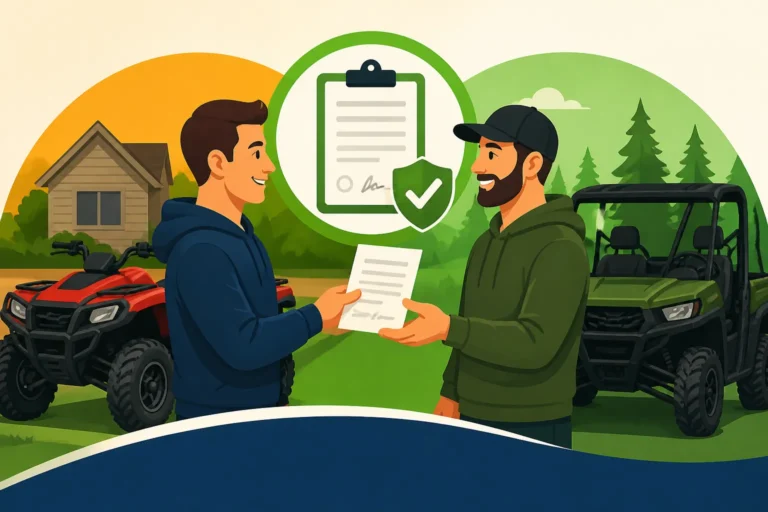
This is a big one that often catches private landowners off guard. Many assume that if they don't need trail insurance, they also don't need to register their machine. Unfortunately, that's generally not the case. The New Brunswick Off-Road Vehicle Act broadly requires the registration of all off-road vehicles operated in the province. There are very specific and limited exemptions, primarily for farm machinery used exclusively for bona fide farming operations, or for machines used strictly on a closed course for competition (and not travelling to or from the course).
For the vast majority of landowners, if you’re using your ATV or UTV for recreational purposes, general property maintenance, or simply riding around your woodlot, it still needs to be registered with Service New Brunswick. The registration identifies your machine and links it to you as the owner. Think of it like your car: you register it even if it mostly stays in your driveway. Not having your machine registered, even on your own property, could lead to a fine, such as those outlined under [New Brunswick Penalties for Riding Unregistered].
The process to [Registering an ATV With Service New Brunswick] is straightforward, involving proof of ownership, identification, and payment of the registration fee. Once registered, you'll receive a registration certificate and a plate, which needs to be displayed on your machine.
Trail Permits: What About Just Getting to My Land?
A trail permit is entirely separate from registration and standard insurance. A trail permit, like those issued by QuadNB, is essentially a user fee that grants you legal access to the province's extensive network of managed, groomed, and signed trails. These permits fund the maintenance and development of the trails by the various clubs.
If your ATV or UTV truly never leaves your own private property, and you never ride on a designated ORV trail, then no, you do not need a trail permit. The permit is specifically for using those shared corridors. However, this is where many people run into issues. What if your private land is landlocked, and you have to cross a small section of a club trail or a provincially designated ORV route to get to it? In that specific instance, you would need a trail permit for that portion of your journey.
It's crucial to distinguish between riding on your private land and using public access points or designated trails to get to your private land. For rules regarding riding on public roads or road allowances to access your property, you'll want to consult guides like [New Brunswick ATV Road Rules Explained]. If you are riding solely on your own land and never touch a managed trail, then the trail permit is not a concern for you.
Essential Documents to Carry (Even on Private Land)
While the legal requirement to carry specific documents like your registration and insurance certificate usually applies when operating on public trails or roads, it's still a smart practice to have certain paperwork readily accessible, even when you're strictly on your own property.
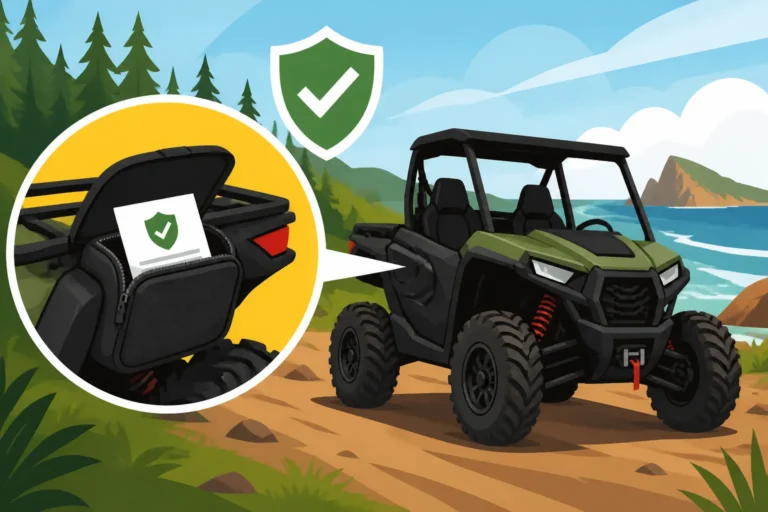
Consider a scenario: you're riding deep in your woodlot, and an unforeseen incident occurs – maybe a serious injury, or a fire starts. First responders or conservation officers might need to access your property. Having your registration certificate handy allows them to quickly identify the machine and confirm ownership, which can be helpful in an emergency or investigation. Similarly, if you have any personal ORV insurance beyond the basic trail liability (e.g., collision or personal injury), having proof of that coverage can expedite claims processes if you need to access those benefits.
While it might seem overly cautious to carry your papers in a pouch in your saddlebag when you're just on your own back forty, it's a habit that serves you well. It ensures you're prepared for any eventuality. For those who do venture onto trails, remembering to carry [Carrying Four Documents at Once] (registration, insurance, driver's licence, and trail permit) is critical. Even on private land, having your registration certificate is a good idea.
Here’s a quick overview of the key distinctions for ORV paperwork in New Brunswick:
| Requirement | On Your Own Private Land (Strictly) | On Public Trails or Roads |
|---|---|---|
| Registration | Generally YES (unless farm exempt) | YES |
| Trail Insurance | NO (specific exemption applies) | YES |
| Trail Permit | NO | YES (for designated trails) |
| Driver's Licence | Recommended | YES |
| Proof of Ownership | Recommended | YES |
Disclaimer
This article is for general informational purposes only and does not constitute professional advice. Laws, prices and regulations vary by location and change over time. Consult a qualified professional for guidance on your specific situation.