New Brunswick Insurance Exemption for Dirt Bikes
Navigating the ins and outs of off-road vehicle (ORV) regulations in New Brunswick can feel like slogging through deep mud – especially when it comes to insurance. Many riders assume every machine needs the same coverage, but that's not always the case, leading to confusion and potential fines. This guide will cut through the legal jargon and clearly explain the specific New Brunswick insurance exemption for dirt bikes, helping you understand when your two-wheeled companion needs coverage and when it might not.
Understanding New Brunswick's General ORV Insurance Requirements
Before we dive into the specifics of dirt bikes, it's really important to grasp the bigger picture of ORV insurance in New Brunswick. The province has a pretty clear stance on off-road vehicles, aiming to keep everyone safe and responsible, but there are nuances that often trip people up. It's not just about having a machine; it's about how and where you ride it.
Why ORV Insurance is Generally Required
For most ATVs, side-by-sides, and snowmobiles, having valid insurance isn't just a suggestion – it's the law if you plan on venturing onto designated trails or land that isn't your own private property. Think of it like car insurance; it’s there to protect you and others in case of an accident. While we all hope for smooth rides, accidents happen, and the financial implications can be devastating without proper coverage.
This insurance typically covers liability, meaning if you're involved in an accident and found at fault, your policy can help cover the costs of injuries to other people or damage to their property. It's about ensuring that if something goes wrong, there's a safety net rather than leaving someone with a massive bill. The Off-Road Vehicle Act is quite serious about this, and for good reason – these machines can cause significant damage if not operated responsibly. If you're looking for a general overview, you might want to check out [New Brunswick ORV Registration Explained].
The "Trail" Trigger for Mandatory Coverage
Here's where a lot of the confusion often arises: the specific trigger for mandatory ORV insurance in New Brunswick is usually tied to riding on a "trail" – and this can mean more than just the groomed QuadNB network. Any designated ORV trail, managed route, or even certain Crown land access roads might fall under this definition. Essentially, if you're riding anywhere other than your own private property or land where you have explicit permission to ride uninsured, you generally need insurance.
This means that even if you're just popping down a municipal woods road to access a hunting blind, you could be subject to the insurance requirement. It's not just about the club trails with their fancy signs; it's about the broader network of shared access. The spirit of the law is to protect the public and property when ORVs are in areas accessible to more than just the owner. You can learn more about this in [New Brunswick Requires Insurance on Trails].
Consequences of Riding Uninsured
Ignoring the insurance requirement is a risk many riders mistakenly take, and the penalties are anything but minor. Riding an ORV without the legally mandated insurance can lead to hefty fines, impoundment of your machine, and even more serious legal repercussions if you're involved in an accident. These aren't just slaps on the wrist; they're designed to deter uninsured operation because of the significant risks involved.
Imagine getting pulled over on a trail, or worse, being involved in a minor fender bender with another ORV. Without insurance, you'd be looking at a minimum fine, and if you caused damage or injury, you'd be personally on the hook for all those costs. This isn't just about paying a fine; it's about potentially losing your machine, your savings, or facing a lawsuit. The financial hit from an accident could be devastating. For a clear idea of the financial risks, look up [New Brunswick Uninsured ATV Fine of $604.50].
The New Brunswick Dirt Bike Insurance Exemption Explained
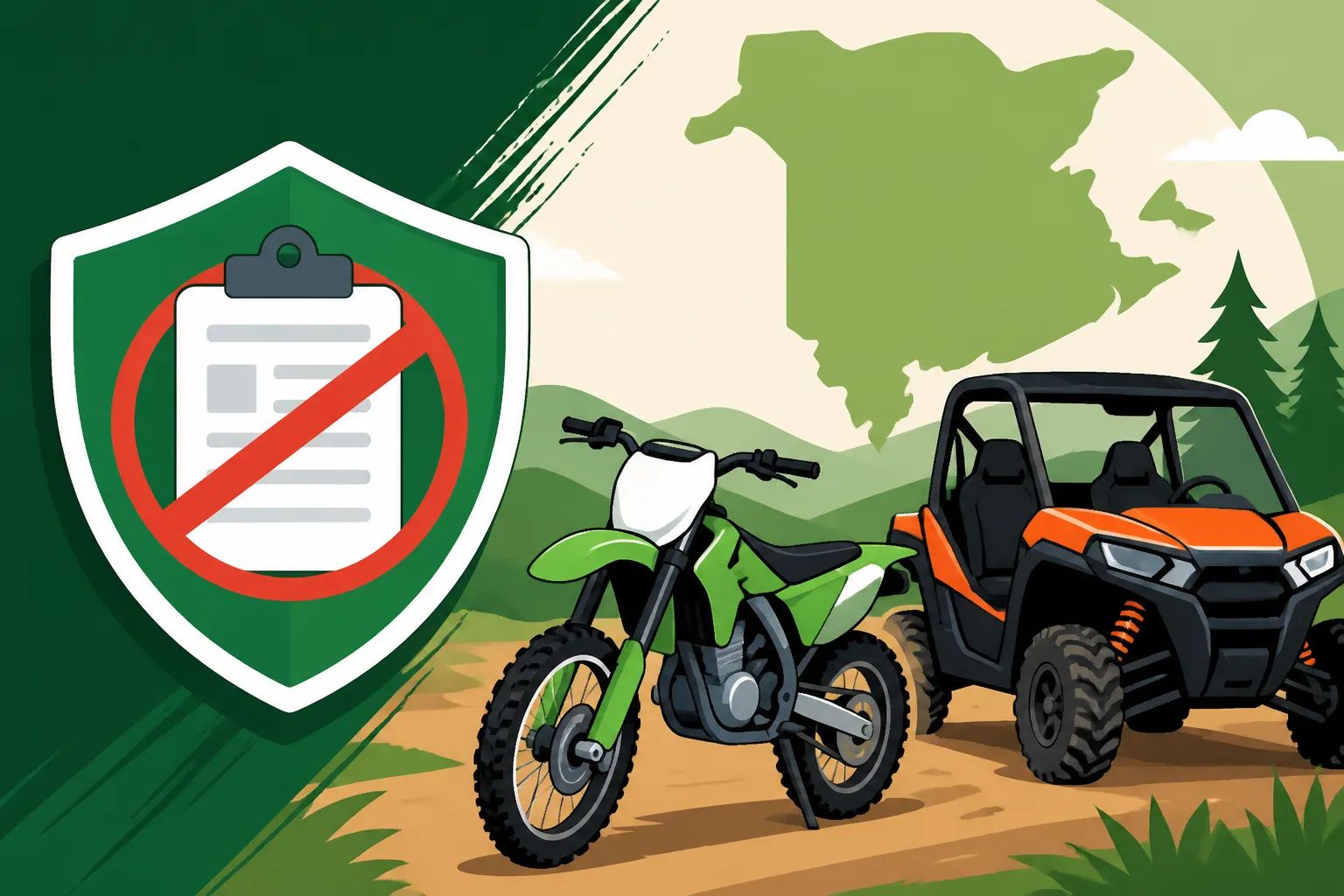
Now, let's get to the heart of the matter for dirt bike enthusiasts. While the general rule in New Brunswick leans heavily towards requiring ORV insurance for trail use, there's a specific exemption carved out for dirt bikes that often brings a sigh of relief to riders who primarily use their machines off the beaten path. It's a key distinction that sets them apart from their four-wheeled cousins, but it's absolutely critical to understand the precise conditions.
What the Exemption Actually Is
Under New Brunswick's Off-Road Vehicle Act, a dirt bike is generally exempt from the mandatory liability insurance requirement if it is operated on land where the operator is the owner or has express permission from the owner to operate it without insurance. This means if you're ripping around on your own land, or a friend's woodlot with their specific consent to ride uninsured, you don't legally have to carry an ORV insurance policy for that specific machine. It's a significant difference from an ATV or side-by-side, which would almost always need insurance if it's registered, regardless of where it's ridden, unless on the owner's private property exclusively.
This exemption acknowledges the often-private nature of dirt bike riding – many riders use these machines for recreation on private properties, motocross tracks, or designated closed courses, rather than extensively on the public trail system. It's a practical recognition of how these machines are typically used. However, "express permission" is key here; a general nod from a landowner might not cut it if an incident occurs. You'll want to ensure you have clear, documented permission, especially if you're riding someone else's property.
Why Dirt Bikes Are Treated Differently
You might wonder why dirt bikes get this special treatment when ATVs and side-by-sides are usually required to be insured when operated off private land. The rationale often comes down to their design and typical use. Dirt bikes are generally single-purpose machines, often lighter and more agile, designed for competitive or recreational off-road riding in controlled environments or on private tracks. They typically don't have the same capacity for hauling, work, or extensive long-distance trail riding that ATVs and side-by-sides do.
Historically, dirt bikes might have been seen as more akin to recreational toys for private use, whereas ATVs gained popularity as utility vehicles and for accessing vast trail networks. This distinction in perception and use has translated into different regulatory approaches. While all ORVs pose risks, the legislative intent appears to differentiate between machines primarily used on private, controlled property and those that frequently traverse shared public access trails. This is why you'll see different rules for various machine types, including [New Brunswick Dirt Bike and Dune Buggy Fees].
Limitations of the Exemption: What It Doesn't Cover
It's crucial not to misinterpret this exemption as a free pass to ride your dirt bike anywhere without insurance. This is probably the biggest trap riders fall into. The exemption is highly specific and comes with significant limitations. It absolutely does not apply if:
- You ride on a designated ORV trail: The moment your dirt bike tires hit a managed trail system (like those maintained by QuadNB or other sanctioned routes), the exemption vanishes, and you are legally required to have insurance. No exceptions.
- You ride on Crown land without explicit "private land" permission: While some Crown land might be accessible, if it's not specifically designated as "owner's land" or you don't have express permission from the Crown to operate uninsured (which is rare), you'll need insurance.
- You cause damage or injury off-trail to someone else's property or person: Even if you're technically on private land and exempt from mandatory insurance, if you crash into a neighbour's fence, injure a bystander, or damage someone else's property, you are still personally liable for those costs. The exemption only removes the legal requirement to have a policy; it doesn't remove your financial responsibility.
This last point is critical. Many riders believe that because they don't need insurance, they're somehow off the hook if something goes wrong. That's a dangerous misconception. The exemption means the province won't fine you for not having a policy in specific situations, but it does not protect you from civil lawsuits or personal financial ruin if you cause harm. Always consider the personal liability aspect, even when exempt.
Proof of Ownership and Operation: Even with Exemptions, Paperwork Matters
Even with the dirt bike insurance exemption, the wheels of bureaucracy keep turning. Just because you might not need an insurance slip doesn't mean you're free from all other paperwork. In fact, proving ownership and ensuring your machine is properly registered are still incredibly important, and overlooking these details can lead to headaches, fines, or even disputes down the road. It's all part of being a responsible ORV owner in New Brunswick.
Beyond Insurance: Other Essential Documents
For any ORV, including dirt bikes, there are fundamental documents that are legally required when you're operating the machine, regardless of its insurance status. These typically include:
- Your ORV Registration Certificate: Every ORV operated in New Brunswick must be registered with Service New Brunswick. This is your machine's official identity and ties it directly to you as the owner.
- Your ORV Plate and Sticker: The physical plate and the annual validation sticker are proof that your machine is registered for the current year. These need to be clearly displayed on your dirt bike.
- Your Driver's Licence (or appropriate permit): You, the operator, need to be legally qualified to drive an ORV. This could be a full driver's licence, a Class 9 licence for younger riders, or a safety course certificate depending on your age and the specific ORV rules.
Even if your dirt bike is exempt from insurance, an officer can still ask to see these documents. Failing to produce them can result in fines and disrupt your ride. It's a good habit to always have your [New Brunswick Documents You Must Carry] with you, in a waterproof bag, whenever you head out.
Importance of a Bill of Sale
A bill of sale isn't just a piece of paper; it's the fundamental proof of ownership when you buy or sell a dirt bike, whether new or used. Even if you're acquiring a machine that falls under the insurance exemption, you absolutely need a clear, properly filled-out bill of sale. This document protects both the buyer and the seller.
For the buyer, it proves that you legally acquired the machine, which is essential for registration and to prevent issues if the machine is ever questioned as stolen. For the seller, it proves you no longer own the machine and are no longer responsible for it. A comprehensive bill of sale should include:
- The date of the sale.
- The full names and addresses of both buyer and seller.
- A detailed description of the dirt bike (make, model, year).
- The Vehicle Identification Number (VIN) – crucial for identification.
- The agreed-upon sale price.
- Signatures of both parties.
Having a proper bill of sale simplifies the registration process. If you're wondering where to get a reliable template, services like LawDepot offer customizable legal forms, including bills of sale, that can help ensure you have all the necessary information covered for your transaction. Using a template like those offered by LawDepot can provide peace of mind that you haven't overlooked any critical details. Always keep a copy for your records. For more details on what you might need, check out the [New Brunswick Registration Paperwork Checklist].
Registering a Dirt Bike (Even if Insurance Exempt)
Here's another point of frequent misunderstanding: the insurance exemption for dirt bikes does not mean they are exempt from registration. Unless your dirt bike is never operated off your own private property, it still needs to be registered with Service New Brunswick. The registration process is separate from the insurance requirement.
Registering your dirt bike ensures it's on the provincial record, helps with recovery if it's stolen, and provides an official link between you and your machine. The fees for dirt bike registration are generally lower than for ATVs, recognizing their different classification and typical usage. You'll need to visit a Service New Brunswick centre with your proof of ownership (that critical bill of sale!), proof of identity, and payment for the registration fee. Even if you're only planning on [Registering a Dirt Bike That Never Leaves Your Land], the process is the same if you ever plan to take it anywhere else.
Navigating the Rules: When Does Your Dirt Bike Need Insurance?
The New Brunswick dirt bike insurance exemption is a fantastic benefit for many riders, but it's not a set-it-and-forget-it rule. The moment your riding habits or location change, so too might your insurance requirements. Understanding these conditional triggers is key to staying legal and protected, ensuring your ride remains fun and worry-free.
Riding on Private Land Only
This is the primary scenario where the dirt bike insurance exemption truly shines. If your dirt bike is used exclusively on land you own, or on private land where you have explicit, written permission from the landowner to operate without liability insurance, then you are generally not required to carry an ORV insurance policy. This covers everything from your backyard track to a friend's vast woodlot.
It's paramount to be crystal clear about the "permission" aspect. "My buddy said it's cool" might not hold up in court if there's an incident. A simple, signed letter or agreement detailing the permission to ride, and specifically stating that it includes riding uninsured if that's the understanding, can save a lot of grief. This practice protects both you and the landowner. Remember, even in this scenario, if you cause damage or injury to someone else, you are still personally liable. This particular situation is well-covered in [Riding Your Own Land Without Trail Insurance].
Joining Club Trails and Public Access Areas
The moment your dirt bike leaves the confines of your truly private, permission-granted land and enters a public ORV trail system, Crown land where the exemption doesn't apply, or any other shared access area, the insurance exemption generally ceases to apply. At that point, your dirt bike needs to be covered by a valid ORV liability insurance policy, just like an ATV or side-by-side.
This shift is crucial. Many riders have excellent private land to ride on but then decide to try a section of a nearby club trail for a change of scenery. This is where the trap lies. Without insurance, you'd immediately be in violation of the Off-Road Vehicle Act and subject to significant penalties. This includes fines, which can be substantial, as highlighted in articles like [New Brunswick Penalties for Riding Uninsured]. Always ensure you have your proof of insurance with you, perhaps in a secure, waterproof pouch on your machine. [Proof of Insurance in a Saddlebag] is a good read for how to keep your documents safe.
Temporary Use and Special Exceptions
There might be specific, limited scenarios that fall outside the typical private land/trail dichotomy. For instance, if you're participating in an organized, sanctioned motocross event on a closed course, the event organizers usually have specific insurance requirements, and your personal ORV insurance might be overridden or supplemented by their event liability coverage. However, these are very particular situations, and you should always confirm the insurance requirements with the event organizer well in advance.
Likewise, certain ministerial designations or temporary permits for specific routes could exist, but these are exceptions rather than the norm. For the vast majority of dirt bike riders in New Brunswick, the line in the sand is clear: private land with permission means no mandatory insurance, while public trails or shared access areas mean mandatory insurance. When in doubt, it's always safer and wiser to err on the side of caution and ensure you have liability coverage. After all, protecting yourself and others is always the priority. For a broader understanding of the legal framework, review [What New Brunswick's Off-Road Vehicle Act Covers].
| Scenario | Insurance Required? | Key Consideration |
|---|---|---|
| Your Private Land (Owner) | No | You are liable for any damages/injuries you cause. |
| Friend's Private Land (Perm.) | No | Must have explicit, written permission from owner. |
| Designated ORV Club Trail | Yes | Mandatory liability insurance required by law. |
| Crown Land (General Access) | Yes | Unless specific exemption/permission applies (rare). |
| Motocross Race (Sanctioned) | Varies | Check event organizer's specific insurance rules. |
| Crossing a Public Road | Yes | Even briefly, during legal crossing. |
Common Misconceptions and Avoiding Pitfalls
The New Brunswick dirt bike insurance exemption, while beneficial, is also a prime source of confusion and missteps for riders. It’s easy to misunderstand the nuances and find yourself in a sticky situation, facing fines or even legal liability. Let’s clear up some of the most common misconceptions and offer advice on how to avoid these common pitfalls.
"It's Just a Dirt Bike, So It's Totally Exempt"
This is perhaps the biggest and most dangerous misconception. As we've thoroughly discussed, the exemption is not a blanket "get out of jail free" card for all dirt bike operations. It’s highly conditional and tied directly to where and how you’re riding. The phrase "it's just a dirt bike" often leads riders to believe they are somehow immune to ORV regulations entirely, which couldn't be further from the truth.
An officer on a trail will not care that you think your dirt bike is exempt. If you are on a designated trail system and do not have proof of insurance, you will be facing consequences. Even if you're riding on what you believe is private land, but it turns out to be Crown land or a shared access road, the exemption likely won't apply. Always verify your location and the specific rules that apply to it. Don't rely on assumptions; rely on facts and current regulations.
Assuming the Exemption Applies to All ORVs
Another common pitfall is assuming that because dirt bikes have this exemption, other ORV types – like quads (ATVs) or side-by-sides – also enjoy a similar break. This is absolutely incorrect. The dirt bike insurance exemption is specific to dirt bikes (as defined by the Act) and does not extend to other classes of ORVs. An ATV or a side-by-side, regardless of how or where it's ridden, will almost always require liability insurance if it's registered and operated off your own private land.
This distinction is important because the fines for operating an uninsured ATV or side-by-side on a trail are significant. Riders often own multiple machines and might mistakenly apply the dirt bike rule to their quad. Always remember that the rules are machine-specific. If you're riding an ATV, you'll need to think about [New Brunswick Insurance Cost for an ATV] and ensure you're covered.
The Importance of Personal Liability (Even if Not Mandated)
Even in situations where your dirt bike is legally exempt from mandatory insurance, carrying a personal liability policy is always a wise decision. As mentioned, the exemption only removes the requirement to have insurance; it does not remove your personal financial liability if you cause an accident, injury, or property damage.
Imagine you're riding on your own land, legally uninsured. You accidentally veer off your property line and damage a neighbour's fence, or worse, cause an injury to someone walking nearby. Without any insurance, you would be solely responsible for all repair costs, medical bills, and potential legal fees from a lawsuit. This could amount to tens of thousands of dollars, or even more, leading to bankruptcy or the loss of assets.
Many homeowners' insurance policies offer some level of personal liability coverage that might extend to ORV use on your own property, but this varies greatly by policy and insurer. It’s essential to contact your insurance provider and explicitly ask about ORV coverage, especially for dirt bikes, and understand its limits and conditions. Investing in a small, separate liability policy, even if not legally required, can provide immense peace of mind and financial protection. It's a small cost for potentially huge protection, safeguarding your future against unforeseen accidents.
Disclaimer
This article is for general informational purposes only and does not constitute professional advice. Laws, prices and regulations vary by location and change over time. Consult a qualified professional for guidance on your specific situation.