New Brunswick Deer on the Trail
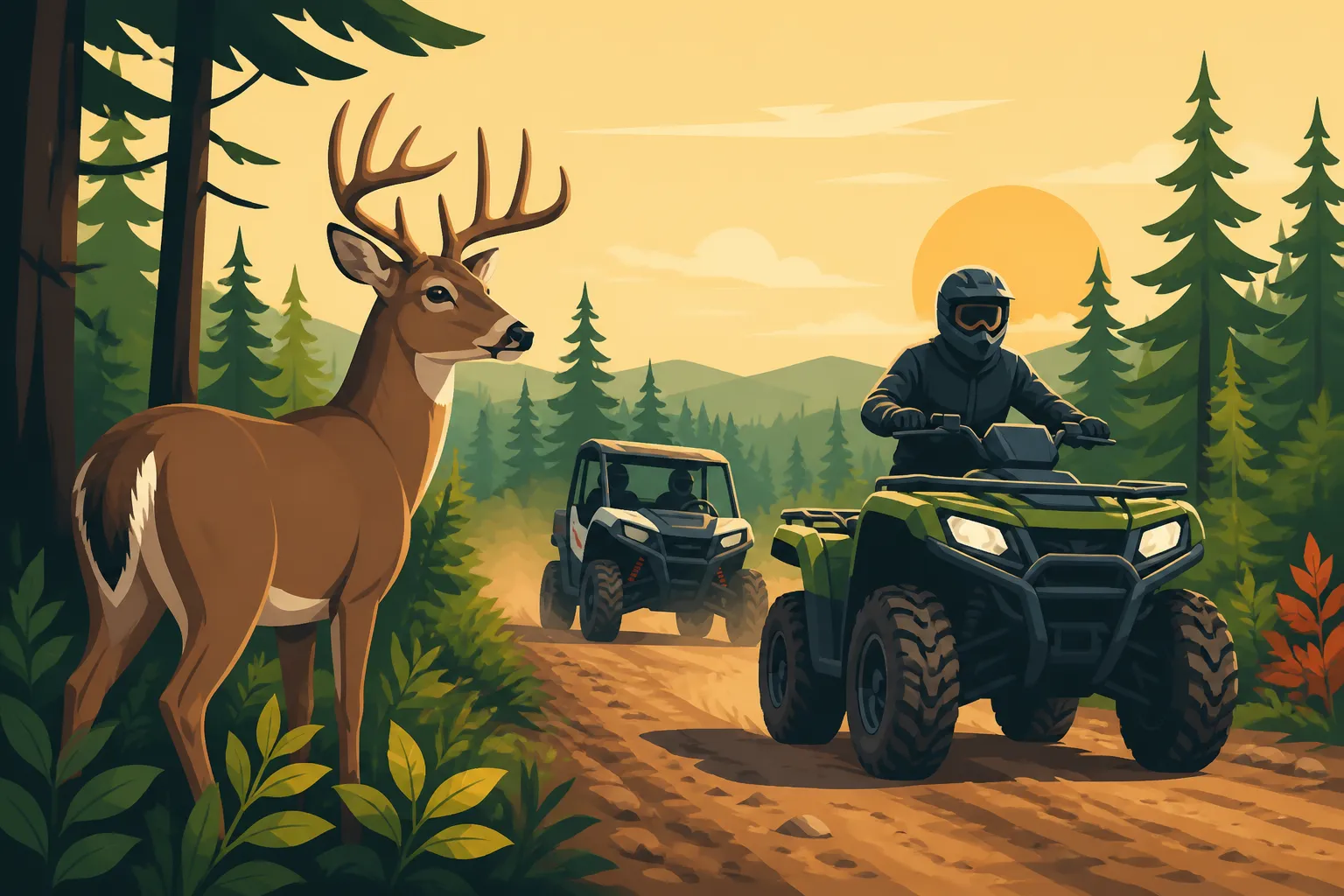
Deer can step onto a New Brunswick trail with little warning, especially where a marked corridor meets a wooded opening or quiet road. The risk is not just hitting an animal: a sudden swerve can send a quad or side-by-side into a ditch, tree, or soft shoulder. This guide explains how to spot deer activity, adjust your riding, and respond safely when one appears.
Why deer encounters happen on New Brunswick trails
Where you are most likely to see deer
White-tailed deer use a mix of wooded cover, fields, forest edges, and openings where they can find food. On a ride, that can mean a deer appears at a trail junction, crosses a cut line, or moves between forest and a clearing. A trail that feels remote and enclosed can still pass through habitat deer use regularly.
In New Brunswick, riders may encounter deer along rural corridors outside communities such as Miramichi, Bathurst, Woodstock, or Fredericton, as well as on trails near camps and woodlots. The exact chance of a sighting varies with the route, season, weather, time of day, and local conditions. A quiet stretch is not necessarily an empty one.
Pay particular attention where your view is blocked by brush, a bank, a bend, or a rise. Deer can be difficult to see against trees and shadow, and a second animal may follow the first. Openings can be deceptive too: a deer may be standing just inside the tree line rather than out in the clearing.
Treat wildlife signs as a reason to ease off rather than as a promise that an animal is nearby. Tracks, droppings, or a path through the brush may indicate regular movement, but they do not tell you exactly when a deer will cross. Keep your attention on the trail ahead and leave enough room to react.
When deer activity may be more noticeable
Deer are often more active in low-light periods, including early morning and evening. That overlaps with times when riders may be travelling to or from a trailhead, heading back to camp, or finishing a longer ride. Light can change quickly under a forest canopy, so a route that seemed easy to read in open daylight may become harder to scan later in the day.
Weather and seasonal changes can affect visibility and movement. Wet leaves, fog, rain, low sun, or fresh snow may make tracks and animal movement harder to interpret. During hunting seasons, the woods may also be busier with people and vehicles. Check local notices and trail information before heading out, and ride with extra awareness when sharing a corridor or nearby access road.
Deer are not the only large animals a New Brunswick rider may encounter. If you are planning a route in an area with moose, review [New Brunswick Moose on the Trail] as well. The safest approach to either animal is similar: reduce speed, avoid crowding it, and do not treat the trail as a place to pursue or get close to wildlife.
How to ride more safely where deer may cross
Slow down before the risky spots
The most useful adjustment is to reduce speed before a blind bend, narrow cut, crest, trail junction, or opening in the trees. Braking only after you see a deer may leave too little time, especially on loose gravel, mud, wet roots, or uneven ground. A speed that feels comfortable on a straight, open section may be too fast when visibility is limited.
Scan the trail in layers. Look at the ground immediately ahead for ruts, rocks, or washouts; then look farther down the corridor for movement at the edge of your view. Check likely crossing points without staring so fixedly at the brush that you miss obstacles on the trail. If you ride with a passenger, agree that they can call out wildlife or hazards without distracting the driver.
Leave more space between machines than you might on a clear, familiar stretch. If the rider in front brakes for an animal, the person behind needs time to respond without swerving into soft ground or striking the machine ahead. On a group ride, let the lead rider communicate a slowdown clearly and avoid bunching up at a sighting.
| Trail situation | Safer riding adjustment | Why it helps |
|---|---|---|
| Blind bend or rise | Reduce speed before entering it | You have more time to react to an animal or obstacle |
| Trail edge hidden by brush | Scan both sides and stay on the marked route | Deer may emerge suddenly, and leaving the corridor can create new hazards |
| Low light or poor visibility | Ride at a pace that lets you stop within the visible distance | Headlights do not make it safe to outrun what you can see |
| Group ride | Increase following distance and call out hazards | The next rider has time to brake smoothly |
| Deer already on the trail | Stop or slow in control and give it room | Avoids a rushed swerve or close approach |
Use lights and visibility thoughtfully
Make sure your machine’s lights are working before the ride, particularly if your plan could bring you home near dusk. Lights help you see the trail and help other trail users notice your machine, but they do not guarantee that a deer will move out of your way. Do not assume that a bright beam will make an animal behave predictably.
If you ride after dark, be even more conservative around corners and forest edges. A headlight shows only part of the trail at once, and shadows can hide movement. Review [New Brunswick Rules for Riding After Dark] before a night ride, and avoid turning a wildlife sighting into a reason to chase or illuminate an animal for an extended period.
Good group habits matter as much as equipment. Keep headlights and other equipment in sound working order, ride at a manageable pace, and use clear verbal or agreed-upon signals when safe to do so. For broader trail conduct, [New Brunswick Trail Etiquette Locals Expect] is a useful companion read.
What to do when a deer appears
If the deer is ahead of you
Ease off the throttle and brake smoothly while keeping the machine under control. Avoid a sharp turn into the woods, ditch, or opposite lane of a shared route. A sudden swerve can be more dangerous than a controlled stop, especially on a narrow trail or loose surface.
Give the deer space and time to leave. Do not ride toward it, rev the engine to drive it away, or try to pass close behind it. If it is safe to stop, wait without blocking the trail more than necessary. A deer may pause, turn, or move back across the corridor, so do not assume that the first direction it takes is the final one.
Look for other animals before continuing. Deer may travel in groups, and one animal crossing does not mean the trail is clear. Once the area appears safe, proceed slowly and keep scanning the trail edges for the next stretch.
If a deer crosses suddenly
Keep a firm, controlled grip and focus on maintaining balance. If you can brake safely in a straight line, do so. Avoid locking up or making an abrupt steering move that could cause a rollover or send the machine off the trail. The right response depends on your speed, traction, machine, and the space available, so the best preparation is to ride slowly enough that you have options.
A rider may feel tempted to accelerate through the crossing or turn sharply to avoid the animal. Either response can create a second emergency. A side-by-side may have more weight and momentum than a quad, but the basic principle is the same: smooth control is preferable to a panic maneuver.
If contact occurs, first check yourself and anyone riding with you. Move to a safe place only if you can do so without creating more danger, and get emergency help if someone is seriously injured. Do not approach an injured or disoriented deer. Give it space and contact the appropriate local authorities or wildlife service for guidance. If your machine is damaged, do not continue riding until you have checked that the controls, wheels, lights, and steering are safe.
Plan a deer-aware ride before leaving
Choose a route and pace that suit your group
Before setting out, consider who is riding, how familiar they are with the machine, and whether the route includes narrow or low-visibility sections. New riders may benefit from a familiar, manageable route rather than a long ride with repeated blind corners and limited places to stop. [New Brunswick Trails for Beginners] can help you think about choosing a route that matches your group’s experience.
Use a current trail map and pay attention to marked corridors, closures, and reroutes. A mapping tool such as onX Offroad can help riders review a route and keep track of where they are, but no map can show where a deer is standing at that moment. Download or save the information you need before entering areas with unreliable service, and keep your attention on the trail rather than the screen while moving. For more preparation ideas, see [New Brunswick Trail Maps and the MapGear App] and [Checking Cell Reception Before a Remote Ride].
Tell someone your general route and expected return time, especially when riding in a remote area. Bring what you need to handle a delay, a minor repair, or a change in weather. A basic day-ride kit is covered in [Packing for a Full Day in the Woods].
Keep the ride considerate and within the corridor
Stay on the marked trail, even if an animal has crossed into nearby brush. Riding around a wet or rough section can widen the route and damage the trail, while following a deer off the corridor can put you onto private land or into unfamiliar terrain. If a section seems unsafe, stop where it is safe to do so and check the trail information rather than making an improvised detour.
Before leaving, check for closures or changing conditions that might affect visibility and footing. Rain, washouts, debris, and seasonal trail conditions can all make it harder to stop or maneuver. [New Brunswick Trail Conditions Before You Go] is a helpful planning resource. Pack out anything you bring in, keep noise and speed under control near homes and camps, and give wildlife a wide berth.
Seeing a deer can be one of the memorable parts of a ride, but the safest sighting is one where the animal has room to move and every rider stays in control. Slow down early, expect more than one animal, and resist the urge to get closer for a better look.
Disclaimer
This article is for general informational purposes only and does not constitute professional advice. Laws, prices and regulations vary by location and change over time. Consult a qualified professional for guidance on your specific situation.