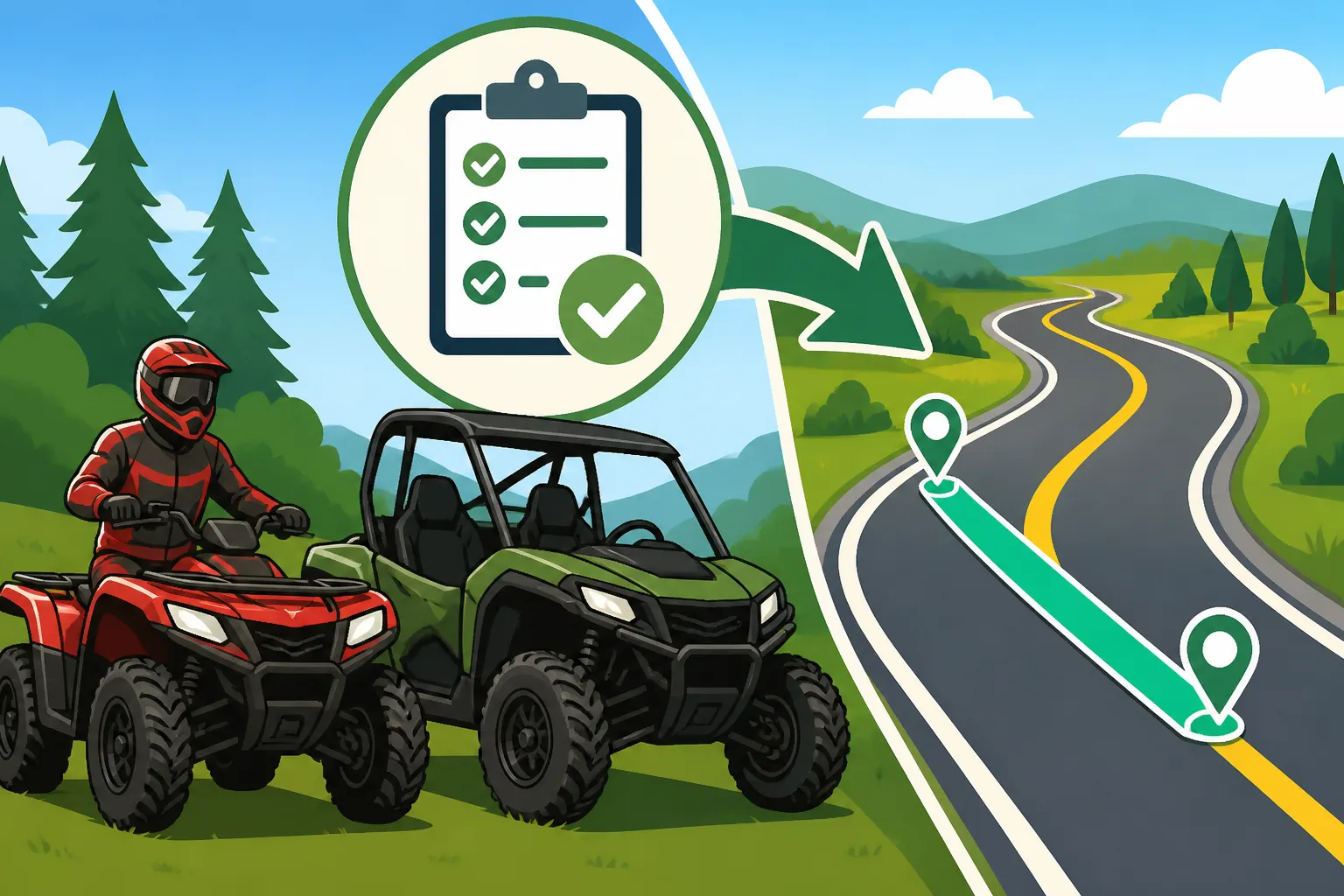
Getting a Highway Usage Permit for One Stretch
It's a familiar feeling for many New Brunswick ATV and side-by-side riders: you're out on a fantastic trail, maybe deep in the woods or along an old rail bed, only to find a short stretch of public highway or a village street stands between you and the next section of trail, or perhaps the gas station, or even your favourite lunch spot. That moment of frustration, wondering if you can legally make that short connection, is exactly what a Highway Usage Permit aims to address. This guide will walk you through understanding, applying for, and responsibly using these permits so you can bridge those gaps legally and safely.
Understanding the "Why" Behind Highway Usage Permits
For off-road vehicle enthusiasts, the freedom of the trail is paramount. However, our trails don't always connect seamlessly, and sometimes, a little piece of public road is unavoidable. The province, understanding the needs of riders while also prioritizing public safety, has provisions for these specific situations.
What a Highway Usage Permit Is (and Isn't)
A Highway Usage Permit is essentially an authorization to operate your registered off-road vehicle (ORV) on a specific, designated stretch of highway or public road that would otherwise be off-limits. It's not a blanket pass to ride your ATV or side-by-side on any road, anywhere, anytime. Think of it as a very specific, limited exemption from the general rule that ORVs belong off public roads. It's about connecting A to B when A and B are trail sections separated by a short stretch of blacktop, or getting to essential services like fuel.
It's crucial to understand what this permit is not. It doesn't magically make your ATV or side-by-side "street legal" in the way a car or motorcycle is. You still won't be cruising down Main Street in Fredericton during rush hour. These permits are typically for short distances, often explicitly stated on the permit itself, and usually on roads less traveled or within specific designated areas. The intent is practical connectivity, not turning your trail machine into a daily commuter. Misunderstanding this can lead to costly fines and potential dangers.
Common Scenarios Requiring a Permit
The need for a Highway Usage Permit often arises in rural communities where the trail network might crisscross municipal roads or provincial highways. For instance, you might be riding the QuadNB trail system near Plaster Rock, and the main trail uses a short portion of a secondary highway to bypass private land or a difficult terrain feature. Without a permit, making that connection would be illegal. Another common scenario is needing to access fuel, food, or lodging in a small town. The main trail might lead you close, but a small stretch of town street or provincial road is required to reach the gas pump or the diner.
These permits are vital for clubs too, who work hard to maintain the extensive [New Brunswick ATV Trails: The QuadNB Network]. Often, to link up segments of their trails, especially when traversing through villages or connecting to existing infrastructure like old rail beds, they rely on these permits for specific road sections. Riders accessing popular regions like the Miramichi riding areas or even the Skedaddle Ridge Trails might find themselves on short stretches of road permitted for ORV use. Always check your [New Brunswick ATV Trail Map Downloads] or the MapGear app for designated road-sharing sections.
The Safety Imperative
The entire concept of regulated ORV use on public roads, even for short stretches, is built around safety. When you're operating an off-road machine on a road designed for cars and trucks, you're entering a different environment with different speeds, traffic patterns, and expectations. These permits come with specific conditions precisely because of this safety imperative. You're expected to be extra vigilant, follow all road rules, and have your machine equipped for maximum visibility.
This isn't just about avoiding a ticket; it's about preventing accidents. A driver in a passenger vehicle might not be expecting an ATV to appear on a paved road, especially in areas not commonly known for ORV traffic. Ensuring your machine is equipped with the best possible lighting and mirrors, perhaps even considering aftermarket options like those from SuperATV, can make a significant difference in how visible you are to others. Wearing brightly coloured gear and adhering strictly to posted speed limits, or even riding below them, is paramount. Remember, these permits are a privilege, and responsible use is what keeps them available to all riders.
Navigating the Application Process
Getting a Highway Usage Permit isn't overly complicated, but it does require attention to detail and understanding who to talk to. It's not a one-size-fits-all process across the entire province, as the authority for issuing permits can vary depending on the road in question.
Identifying the Issuing Authority
This is often the first and most critical step. The issuing authority depends on who owns and maintains the road you intend to use. For roads managed by the provincial government (think most provincial highways and secondary roads), you'll likely be dealing with the Department of Transportation and Infrastructure (DTI). Their regional offices or specific permit divisions handle these applications. However, if the stretch of road is within a municipality – a town or village street, for example – then the local municipal council or their designated department would be the authority.
It’s not uncommon for riders to be unsure which authority to approach. A good starting point is often the local ATV club in the area where you want to ride. They are usually well-versed in [New Brunswick Municipal Bylaws That Open Roads] and how to apply for permits for specific stretches of highway. If you're planning a trip to the northern parts of the province, perhaps around Restigouche or Bathurst, a quick call to the local municipal office or the nearest DTI branch can clarify who holds jurisdiction over the specific road segment you need to cross. Don't be shy about asking questions; it saves a lot of headaches down the road.
Required Documentation and Information
When you approach the relevant authority, whether it's DTI or a municipal office, they will need specific information to process your application. Generally, you'll need to provide details about the specific ORV you intend to operate, including its registration information. This means having your [New Brunswick ORV Registration Explained] certificate handy. You'll also need to clearly define the exact stretch of road you wish to use – usually by identifying specific intersections, civic addresses, or distances along a road. Precision here is key, as permits are often granted for very short, defined segments.
Additionally, you'll likely need to provide proof of insurance, as [New Brunswick Requires Insurance on Trails] and certainly on any public road. Details about the operator, including their driver's licence information, will also be necessary. For those who are part of a club, sometimes the club will facilitate group applications for stretches of road that serve their trail network. Always be prepared to present your driver's licence (or [A Class 9 Licence Explained] if you're a young rider who qualifies) and proof that your ORV is properly registered and insured. Gathering all this paperwork beforehand will make the application process much smoother.
| Document/Information Required | Why It's Needed |
|---|---|
| ORV Registration Certificate | Proof of legal ownership and provincial registration. |
| Proof of Insurance | Mandatory for operating an ORV, especially on public roads. |
| Operator's Driver's Licence | Confirms the operator is legally permitted to drive. |
| Detailed Road Segment Map | Clearly defines the exact stretch of highway/road for the permit. |
| Purpose of Use | Helps authorities understand the necessity (e.g., trail connection, access to services). |
Submitting Your Application
Once you have all your documentation in order and know which authority to contact, it's time to submit your application. This can often be done in person at a DTI regional office or a municipal planning department, or sometimes by mail or email, depending on the specific authority and their process. Be prepared for a processing time, as these permits often require review to ensure safety and adherence to local bylaws. It's not usually an on-the-spot approval process.
When submitting, it's always a good idea to keep copies of everything you submit for your own records. If there's an application fee, be prepared to pay it. The fees are typically nominal, covering administrative costs. During this stage, remember to be patient. Staff are often dealing with many requests, and clear, concise communication from your end will be appreciated. Follow up politely if you haven't heard back within the expected timeframe. Getting a [New Brunswick Highway Usage Permit] is a formal process, but one that is well worth it for the peace of mind and legal riding it provides.
Key Conditions and Responsibilities of Permit Holders
Obtaining a Highway Usage Permit is just the first step. The permit comes with a set of specific conditions, and it's your responsibility as a rider to understand and adhere to every single one. Failure to do so can result in fines, the revocation of your permit, and even serious accidents.
Understanding Permit Restrictions
Every Highway Usage Permit will clearly outline the specific restrictions and conditions under which you can operate your ORV on the designated road segment. These typically include:
- Designated Route and Distance: The permit will specify the exact road numbers, names, and the length of the stretch you are allowed to use. Deviating from this route, even by a short distance, can put you in violation. This isn't a suggestion; it's a legal boundary. If your permit says you can ride on Route 105 for 200 metres between Elm Street and Oak Avenue, that's exactly what you do. No more, no less.
- Operating Hours: Some permits might specify certain hours of the day during which ORV use is permitted, often to avoid peak traffic times. Always check these details carefully. [New Brunswick Rules for Riding After Dark] are already strict, and a permit might add further specific limitations.
- Speed Limits: You will be expected to adhere strictly to the posted speed limits for the road you are on. In fact, many recommend riding at a reduced speed, even below the limit, to enhance safety and allow for better reaction time from both you and other motorists.
- Vehicle Type: The permit might specify the type of ORV (e.g., ATV, side-by-side) that is allowed. Ensure your machine matches the permit's specifications.
- Purpose of Use: While often implied, the permit's purpose (e.g., trail connectivity, access to services) reinforces that it's not for recreational joyrides on the highway.
These restrictions are not arbitrary; they are put in place to integrate ORV use as safely as possible into the existing road infrastructure. Disregarding them not only puts you at risk but also jeopardizes the ability of other riders to obtain similar permits in the future.
Operator and Machine Requirements
Beyond the route and time restrictions, there are also strict requirements placed on both the operator and the machine itself when using a permitted highway stretch.
- Operator Qualifications: The operator must hold a valid driver's licence (Class 5 or equivalent) or a Class 9 ORV licence if they are 14 or 15 years old and meet all other requirements, including having a [New Brunswick Driver Training Certificates] and being escorted by a qualified adult. Regardless of age, [New Brunswick Helmet Law for Every Occupant] mandates that all riders and passengers must wear an approved helmet. This is non-negotiable and strictly enforced.
- Machine Equipment: Your ORV must be equipped to a standard that allows it to safely share the road with other vehicles. This typically includes:
- Working Headlights and Taillights: Essential for visibility, especially during dawn, dusk, or adverse weather conditions. [New Brunswick Lighting Requirements at Night] are specific and must be met.
- Brake Lights: To signal braking to vehicles behind you.
- Rear-View Mirrors: At least one mirror, but two are highly recommended, to give you a clear view of traffic approaching from behind. Aftermarket mirrors, perhaps from a brand like SuperATV, can often offer wider fields of view and greater durability.
- Muffler: Your machine must have an effective exhaust system to keep noise levels within legal limits. Excessive noise can draw unwanted attention and erode public acceptance of ORV use on roads.
- Plate and Sticker: Your provincial registration plate must be clearly displayed, along with your current registration sticker. Your [New Brunswick Plate Placement on a Quad] should ensure it's visible.
Always carry a copy of your permit, along with your [New Brunswick Documents You Must Carry], including your registration and proof of insurance, on your person or securely on your machine. An officer could ask to see these at any time.
Maintaining Your Permit and Records
A Highway Usage Permit is not necessarily a one-time acquisition. Depending on the authority and the specific permit, it might have an expiration date, requiring annual or periodic renewal. It's your responsibility to keep track of this. Just like your [New Brunswick Registrations Expire December 31] each year, these permits often have a validity period. Ensure you understand how long your permit is valid and what the renewal process entails. Some permits, especially those issued for specific events or short periods, will be clearly marked as such.
Furthermore, if there are any changes to your machine (e.g., you sell it and buy another, or make significant modifications) or your personal information, you should check if these changes affect your permit's validity. Keeping clear records of your application, the permit itself, and any communications with the issuing authority is always a good practice. This documentation can be invaluable if there are any questions or disputes about your right to operate on a specific road segment.
Practical Considerations for Riding Permitted Stretches
Even with a permit in hand, riding your ORV on a public road, even a short, designated stretch, requires a shift in mindset and specific practical precautions. It's different from the trail, and treating it as such is vital for your safety and the perception of all riders.
Pre-Ride Checks and Safety Gear
Before you even turn the key to venture onto a permitted highway stretch, a thorough pre-ride check of your machine is non-negotiable. This is where the rubber literally meets the road, and any mechanical issues can become significantly more dangerous than on a loose trail. Check your tire pressure, ensuring it's appropriate for pavement use if you'll be on it for more than a few hundred feet (often higher than trail pressures for better handling and wear). Verify that all lights are functioning – headlights, taillights, and brake lights – and that your mirrors are clean and properly adjusted. Check your brakes for responsiveness and your steering for any play.
Beyond the machine, your personal safety gear is paramount. Your approved helmet is a given, but consider wearing highly visible clothing, perhaps even with reflective elements, especially if there's any chance of low light conditions. Bright colours make you stand out. While full body armour might be overkill for a short road stretch, sturdy boots, gloves, and protective outerwear are always recommended. Think about how you would dress for a motorcycle ride; the risks on a paved surface are similar when sharing with larger vehicles. For those moments when you are on the pavement, [New Brunswick Equipment a Rider Must Carry] extends beyond just your papers to include your personal protective equipment.
Etiquette and Road Sharing
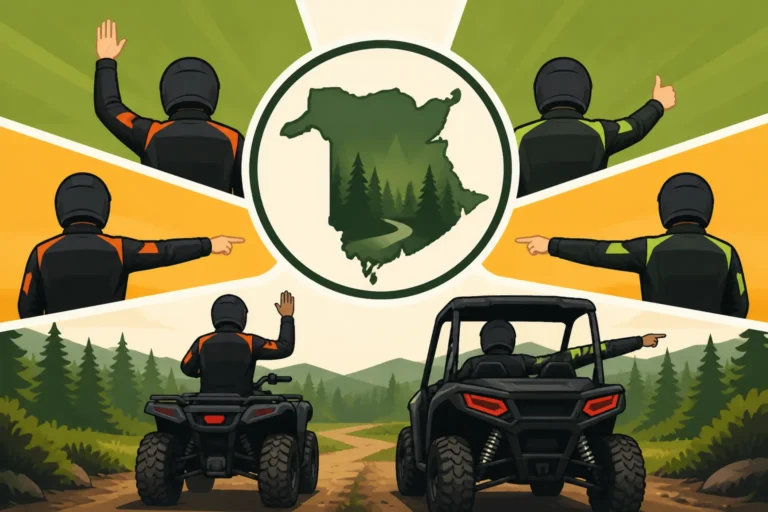
When you enter a public road with your ORV, you become part of the general traffic flow. This means adhering to all rules of the road, just like any car or truck. Signal your turns using your machine's indicators if it has them, or clear [New Brunswick Hand Signal Requirements] if it doesn't. Maintain a safe following distance, and be aware of vehicles around you. Expect cars to pass you, and make it easy for them to do so safely by staying to the right of your lane. Avoid sudden movements or erratic driving.
Be particularly mindful at intersections and when entering or exiting the permitted stretch. Slow down, look both ways, and yield when required. Remember the [New Brunswick Quads Yield to Motor Vehicles] rule. The general public's perception of ORV riders is heavily influenced by how responsibly we act on shared roads. Every time you ride legally and safely on a permitted stretch, you're contributing positively to that perception, helping to secure future access for everyone. Conversely, reckless behaviour can swiftly lead to permit revocations and more restrictions.
Potential Pitfalls and Enforcement
Despite having a permit, there are still potential pitfalls. One of the biggest is simply forgetting you have the permit and getting lax about the rules. It's easy to get comfortable, but complacency on a public road is dangerous. Another pitfall is assuming all short road segments are covered by a permit; they are not. Your permit is for a specific stretch. Riding on an unpermitted section, even if it's identical to a permitted one nearby, is a violation.
Enforcement of ORV laws on public roads is often handled by the RCMP or local police, just like any other traffic law. They are well aware of the regulations, including those surrounding Highway Usage Permits. If you are stopped, be polite, produce your permit and other required documents promptly, and cooperate fully. [New Brunswick Penalties for Riding Unregistered] or [New Brunswick Penalties for Riding Uninsured] are significant, and even riding on a permitted stretch without the permit itself could lead to [New Brunswick No-Registration Fine of $172.50] or worse, if the officer deems you to be operating illegally without proper authorization. Officers also conduct [New Brunswick Equipment Checks by Officers], so ensure your machine is compliant.
Beyond the Permit: Local Bylaws and Future Planning
While provincial regulations provide the framework for ORV use, local communities often have their own specific bylaws that can impact where and how you ride. Understanding this local layer is crucial for responsible riding and contributing to the future of our sport.
Connecting with Local Clubs and Information
Local ATV clubs, like the many that comprise the QuadNB Federation, are often the best source of up-to-date information on Highway Usage Permits and local riding regulations. These clubs work directly with municipalities and provincial authorities to establish and maintain trail networks, which often include securing permits for road crossings and short road sections. They are intimately familiar with [New Brunswick Local Bylaws and Where to Find Them] in their specific areas.
Many clubs actively lobby for more rider access and can inform you about the specific roads that are open to ORVs, either through a permit or a local bylaw. Joining a local club not only supports the maintenance of trails but also keeps you informed about changes to regulations, group rides, and community events. For example, if you're planning a trip to ride the trails around Juniper or Florenceville-Bristol, connecting with the local club there can give you invaluable insights into specific road access points and any local nuances. Their websites and social media channels often share updates on [New Brunswick Trail Conditions Before You Go] and legal riding areas.
Advocacy for Rider Access
The continued availability of Highway Usage Permits and the expansion of legal road access for ORVs are not guaranteed; they are often the result of ongoing advocacy efforts by riders and clubs. Every time you ride responsibly on a permitted stretch, you're reinforcing the message that ORVs can coexist safely with other road users. Conversely, irresponsible behaviour makes it harder for clubs and associations to make the case for expanded access.
Consider getting involved with your local club or even the QuadNB Federation. Their work helps to shape future legislation and agreements that benefit all riders. Issues like [New Brunswick's 7.5 Metre Rule From a Highway] or the push for [New Brunswick Ministerial Designations] to open more specific road sections are ongoing efforts where rider support makes a difference. Your voice, combined with others, can help ensure that our provincial trail network continues to grow and connect, reducing the need for illegal road use.
Future Developments and Regulations
The landscape of ORV regulations is not static. As communities grow, traffic patterns change, and new safety concerns emerge, regulations can and do evolve. What might be permitted today could be restricted tomorrow, or vice versa. For instance, there have been past discussions about how to better manage [New Brunswick Snowmobile and Quad Sharing] on certain road sections, or the designation of more shared highway stretches.
Stay informed by regularly checking official government websites (Service New Brunswick, DTI) and the QuadNB Federation for updates. These sources will communicate any changes to permit requirements, application processes, or the rules governing ORV use on public roads. Being proactive about staying informed is crucial for any responsible rider in New Brunswick. The more we understand and respect the regulations, the more sustainable and enjoyable our riding experiences will be for everyone.
Disclaimer
This article is for general informational purposes only and does not constitute professional advice. Laws, prices and regulations vary by location and change over time. Consult a qualified professional for guidance on your specific situation.