Buying From a Seller in Quebec
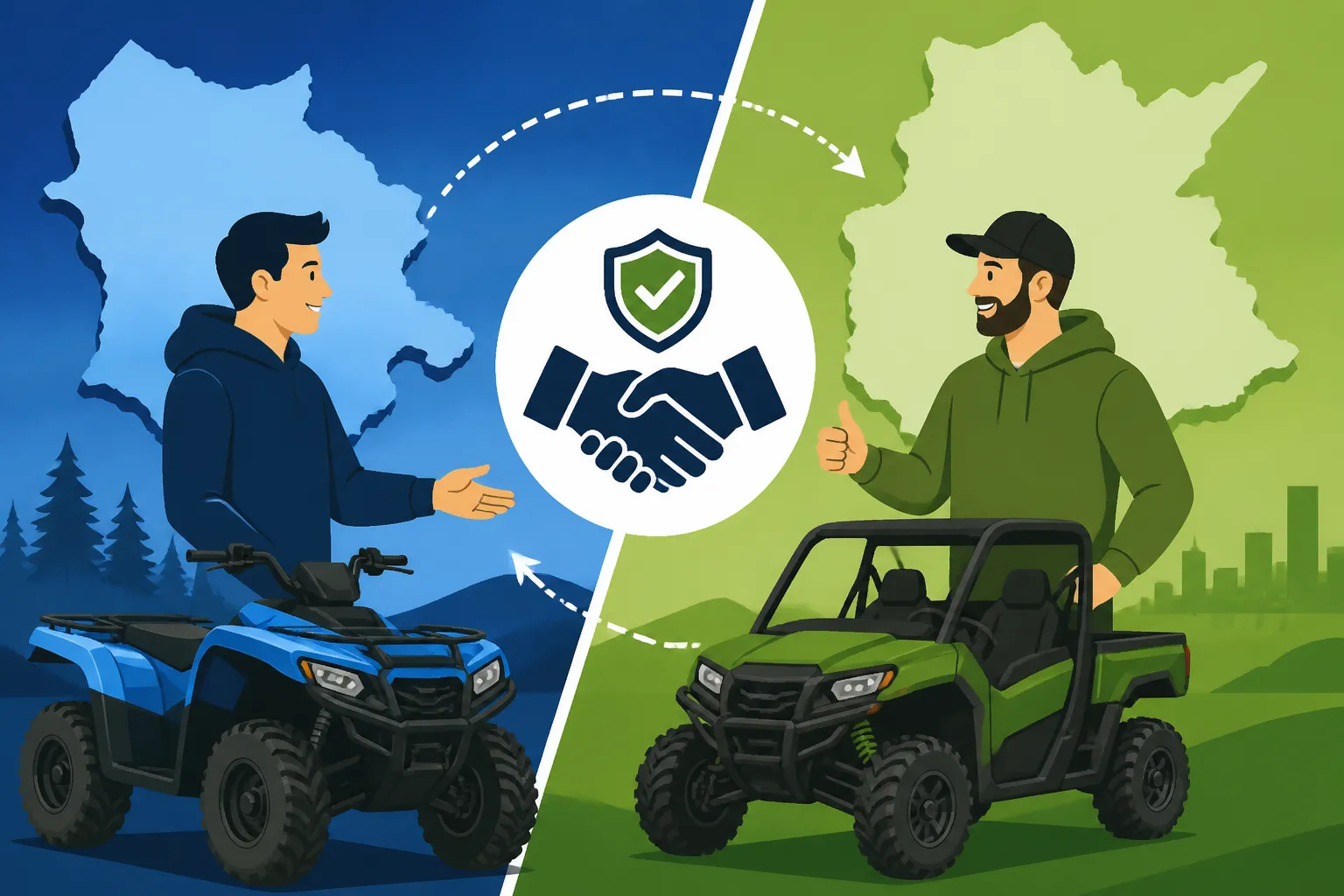
So, you’ve found that perfect ATV or side-by-side just over the border in Quebec. Maybe the price was right, maybe it was a specific model you’ve been hunting for, or perhaps the selection simply blew New Brunswick options out of the water. Whatever the reason, bringing an off-road vehicle across provincial lines can feel like stepping into a bureaucratic maze, especially when it comes to taxes and registration. But don't you worry, because this guide is here to walk you through the entire process of purchasing an ORV from a private seller in Quebec and getting it properly registered for the trails here in New Brunswick.
The Initial Hurdles of Out-of-Province Purchases
It's completely understandable to be drawn to a great deal or a unique machine that pops up for sale in Quebec. Our neighbours just next door have a vast market, and sometimes, you simply find what you're looking for there. However, it's crucial to remember that while the machine itself might be similar to what you'd find in New Brunswick, the process of bringing it home and making it trail-legal is anything but. The administrative side can be a headache, but with a bit of foresight and the right information, it's totally manageable.
Why Quebec? Understanding the Appeal and the Differences
There are plenty of reasons why a New Brunswick rider might look to Quebec for their next off-road vehicle. Sometimes, the sheer volume of listings means more competition among sellers, potentially leading to better prices. Other times, it's about finding that rare vintage quad or a specific trim level of a side-by-side that just isn't available locally. You might even find a machine that's been impeccably maintained, owned by someone who rarely hit the trails. The initial excitement of finding "the one" can easily overshadow the impending paperwork mountain.
The key difference, and often the source of frustration, lies in the provincial regulations and tax structures. What's perfectly normal for a private sale in Quebec might require additional steps or documentation when you cross into New Brunswick. You can't just slap a New Brunswick plate on it and go; there's a specific, multi-step process. Understanding these differences from the outset will save you a lot of headaches and potential delays down the line. It's not about discouraging you from buying in Quebec, but rather equipping you with the knowledge to make it a smooth transaction.
The Key Documents You'll Need from the Seller
This is where the rubber meets the road, or rather, where the ink meets the paper. The documents you secure from the Quebec seller are absolutely critical for a smooth registration process in New Brunswick. Without them, you're essentially buying a very expensive paperweight. Don't be shy about asking for these things upfront – a legitimate seller will understand and provide them.
First and foremost, you need a comprehensive Bill of Sale. This isn't just a scribble on a napkin; it needs to be a proper legal document. It should clearly state the full names and addresses of both the seller and the buyer, the date of the sale, the purchase price, and a detailed description of the ORV, including its make, model, year, and crucially, the Vehicle Identification Number (VIN). The VIN is paramount for proving ownership and registering the machine. If you're unsure how to draft a solid bill of sale, services like LawDepot can provide templates that cover all the necessary legal bases, ensuring both parties are protected and that Service New Brunswick will accept the document.
Secondly, you should always request a copy of the ORV's Quebec registration certificate. This document proves that the person selling the machine is the legal owner in Quebec. You want to make sure the seller's name on the registration matches the name on their identification and on the bill of sale. Any discrepancies here should be a huge red flag and should be investigated thoroughly before you hand over any money. This step is vital for avoiding potential fraud and ensuring you're buying from the rightful owner.
Lastly, and this is a big one, you should strongly consider asking the seller for proof of a lien search, or better yet, conduct one yourself if possible. An ORV with an outstanding loan against it means the lender still has a claim on the machine, even if it's sold. You certainly don't want to unknowingly inherit someone else's debt. While not always mandatory for registration, clearing any liens ensures a clean title transfer and protects your investment. Being thorough with these documents will make the subsequent steps in New Brunswick much easier, as Service New Brunswick staff rely heavily on accurate paperwork to process your [New Brunswick Transfer of Ownership Explained].
Navigating Customs and Taxes When Importing from Quebec
Once you've got the machine and the necessary paperwork in hand, the next big hurdle is dealing with taxes and getting your ORV officially recognized as being in New Brunswick. This isn't like crossing a country border where customs might be involved, but there are still important financial considerations when moving property from one province to another, especially regarding sales tax.
Harmonized Sales Tax HST and Provincial Sales Tax QST Implications
New Brunswick operates under a Harmonized Sales Tax (HST) system, which combines the federal Goods and Services Tax (GST) with a provincial sales tax into one rate. Quebec, on the other hand, has its own provincial sales tax (QST) in addition to the federal GST. This difference can lead to confusion and is often a sticking point for buyers.
When you purchase an ORV from a private seller in Quebec, you will generally not pay QST to the private seller. You are essentially responsible for paying the New Brunswick HST on the fair market value of the machine when you register it at Service New Brunswick. Even if you mistakenly paid some form of provincial sales tax in Quebec (which is unlikely in a private sale), New Brunswick's HST will still apply. The Service New Brunswick agent will calculate the HST based on the purchase price stated on your bill of sale or their own valuation if they deem your declared price to be too low. This is a crucial financial aspect, so make sure you factor the [New Brunswick HST on an ATV Purchase] into your total cost.
The calculation can sometimes be tricky. If the Quebec seller provided you with a receipt showing they collected QST, you would still be liable for the HST in New Brunswick. However, private sellers typically do not collect sales tax. Therefore, expect to pay the full New Brunswick HST when you go to register your ORV. It’s always best to be prepared for this expense, as it’s a non-negotiable part of bringing an out-of-province machine onto the books here.
The Importance of the Bill of Sale for Tax Assessment
The bill of sale isn't just for proving ownership; it's also the primary document Service New Brunswick uses to assess the HST you owe. This is why having an accurate and complete bill of sale is incredibly important. The purchase price you list on that document will be the basis for the tax calculation.
However, Service New Brunswick isn't just going to take your word for it, especially if the price seems unusually low. They have their own internal valuation guides and systems to determine the fair market value of off-road vehicles. If the price on your bill of sale is significantly lower than what they determine the machine is actually worth, they reserve the right to assess the HST based on their valuation, not your declared purchase price. This is to prevent people from artificially lowering the declared price to avoid paying their fair share of taxes. So, while you might be tempted to list a lower price, it's generally not worth the risk, as you could end up paying HST on a higher amount than you expected anyway, potentially facing questions about your declared value. A clear, honest, and comprehensive bill of sale, perhaps using a template from a reputable source like LawDepot, will streamline this process considerably.
What If the Machine is a Gift or Very Low Price?
Sometimes, you might acquire an ORV from a friend or family member in Quebec as a gift, or you might purchase it for a nominal fee, perhaps just to cover the cost of a new battery. While this seems straightforward, the New Brunswick tax rules still apply, often in a way that surprises new owners.
Even if an ORV is gifted to you, or purchased for an amount like "one dollar," Service New Brunswick will still assess HST based on the machine's fair market value. They will use their valuation guides to determine what the ORV would typically sell for and calculate the HST on that amount. This means you can't bypass the sales tax simply because no money exchanged hands or only a token amount was paid. This policy ensures fairness and prevents people from using gifts or extremely low prices to avoid paying taxes on valuable assets.
So, if you're receiving a gift, be prepared for the fact that you'll still have to pay HST on its estimated market value. It's a common point of misunderstanding, but it's a standard practice across the province. Always budget for this tax, regardless of the direct transaction cost, to avoid any surprises when you're at the Service New Brunswick counter.
Registering Your Quebec-Bought ORV in New Brunswick
Now that you’ve handled the purchase and understood the tax implications, it’s time for the final, crucial step: getting your ORV officially registered in New Brunswick. This is where you transform your Quebec purchase into a trail-ready machine for our beautiful province.
The Service New Brunswick Process Step-by-Step
Getting your ORV registered is typically done in person at one of the many [New Brunswick Service Centres That Register ORVs]. It's a straightforward process if you have all your ducks in a row.
First, gather all your essential documents. This includes the completed bill of sale, the Quebec registration certificate (if the machine was previously registered in Quebec), and valid personal identification (like your driver's license). You'll then head to your chosen Service New Brunswick location. Once there, you’ll be guided to a counter where a representative will assist you. You’ll need to [Fill Out the Application for Vehicle Registration], providing all the necessary details about yourself and your new-to-you ORV. The VIN on the bill of sale and any previous registration will be verified here.
The Service New Brunswick agent will then process your application, calculate the HST based on the purchase price or fair market value, and collect the applicable registration fees. For example, [New Brunswick Charges $41 for an ATV] annually. They will also collect the fee for the physical plate itself. This is also the point where you'll need to demonstrate that you have the required liability insurance for your ORV, as [New Brunswick Requires Insurance on Trails]. You will need to show proof of insurance, typically your pink slip, to complete the registration. Once everything is paid and approved, you'll walk out with your new New Brunswick ORV registration certificate and your shiny new licence plate, ready to be affixed to your machine.
Common Pitfalls and How to Avoid Them
Even with the best preparation, sometimes things can go sideways. Knowing the common pitfalls can help you avoid them, saving you time, frustration, and perhaps another trip to Service New Brunswick.
One significant issue can be a missing or unclear VIN. The Vehicle Identification Number is like your ORV's fingerprint, and it must be clearly legible and match all your documentation. If the VIN is rusted, painted over, or simply not present on your bill of sale, you might face delays. Service New Brunswick may require a physical inspection or even additional affidavits to confirm the machine's identity, especially if it appears to be a [New Brunswick Registration When the VIN Is Gone]. Always double-check the VIN's clarity and presence on all documents before you even leave Quebec.
Another common problem is an incomplete or improperly filled-out bill of sale. A hurried transaction might lead to missing information, incorrect dates, or an omitted VIN. As mentioned earlier, this document is vital for both ownership and tax assessment. Ensure it’s thoroughly completed. Using a pre-made template, like those from LawDepot, can help ensure all critical fields are covered, minimizing the chances of rejection.
Discrepancies between documents can also cause significant headaches. What if the seller's name on the Quebec registration doesn't match the name on the bill of sale? This could indicate an uncompleted previous transfer or a potential ownership issue. Service New Brunswick will want a clear chain of ownership. Similarly, if the declared value on your bill of sale seems excessively low, expect questions. They are diligent about fair tax collection and will not hesitate to use their own valuation system to calculate the HST due. Addressing these potential issues before you go to register will make the process much smoother.
What About a Machine Without Previous Quebec Registration?
While less common for a used machine, sometimes you might encounter an ORV from Quebec that doesn't have a previous registration certificate. This could be a brand new machine purchased from a dealer (though this guide focuses on private sales) or an older machine that was never officially registered in Quebec, perhaps because it was used exclusively on private land.
For a brand-new machine purchased from a dealer, you would typically receive a Manufacturer's Statement of Origin (MSO). This document acts as the initial proof of ownership from the manufacturer and is used for the very first registration of the vehicle. [An MSO at a Service New Brunswick Counter] is a perfectly acceptable document for registering a new machine here in New Brunswick.
For older machines without any prior registration in Quebec, the process can be a bit more involved. Service New Brunswick will still need to verify ownership and the machine's identity. This might involve additional steps such as a sworn affidavit from the seller attesting to their ownership and how they acquired the machine, or even a physical inspection by law enforcement or a Service New Brunswick official to verify the VIN. It's crucial to be upfront with Service New Brunswick about the lack of prior registration. They will guide you through the specific requirements, which may differ based on the age and type of the ORV. While it adds a few extra hoops to jump through, it's not an impossible situation, just one that requires more diligence and possibly more patience.
| Document Type | From Quebec Seller (Highly Recommended) | For New Brunswick Registration (Required) | Notes |
|---|---|---|---|
| Bill of Sale | Yes (Detailed & Complete) | Yes (Original or Certified Copy) | Must include VIN, buyer/seller info, date, price. Essential for tax. |
| Quebec Registration | Yes (If previously registered) | Yes (To show ownership history) | Verifies seller as legal owner in Quebec. |
| Proof of Lien Search | Recommended | No (But protects buyer) | Ensures machine has no outstanding debts. |
| Personal ID | Not from seller | Yes (Your valid driver's licence/ID) | To verify buyer's identity. |
| Proof of Insurance | Not from seller | Yes (New Brunswick Liability) | Must show current New Brunswick ORV insurance. |
| MSO (New Machine) | Yes (If applicable) | Yes (If no previous registration) | Manufacturer's Statement of Origin for first-time registration. |
In the end, while buying an ORV from Quebec can offer some fantastic opportunities, it definitely comes with its own set of administrative steps. Don't let the paperwork intimidate you. With a solid bill of sale, verification of the seller's ownership, and an understanding of the tax and registration process in New Brunswick, you'll be hitting our beautiful trails in no time. Prepare your documents, budget for the HST, and don't hesitate to ask questions at Service New Brunswick if you're unsure about anything. Happy riding!
Disclaimer
This article is for general informational purposes only and does not constitute professional advice. Laws, prices and regulations vary by location and change over time. Consult a qualified professional for guidance on your specific situation.