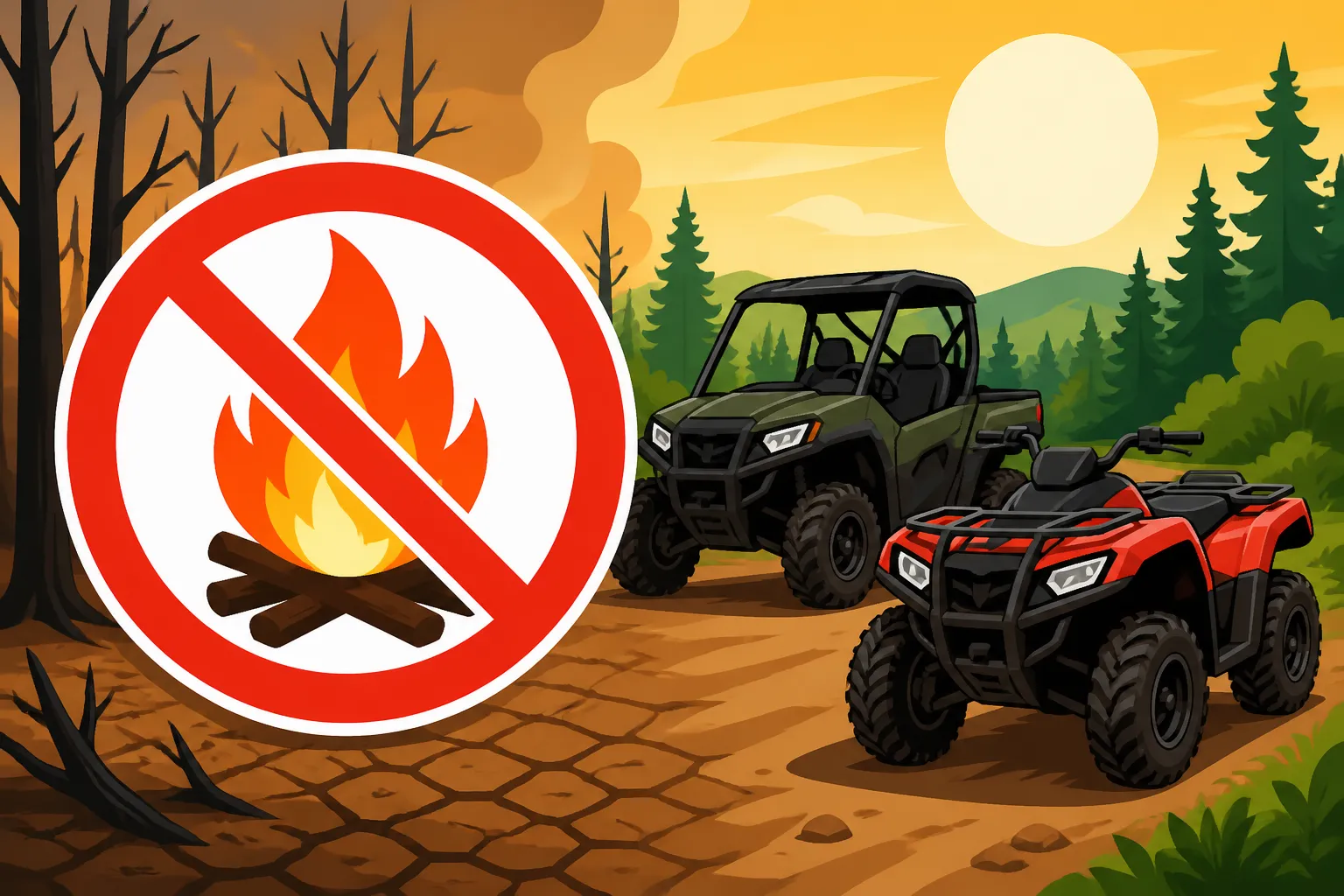
New Brunswick Fire Restrictions in Dry Summers
Dry summers can turn an ordinary ATV or UTV ride into a fire-risk decision. In New Brunswick, restrictions may change with conditions and can differ by location, so a ban on open fires is not the only notice to check. Here’s how to find current rules, understand what they mean for riding, and reduce the chance your machine starts a fire.
Check the Current Restrictions Before You Ride
Fire restrictions can change as weather and forest conditions change. A notice that applied last week may no longer apply, and a restriction in one area may not cover another. Check official provincial fire information and relevant local notices on the day you plan to ride. If your route crosses municipal boundaries, private woodlots or Crown land, check that your intended access is permitted at each part of the route.
Do not rely on an old screenshot, a social media post without a date, or a restriction notice from another province. If wording is unclear, contact the authority that issued the notice or the local club responsible for the trail. New Brunswick Trail Conditions Before You Go covers other useful checks to make before setting out.
A useful distinction: an open-fire ban does not necessarily mean all ATV or UTV riding is prohibited. But it also does not guarantee that riding is allowed. A separate closure or direction may restrict access to a particular trail, forest area or road. Read the notice itself rather than inferring what it permits from the word “fire ban.”
| Notice or restriction | What to check | What it may mean for your ride |
|---|---|---|
| Open-fire restriction | Which activities and locations are covered | Do not light a campfire or use an appliance if the notice prohibits it |
| Trail or area closure | The exact boundary, route and effective dates | Do not enter or ride through the closed area |
| Access or forestry restriction | Who issued it and which roads or land it covers | Your planned route may be unavailable even if nearby trails are open |
| Local municipal notice | The municipality and activities named | A local rule may apply in addition to provincial direction |
| Unclear or changing conditions | Whether the notice is current and authoritative | Delay the ride until you can confirm what is allowed |
Check the whole route, not just the trailhead. A ride that begins on an open trail may pass into an area with different access conditions. On Crown land, permitted access and fire restrictions are separate questions; review New Brunswick Crown Land Riding Rules as well. For private land, make sure you have permission and know any landowner conditions. New Brunswick Private Woodlot Permission explains why access permission should not be assumed.
Understand What a Fire Restriction Does and Does Not Allow
Fire restrictions are instructions about specific activities, places or conditions. They are not all interchangeable. One notice may prohibit open burning, while another may close an area or limit access. Some activities that seem low-risk to a rider—such as using a portable stove, smoking or stopping in dry vegetation—may still be restricted or unsafe.
Read the wording closely. Look for the named area, the activities covered, the dates or conditions that end the restriction, and any exceptions. If an exception is unclear, do not treat it as permission. A trail permit, landowner’s permission or a route shown on a map does not override a fire-related closure or other applicable direction. Similarly, a fire restriction does not automatically answer whether a trail permit is required. Keep those requirements separate.
Before leaving, decide what you will do if the route is closed or conditions worsen. Choose an alternate route only after checking that it is open and that you are allowed to use it. Do not ride around a gate, closure sign or blocked section to get back onto the route. A detour can take you onto private land, a closed corridor or dry ground that is especially vulnerable to damage.
Conditions can also change during the day. If a restriction comes into effect while you are out, follow the instructions that apply and leave the affected area by a permitted route. If you cannot tell whether your route is affected, stop somewhere safe and confirm before continuing. New Brunswick Trail Closures After Rain explains why route conditions and closures are worth checking again rather than treating a morning plan as fixed.
Reduce Fire Risk From the ATV or UTV
A machine can be hot after normal use. The exhaust and other components can ignite dry grass, leaves or brush if they contact them. A small spark or smouldering material can also become a serious problem when the ground and vegetation are dry. Good habits do not replace a restriction, but they lower avoidable risk.
Choose stops carefully
When you stop, use a firm, open surface away from dry grass, leaves, brush and slash. Avoid parking over vegetation or letting a hot exhaust sit close to material that could catch. Do not idle in dry brush or leave the machine unattended in a spot where heat could start a fire. If a trail surface is covered in dry vegetation, move to a safer permitted stopping place rather than pulling off into the woods.
Stay on the marked corridor. Riding around a wet patch, obstruction or crowded stopping area can put your machine into vegetation and widen the disturbed area. If a section does not look safe to pass, turn back or use an approved reroute. Staying on a Marked New Brunswick Corridor explains why leaving the route can create problems beyond the immediate stop.
Avoid ignition sources
Do not smoke or discard cigarette material in the woods. Do not use fireworks, open flames or portable cooking equipment unless current rules permit them and you can use them safely. Never assume that a cleared patch beside a trail is an approved place for a fire.
A restriction may ban an activity even when you have water or an extinguisher with you. Carrying firefighting equipment is not a substitute for following the notice. When there is any doubt about whether an activity is allowed, skip it.
Check the machine before and during the ride
Look for debris around hot components, especially after riding through tall grass, leaves or brush. Remove buildup only when the machine is safely stopped and cool enough to handle. Check that the exhaust area is not damaged or unusually hot, and deal with maintenance concerns before riding in dry conditions.
Avoid dragging chains, metal parts or other gear where they can strike the ground. Secure cargo so it cannot fall or rub against hot components. If a machine has a mechanical fault that creates unusual heat, smoke or a burning smell, stop in a safe location and shut it down. Do not keep riding in the hope that the problem will clear.
Carry equipment you can reach
A compact vehicle-rated fire extinguisher can be a useful precaution, especially on a group ride, but it is only appropriate for a small fire that can be approached safely. Secure it so it cannot shift or become a hazard, and make sure the rider can reach it quickly. Check the manufacturer’s instructions and service condition before relying on it. Retailers such as Amazon may list vehicle-rated extinguishers, but confirm that the specific unit is suitable for your machine and that it can be mounted securely.
Carry a charged phone where service is available, and tell someone your route and expected return time. If you ride in an area with limited reception, plan how you will call for help if needed. New Brunswick Equipment a Rider Must Carry offers a broader checklist for a trail ride, and New Brunswick Trail Conditions Before You Go can help with route and communication planning.
What to Do if You See Smoke or a Fire
If you see smoke, flames or a spreading patch of burning vegetation, treat it as an emergency. Do not assume someone else has already reported it. Get yourself and other riders away from immediate danger, then contact emergency services when it is safe to do so. Give the clearest location you can: a trail name or marker, nearby road, landmark, direction of travel or GPS coordinates if available.
Do not ride toward a fire to investigate, take photos or look for a way through. Smoke can reduce visibility and affect breathing, while a fire can move quickly and cut off the route you used to enter. Leave by a safe, permitted route if one is clear. If there is no safe route, move away from the fire and follow emergency responders’ instructions rather than attempting a risky crossing.
Only try to extinguish a very small, contained fire if it is safe to do so, you have suitable equipment, and you have a clear escape route. If the fire is spreading, producing heavy smoke, or close to fuel or vegetation, back away and call for help. A small extinguisher may control a brief flare-up, but it cannot make an unsafe situation safe.
After reporting the fire, follow instructions from responders or land managers. Do not return to a closed area to retrieve equipment unless authorities say it is safe and access is permitted. If you see damage on a trail that could create a hazard or make a fire more likely, report it to the responsible club or land manager. Keep the message factual: where it is, what you saw and whether anyone is in immediate danger. New Brunswick Trail Etiquette Locals Expect covers responsible ways to share and care for trail corridors.
Dry-weather riding calls for a little more planning: confirm the current restriction, check every part of your route, keep the machine out of dry vegetation and leave promptly if conditions or instructions change. When a notice is unclear, pausing the ride is safer than guessing.
Disclaimer
This article is for general informational purposes only and does not constitute professional advice. Laws, prices and regulations vary by location and change over time. Consult a qualified professional for guidance on your specific situation.