Tow Straps on a Muddy Miramichi Loop
A muddy Miramichi trail can turn a routine ride into a frustrating recovery fast: tires spin, the machine settles deeper, and a helpful pull can become risky if the gear or attachment point is wrong. This guide explains how to choose and use a tow strap, prepare for a stuck ATV or UTV, and make safer decisions before mud becomes a bigger problem.
Prepare for a Muddy Miramichi Ride
Check trail conditions before setting out
Mud depth and traction can change across a single ride. A shaded section may stay soft after rain, while an exposed stretch firms up; a familiar crossing can also become rutted or waterlogged. Check trail conditions before leaving and look for club notices or closures, especially after heavy rain or during spring thaw. New Brunswick Trail Conditions Before You Go and New Brunswick Trail Closures After Rain are useful starting points when planning a route.
The Miramichi area includes long stretches where help may not be close by. Before riding, tell someone where you expect to go and when you plan to return. Share your route, not just the name of a trail system. A mapping app such as onX Offroad can help you review a route before departure; check its map and offline-use options ahead of time rather than relying on a phone signal in the woods.
Plan for the possibility that conditions will be worse than expected. Carry enough fuel for a slower ride, bring water and basic first-aid supplies, and dress for getting wet or waiting outside. A strap is useful equipment, but it does not replace a ride plan, a charged phone, or a second person who knows where you are.
Pack recovery gear that suits the machine
A small utility strap from a garage may not be appropriate for pulling an ATV or UTV. Choose recovery equipment intended for vehicle recovery, and follow the manufacturer’s instructions for the strap, shackles, and any other hardware. Check the product label and documentation for its rated use. Do not assume that a strap’s breaking strength is the same as its working load limit.
Inspect the strap before every ride. Look for cuts, fraying, pulled stitching, damaged eyes, contamination, or signs that it has been dragged over sharp edges. Mud can hide damage, so rinse and dry the strap after use, then store it where it will not be cut or crushed by tools. Retire damaged gear rather than trusting it for one more pull.
A practical recovery kit may include a rated strap, compatible recovery hardware, gloves, and a way to protect the strap from sharp contact where the manufacturer allows it. Bring equipment that you already know how to use. If you carry a spare belt for a remote ride, keep it protected and accessible rather than buried beneath cargo; Carrying a Spare Belt in the Woods covers another common breakdown to plan for.
| Gear or decision | What it helps with | Important check |
|---|---|---|
| Vehicle recovery strap | Connecting a stuck machine to a recovery vehicle | Confirm its intended use and rating; inspect for damage |
| Compatible recovery hardware | Connecting the strap at approved points | Check compatibility and the manufacturer’s instructions |
| Gloves | Handling muddy or abrasive gear | Make sure they still allow a secure grip |
| Route plan | Helping others locate your group | Share the route and expected return time |
| Recovery plan | Preventing an improvised, risky pull | Identify suitable machines, attachment points, and bystander positions |
Use a Tow Strap Without Making the Situation Worse
Decide whether a pull is appropriate
First, stop spinning the tires. Repeated throttle can dig the machine deeper, turn a shallow rut into a trench, and make the eventual pull harder. Take a moment to assess what is holding the vehicle: packed mud at the frame, a wheel trapped in a rut, a machine resting against a hidden obstacle, or simply a lack of traction. If the vehicle is leaning, partly submerged, or at risk of rolling, do not treat it as an ordinary strap pull.
Check whether the stuck machine can move under its own power with a gentle, controlled attempt. Clear loose material from around the tires if it is safe to do so, and use only recovery methods permitted by the vehicle’s manual. Keep people away from pinch points and never ask someone to push or pull from a position where the machine could shift onto them.
A strap pull may not be the right solution if the vehicle is deeply buried, tilted, damaged, or caught on an obstacle. In those situations, stop and consider getting experienced help. A forceful pull can damage a machine, snap equipment, or cause a sudden release. Being cold, tired, or eager to get home is understandable, but it is also when people are most tempted to rush.
Connect only at approved recovery points
Before attaching anything, consult the ATV or UTV manual for approved recovery points and instructions. Do not attach a strap to a ball hitch, rack, bumper, axle, steering component, or another part simply because it is easy to reach. An unsuitable point may break away under load or damage the machine.
Use hardware that is compatible with the strap and the recovery point. Avoid knots, improvised connectors, and damaged or mismatched hardware. Keep the strap away from sharp edges, hot exhaust parts, and moving components. If the vehicle does not have a suitable recovery point, do not invent one on the trail.
Agree on a simple plan before the pull begins: who is operating each machine, who gives the signal, which direction the recovery vehicle will move, and where everyone else will stand. Keep bystanders well away from the strap and both machines. No one should stand in line with a loaded strap or reach over it while it is under tension. New Brunswick Trail Etiquette Locals Expect is also worth keeping in mind: make room safely for other trail users and avoid blocking a corridor longer than necessary.
Make a Controlled Recovery
Keep the pull slow and predictable
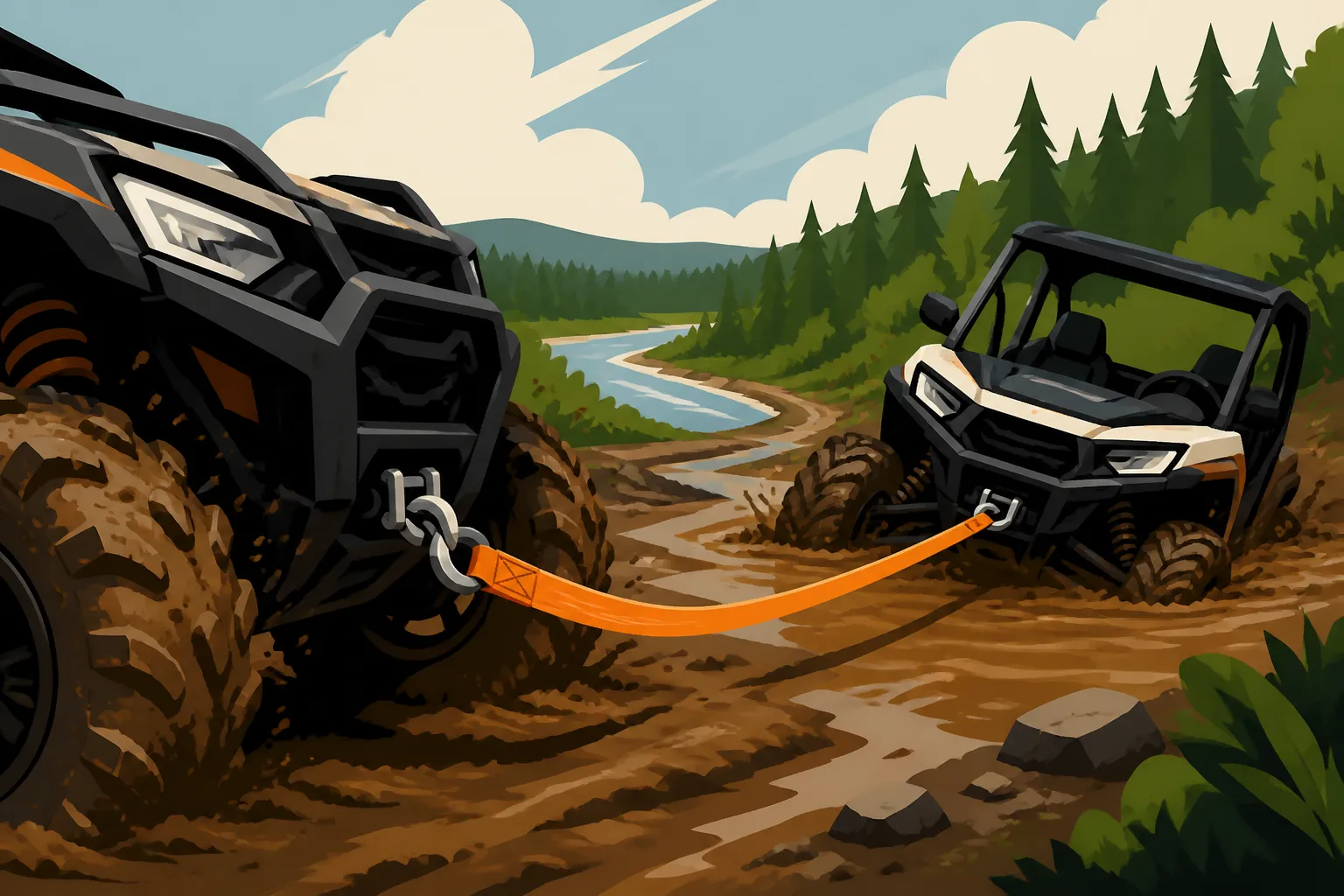
Once the strap is connected, remove slack gradually and follow the equipment and vehicle manufacturers’ directions. A smooth, steady pull is generally more controlled than a sudden surge. Avoid jerking, spinning the recovery vehicle’s tires, or building speed to “pop” the stuck machine free. A sharp shock can put high force on the strap, connectors, recovery points, and frames.
The operators should be able to communicate clearly. If the machines are noisy or separated, agree on a signal before starting. The person supervising should stay in a safe position with a clear view, not between the vehicles or near the strap. If anything shifts unexpectedly, the strap moves toward an unsafe position, or the machine begins to tip, stop the attempt if it is safe to do so.
Do not confuse a regular tow strap with a kinetic recovery rope. They can be designed for different uses and behave differently under load. Follow the specific product instructions; do not use a strap in a dynamic, running start unless it is expressly intended for that purpose and you know how to use it safely. If you are uncertain what equipment you have, don’t guess during a recovery.
Stop when the recovery is not working
If a careful pull does not move the machine, stop and reassess instead of repeating it harder. The vehicle may be hung up underneath, the recovery machine may lack stable traction, or the chosen direction may be wrong. A short pause to reposition or remove loose mud can be safer than increasing force. Keep checking the ground beneath both machines; the recovery vehicle can become stuck too.
Once the machine is free, move it to firm, safe ground before disconnecting the strap. Release tension before handling connectors, and keep hands clear of any point where the strap or hardware could shift. Inspect all equipment again. A strap that looks stretched, torn, or otherwise compromised should not go back into the kit without careful assessment against its manufacturer’s guidance.
If a recovery becomes complicated, call for help rather than turning it into a contest of horsepower. Remote-area preparation matters: First Aid on a Remote Woods Loop can help you plan for an injury or delay, and New Brunswick Cellular Reception Maps is relevant when deciding whether a route may leave you without reliable service. onX Offroad can be part of a route-planning routine, but it should not be your only navigation or communication plan.
Reduce the Chances of Getting Stuck
Choose a line and pace for the conditions
Before entering a muddy section, stop where the ground is stable and look for a safe route through. Avoid assuming that the deepest rut is the intended path or that the wettest-looking route is harmless. Watch for hidden rocks, branches, holes, and soft shoulders. If you cannot see what is beneath standing water, consider turning around rather than probing it with the machine.
Use a controlled pace and avoid abrupt steering or throttle changes. If traction fades, stop before the tires dig in. Riding around a wet patch can widen the damaged area and create new ruts, so do not leave the marked corridor just to find firmer ground. Staying on a Marked New Brunswick Corridor offers a useful reminder to respect the trail rather than creating a bypass.
Tire condition also affects how a machine handles clay and soft ground. Choose tires suited to your machine and riding conditions, and check pressure according to the manufacturer’s guidance. Tires for New Brunswick Clay can help you think through local terrain, but no tire setup makes every muddy section safe to cross.
Make route planning part of your recovery plan
Before you leave, identify places where your group could stop, turn around, or wait without blocking the trail. Review the route with the people riding with you, and make sure someone else knows the plan. onX Offroad may help you examine a planned route in advance; confirm your chosen map area is available for the kind of use you expect and carry a backup plan for navigation.
Keep your group together and agree on what to do if a machine gets stuck or a rider becomes separated. A buddy should know how to shut down a machine, where the recovery gear is kept, and how to call for help if needed. Don’t send one rider ahead alone to find a way through while the rest wait in a remote location without a clear plan.
Finally, treat a recovery as a reason to reassess the ride. If rain has softened the route, several machines are bogging down, or your group is losing daylight, turning back may be the wisest choice. A tow strap is valuable when used appropriately, but the safest recovery is often the one you avoid by choosing a suitable route, respecting trail conditions, and stopping before a small traction problem becomes a dangerous one.
Disclaimer
This article is for general informational purposes only and does not constitute professional advice. Laws, prices and regulations vary by location and change over time. Consult a qualified professional for guidance on your specific situation.