New Brunswick Winter Trail Sharing
Winter riding in New Brunswick can be confusing: a familiar quad route may be groomed for snowmobiles, closed to ATVs, or open only under specific conditions. The safest approach is to confirm access for the exact trail and date, then ride in a way that gives snowmobilers room and keeps the shared corridor in good shape.
What winter trail sharing means in New Brunswick
A shared corridor does not always mean shared access
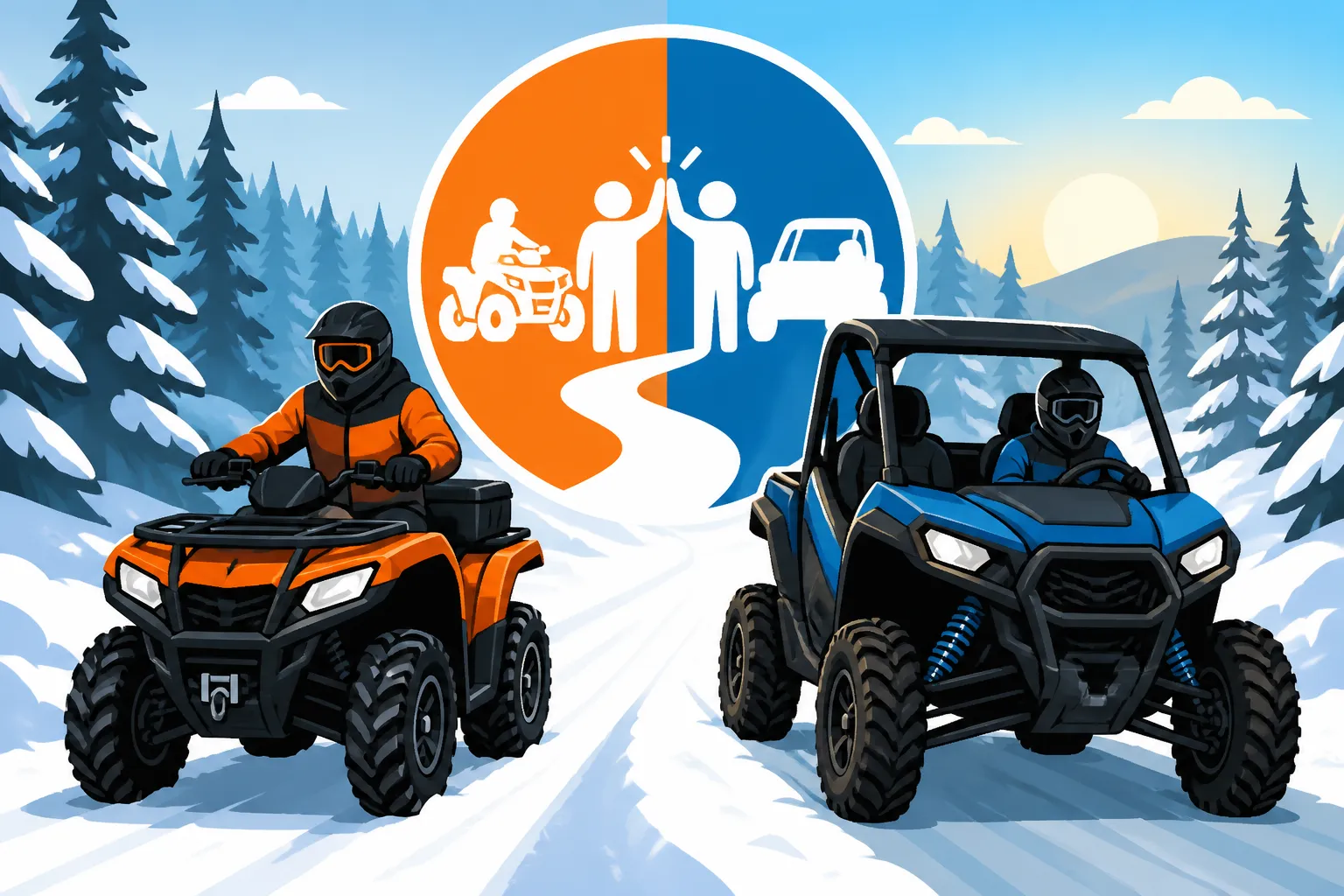
In winter, ATV and snowmobile trails may run along the same corridor, but that does not automatically mean both types of machines can use the trail at the same time. Access can depend on the trail section, the season, grooming activity, land arrangements, and direction from the local club or trail operator. A route that is open to ATVs in fall may have different access once winter operations begin.
This distinction matters on rail beds and other established corridors. Some sections may be managed or leased for snowmobile use during winter. Where that arrangement applies, quad access may be restricted or removed for the season. Check [New Brunswick Snowmobile Leases on Rail Beds] and [Why Quads Come Off the Rail Bed in December] before assuming a summer route remains available.
It also helps to separate three questions: Is the corridor open? Is it open to your type of machine? And is it open today? A trail can appear on a map while a particular segment is closed or temporarily unavailable. Treat a fresh groomer track, a well-used snowmobile path, or another rider’s tire marks as clues about activity—not as permission to enter.
For a broader look at how access can vary between trail types and seasons, see [New Brunswick Groomed and Non-Groomed Trails]. The practical rule is simple: confirm the status of the specific section rather than relying on what was allowed on the same route last winter.
How to confirm whether a trail is open to ATVs
Start with the trail club or organization responsible for the area. Look for recent notices about winter closures, grooming, reroutes, or shared use. When the notice is unclear, contact the club or another responsible local contact and ask about the exact trail segment, not just the general region. “Is the trail near town open?” can mean several different corridors; giving a trail name, access point, or map location makes the question easier to answer.
Use maps for orientation, but do not let a map replace current access information. A trail line shows where a route may go; it does not necessarily confirm that the route is currently open to ATVs. If you use onX Offroad to plan, compare the route with current local trail information and any posted closures. Save a second route or a sensible turnaround point in case the trail status changes.
Before leaving, check again for updates and look for signs at the trailhead or junction. A closure notice posted where the route begins or changes direction should be taken seriously, even if an older screenshot or saved route suggests otherwise. [New Brunswick Trail Closures in Winter] and [New Brunswick Trail Conditions Before You Go] are useful topics to review when planning a cold-weather ride.
| What you find | What it tells you | What to do |
|---|---|---|
| Current club notice says ATVs are permitted | There is a recent access update for the listed area | Confirm the notice covers your exact segment and date |
| A trail appears on a general map | The route may exist, but current access is not confirmed | Check local updates and posted signs |
| Snowmobile tracks or fresh grooming | Snowmobiles may be using the corridor | Slow down, give space, and verify ATV access |
| A closure or reroute sign | Access has changed or the route is restricted | Follow the notice and do not ride around it |
| No clear information is available | Permission and conditions remain uncertain | Choose a confirmed route instead |
Sharing the trail safely with snowmobilers
Expect different speeds and limited sightlines
A snowmobile may approach quickly on a straight stretch, while a quad can be slower through ruts, slush, or deep snow. Around bends, tree cover, hills, and narrow cuts, neither rider may have much time to react. Keep your speed low enough to stop within the visible distance ahead, especially where the trail narrows or bends out of sight.
Stay alert for approaching machines and avoid stopping in the middle of the corridor. If you need to check a map, adjust gear, or let someone catch up, move to a safe spot well off the travelled trail where you are visible and not blocking the route. In a group, leave enough room between machines to avoid bunching up at a blind corner.
When you meet a snowmobile, reduce speed and make room without moving into an unsafe shoulder or leaving the marked route. Snowbanks can hide rocks, drainage edges, or soft ground. Do not assume that a wide-looking snowy shoulder will support a heavy machine. Use local signs and trail etiquette, and review [New Brunswick Snowmobile and Quad Sharing] and [New Brunswick Trail Etiquette Locals Expect] before heading out with a group.
Protect groomed surfaces and respect signs
A groomed snowmobile trail can be damaged by tires, especially when the snow is soft or the base is not fully set. Ruts and churned sections can make travel harder for other riders and may create hazards after freezing. If ATVs are not specifically permitted on a groomed section, stay off it. If shared use is permitted, ride gently and follow any instructions about where or when ATVs may travel.
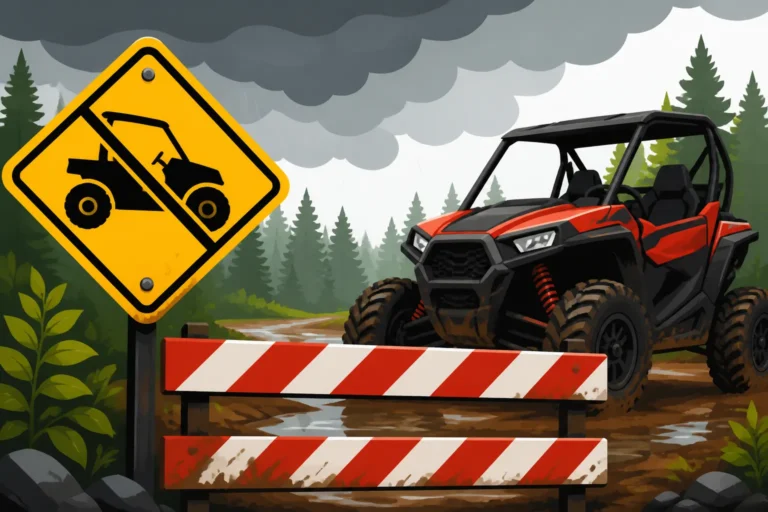
Signs may mark a closure, a detour, a change in permitted use, or a hazard that is not obvious from the trail itself. Do not ride around a gate or take an unofficial cut simply because a route looks passable. A short detour through a wet field or wooded edge can cause damage, trespass onto private land, or put you on an unapproved route. For help interpreting common markers, see [New Brunswick Trail Signage Explained].
Tire choice and riding style matter, too. Avoid spinning tires to climb a soft rise or powering through a muddy patch under the snow. If you are making deep ruts, struggling to keep moving, or pushing snow into the groomed track, turn back or choose a more suitable route. A conservative decision may feel disappointing when you have driven a long way to ride, but it is better than leaving damage that affects the next group.
Planning a winter ATV ride
Check conditions, equipment, and your turnaround plan
Winter trail conditions can change substantially over a short distance. One section may be packed and easy to follow, while another has drifted snow, ice, exposed rock, slush, or water beneath the surface. A recent report is helpful, but it cannot guarantee conditions along every kilometre of trail. Plan for slower progress than you would expect in summer and leave yourself enough daylight to return without rushing.
Before setting out, inspect the machine, dress for wind and damp conditions, and carry basic recovery and emergency supplies. A warm layer, gloves, water, a first-aid kit, a charged phone, and a way to communicate if you become delayed are sensible starting points. For a remote ride, tell someone where you plan to go and when you expect to be back. Turn around if visibility drops, the trail becomes difficult to identify, or the route no longer matches the information you checked.
Think through the route before reaching a dead zone. If you use onX Offroad or another mapping tool, prepare the information you may need before leaving reliable service, and keep a backup plan that does not depend on a live connection. [Checking Cell Reception Before a Remote Ride] is especially relevant for trips away from populated areas around the Miramichi, Restigouche, or northern interior.
Make the trip suitable for the whole group
A winter ride that works for an experienced local may be too demanding for a new rider, a family group, or a machine with limited winter setup. Match the trail to the least experienced rider and the least capable machine in the group. Agree beforehand on a steady pace, a regrouping routine, and what you will do if a machine gets stuck or someone needs to stop.
Keep the group together at junctions and make sure the last rider knows the route. In poor visibility, the rider in front should not disappear around a bend while the rest of the group is still sorting out a turn. If someone falls behind, stop in a safe place rather than continuing farther into unfamiliar terrain.
When planning with onX Offroad, use the route as a navigation aid, not as proof of permission or a substitute for local updates. A saved line can help the group understand where it is, but trail signs and current club information should guide decisions about access. For more on choosing and checking routes, see [New Brunswick Trail Maps and the MapGear App].
Common winter-sharing mistakes to avoid
Assuming last season’s route is still open
A route that was available to quads in one season may be closed, rerouted, or managed differently in winter. This is particularly important where a corridor is being used for snowmobile operations. Avoid relying on memory, an old screenshot, or a friend’s report that does not identify the date and exact section.
A more reliable habit is to check access shortly before the ride and again at the trailhead. If the route status is uncertain, choose another trail with confirmed ATV access. Turning back is frustrating, especially after loading machines and travelling to a starting point, but it is still the better option than riding into a closed area.
Treating snowmobile tracks as an invitation
Tracks can create a strong impression that a route is active and open. They show that somebody travelled there; they do not establish that ATVs are permitted. The same caution applies to a packed trail, an open gate, or a route line in a navigation app.
Do not follow snowmobile tracks onto a section you have not confirmed is open to quads. If you cannot establish the status, stop at a safe location and check with the club or choose a known alternative. This small pause can prevent a long, uncomfortable argument at a closure point—or a costly trip back to the truck.
Riding as if the corridor belongs to one group
Shared use works best when riders make space and accept that winter trails are used by people with different machines and priorities. A snowmobiler may be focused on a groomed surface; an ATV rider may be watching for hidden ruts or ice. Neither group benefits when riders speed, block the trail, ignore signs, or assume the other person will move first.
Stay courteous, keep noise and speed under control near homes and trail access points, and leave the corridor as you found it. If conditions are deteriorating or the trail is becoming damaged, report the issue through the appropriate local channel rather than trying to solve it by creating a new route. A little patience helps preserve access for the next ride.
Disclaimer
This article is for general informational purposes only and does not constitute professional advice. Laws, prices and regulations vary by location and change over time. Consult a qualified professional for guidance on your specific situation.