Checking Whether an Agreement Is Live
A trail sticker that worked on your last trip may not be enough for your next one. Reciprocity agreements between New Brunswick and neighbouring jurisdictions can change, and a pass accepted for one kind of trail or season may not cover another. Before loading your ATV or UTV, confirm the agreement is active, what it recognizes, and what you still need to carry.
What a Reciprocity Agreement Actually Covers
A reciprocity agreement is an arrangement under which one jurisdiction recognizes some form of trail permit or membership from another. For a New Brunswick rider, that may mean an eligible QuadNB permit is recognized on certain trails outside the province, or that visitors from elsewhere can ride eligible New Brunswick trails with a qualifying pass from home.
The key word is eligible. Reciprocity is not the same as unrestricted trail access. An agreement may recognize a permit for a defined trail network, while leaving other requirements untouched. It also may apply only to certain permit types, dates, machines, or riders.
Before relying on an agreement, establish exactly which of these questions it answers:
- Does it recognize the trail permit or sticker you currently hold?
- Does recognition apply to an ATV, a side-by-side, or both?
- Does it cover all trails in the destination or only participating club trails?
- Does it apply to the season and dates of your trip?
- Are there additional local rules, documents, or insurance requirements?
A permit is also not the same thing as vehicle registration. Reciprocity for trail access does not automatically transfer your New Brunswick registration to another jurisdiction or satisfy every rule for riding there. Check the destination’s requirements for registration, insurance, safety certificates, age, helmets, and road use separately. For background, see New Brunswick ORV Registration Explained and New Brunswick Requires Insurance on Trails.
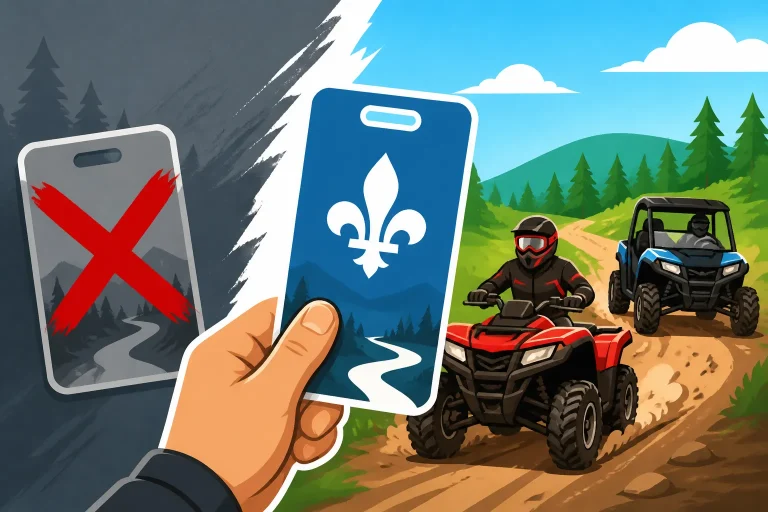
Agreements can be especially easy to misunderstand when several neighbouring jurisdictions are involved. New Brunswick has had reciprocity arrangements with Nova Scotia and Prince Edward Island, while its Quebec arrangement ended. New Brunswick also has an agreement connected to Maine. Those histories are useful starting points, not proof that a specific arrangement is active for a particular trip. Details can change, and the agreement that matters is the one in force when and where you plan to ride.
| What you are checking | What to confirm |
|---|---|
| Your New Brunswick permit | That it is valid for the trip dates and the trail type you intend to use |
| The destination’s recognition | That the destination still recognizes your permit, not just that an agreement existed in the past |
| Machine eligibility | Whether the arrangement covers your ATV or UTV and how it must be identified |
| Trail coverage | Which trails, clubs, or regions participate |
| Other obligations | Whether registration, insurance, documents, or local rules apply separately |
If your trip includes more than one province or state, treat each border crossing as a new check. Recognition in one destination does not establish recognition in the next. The general rules for New Brunswick Reciprocity With Nova Scotia, New Brunswick Reciprocity With PEI, and New Brunswick and the Maine Agreement are useful context, but confirm the details directly before riding.
How to Confirm an Agreement Is Live
Use current information from the organizations responsible for the permit and the trails. An old social media post, a saved screenshot, or a sticker from a previous season cannot confirm today’s status.
-
Start with the permit issuer. Check QuadNB’s current permit or reciprocity information. Look for the destination, the type of permit recognized, and any stated exclusions. If the wording is broad or unclear, ask the issuer to confirm that it applies to your planned trip.
-
Check with the destination’s official trail organization. Look for a current notice from the federation, association, or organization responsible for the trails you intend to ride. A statement from the destination is important because it can confirm how the agreement is being applied on that network.
-
Confirm the exact trail area. A province-wide or state-wide arrangement may not mean every route is open to visitors. Contact the local club or trail operator if the route includes club-managed trails, leased corridors, or a specific region. Ask whether the agreement is accepted on the trail segments you plan to use.
-
Ask about your exact permit. State whether you have a groomed or non-groomed permit, a day or week permit, or another type of pass. Do not assume that all permit categories receive the same treatment. If you are visiting from another jurisdiction, ask what pass a New Brunswick rider must hold to ride there.
-
Check the dates and season. Confirm that the arrangement applies on your travel dates and that the trail itself is open. A recognized permit does not override a seasonal closure, a temporary reroute, or a local restriction.
-
Ask what to carry. Find out whether you need to display a sticker, carry a receipt, show proof of membership, or provide another document. Keep any confirmation with your trip records, but follow the destination’s rules about what must be physically carried on the machine or by the rider.
-
Check again shortly before departure. If you verified the agreement well in advance, look for a newer update before you travel. Trail access and agreement terms can change between planning and departure.
When you contact an organization, make the question specific. For example: “I have a current New Brunswick non-groomed trail permit and plan to ride the named trail network on these dates with a registered side-by-side. Is that permit accepted there, and what else must I carry?” This is more useful than asking only whether “reciprocity” exists.
If answers conflict, do not choose the one that sounds most convenient. Ask the relevant organizations to clarify in writing, and avoid riding until you know which requirement applies. A local club can explain its trails, but it may not be able to confirm a province-wide permit policy. Conversely, a federation’s general statement may not answer whether a particular trail is open.
For a practical overview of the New Brunswick side, see New Brunswick Reciprocity With Nova Scotia, New Brunswick Reciprocity With PEI, New Brunswick Riders Visiting Quebec, and New Brunswick Riders Visiting Maine. These topics can help identify the right questions, but current confirmation from the organizations involved should guide your trip.
What to Verify Beyond the Agreement
The most common mistake is treating reciprocity as a complete travel authorization. In practice, it is only one part of the pre-ride check. Your destination may recognize your trail permit while still requiring you to meet its separate rules for the machine, the rider, or the route.
Permit validity and trail access
Check that your permit is current and matches the type of riding you plan to do. A permit for one trail category may not substitute for another, and a sticker does not guarantee access to every trail in a region. Confirm whether the route is maintained by participating clubs and whether it is open for your machine and the season.
If you are planning a New Brunswick ride, review New Brunswick Groomed vs Non-Groomed Permits and New Brunswick Permit Start Date. If your trip is outside the province, ask the destination organization which local trails are covered by its recognition policy.
Registration and insurance
Keep permit recognition separate from vehicle registration and insurance. Confirm that your registration is valid, that the machine meets the destination’s requirements, and that your insurance applies where you intend to ride. Do not assume your home coverage automatically meets another jurisdiction’s rules.
A rider borrowing a machine should not rely only on the owner’s reassurance. Confirm that the machine has the required documents and that the rider is permitted to operate it. New Brunswick Documents You Must Carry explains the documents relevant to New Brunswick riding; the destination may require additional or different paperwork.
Rider and route rules
Age limits, safety-course requirements, helmet standards, passenger rules, road access, and local bylaws may differ across a border. A trail permit does not override them. Check the rules for each rider in your group, especially when children or passengers are involved.
Also distinguish a club trail from a public road. A permit that allows access to a managed trail does not automatically authorize travel along a road or through a town. Ask about permitted crossings and any local restrictions along your route. If the trip involves highway use in New Brunswick, review New Brunswick ATV Road Rules Explained separately.
Machine and sticker details
Confirm that the permit is associated with the machine you will ride and that the required sticker is attached as directed. If you are switching machines, bringing a second ATV, or using a rental, ask whether the permit can be transferred or whether each machine needs its own coverage. Do not assume a rider’s membership covers every machine in the group.
The same care applies when the machine is an ATV rather than a side-by-side. Ask the organization to confirm that the specific vehicle type is included. See Does a Side-by-Side Register the Same Way? for New Brunswick registration context, but verify destination rules independently.
A Pre-Trip Check That Avoids Border Surprises
A short checklist makes it easier to confirm the agreement without confusing a valid sticker with permission to ride everywhere.
- Identify the destination and the trail system, not just the province or state.
- Note the exact permit type you hold and its validity dates.
- Confirm directly with the permit issuer and the destination trail organization.
- Ask whether your ATV or UTV is covered.
- Check whether all trails on your route participate and are open.
- Verify registration, insurance, rider qualifications, helmets, and passenger rules separately.
- Ask what documents and stickers must be carried or displayed.
- Save a dated copy of the confirmation and the relevant permit receipt.
- Recheck the agreement and trail status before leaving.
When you ask for confirmation, keep a record of who responded, when they responded, and what trail area they were discussing. A general answer such as “we accept New Brunswick riders” may not settle whether your particular permit qualifies or whether a specific route is included.
If you cannot get a clear answer, the safest option is to buy the destination’s required permit or choose a trail network whose requirements are confirmed. That may mean extra planning or cost, so check the provider for current figures before deciding. It is still better than reaching a trailhead with a sticker that is not accepted.
The practical rule is simple: treat reciprocity as a current, specific permission to verify, not a permanent benefit to assume. Confirm the agreement, the trail, the machine, and the other riding requirements before you unload. That gives you a clearer answer than relying on an old post or a rider’s memory, and it helps prevent an avoidable turn-around or violation.
Disclaimer
This article is for general informational purposes only and does not constitute professional advice. Laws, prices and regulations vary by location and change over time. Consult a qualified professional for guidance on your specific situation.