New Brunswick Quad Safety Course Explained
A quad safety course is more than a box to tick before a ride. In New Brunswick, families need to understand who may need training, what a course can teach, and what the certificate does—and does not—allow. This guide explains how to find a course, prepare for it, and check the rules that apply to the rider and machine.
What the New Brunswick quad safety course is for
A quad safety course teaches riders how to operate an off-road vehicle with more control and judgment. It is especially important for young riders, who may have additional legal requirements before they can ride in particular places or situations.
Training is useful even for an adult who has ridden for years. Familiarity can make a rider confident, but it does not necessarily mean they understand current rules, safe passenger practices, trail etiquette or how to respond when the machine behaves differently on steep, soft or slippery ground.
The course is not the same thing as registering a machine, buying a trail permit or getting insurance. Those are separate requirements. A certificate does not automatically make an unregistered or uninsured quad legal to use, and it does not give a rider permission to travel on every road or trail.
It also does not replace the judgment needed to decide whether a route, machine or riding group is suitable. A rider can complete training and still need to follow age restrictions, licensing or supervision rules, posted trail conditions, local bylaws and the requirements of the specific place they plan to ride.
For a young rider, check the rules as a package rather than focusing on the course alone. Start with New Brunswick ATV Age Requirements, then confirm whether the rider’s age, machine and intended riding location trigger other conditions. For example, the rules for a young person riding on a closed course are not necessarily the same as those for using a designated trail or crossing a road. A course certificate is one piece of the picture, not a universal riding pass.
A good way to think about the course is as practical preparation. It should help a rider build skills and recognize hazards, while giving a parent or caregiver a clearer basis for deciding whether that rider is ready for a particular kind of ride.
Who may need training and what the certificate allows
Requirements can depend on the rider’s age and the kind of riding involved. That makes it important to confirm the current rule for the specific rider rather than assuming that every rider has the same course obligation.
For teens, training may sit alongside other requirements. A course completion certificate does not necessarily replace a licence, escort, supervision condition or restriction on where the teen may operate. Review the details for New Brunswick Rules for a 14-Year-Old Rider and New Brunswick Rules for a 15-Year-Old Rider before planning a ride. If the rider is required to hold a particular licence or credential, the safety course alone will not satisfy that separate condition.
Younger children may be subject to limits on the machine they can use and where they can ride. An adult should verify those details before enrolling a child or bringing a machine to a course. The fact that a child is physically able to reach the controls does not, by itself, establish that the machine or riding location is permitted.
| Question | What to check |
|---|---|
| Does this rider need a course? | Confirm the current age-based requirements and whether they apply to the intended riding situation. |
| Does the certificate replace a licence? | No assumption is safe. Check whether the rider also needs a licence, escort or other qualification. |
| Does it allow road riding? | A course certificate does not itself open a road to quads or replace a required road permit. |
| Does it authorize any machine? | Check age, machine size or type restrictions that may apply to the rider. |
| Does it replace a trail permit? | No. A trail permit is a separate requirement for riding on trails where one is required. |
| Does it provide insurance? | No. Confirm insurance requirements separately for the machine and the planned use. |
The legal details can be easy to confuse because several documents may be involved on the same ride. Registration relates to the machine and its permitted use; insurance provides a separate form of financial protection; a trail permit relates to access to participating trails; and training establishes that a rider has completed an approved course. A rider may need more than one of these, and having one does not imply that the others are in order.
It can help to write down the rider’s age, the machine’s type, the planned location and whether the ride includes a road crossing. Then ask the course provider or the appropriate provincial contact which requirements apply. This is more reliable than asking only, “Does my child need a course?” because the full answer may depend on what the child intends to do after completing it.
If you are arranging training for a 14-year-old, see New Brunswick Safety Course for a 14-Year-Old alongside the age-specific riding rules. If you are unsure whether a certificate earned elsewhere will count, check Does New Brunswick Accept an Out-of-Province Safety Course? before relying on it. Do that before the ride, not when you are already at a trailhead.
What a course may cover
Course outlines can vary, so ask the provider what is included and what the participant must bring. In general, a useful quad safety course should combine rules and decision-making with practical information about operating a machine safely. Do not assume that every course includes the same amount of hands-on riding or the same assessment.
Understanding the machine
A rider needs to know how the controls work before learning to use them under pressure. Instruction may cover starting and stopping, throttle and braking, steering, shifting where applicable, and safe mounting and dismounting. A learner should also be shown how to approach basic pre-ride checks and identify an obvious problem that means the machine should not be used.
A quad can feel stable on a flat, familiar surface and become much less predictable on a slope, in loose gravel or in mud. Good instruction helps riders understand how weight, speed and terrain affect control. It should encourage smooth inputs rather than sudden acceleration, hard braking or sharp turns at speed.
Choosing a safe riding approach
A rider’s safest choice is sometimes to slow down, stop, turn back or walk a difficult section on foot. Training should make that kind of decision feel normal rather than embarrassing. The point is not to prove that a rider can get through every obstacle. It is to recognize what the rider and machine can handle and to avoid creating a situation that is harder to control than expected.
Terrain changes the risk. A narrow trail can hide a rut around a bend. A wet section can have a firm-looking edge that gives way. A hill can be difficult to climb safely and even more difficult to descend. Beginners benefit from learning to assess the route early, leave room to stop and avoid following another rider into an obstacle they cannot see clearly.
Recognizing hazards and sharing space
Off-road riding is not isolated from other people. Riders may meet hikers, other machines, horses, wildlife, logging trucks or maintenance crews. A course can introduce safe passing habits, following distances, group communication and the importance of obeying trail signs and closures.
For a group ride, being able to signal and communicate matters. Riders should know who is leading, who is at the back and what the group will do if someone stops or becomes separated. A new rider may not be ready to keep up with a fast group, even if the route itself seems easy. The group should set a pace that allows everyone to ride within their ability.
Personal protective equipment and responsible choices
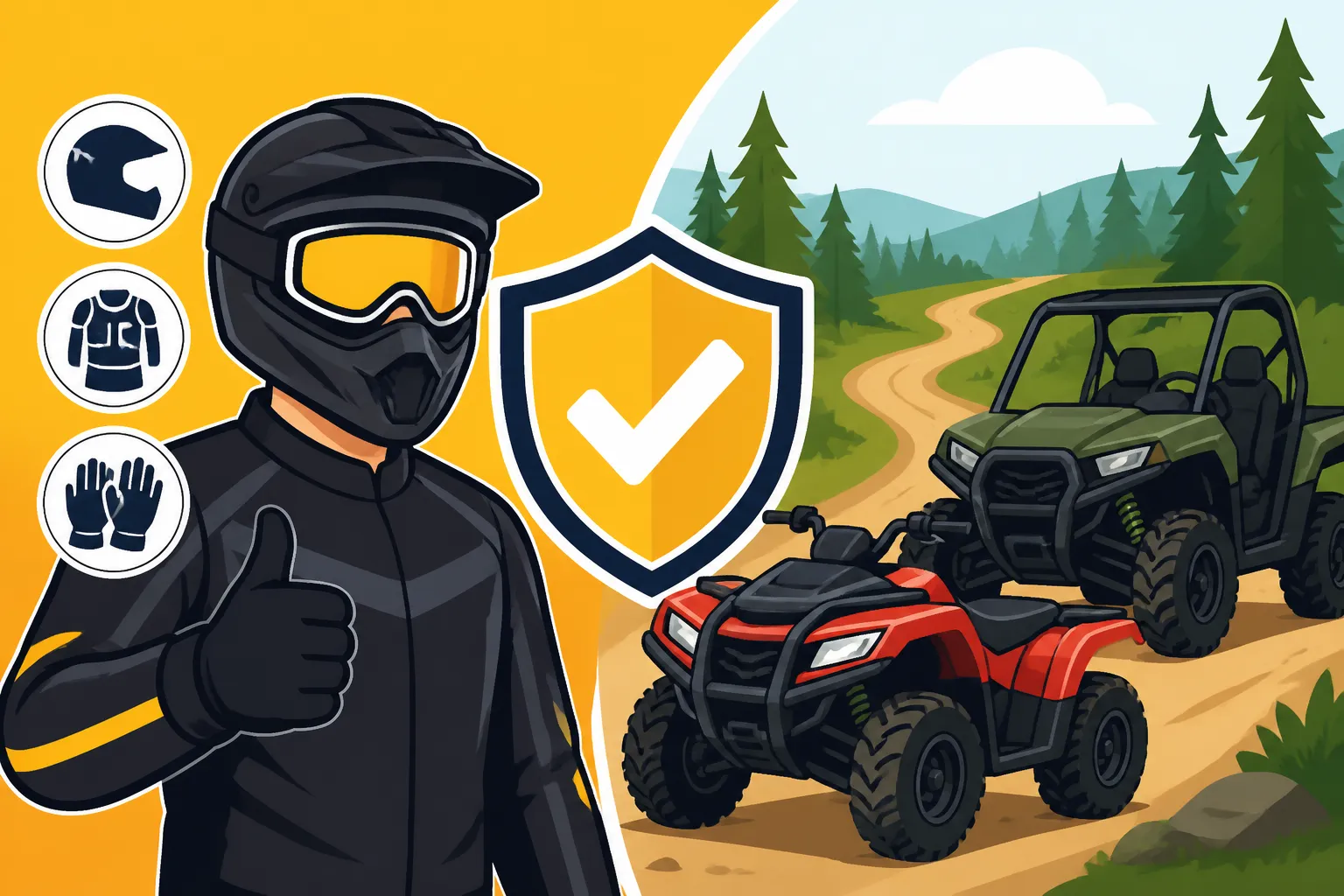
A helmet that fits correctly and meets the applicable standard is essential. Other protective equipment can reduce exposure to debris, weather and contact with the ground. Riders should understand the difference between owning protective gear and wearing it correctly: a loose or poorly fitted item may not protect as intended.
A course may also discuss the risks of fatigue, distraction, impairment and riding beyond one’s skill level. These are not minor details. A tired rider can miss a hazard or make a poor decision, while a rider who is impaired may be unable to control the machine safely.
The course is most valuable when participants leave with habits they will use later: check the machine, choose an appropriate route, ride at a manageable pace, wear protective gear and stop when conditions exceed their ability.
Finding a course and planning the booking
Safety courses are generally arranged through organizations or local providers that offer approved training. Availability can vary by area and season, so start looking before you need a certificate. A course that suits your child’s age and schedule may not be offered every week, and a last-minute search can leave you with fewer options.
A practical first step is to ask a local club whether it runs a course or can direct you to an approved provider. Finding a Club That Runs the Safety Course can help you start that search. You can also ask what ages the course accepts, whether a parent must attend, what proof of completion is issued, and how the certificate can be replaced if it is lost.
When contacting a provider, be specific. Tell them the rider’s age, whether the rider has operated a quad before, and whether the goal is to meet a requirement for a particular kind of riding. Ask these questions before paying or setting aside a day:
- Is the course approved for the purpose the rider needs?
- What age groups can attend?
- Is there a written or practical assessment?
- Is the rider expected to bring a machine, or is equipment supplied?
- What clothing and protective equipment are required?
- Does a parent or guardian need to attend or sign a form?
- What certificate or proof of completion will the rider receive?
- How does the provider handle cancellations, rescheduling or bad weather?
- Who should be contacted if the certificate is delayed or needs replacing?
Do not assume that a course described casually as “ATV training” is accepted for every provincial requirement. Ask directly whether it is the appropriate course and how completion is documented. If you are dealing with an out-of-province course, confirm acceptance before enrolling.
It is also sensible to ask about course length and format rather than planning around a generic estimate. Some training may be delivered in a compact session, but the actual schedule depends on the provider and course. The overview in [New Brunswick Safety Course Length] is useful when planning, but confirm the current session details directly with the organizer.
Check the current cost and any rebate
Course costs and rebate arrangements can change. Confirm the current amount, what it includes and how any rebate is claimed with the provider or the organization administering the program. Ask whether the participant must pay first, what proof is needed and whether membership or age affects eligibility. See [New Brunswick Safety Course Cost] and [New Brunswick Safety Course Rebates] for related details.
Treat a rebate as something to verify, not something to assume will be applied automatically. The course organizer may not be the same organization that processes a rebate, and required paperwork or timing may differ. Keep the registration confirmation, receipt and certificate together until you know the process is complete.
If the rider is a minor, ask whether a parent or guardian must attend the session or remain available. This can affect travel and scheduling. The details are covered in New Brunswick Parental Attendance Rules, but the provider should confirm what applies to the particular session.
Preparing a young rider for the day
A young rider will get more from training if they arrive rested, prepared and ready to listen. They do not need to be an experienced operator before attending. In fact, the course can be a good way to learn basic habits before a young rider develops shortcuts by copying friends or adults.
Before the course, explain that the goal is not to be the fastest or to show off. A good participant asks questions, follows directions and says when something feels confusing. If the course includes practical activity, let the instructor set the pace. Do not coach over the instructor or pressure the child to attempt something they are uncomfortable with.
Clothing and equipment
Ask the provider for its exact clothing list. Depending on the session, that may include sturdy footwear, gloves, eye protection and suitable layers. A helmet may be supplied or may need to be brought by the participant; never guess. If the rider needs a helmet, check the required standard, fit and condition before the course. A helmet that is damaged, too large or improperly fastened is not a good substitute for a correctly fitted one.
Amazon can be one place to compare basic riding accessories, but it is not a source for deciding which helmet standards New Brunswick accepts. Confirm the required standard through an official or qualified source, and make fit the priority. If you are buying online, make sure there is a practical way to check the fit and return an unsuitable item.
For gloves, eye protection or weather layers, an Amazon listing can help you compare features, but a product description is not proof that an item is appropriate for the course. Ask the instructor what is acceptable, especially if the course has specific equipment requirements. For a child, check that the gear fits now rather than buying a size they may grow into.
Amazon may also be useful for simple items such as a waterproof pouch for keeping course paperwork dry afterward. Still, keep the certificate itself somewhere secure at home and carry it as required for the rider’s situation. A pouch does not replace the need to protect the original document or know how to get a replacement.
Set expectations before the session
Talk through basic safety expectations ahead of time:
- Listen to the instructor before touching or starting any machine.
- Keep a safe distance from moving equipment.
- Do not ride unless the instructor says it is time and explains what to do.
- Tell the instructor about discomfort, uncertainty or a problem with the machine.
- Do not imitate another participant without permission.
- Stop when instructed, even if the rider thinks they can continue.
For parents, the best preparation is often logistical: confirm the arrival time, paperwork, equipment and contact arrangements. Avoid turning the drive to the course into a high-pressure test. A child who is nervous may need reassurance that the purpose is to learn, not to pass by pretending to be confident.
If the course is intended to satisfy a requirement, ask the provider what counts as successful completion. A participant should know whether they need to attend the whole session, complete an assessment or submit any additional paperwork. If a young person misses part of the course, do not assume they will still receive a valid certificate.
After the course: keep proof and keep checking the rules
When the rider completes the course, get clear information about the certificate. Check that the name is correct, find out whether the certificate is issued immediately or later, and ask what to do if it is misplaced. Take a photo or make a digital backup for your own records, while keeping the original in a safe place.
A photo can help you remember the certificate details, but do not assume a phone image is accepted wherever proof is requested. Check the current requirement for carrying or producing proof. The guidance in Producing Your Safety Certificate When an Officer Asks can help you think through how to keep the document available. If the original goes missing, consult Replacing a Quad Safety Certificate You Lost rather than assuming that a course receipt will serve as a replacement.
The certificate is only one item in a rider’s paperwork. Depending on the machine and ride, the operator may also need documents related to registration, insurance or trail access. Use Four Things to Carry on a New Brunswick Trail to review the broader set of documents, and check what applies before setting out.
Keep the course information with the rider’s other records. If the rider is underage, write down any conditions that apply, such as supervision, a permitted machine or limits on where they can ride. This avoids the common mistake of remembering “the course is done” but forgetting the separate rule that still governs the ride.
A certificate does not make every ride legal
Before each ride, confirm that the machine is properly registered and insured where required, that the trail permit is appropriate for the route, and that the rider meets the age and other conditions for that location. A course certificate cannot open a road to ATV use. Road access, crossings and local permissions are separate matters, so review New Brunswick ATV Road Rules Explained if the ride involves a road.
Likewise, do not assume that a certificate issued for one kind of vehicle or course automatically covers another. If a rider switches from a quad to a side-by-side, check whether the training and age rules still fit the machine and situation. The rules for passengers and operators can differ, too.
An officer may ask for proof of training when it is relevant to the rider’s situation. If the required certificate is missing or the rider does not meet a course requirement, there may be consequences. Confirm the current rules and possible consequences through New Brunswick Penalties for No Safety Course. Avoid relying on a friend’s recollection of an old rule or a certificate that belongs to a different rider.
Common mistakes and a simple pre-ride checklist
The most avoidable problems usually come from treating the course as a one-time formality. Training gives a rider a foundation, but safe operation depends on choices made before and during every ride.
Mistakes to avoid
- Booking without checking approval. Ask whether the course meets the purpose for which the rider needs it.
- Assuming the certificate replaces other requirements. Check age, licence, supervision, registration, insurance and trail access separately.
- Leaving equipment questions until the last minute. Confirm what the participant must bring and whether the gear meets the provider’s requirements.
- Assuming a child is ready because they completed training. Readiness also depends on the child’s judgment, coordination, confidence and ability to follow instructions.
- Choosing a machine based on appearance or engine power. The machine must suit the rider and comply with any age-related limits.
- Treating a familiar route as risk-free. Trail surfaces, closures, weather and other users can change.
- Forgetting proof after the course. Keep the certificate available in the way current rules require, and know how to replace it.
- Riding with a group that sets the wrong pace. A new rider should not feel pushed to keep up with more experienced operators.
- Assuming an online listing answers a safety question. Product pages can help compare gear, but they do not replace legal guidance, course-provider instructions or a proper fit check.
A checklist before enrolling
- Confirm the rider’s age and the requirements for the intended use.
- Ask whether the course is approved for the rider’s purpose.
- Confirm the course date, length, cost and any available rebate.
- Ask about parent or guardian attendance and consent forms.
- Find out whether the rider must bring a machine or protective equipment.
- Check how completion is documented and how to replace the certificate.
- Keep receipts and course correspondence until any rebate or paperwork is settled.
A checklist before riding
- Confirm the rider is legally eligible for the route and machine.
- Check that registration, insurance and trail access requirements are met.
- Ensure the rider has the required certificate and other documents.
- Inspect the machine and protective equipment.
- Review the route, weather, closures and group plan.
- Set a pace the least experienced rider can manage.
- Agree on what to do if the group separates or someone needs to stop.
A safety course is most effective when the learning continues after the classroom or practical session. Parents can reinforce it by choosing manageable routes, giving the rider time to practice in an appropriate setting and making it acceptable to turn around. Experienced riders can support beginners by keeping the group together and demonstrating calm, predictable riding.
Disclaimer
This article is for general informational purposes only and does not constitute professional advice. Laws, prices and regulations vary by location and change over time. Consult a qualified professional for guidance on your specific situation.