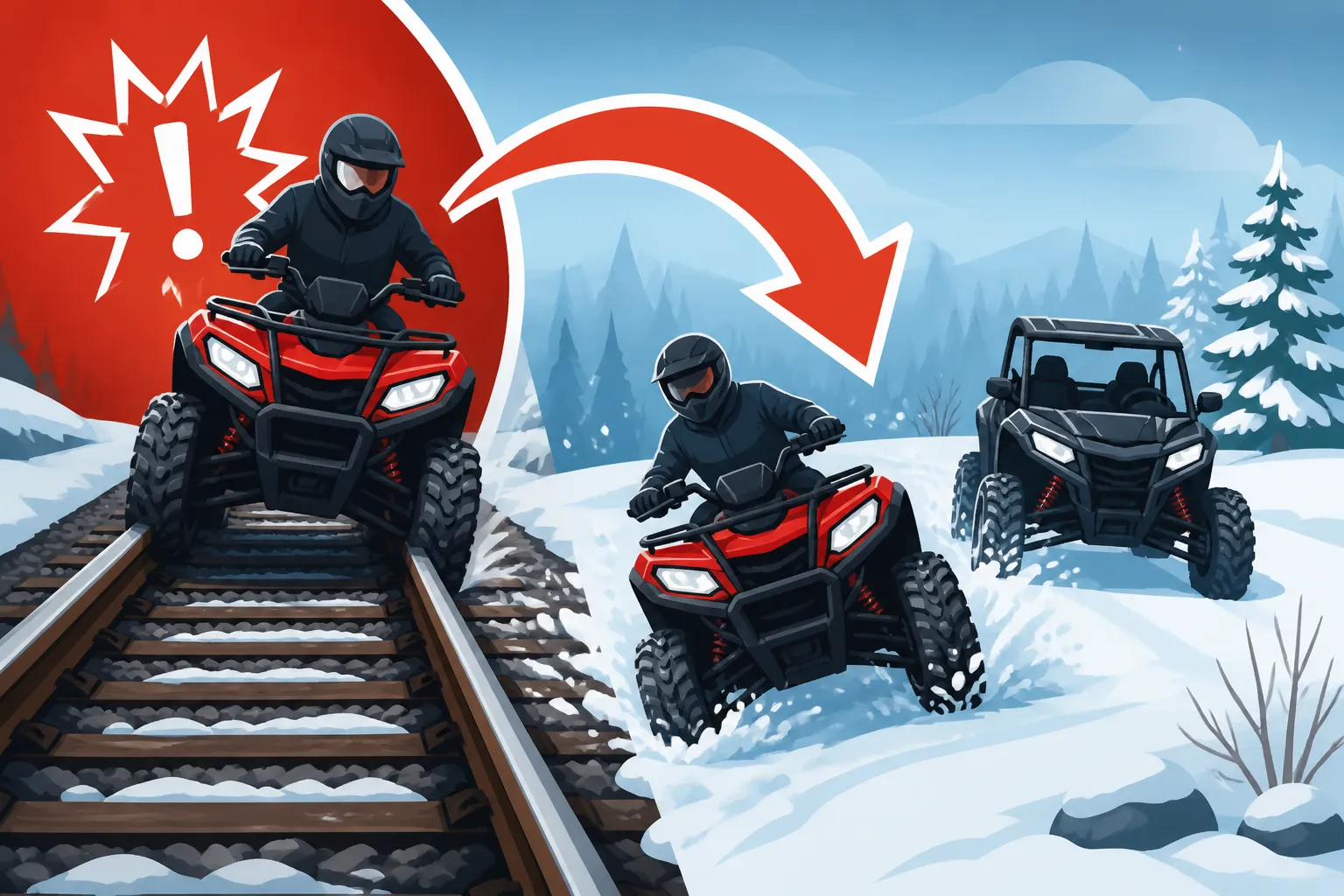
Why Quads Come Off the Rail Bed in December
A rail bed can look like an easy, familiar route for a quad, but December changes what that corridor is being used for. In parts of New Brunswick, a trail used by ATVs in warmer months may be closed or reserved for snowmobiles in winter. This guide explains why the switch happens, how to tell what’s open, and what to do when a route’s status is unclear.
Why a rail bed can change from an ATV route to a winter corridor
Seasonal trail use is planned, not decided by appearance
A rail bed may seem like a wide, durable place to ride: it is relatively flat, easy to follow, and often connects communities or trail networks. But a broad, smooth corridor can also be useful for snowmobiles once winter conditions arrive. In some areas, a rail bed is leased or managed for snowmobile use during the winter season, so summer access for quads does not automatically mean winter access for quads.
That seasonal handoff is one reason riders may be asked to leave a rail bed in December. The change is about how the corridor is designated and managed, not simply whether the surface looks firm enough for an ATV. [Rail Trails Leased to Snowmobile Clubs in Winter] explains the seasonal arrangement in more detail, while [New Brunswick Winter Trail Sharing] covers why different trail users need clear boundaries and timing.
It’s also important not to assume that every rail bed follows the same schedule. Conditions, local trail arrangements, and posted rules can vary from one section to another. A corridor near Woodstock, Miramichi, or another riding area might not have the same status as a route elsewhere. Check the local trail information rather than treating one familiar rail bed as a guide to all of them.
Snow and grooming make the corridor a different kind of trail
Once snow arrives, a rail bed may be groomed or prepared for snowmobile travel. Grooming creates a maintained winter surface, and repeated use can establish a track that is much narrower and more predictable than an ungroomed snow-covered route. A quad driving over that surface can rut, churn, or break up the packed snow, leaving a rougher track for snowmobiles and making further maintenance more difficult.
This isn’t only about convenience. A groomed winter corridor is managed for particular users, equipment, and conditions. A quad may be heavier than a snowmobile and may interact with soft snow differently, especially during a thaw or after fresh snowfall. Even when a machine appears to leave only a shallow track, that damage can harden or deepen as temperatures change.
The exact season and grooming pattern aren’t identical everywhere. [New Brunswick Groomed Trails Run Four Seasons] and [New Brunswick Non-Groomed Trails Run Three Seasons] are useful reminders that trail seasons can depend on the type of trail and its management. A calendar month alone does not tell you whether a specific corridor is open to your machine.
How to check whether a rail bed is open to quads
Read local signs and current trail notices
Before riding, look for signs at the trail entrance and along the corridor. A sign may identify permitted users, show a seasonal restriction, or point out that the trail is closed. If you encounter a gate, barrier, closure notice, or clear direction to stay off, don’t ride around it to see whether the rest of the route looks usable. The surface can continue beyond the point where you can see, and the restriction may apply to the entire corridor.
Trail status can change with weather and maintenance. A route that was open on your last visit may be closed now, or a section may be temporarily unavailable because of snow, a washout, a maintenance project, or a seasonal transition. Check club or trail-network updates close to your planned ride, then confirm what you see at the trailhead. [New Brunswick Trail Conditions Before You Go] offers more guidance on checking conditions before setting out.
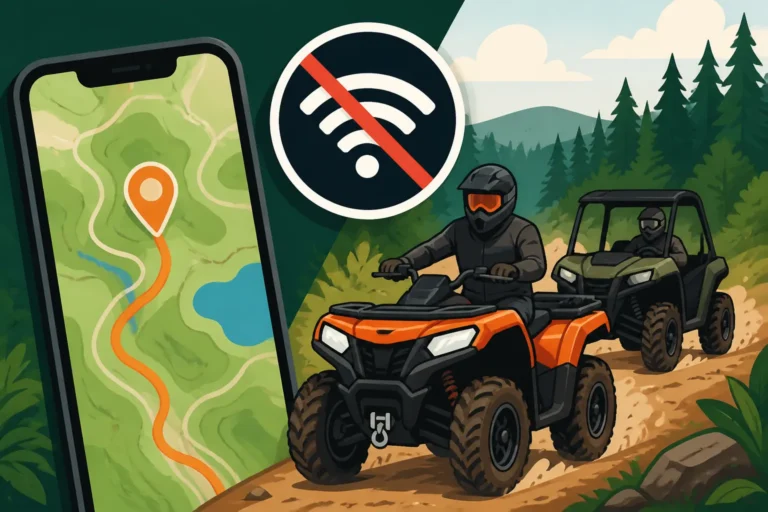
A mapping app can help with orientation, but it should not be treated as permission to ride. For example, onX Offroad may help you understand where a route appears on a map and plan how to reach a trailhead. Still, app information is not a substitute for current local notices, a posted closure, or confirmation from the relevant trail organization. A mapped line is not necessarily an open ATV route.
Distinguish a rail bed from a marked ATV corridor
The phrase “rail bed” describes the former or existing corridor, not necessarily its current access rules. Some sections may be part of a managed ATV route during a particular season; others may be assigned to another use, closed, or governed by different arrangements. Being able to ride a connecting section does not mean you can continue onto every adjoining path.
Stay on the marked route, and pay attention when trail signs change. A turn, junction, or temporary marker may redirect riders away from a winter corridor. [Staying on a Marked New Brunswick Corridor] and [New Brunswick Trail Signage Explained] are helpful for understanding why following the marked route matters even when a nearby track looks more direct.
It’s also easy to confuse different trail networks because names and surfaces can overlap. A rail trail or multi-use path is not automatically an ATV trail. [Sentier NB Trail Is Not a Quad Trail] is a useful reminder to identify the route’s intended use instead of judging by its appearance. When in doubt, ask the local club or trail organization before riding that section.
| What you find | What it may mean | What to do |
|---|---|---|
| A clear seasonal closure notice | ATV use may be restricted for the season | Do not enter; check local updates for an authorized alternative |
| Snowmobile grooming or fresh maintenance | The corridor may be prepared for winter use | Confirm whether quads are permitted before riding |
| A route shown in an app but no local confirmation | The map may not reflect current access | Check signs and contact the relevant trail organization |
| A marked ATV route that changes at a junction | Access may differ beyond the junction | Follow the signs and stay on the designated route |
| No sign and no reliable status information | The route’s current use may be uncertain | Pause and verify before proceeding |
Why riding a closed rail bed can cause problems
It can damage the trail and affect other users
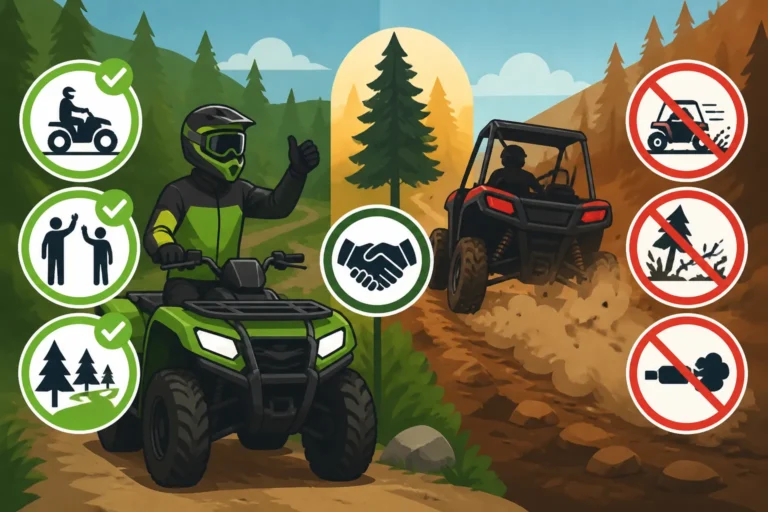
A quad can leave deep ruts in soft ground or disturb a packed snow surface. On a winter corridor, those marks may make the trail rougher for snowmobilers and more difficult for grooming equipment to maintain. On a thawing or wet trail, repeated tire passes can widen the damage and make a small soft spot harder to repair.
It’s tempting to think, “I’ll only go a short distance,” especially if the route looks empty. But one rider’s tracks can encourage others to follow, and a narrow damaged area can quickly become a much wider one. If you reach a closed section, turning around may feel inconvenient. It is still the better choice for the trail and the people responsible for maintaining it.
There can also be a safety concern. A snowmobile operator approaching a blind bend or a narrow stretch may not expect to meet a quad on a route designated for winter use. Differences in speed, stopping distance, and visibility can make an unexpected encounter stressful for both riders. A seasonal restriction helps reduce that uncertainty.
The consequences can extend beyond the trail surface
Ignoring a closure can create friction with trail clubs, land managers, nearby property owners, and other riders. Clubs depend on cooperation to maintain routes and work with the people who grant access. Repeated damage or unauthorized use can make those relationships harder to maintain and can affect access for riders who follow the rules.
There may also be consequences under the rules that apply to the particular trail or location. Don’t assume that a route is open just because no one is stationed at the entrance, or that an app showing a line makes access lawful. If you need to understand the broader rules for seasonal routes, [New Brunswick Trail Closures in Winter] and [New Brunswick's Trail Infrastructure Fund] provide related context on winter closures and trail management.
If you’re uncertain whether a closure applies to your machine, stop before entering and get local clarification. That small pause is easier than dealing with a damaged route, a difficult encounter, or a ride that has to be abandoned farther down the trail.
Planning a December ride without the rail bed
Build a route around confirmed open trails
Start by checking the status of the trails you intend to ride, not just the route you used in summer. A winter plan should include a confirmed open corridor, an alternate route, and a clear turnaround point. If your intended trail depends on crossing a rail bed whose status you cannot verify, plan a different ride rather than hoping the route will be accessible when you arrive.
A mapping app can be useful for organizing possible routes. Riders may use onX Offroad to review mapped terrain and keep track of a planned route, but confirm access with local trail information and on-the-ground signs. Save enough information to navigate without relying on a strong phone signal, and don’t let a route line tempt you past a closure.
Leave extra time for winter conditions. Snow, ice, early darkness, and changing temperatures can make familiar distances take longer. Tell someone where you plan to ride, keep your machine and gear suitable for the conditions, and be willing to change plans if local notices or trail conditions don’t support the route.
Ask the local club a specific question
If the status is unclear, contact the club or trail organization responsible for that area. A specific question is more useful than asking whether “the trails” are open. Mention the rail bed or trail section, where you plan to enter it, the date of your ride, and that you’ll be on a quad or side-by-side. This helps the person answering distinguish your question from one about snowmobile access or a different nearby route.
You can also ask whether there is an approved ATV alternative, whether the closure is seasonal or temporary, and where the restriction begins. If you receive directions, compare them with signs at the trailhead. Conditions can change, and posted instructions should not be ignored just because you received different information earlier.
December can be a frustrating time to discover that a favourite route has changed use. Still, the reason is usually practical: winter maintenance, snowmobile access, trail conditions, or a local seasonal arrangement. Checking before you leave, respecting closures, and choosing a confirmed ATV route helps protect the trail network and makes the ride more predictable for everyone.
Disclaimer
This article is for general informational purposes only and does not constitute professional advice. Laws, prices and regulations vary by location and change over time. Consult a qualified professional for guidance on your specific situation.