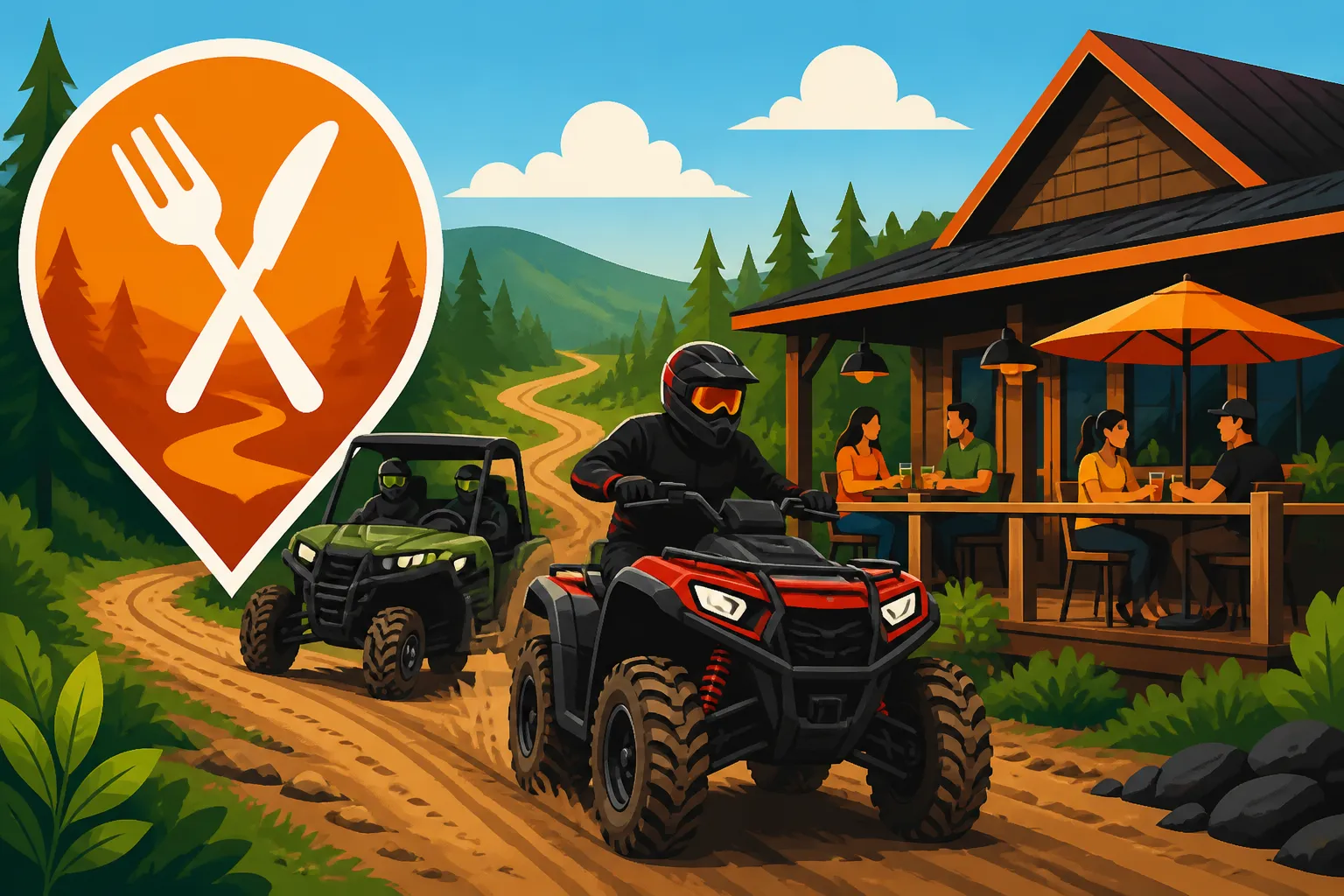
New Brunswick Restaurants Along a Trail
A trail ride can turn into a frustrating lunch hunt when the nearest restaurant is farther away than expected, the route does not legally connect to town, or the kitchen is closed when your group arrives. This guide explains how to plan New Brunswick ATV and UTV rides around meal stops, choose practical towns, and avoid relying on assumptions about trail access.
How to Plan a Restaurant Stop Around a New Brunswick Trail Ride
A restaurant may look close to a trail on a map without being reachable from it. Club trails, public roads, private land, and business access points are not interchangeable, so plan the meal stop as a destination with its own route and access checks—not simply as a dot beside a trail.
Start with the trail, then find a nearby town
Choose your ride first: identify the trail system or region, check which sections are open, and estimate how long your group expects to be out. Then look for a town or service area where riders can stop and eat. Depending on your route, places such as Woodstock, Hartland, Miramichi, Bathurst, Fredericton, and Campbellton may be useful planning points. That does not mean a particular trail connects directly to a restaurant in town; you still need to confirm how to reach it legally.
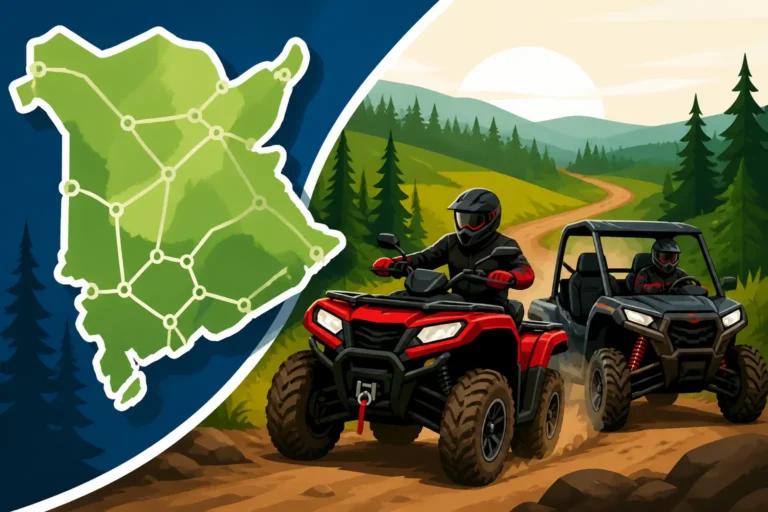
Use an official club or federation map for trail information, and check local conditions before leaving. A general navigation app can help you see nearby roads and businesses, but it may not show whether a route is an authorized ATV corridor. [New Brunswick ATV Trail Map Downloads] can help you plan around the recognized trail network, while [New Brunswick Trail Conditions Before You Go] is useful when weather, seasonal closures, or maintenance could affect the day’s route.
Confirm the last part of the route
The final stretch to a restaurant is often the part riders overlook. A trail may come close to a village but stop short of the business district. You might need to trailer your machine to a suitable parking area, walk to a restaurant, or choose a different place that can be reached through an authorized route.
Before setting out, check whether every road section is open to ATVs and whether any local rules apply. Do not assume that a rural road, town street, shoulder, or parking-lot entrance is legal for an off-road vehicle just because it appears to connect two parts of your route. [New Brunswick ATV Road Rules Explained] is a useful starting point for understanding why road access needs to be checked separately from trail access.
Check the restaurant before you build the ride around it
Hours, seating, kitchen service, and seasonal schedules can change. Call or check the restaurant’s own information before relying on it, especially if your ride falls outside the usual lunch period, during a holiday weekend, or in a quieter season. Ask whether they can accommodate your group and whether there is a practical place to park the truck and trailer if you are not riding directly to the door.
If your group expects to arrive dusty, wet, or in riding gear, ask about that too. A restaurant may welcome outdoor groups but still have limited space, no room for helmets and jackets, or a busy dining room at peak hours. A quick call can prevent an awkward arrival after a long ride.
Choosing a Meal Stop That Works for Riders
The best restaurant stop is not always the closest one. For a riding group, the useful details are often straightforward: whether the route is legal, whether there is parking, whether the kitchen will be open, and whether the stop fits the ride’s timing.
Compare your options before choosing
Use this checklist to compare a restaurant, café, or takeout stop. The answers can help you decide whether it belongs on your route or whether it is better to eat before or after riding.
| What to check | Why it matters | What to confirm |
|---|---|---|
| Legal access | A nearby business may not be reachable by an authorized ATV route | Whether the entire approach is permitted, including any road segment |
| Opening hours | Hours can vary by day or season | Current hours and kitchen closing time |
| Group capacity | A full group may not fit without planning | Whether the restaurant can seat your party together |
| Parking | Trucks, trailers, and machines need appropriate space | Where to park and whether trailer parking is allowed |
| Meal timing | A late arrival can mean limited menu options | Whether the kitchen will still be serving |
| Weather backup | Rain or a closure can change the plan | A second stop or a place to eat before departure |
| Ride distance | A detour can use more fuel and time than expected | Distance from the planned trailhead and return route |
For some groups, a sit-down lunch is the point of the outing. For others, stopping briefly for takeout or packing food makes more sense, especially on a remote loop. Either way, build enough time into the plan so that a meal stop does not turn into a rushed detour or leave someone navigating unfamiliar roads under pressure.
Think about parking and group size
A restaurant that works for two riders may not work for a group of ten. Several pickup trucks with trailers can take up more space than a typical lunch crowd, and parking arrangements may be different during a busy weekend. Ask where the group can park, whether vehicles need to be moved after unloading, and whether the restaurant has a suitable place for trailers.
If everyone is riding their own machine, do not assume the restaurant has a place for ATVs or UTVs. Keep machines out of private lots and away from entrances unless the owner or manager has clearly allowed parking there. A trailhead with designated parking can be a better option: leave the machines there and travel to the restaurant by another legal means. [New Brunswick Trailheads With Parking] is a helpful topic to check when planning a start or regrouping point.
Match the restaurant to your group
Families, first-time riders, and larger groups may need a different kind of stop than a small group of experienced riders. Families may value quick service, accessible washrooms, and a predictable menu. A larger group may want to call ahead and ask about seating. A couple of riders on a short outing may prefer a simple coffee or takeout stop rather than a long meal.
Be realistic about how long everyone will need. Ordering, eating, paying, and getting back to the trail can take longer than expected, especially if the restaurant is busy. If your route depends on reaching a particular trail section before a closure, daylight change, or meeting time, plan the restaurant stop around that constraint rather than hoping the timing works out.
Route, Fuel, and Trail Etiquette Around Town Stops
A restaurant stop is only one part of the ride plan. The route must work for the machines, the group’s fuel range, local access rules, and the people who live and work along the corridor.
Plan fuel and distance around the meal
Do not use a restaurant as a substitute for a fuel stop unless you have confirmed fuel is available and accessible to your group. A business may serve meals but not sell fuel, and a fuel station may be in town without being reachable by a legal ATV route. Check fuel availability separately and estimate the full day’s distance, including detours to and from the meal stop.
Fuel planning matters even more when riding outside a town. A long leg through a rural area can leave little room for an unplanned diversion. [New Brunswick Fuel Range Between Villages] offers a useful planning angle for thinking about distance between services. Consider the least fuel-efficient machine in the group, not only the machine with the largest tank or best range.
A mapping app such as onX Offroad can be useful for reviewing terrain, saving route notes, and marking a planned stop, but do not treat a line on a screen as proof that a road or trail is open to ATVs. Check the relevant local or club information as well. If you use onX Offroad or another mapping app, download the information you need before entering an area where cellular service may be unreliable, and keep a separate backup plan.
Respect town streets and private property
Riding into a restaurant area can involve roads that are governed by rules different from those on a club trail. Never improvise a connection across a private driveway, business lot, field, or road because it appears convenient. If the route is unclear, stop somewhere safe and verify the permitted way forward rather than riding on and hoping the next turn is allowed.
Arrive quietly, follow posted instructions, and keep access clear for customers, deliveries, and emergency vehicles. Avoid revving engines, blocking entrances, or leaving mud and debris where people walk. These small courtesies help keep relationships with businesses and local communities positive. [New Brunswick Trail Etiquette Locals Expect] covers the kind of considerate behaviour that makes shared riding areas work better for everyone.
Keep the group together without creating a traffic problem
Before leaving the trail, agree on the route, the meeting point, and what the group should do if someone gets separated. A clear plan matters when riders have different navigation skills or machines with different speeds and fuel needs. If the restaurant is in a town, brief the group on where to stop and how to reassemble without blocking a road or parking area.
A lead rider can confirm turns and access while a sweep rider makes sure nobody is left behind. For a larger outing, share the route and stop plan in advance, and decide who will contact the restaurant if the group is delayed. [New Brunswick Group Ride Planning] can help you think through those details before the ride day.
A Practical Meal-Stop Planning Routine
A little preparation makes it easier to enjoy the ride rather than spend lunch trying to solve access, parking, and timing problems on the fly.
Before the ride
Start by choosing the trail area and checking its status. Mark a primary meal stop and a backup, then check the legal route to each one. Confirm the restaurant’s hours and group capacity directly, and ask about parking if you are bringing trucks or trailers.
Share the plan with everyone, including the expected meal time, fuel options, and a meeting point if the group becomes separated. If you are using a phone-based map, save the route and important locations ahead of time. onX Offroad may help organize waypoints and route notes, but pair it with reliable trail information and do not rely on a phone signal in remote areas.
On the day
Check conditions again before setting out. Rain, trail work, a closure, or a late start can change the best route and meal timing. Keep the group together at major turns, and make sure everyone knows the backup plan if the primary stop is unavailable or the legal approach is blocked.
If the group is running behind, call the restaurant rather than arriving after the kitchen has closed. If access is uncertain, do not ride onto a road or property to test it. Choose the safer option: stop at a permitted location, use a different legal route, or adjust the meal plan.
If you are travelling from outside the area
Visitors should be especially careful not to assume that trail rules or access arrangements are the same as those at home. Check permit requirements, local rules, and any reciprocal arrangements that apply to your ride. Also confirm whether your planned route is suitable for the machines in your group and whether there are enough services along the way.
If the restaurant is part of a weekend trip, book lodging and meals with the riding plan in mind. A place to stay near a trail does not necessarily mean machines can travel directly from the lodging to a restaurant or trail entrance. [New Brunswick Trails With Lodging Nearby] can help frame the accommodation side of the plan, while [New Brunswick Trail Etiquette Locals Expect] remains relevant when riding near homes and businesses.
A good New Brunswick restaurant stop is one your group can reach legally, use comfortably, and leave without disrupting the people around you. Confirm the route, hours, parking, and fuel plan before departure, and treat the map as a planning aid rather than permission to ride anywhere. That simple routine helps turn lunch into an enjoyable part of the ride instead of the day’s biggest complication.
Disclaimer
This article is for general informational purposes only and does not constitute professional advice. Laws, prices and regulations vary by location and change over time. Consult a qualified professional for guidance on your specific situation.