New Brunswick Safety Course Fines
It's incredibly frustrating when you're out enjoying the beautiful New Brunswick trails on your ATV or UTV, only to be stopped and discover you've unknowingly violated a rule – especially one as fundamental as having a safety course certificate. Many riders, particularly those new to the province or those who’ve been riding for years under old regulations, are caught off guard by the fines associated with not meeting the mandatory safety training requirements. This guide is here to shed light on New Brunswick's safety course requirements, the penalties for non-compliance, and how to ensure your paperwork is always in order so you can ride with peace of mind.
The Mandatory ATV Safety Course in New Brunswick
Riding an off-road vehicle (ORV) in New Brunswick isn't just about having a machine and a place to ride; it's about adhering to a set of regulations designed to keep everyone safe and preserve our stunning natural environment. One of the cornerstones of this regulatory framework is the mandatory ATV safety course. It's a requirement that sometimes gets overlooked, but carrying that certificate is as important as having your registration.
Who Needs the Safety Course and Why
In New Brunswick, the ATV safety course is a critical component for many riders, particularly those under a certain age. While adults benefit immensely from the training, it's legally mandated for anyone between the ages of 14 and 15 who wishes to operate an ATV, and it's a prerequisite for obtaining a Class 9 licence, which permits these young riders to operate ORVs. Even if you're an adult and not legally required to have the course, it's highly recommended. The course isn't just about learning how to turn the handlebars; it’s about understanding the specific nuances of off-road operation, trail etiquette, and the unique hazards you might encounter in the varied terrain across New Brunswick.
The province’s commitment to safety is paramount, and the course plays a significant role in reducing accidents and promoting responsible riding habits. It instills a deeper appreciation for the machines and the environment, ensuring riders understand the impact of their actions. Think of it as investing in your safety and the safety of those you ride with, preventing avoidable incidents on our shared trails. Many experienced riders who took the course later in life often remark on how much they still learned, even after years in the saddle.
The importance extends beyond personal safety; it’s also about legal compliance. Failing to meet these training requirements can lead to serious legal consequences, including fines. For a full breakdown of what this training entails, you can refer to [New Brunswick Quad Safety Course Explained]. It provides a comprehensive overview of the curriculum and what to expect during your training session.
What the Course Covers
The ATV safety course in New Brunswick is comprehensive, blending both theoretical knowledge and practical, hands-on experience. Typically, the curriculum includes crucial topics such as pre-ride inspections, ensuring your machine is in top working order before you even hit the dirt. This often involves checking tires, fluids, lights, and brakes – fundamental safety checks that can prevent breakdowns or accidents far from home. Safe operating procedures are a major focus, teaching riders proper body positioning, braking techniques, throttle control, and how to navigate various types of terrain, from rocky climbs to muddy sections.
Beyond machine operation, the course delves into environmental awareness, covering topics like staying on marked trails, avoiding sensitive ecosystems, and minimizing your impact on the wilderness. Basic first aid and emergency procedures are also often included, preparing riders for unforeseen circumstances out on the trail. Crucially, the course also provides an in-depth review of the New Brunswick Off-Road Vehicle Act, ensuring you understand the provincial laws, including where you can and cannot ride, passenger rules, and equipment requirements.
You'll find that companies like SuperATV, known for their durable aftermarket parts and accessories, also emphasize the importance of proper training and safety gear alongside their product innovations. They understand that even the most robust machine, equipped with the best parts, is only as safe as its operator. From winches to advanced lighting systems, these products enhance your riding experience, but they complement, rather than replace, the foundational knowledge gained from a safety course. For younger riders, especially those 14 and 15 years old, the course is an absolute necessity, detailing the responsibilities that come with being on an ORV. More information on specific requirements for this age group can be found in [New Brunswick Safety Course for a 14-Year-Old].
Understanding New Brunswick's Safety Course Fines
Ignorance of the law is never an excuse, and when it comes to ORV operation in New Brunswick, this holds especially true for safety course requirements. The province takes these regulations seriously, and officers on patrol are equipped to verify that riders have met their training obligations. Getting caught without the required certificate can lead to a significant financial penalty.
The Cost of Non-Compliance
Unfortunately, there's a specific, hefty set fine waiting for riders who fail to comply with New Brunswick's ATV safety course regulations. While I cannot state the exact, up-to-the-minute dollar amount, you should expect a significant set fine for not being able to produce a valid safety course certificate when requested by a law enforcement officer. This isn't just a minor slap on the wrist; it's designed to be a strong deterrent, encouraging all riders to prioritize their training.
A "set fine" means that the penalty amount is predetermined by regulation. If you're issued such a ticket, you typically have the option to pay the fine by the due date without needing to appear in court. However, paying it means you’re admitting guilt, and the violation will be recorded. For most riders, the shock of receiving such a ticket is often the first time they truly grasp the importance of the safety course requirement. Imagine being out on a fantastic day trip, perhaps near Sussex or exploring the Miramichi region, only for your ride to be cut short by an unexpected fine that could have been easily avoided. For a broader perspective on the various penalties, you can consult [New Brunswick Ticket Costs for Trail Violations].
Broader Implications and Escalation
The fine for not having a safety course certificate rarely stands alone. It's often just one part of a larger picture of non-compliance, which can lead to even more severe consequences. For instance, if a rider under the age of 16 is found operating an ATV without the required safety training, they may also be cited for age-related violations, which carry their own distinct penalties. This layered approach to enforcement means that one oversight can quickly snowball into multiple tickets and a much larger financial burden.
Repeat offenses are treated with increasing severity. A second or third infraction might not only mean higher fines but could potentially lead to the impoundment of your ATV or UTV. The hassle and cost of recovering an impounded machine are substantial, including towing fees, storage charges, and administrative penalties. Furthermore, these violations can have an impact on your insurance premiums. Your insurance provider might view a safety course fine as an indicator of higher risk, potentially leading to increased rates or even difficulty renewing your policy. No matter how many high-performance parts from SuperATV you've bolted onto your machine, these components won't protect you from the legal and financial repercussions of riding without the proper training and certification.
Related Requirements and How They Intersect with Safety Training
The New Brunswick Off-Road Vehicle Act is a comprehensive piece of legislation, and many of its rules are interconnected. The safety course requirement, while important on its own, is deeply woven into other critical aspects of riding an ATV or UTV, especially concerning age restrictions and the mandatory documents you must carry. Understanding these connections is key to remaining fully compliant and avoiding fines.
Age Restrictions and Licensing
The link between the ATV safety course and age restrictions is particularly strong for younger riders. In New Brunswick, a person must be at least 16 years old to operate an ATV or UTV on designated trails without supervision. However, there's a specific provision for riders aged 14 and 15. These teens are permitted to operate an ORV if they have successfully completed an approved ATV safety course and possess a Class 9 licence. This licence is distinct from a regular driver’s licence and specifically caters to ORV operation. Without both the course certificate and the Class 9 licence, a 14- or 15-year-old rider is in violation of the law.
Furthermore, even with the Class 9 licence and safety certificate, riders aged 14 and 15 must be accompanied and supervised by an adult who is at least 19 years old and also holds a valid driver's licence or an ORV licence, and has completed an approved safety course. This adult is responsible for the younger rider's actions, highlighting the gravity of the requirement for proper training and supervision. The consequences for [New Brunswick Rules for a 14-Year-Old Rider] or [New Brunswick Rules for a 15-Year-Old Rider] riding without these prerequisites can be severe, not only for the minor but also for the supervising adult. Understanding the responsibilities of [New Brunswick Adults Escorting Young Riders] is paramount to ensure everyone stays on the right side of the law.
Mandatory Documents to Carry
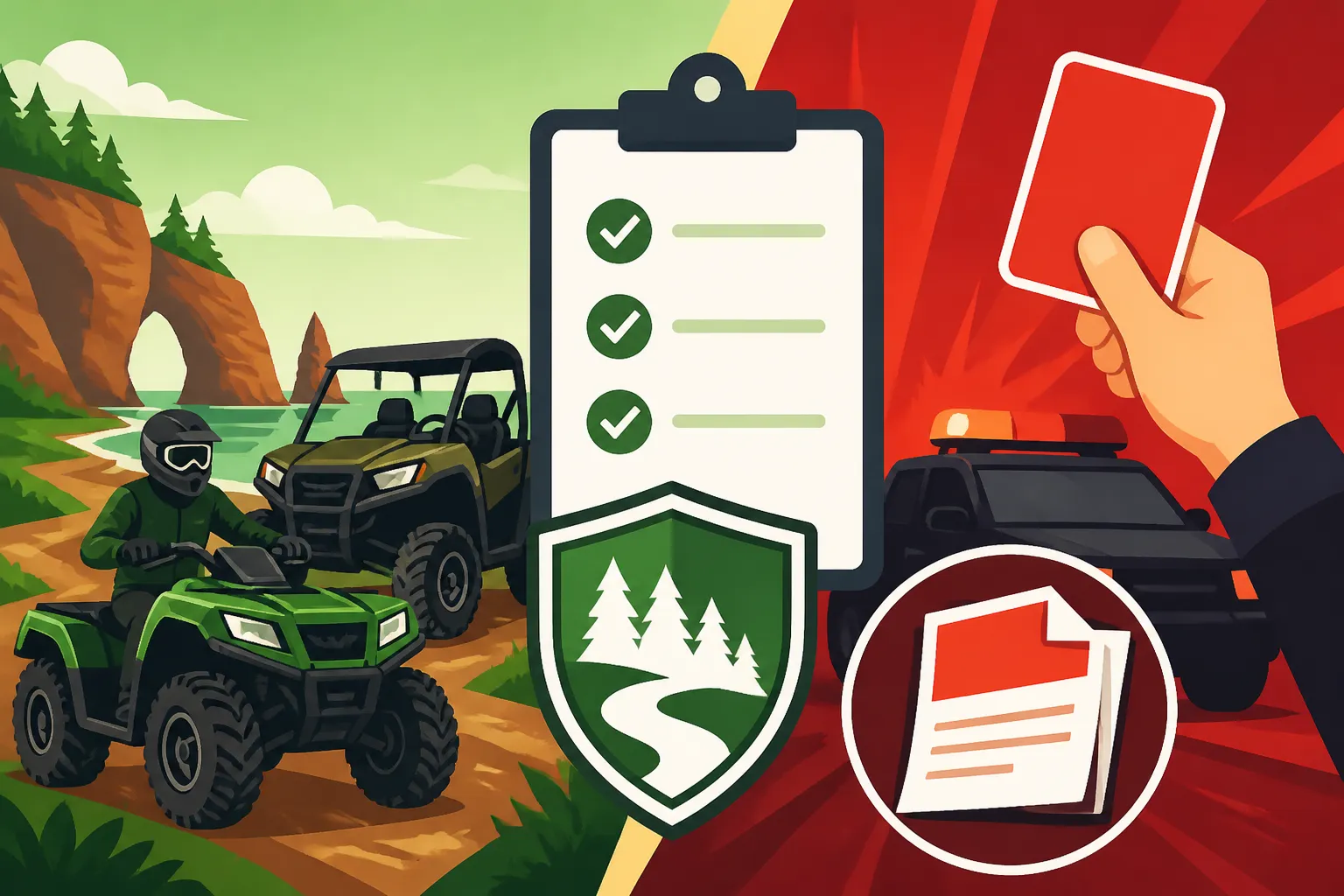
One of the most common reasons riders face fines, even if they've completed their safety course, is simply not having the proof of certification on hand. It's not enough to have completed the course; you must be able to produce the certificate when asked by a law enforcement officer. This isn't an isolated requirement either. The safety course certificate is one of four essential documents that New Brunswick riders are legally required to carry whenever they are operating their ORV on public trails or designated areas.
The full list of documents typically includes: your ORV registration certificate, proof of liability insurance (which is mandatory for trail riding), your valid trail permit (if you're on a managed trail system), and your ATV safety course certificate (if required for your age or as proof of training). Failing to produce any of these documents can result in a separate fine. An officer performing a routine check could, for instance, issue you a fine for not carrying your registration and another for not having your safety certificate. It's a quick way for fines to pile up. For a complete understanding of what paperwork you need to keep with you, refer to [New Brunswick Documents You Must Carry] and the detailed checklist in [Carrying Four Documents at Once]. Even with the most rugged storage solutions, like a waterproof cargo box or saddlebags from SuperATV, the onus is on the rider to ensure these vital documents are packed and readily accessible.
Here's a quick reference for the requirements:
| Age Group | Safety Course Required? | Class 9 Licence | Adult Escort Required? |
|---|---|---|---|
| Under 6 | No (Closed Course Only) | No | Yes |
| 6-13 | No (Closed Course Only) | No | Yes |
| 14-15 | Yes | Yes | Yes |
| 16+ (No Driver's Lic) | Yes (Recommended) | Yes (Optional) | No |
| 16+ (With Driver's Lic) | No (Recommended) | No | No |
Note: For ages 6-13, specific engine size restrictions apply, and riding is limited to closed courses or private land with permission. The safety course is highly recommended for all riders, regardless of legal requirement.
Staying Compliant and Avoiding Fines
No one wants to receive a fine, especially not one that could have been easily avoided. The good news is that staying compliant with New Brunswick's ATV safety course requirements is straightforward and entirely within your control. It involves a simple process of getting certified, always carrying your documentation, and staying informed about the rules.
Getting Certified and Renewing
The first and most crucial step to avoid safety course fines is to actually complete an approved ATV safety course. In New Brunswick, QuadNB (the New Brunswick All-Terrain Vehicle Federation) is the primary organization that coordinates and delivers these courses across the province. They have certified instructors and a structured curriculum that meets provincial standards. You can usually find a schedule of upcoming courses on their website or by contacting local ATV clubs. [New Brunswick Safety Course Schedule] can provide information on when and where these courses are available.
There are also incentives to make certification more accessible. For instance, young riders aged 6 to 15 may be eligible for significant [New Brunswick Youth Course Rebates], making the training more affordable for families. Additionally, if you're a member of a QuadNB-affiliated club, you might qualify for discounts; for example, [New Brunswick Members Pay Half Price] for the course. Once you complete the course, you'll receive a certificate that serves as your official proof of training. While the knowledge you gain is lifelong, the physical certificate is what officers will ask to see. While the certificate itself doesn't expire, staying updated on new laws and best practices is always a good idea.
Best Practices for Riders
Beyond merely obtaining the certificate, several best practices can help you avoid fines and ensure a safer, more enjoyable riding experience. The most important one is simple: always carry your physical (or sometimes an accepted digital copy) of your ATV safety course certificate whenever you're riding your ORV. Many riders keep a laminated copy in a waterproof pouch along with their other essential documents. Imagine the frustration of having completed the course, only to be fined because the certificate was sitting at home in a drawer. As discussed in [Producing Your Safety Certificate When an Officer Asks], this document is key.
Another critical best practice is to regularly review the New Brunswick Off-Road Vehicle Act. Laws and regulations can change, and what was permissible last year might not be this year. Staying informed prevents unintended violations. Many local ATV clubs also offer refresher sessions or share updates on rule changes, providing a great opportunity to stay current. Participating in these community events not only keeps you informed but also fosters a sense of camaraderie among riders. Before every ride, conduct a quick mental checklist: "Do I have my registration? Insurance? Trail permit? Safety certificate?" This routine can save you a lot of grief. Even if you've invested in top-tier performance and safety equipment from brands like SuperATV, your personal responsibility for knowledge and compliance remains your ultimate defense against fines. Always remember that proactive preparation is the best way to ensure your adventures on the New Brunswick trails are nothing but fun.
Disclaimer
This article is for general informational purposes only and does not constitute professional advice. Laws, prices and regulations vary by location and change over time. Consult a qualified professional for guidance on your specific situation.