New Brunswick Registration Compared to Quebec
Figuring out the ins and outs of ATV and UTV registration can feel like a puzzle, especially when you love to explore trails that might take you across provincial borders. Many riders dream of hitting the varied terrains of New Brunswick and Quebec, only to get bogged down in the confusing differences in off-road vehicle laws. This guide is here to clear up the confusion, directly comparing the registration processes, requirements, and crucial inter-provincial rules between New Brunswick and Quebec, so you can ride with confidence, no matter where your adventures take you.
The Basics of ATV/UTV Registration in New Brunswick
Let's start right here in New Brunswick, where getting your off-road vehicle (ORV) on the books is a pretty straightforward process, but one that absolutely cannot be skipped if you plan to hit the trails or even cross a highway. It’s all about making sure everyone is accountable and our beautiful trail system remains well-managed.
What Needs to Be Registered
In New Brunswick, the law is quite clear: if it's an off-road vehicle and you intend to operate it anywhere beyond your own private, completely enclosed property, it needs to be registered. This isn't just for the big, beefy quads or side-by-sides. We're talking about all-terrain vehicles (ATVs), utility terrain vehicles (UTVs), dirt bikes, and even specialized machines like dune buggies. The purpose of registration is essentially to give your machine an official identity, tying it to you as the owner. It ensures that if there's an incident, or if you're out enjoying our vast trail network, your machine is recognized by the province. It's a fundamental step for responsible riding. You can dive deeper into the full scope of what's covered in [New Brunswick ORV Registration Explained].
The New Brunswick Registration Process
When it's time to register your machine, your go-to spot is Service New Brunswick. They are the central hub for all things registration, and their staff are usually quite helpful in guiding you through the steps. You'll need to gather a few key documents before you head in. This typically includes proof of ownership, like a bill of sale (especially if you bought it used from a private seller) or a Manufacturer's Statement of Origin (MSO) if it's brand new from a dealership. You'll also need personal identification, something with your photo and signature. If you're buying from a dealer, they often handle much of this paperwork for you, which is a huge convenience. For private sales, it's all on you, so make sure that bill of sale is complete and accurate! Getting all your ducks in a row beforehand can save you a lot of time and frustration at the counter. For a comprehensive list, check out [Registering an ATV With Service New Brunswick].
Key Financials and Renewal Cycle in New Brunswick
Registration isn't free, but the fees contribute to the administration of the ORV program. While I can't give you exact numbers, understand that there's a cost involved for the plate and the annual renewal. These fees are typically fixed and vary by the type of ORV – for instance, quads usually have a different fee structure than dirt bikes. The crucial thing to remember in New Brunswick is the renewal cycle: every single ORV registration expires on December 31st, regardless of when you first registered it during the year. This means that if you register your quad in November, you'll still need to renew it by the end of December. It's an annual commitment to keep your machine legal for the trails. This consistent expiry date means everyone is on the same page for renewals. You can read more about the costs in [New Brunswick ORV Plate Costs] and the expiry date in [New Brunswick Registrations Expire December 31].
Understanding Quebec's ATV/UTV Registration Landscape
Just next door, Quebec has its own distinct system for off-road vehicles, managed by the SAAQ (Société de l'assurance automobile du Québec). While the goal is similar – ensuring safe and regulated riding – the specifics can differ quite a bit from what we're used to in New Brunswick.
Quebec's Off-Road Vehicle Definition and Requirements
In Quebec, an off-road vehicle, often referred to as a VTT (Véhicule Tout-Terrain), also encompasses ATVs, UTVs, and dirt bikes designed for off-road use. Just like in New Brunswick, if you plan to ride it anywhere other than private property, it needs to be registered. Quebec has a strong emphasis on designated trails and managing the impact of ORVs, and registration is a cornerstone of that system. They have their own set of classifications and rules that dictate everything from permissible engine size for minors to required safety equipment. Understanding these initial definitions is paramount before you even consider bringing a machine into or buying one within Quebec.
The Quebec Registration Process and Documentation
Registering an ORV in Quebec involves a visit to a SAAQ service centre. The documentation required will mirror New Brunswick's in many ways: proof of ownership (bill of sale, MSO), and valid identification. However, there might be subtle differences in the forms or specific information they require. If you're a new resident or purchasing an ORV that has an out-of-province history, you might face additional checks to ensure the vehicle meets Quebec's standards and that all previous taxes and fees are accounted for. It's always a good idea to check the SAAQ website directly or call ahead to ensure you have every single piece of paper they require, as turning up with incomplete documentation is a common frustration for many.
Fees, Taxes, and Annual Renewal in Quebec
Quebec's fee structure for ORV registration also involves an annual cost, and it's important to be aware of how they calculate these charges. Their system might also include specific taxes that differ from New Brunswick's HST (Harmonized Sales Tax) approach on ORV purchases, especially for private sales. The annual renewal process also follows a specific timeline, though it might not align perfectly with New Brunswick's blanket December 31st expiry. Quebec's renewal period could be based on your original registration date, or a different provincial standard. This means riders who own machines in both provinces, or frequently travel between them, need to be extra diligent about checking the expiry dates for each jurisdiction to avoid any lapses in registration.
Navigating Cross-Border Riding and Reciprocity
This is where things can get truly tricky, and where a lot of riders find themselves scratching their heads. The idea of seamlessly crossing provincial lines with your registered and insured ORV is a nice thought, but the reality is often more complex, especially when Quebec is involved.
New Brunswick Riders Visiting Quebec
Unfortunately, this is the area that causes the most confusion and frustration. For a long time, there was a reciprocity agreement in place between New Brunswick and Quebec, meaning your New Brunswick trail permit would be honoured in Quebec, and vice-versa. However, that agreement ended. What this means now for New Brunswick riders is that if you want to legally ride on Quebec's managed trail system, your New Brunswick ORV registration and trail permit are not enough. You will need to obtain a valid Quebec trail permit from the Fédération Québécoise des Clubs Quads (FQCQ) in addition to your New Brunswick registration. This can feel like double-dipping, but it's the current reality for accessing their trails. Always check the latest information before you plan a trip, as rules can change. For more details on this, you'll want to read [New Brunswick Riders Visiting Quebec] and [New Brunswick's Ended FQCQ Agreement].
When you're riding a borrowed machine or sharing ownership across borders, having the right paperwork becomes even more critical. Imagine a scenario where you borrow your buddy's quad for a weekend trip to Quebec. While it's registered in New Brunswick, you'll still need that Quebec trail permit. Beyond that, if you ever get stopped, proving you have permission to operate the machine is vital. This is where tools from companies like LawDepot can be incredibly useful. You could use their platform to draft a simple "permission to use" agreement or a temporary bill of sale, clarifying that you have legitimate access to the machine. It might seem like overkill, but having a clear, legally sound document can prevent a lot of headaches if you encounter an officer who questions your authority to ride the machine.
Quebec Riders Visiting New Brunswick
On the flip side, if you're a Quebec rider looking to explore the beautiful trails here in New Brunswick, the situation is a bit more favourable, but still requires adherence to our local rules. Generally, your Quebec ORV registration is recognized in New Brunswick. However, and this is a big "however," you absolutely must obtain a valid New Brunswick trail permit from QuadNB (the New Brunswick All Terrain Vehicle Federation) to ride on our managed trails. Think of it this way: your Quebec registration makes your machine legal to own and operate in your home province, but the New Brunswick trail permit is your access pass to our specific trail network, which is maintained by our clubs. This ensures you're contributing to the upkeep of the very trails you're enjoying. So, while your SAAQ paperwork is generally accepted, don't forget that crucial New Brunswick trail sticker. Further information can be found in [New Brunswick Visitors From Quebec] and [New Brunswick Trail Permits for 2026 and 2027].
Essential Documents and Safety Courses for Cross-Border Travel
Whether you're heading from New Brunswick to Quebec or vice-versa, always, always carry your full suite of documents. This includes your ORV registration certificate, your proof of insurance, your driver's license, and any required trail permits from the province you're riding in. Having these readily available is not just good practice, it's often legally mandated. Officers in both provinces can, and do, stop riders to check documentation. For New Brunswick riders, knowing [New Brunswick Documents You Must Carry] is essential.
Beyond registration, safety courses play a significant role. Both provinces encourage, and in some cases require, ORV safety training, especially for younger riders. While a safety course completed in one province might be recognized for licensing purposes in another, it’s always best to understand the specific requirements of the province you’re riding in, particularly regarding age and supervision. For instance, New Brunswick has specific rules for youth riders and escorts, and those rules apply to visitors too. Being proactive and completing a recognized course, like those discussed in [New Brunswick Quad Safety Course Explained], can not only keep you safer but also demonstrate your commitment to responsible riding, regardless of the province.
Another situation where a legal document can really come in handy is when organizing group rides that might involve participants from different provinces. If you're putting together a weekend trip that crosses into Quebec, for example, and you have riders from New Brunswick, you might consider having everyone sign a liability waiver. This protects you as the organizer and ensures everyone understands the risks and responsibilities. LawDepot offers templates for various legal documents, including waivers, which can be easily customized to suit your specific group and itinerary, providing an extra layer of peace of mind.
Key Differences and What to Watch Out For
Beyond the reciprocity rules, there are other nuances in the registration systems of New Brunswick and Quebec that are important for any cross-border rider to understand. These differences, while sometimes subtle, can have significant impacts if overlooked.
Registration Plates vs. Stickers and Their Placement
New Brunswick generally uses a physical registration plate that mounts on the rear of your ATV or UTV, along with a sticker that indicates the current year's validity, typically placed on the left-side fender. This plate and sticker combination makes it easy for enforcement officers and trail wardens to quickly verify your registration status. Knowing [New Brunswick Plate Placement on a Quad] and [Why the Registration Sticker Goes on the Left Fender] is key for compliance here.
Quebec also uses a system of plates and stickers, but the specifics of their design, placement, or even what constitutes a "plate" for certain types of ORVs might differ. For example, some jurisdictions might rely more heavily on a visible sticker rather than a traditional metal plate for certain machines. It's crucial not to assume that what works in one province will automatically be identical in the other. When riding in Quebec, always ensure your vehicle displays its registration credentials according to their provincial laws to avoid any issues.
Insurance Requirements and Cross-Provincial Validity
New Brunswick has a clear mandate for ORV insurance, especially if you plan to use the provincial trail network. You absolutely need proof of insurance to ride on designated trails, as outlined in [New Brunswick Requires Insurance on Trails]. This isn't just about protecting your machine, but also about liability in case of an accident involving other riders or property. The cost of this insurance can vary, which is why [New Brunswick Insurance Cost for an ATV] is a frequent topic of discussion.
Quebec also requires off-road vehicle insurance, particularly for liability coverage. While your New Brunswick insurance policy should provide coverage for liability when riding in Quebec (always check with your specific insurer!), it's the proof of that insurance that matters. Carrying your physical insurance card is non-negotiable. Furthermore, if you’re lending your machine to someone, or riding a machine with multiple owners, ensuring everyone is properly covered and that your policy extends to all operators and territories is paramount. LawDepot can be a helpful resource if you need to create a formal co-ownership agreement or a detailed loan agreement for an ORV, explicitly stating insurance responsibilities and coverage details, which can be invaluable in clarifying who is responsible for what in case of an incident.
Penalties for Non-Compliance Across Borders
The consequences of not adhering to registration and permit rules in either province can be severe. In New Brunswick, riding an unregistered ORV or riding without the required insurance on a trail can result in hefty fines. These penalties are designed to deter illegal riding and ensure everyone contributes to a safe and regulated environment. You can find more information about these consequences in [New Brunswick Penalties for Riding Unregistered] and [New Brunswick Penalties for Riding Uninsured].
Similarly, Quebec has its own schedule of fines for unregistered ORVs, lack of valid trail permits (if required), and insufficient insurance. Ignorance of the law is generally not considered a valid excuse, and officers in both provinces are vigilant about enforcing ORV regulations. A simple oversight like forgetting a renewal sticker or not having the correct provincial trail permit can quickly turn a fun day of riding into an expensive and frustrating experience. Always take the time to double-check all your documents before you head out, especially when planning a trip that crosses provincial lines.
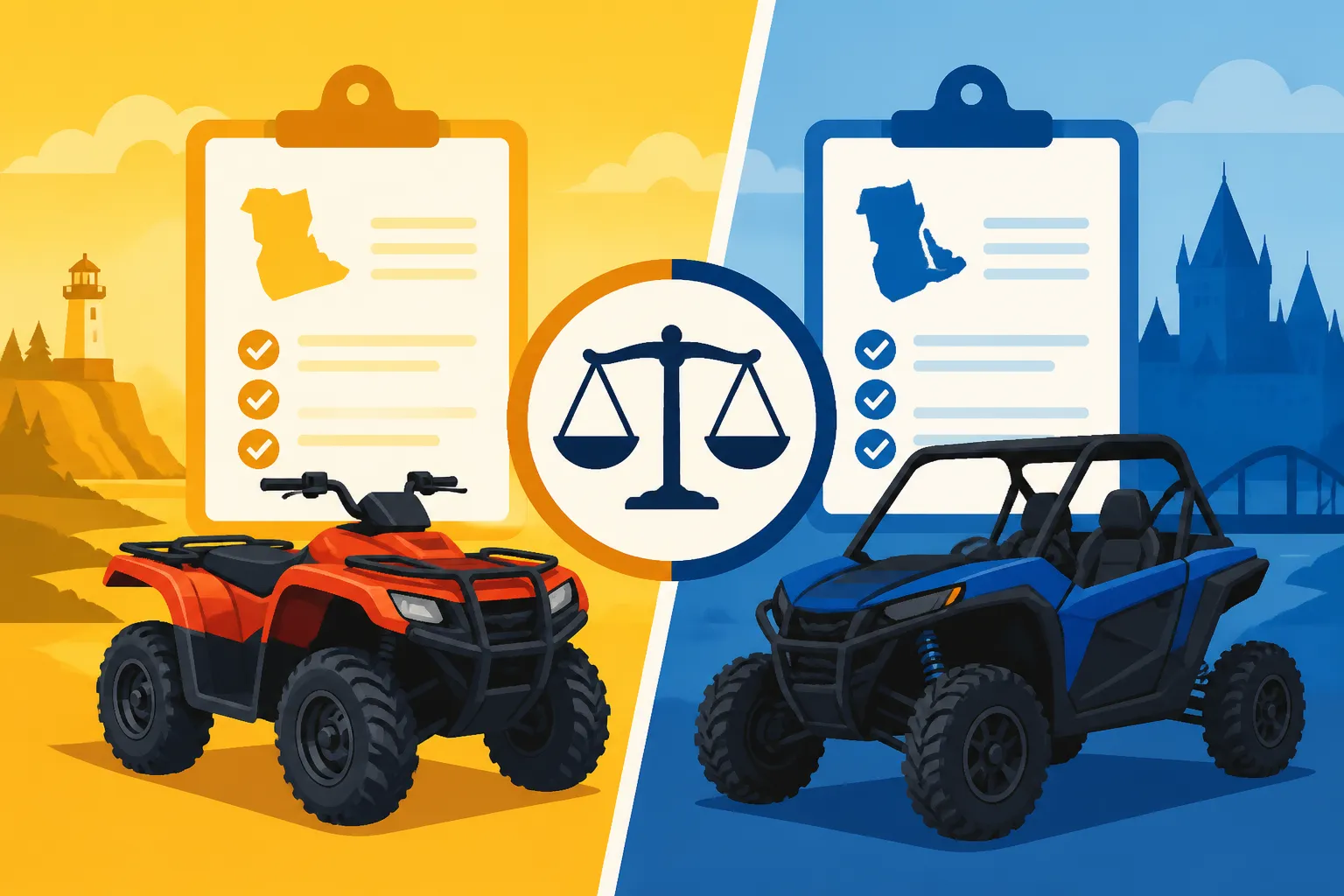
Here's a quick overview of some of the key comparison points:
| Feature | New Brunswick (NB) | Quebec |
|---|---|---|
| Registration Authority | Service New Brunswick | SAAQ (Société de l'assurance automobile du Québec) |
| Plate/Sticker System | Rear-mounted plate + left-fender annual sticker | Plate/sticker system (check SAAQ for specifics) |
| Annual Renewal Date | December 31st (universal) | Varies (may be tied to original registration date) |
| Reciprocity for NB riders in QC | No longer recognized; Quebec trail permit required for QC trails | (N/A for NB riders) |
| Reciprocity for QC riders in NB | QC registration recognized; NB trail permit required for NB trails | (N/A for QC riders) |
| Key Documents to Carry | Registration, Insurance, Driver's Licence, NB Trail Permit | Registration, Insurance, Driver's Licence, QC Trail Permit (if applicable) |
| Insurance Requirement | Mandatory for trail riding | Mandatory (liability) |
Disclaimer
This article is for general informational purposes only and does not constitute professional advice. Laws, prices and regulations vary by location and change over time. Consult a qualified professional for guidance on your specific situation.