New Brunswick Machines With No Paperwork
It's a classic scenario: you've stumbled upon what seems like an incredible deal on an ATV or UTV, perhaps it's an old "barn find" or a machine passed down through the family, only to realize there's absolutely no paperwork to go with it. That initial excitement quickly turns into a sinking feeling as you wonder how you're ever going to get this beauty registered and legally on the trails in New Brunswick. This guide is here to walk you through the frustrating, but often solvable, process of getting your off-road vehicle legal when it feels like all the proper documents have vanished into thin air.
The Frustration of the "Barn Find" – Why Paperwork Matters
We've all been there, browsing online classifieds or chatting with a neighbour, and a sweet deal on a quad or side-by-side pops up. The price is right, the machine looks solid, but then comes the kicker: "no papers." It’s incredibly tempting to overlook this detail when the cost is low, but taking shortcuts here can lead to a lot more headache and expense down the road. In New Brunswick, getting your ORV registered isn't just a suggestion; it's a fundamental step to legally enjoy our province's incredible trail system. Without proper registration, that dream machine quickly becomes a yard ornament, or worse, a source of significant fines.
The Legal Requirements in New Brunswick
Let's be blunt: in New Brunswick, if you plan on riding your ATV or UTV anywhere beyond your own private, fenced-in land, it needs to be registered. This isn't just about showing you own it; it’s about making sure the machine is accounted for, and that you’re contributing to the upkeep and safety of our shared trail networks. Trying to bypass this requirement might seem like a way to save a few bucks or avoid a bit of bureaucracy, but it rarely pays off. You could face stiff penalties if caught riding an unregistered machine. [New Brunswick ORV Registration Explained] delves deeper into the basic requirements, but the takeaway here is clear: paperwork is paramount. An officer on patrol, especially if you're out enjoying the [New Brunswick ATV Trails: The QuadNB Network], will absolutely be asking to see your documentation.
Common Scenarios for Missing Paperwork
So, why does paperwork go missing in the first place? It's not always a nefarious plot. Often, it's just life happening. You might encounter a "barn find" that's been sitting in a shed for decades, forgotten after the original owner stopped riding. Perhaps you've inherited a machine from a family member who wasn't meticulous about keeping records, or maybe the machine was part of a property sale and the original owner simply never bothered to register it in their name. We also see situations where a seller genuinely believes they have the paperwork, only to discover it’s lost in a box of old documents, or even that they never fully registered it themselves after an initial private sale. These situations are common, and while frustrating, they usually have a path forward.
Your Options When Paperwork is Missing
The good news is that "no paperwork" doesn't necessarily mean "no hope." While it adds a few extra steps and requires patience, there are established ways to navigate this challenge with Service New Brunswick. The key is to be diligent, gather as much supporting evidence as possible, and be prepared to prove ownership.
Reaching Out to the Seller (If Applicable)
If you're buying a machine and the seller says "no paperwork," your first and best course of action is to insist they try to locate it. Even an old, expired registration certificate or a previous bill of sale can provide a crucial link in the chain of ownership. Ask them to dig through their records, check old files, or even contact the dealer where they originally bought it. A good seller, even if they don't have the current registration, should be able to provide you with a valid bill of sale from when they acquired the machine, along with their name and contact information. This documentation, even if incomplete, is far better than nothing at all. Emphasize that you need something to prove the machine changed hands legitimately. If they registered it previously, even an old certificate of registration can sometimes help Service New Brunswick trace its history.
Reconstructing a Bill of Sale
Okay, so the seller can't find anything, or perhaps you've inherited the machine and there's no original bill of sale. This is where you might need to get a little creative and formal. A bill of sale is critical because it officially transfers ownership from one party to another. If you don't have one, you might need to create one retrospectively, especially if the seller is still cooperative.
You can use a generic bill of sale template, often found online through legal document services like LawDepot. These templates are designed to be legally sound and cover all the necessary details. When reconstructing a bill of sale, make sure it includes:
- Date of Sale: When the ownership officially transferred.
- Buyer's Full Name and Address: Your information.
- Seller's Full Name and Address: The person who sold you the machine, or the estate if inherited.
- Machine Details: Year, make, model, and crucially, the Vehicle Identification Number (VIN). This is non-negotiable.
- Sale Price: Even if it was a gift, a nominal amount can be listed.
- Signatures: Both buyer and seller must sign it. If inherited, the executor of the estate or a designated family member would sign as the seller.
Having a robust, signed bill of sale is the foundation of proving ownership when you walk into a Service New Brunswick centre. Remember, this document is your official record of the transaction. For more specifics on what Service New Brunswick looks for, you might find [New Brunswick Registration Without a Bill of Sale] helpful.
The Affidavit or Statutory Declaration Route
What if the seller is completely unreachable, or perhaps they've passed away and there’s no executor to sign a bill of sale? This is where an affidavit or statutory declaration becomes a powerful tool. Essentially, this is a sworn statement, made in front of a commissioner of oaths, affirming that you are the rightful owner of the ATV or UTV.
In an affidavit, you would detail how you acquired the machine – whether through purchase, gift, inheritance, or even finding an abandoned vehicle (though the last one has more hurdles). You'd explain the lack of original paperwork and affirm, under oath, that you own the machine and are seeking to register it. You’ll need to include as much detail about the machine as possible, especially the VIN.
Many online legal resources, including platforms like LawDepot, provide templates for statutory declarations or affidavits. You would fill it out, describing the circumstances of your ownership, and then take it to a lawyer, notary public, or a commissioner of oaths to have it officially witnessed and signed. This sworn statement, combined with the machine's VIN, gives Service New Brunswick the legal assurance they need about your ownership claim. This can be a particularly useful path if you're dealing with a situation where a machine was left to you, and the original owner is no longer alive to complete a bill of sale. [New Brunswick Registration for an Inherited Machine] covers this scenario in more detail.
The Service New Brunswick Process (When You Have Minimal Paperwork)
Once you've done your due diligence and gathered as much proof of ownership as possible, it's time to visit a Service New Brunswick centre. This is where all your hard work comes together. Being prepared and patient is key. The staff are there to help, but they need to ensure everything is legitimate before issuing a registration.
Gathering Your Proof of Ownership
Before you even step foot in a Service New Brunswick office, ensure you have all your ducks in a row. This means:
- Your Reconstructed Bill of Sale: If you have one, this is your primary document. Make sure it's fully completed and signed by all parties.
- Your Affidavit/Statutory Declaration: If a bill of sale wasn't possible, this sworn statement takes its place as proof of ownership.
- Photographic Evidence: Take clear photos of the ATV or UTV, especially the VIN.
- VIN Verification: Service New Brunswick will definitely want to verify the VIN. Make sure it's clean and legible on the machine itself. If it's difficult to find or read, try to locate it beforehand and clean off any dirt or rust.
Having multiple forms of proof strengthens your case. Even an old ownership manual for the machine, if you happen to have one, can sometimes help support your claim, especially if it lists the model and serial number.
The Application for Vehicle Registration Form
At Service New Brunswick, you'll need to complete an "Application for Vehicle Registration" form. This form collects all the necessary information about you and the off-road vehicle. You'll need details like:
- Your full name and address.
- Your driver's license number (if applicable).
- The year, make, model, and VIN of the ATV/UTV.
- The type of ORV (ATV, UTV, dirt bike, etc.).
Even though you're working with minimal paperwork, this form is standard for all registrations. You'll clearly state on this form that you are the new owner and provide the supporting documentation you've prepared. The staff will review your bill of sale, affidavit, and any other evidence you bring. They might ask questions to clarify how you acquired the machine, so be prepared to explain your situation clearly and calmly. Having all your documents neatly organized will definitely help the process move smoothly. [Filling Out the Application for Vehicle Registration] can give you a heads-up on what to expect on the form.
Fees and What to Expect
Once your ownership has been established to Service New Brunswick's satisfaction, you'll need to pay the applicable registration fees. These fees vary depending on the type of machine you're registering – for instance, quads typically have a different annual fee than dirt bikes or side-by-sides. While I can't give you exact figures, know that there's an annual cost involved. [New Brunswick ORV Registration Cost] will help you understand the general fee structure.
Be aware that if your bill of sale doesn't show a clear purchase price, or if the transaction was a gift, Service New Brunswick might assess Harmonized Sales Tax (HST) based on the estimated market value of the machine. This is a common practice to ensure fair tax collection. So, even if you paid very little, or nothing at all, for the machine, be prepared for a potential tax assessment. [New Brunswick HST on an ATV Purchase] sheds more light on this.
The processing time for your registration can vary. Sometimes, if everything is straightforward, you'll walk out with your registration certificate and plate that same day. However, if your situation is complex due to missing paperwork, they might need to do some internal checks or refer it to a supervisor, which could mean a slight delay. Patience is a virtue here!
What If the VIN is Missing or Unreadable?
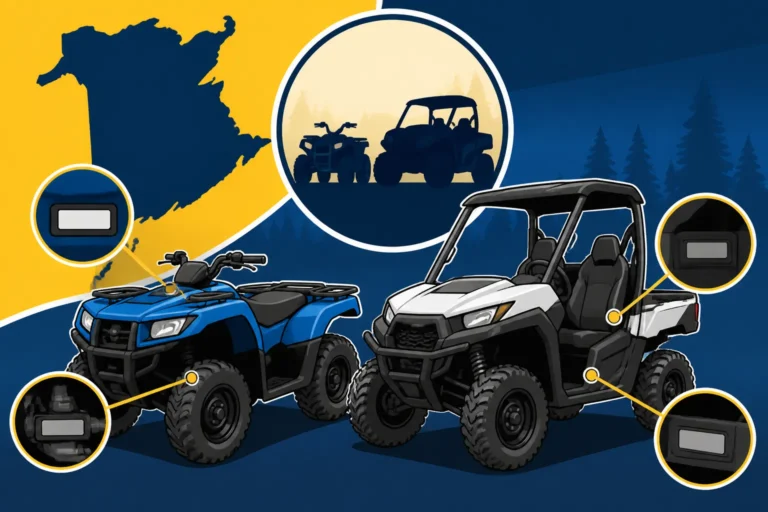
This is truly the trickiest scenario when dealing with a machine that has no paperwork. The Vehicle Identification Number (VIN) is like the off-road vehicle's DNA; it's a unique identifier that links the machine to its history, manufacturer, and ultimately, its owner. Without a clear, verifiable VIN, registering an ATV or UTV becomes significantly more challenging, if not impossible.
The Absolute Last Resort: VIN Verification
If the VIN on your machine is unreadable, rusted out, or appears to be tampered with, you've hit a major roadblock. Service New Brunswick absolutely needs a clear VIN to process any registration. In such cases, they will likely require you to involve law enforcement. You might need to file a police report to have the machine inspected. The police would verify if the machine is stolen and try to find any hidden or original VINs that might still be legible. This process is for legitimate situations where the VIN has simply degraded over time, not for attempting to register a machine with a deliberately altered VIN. [New Brunswick Registration When the VIN Is Gone] explains the gravity of this situation. If no VIN can be found or verified, the machine truly becomes scrap metal in the eyes of legal registration.
When it Might Be Too Much Trouble
Let's be realistic: there are limits to how much effort and money you should pour into trying to register a machine with severe paperwork issues, especially if it also has a missing or unreadable VIN. If the machine is very old, in rough shape, and you're facing both a lack of ownership papers and a questionable VIN, you might reach a point where the cost and bureaucracy outweigh the value of the machine.
Consider the potential expenses: the time spent chasing down information, the cost of an affidavit, the registration fees, and potentially a tax assessment. If you're dealing with a machine that's only worth a few hundred dollars, and the hurdles are extensive, it might genuinely be more practical to use it only on completely private land where registration isn't required (and even then, only if you're certain it's not stolen), or to consider it a parts machine. This is a tough call, but sometimes, walking away or salvaging parts is the most sensible option to avoid throwing good money after bad.
Here's a quick comparison of common ownership proofs when dealing with minimal paperwork:
| Document Type | Description | Pros | Cons | When to Use |
|---|---|---|---|---|
| Original Bill of Sale | Document signed by previous owner, detailing sale. | Strongest proof, clear transfer of ownership. | Often lost, difficult to obtain for old machines. | Ideal, if available. |
| Reconstructed Bill of Sale | Buyer & seller create new document based on past transaction. | Legally valid if accurately filled and signed by both parties. | Requires cooperation from seller, potential for HST assessment. | When original is lost but seller is cooperative. |
| Affidavit/Statutory Declaration | Sworn statement by buyer confirming ownership, witnessed by official. | Proof of ownership when seller is unavailable/deceased. | Requires commissioner of oaths, detailed explanation needed. | Inherited machines, seller unreachable, "found" machines. |
| Previous Registration Certificate | Old, expired registration in prior owner's name. | Shows history, helps Service NB trace ownership. | Not proof of current ownership transfer. | As supporting evidence with a bill of sale or affidavit. |
| Manufacturer's Statement of Origin (MSO) | Document from manufacturer proving first ownership. | Perfect for new machines, but rare for used ones. | Almost never available for used machines, especially old ones. | Only for brand new machines or those never previously registered. |
Dealing with an ATV or UTV that lacks proper paperwork can certainly be a headache, but it’s not an insurmountable obstacle. By understanding the importance of the VIN, diligently preparing your proof of ownership through a robust bill of sale or a sworn affidavit (perhaps using a template from a service like LawDepot), and patiently working with Service New Brunswick, you can often get that machine legally registered. Just remember, a little effort upfront can save you a lot of trouble and potential fines down the road, ensuring you can hit the incredible trails of New Brunswick with peace of mind.
Disclaimer
This article is for general informational purposes only and does not constitute professional advice. Laws, prices and regulations vary by location and change over time. Consult a qualified professional for guidance on your specific situation.