New Brunswick Registration and Proof of Address
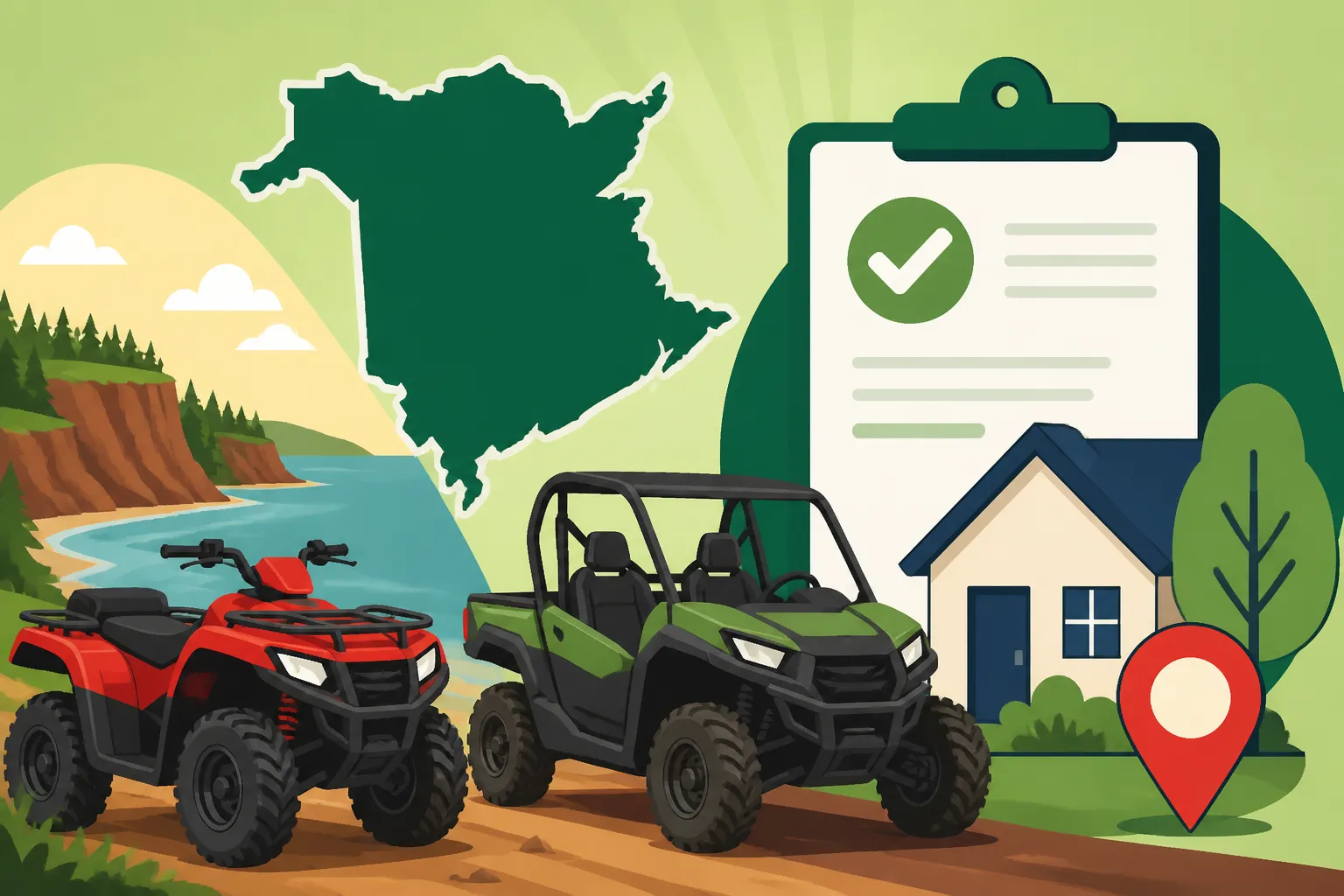
Oh, the joys of paperwork! Getting your ATV or UTV registered in New Brunswick can sometimes feel like a treasure hunt, especially when it comes to proving you actually live where you say you do. Many riders find themselves scratching their heads, wondering exactly what counts as "proof of address" for Service New Brunswick. This guide is here to untangle that knot, walking you through the ins and outs of acceptable documents, common sticking points, and how to make sure your registration goes as smoothly as possible.
Why Proof of Address Matters for Your ATV Registration
You might think, "Why do they care so much where I live?" It’s a valid question, and one that many New Brunswickers have muttered under their breath while rummaging through old mail. The core reason Service New Brunswick requires proof of address is to establish your residency within the province. This isn't just about knowing where to send your mail; it’s fundamental to ensuring you're eligible for provincial services and that the correct fees and taxes are applied.
Imagine you're buying a machine from a private seller, or perhaps you've just moved to the province. Service New Brunswick needs to confirm you're a legitimate resident to process your registration and issue that all-important plate. It can feel like an extra hoop to jump through, but it's part of maintaining accurate records and ensuring compliance with the Off-Road Vehicle Act. For a general overview of the process, you might find our article on [New Brunswick ORV Registration Explained] helpful.
Establishing Residency for ORV Purposes
When Service New Brunswick asks for proof of address, they're essentially asking for proof of residency. This means they need to see documentation that clearly links you to a specific physical address within New Brunswick. It’s not enough to just have a P.O. box or a friend's mailing address; they want to see that you reside here. This distinction is crucial, particularly if you're a new arrival to the province. If you've recently moved, you'll find that proving your new home base is a key step in getting your off-road vehicle legal. You'll want to review [New Brunswick Registration for a New Resident] for specific guidance if that's your situation.
For long-time residents, this might seem like a no-brainer – your driver's license likely has your current address. But what if you've recently moved across town, or your license is expired, or you're simply trying to register a machine you keep at a seasonal camp? These are the scenarios where having a clear understanding of accepted documents becomes incredibly valuable. The province needs to ensure that the ATV or UTV is being registered by someone who genuinely lives within its borders, which can impact everything from how your machine is taxed to how fines are administered.
The Role of Your Address in Taxes and Fees
Your residential address in New Brunswick plays a more significant role than you might initially assume, especially concerning the financial aspects of your ATV or UTV. While we can't get into specific figures, generally speaking, your residency determines which provincial taxes and fees apply to your purchase and registration. For instance, being a New Brunswick resident can influence the Harmonized Sales Tax (HST) applied to an ATV purchase, particularly if you're buying it new from a dealer or transferring ownership privately.
It also ensures you're paying the correct registration fees, which are set at a provincial level for residents. If you were a non-resident trying to register a machine here without proper proof of address, the system wouldn't know which set of rules or fee schedules to apply. It’s all part of the provincial government's framework to ensure everyone contributes fairly and is correctly accounted for. Understanding this connection can make the sometimes-tedious task of gathering documents a little more palatable. You can read more about how tax applies in our guide [New Brunswick HST on an ATV Purchase].
Acceptable Documents for Proof of Address at Service New Brunswick
Alright, let's get down to the nitty-gritty: what pieces of paper will Service New Brunswick actually accept to prove where you live? This is often the biggest hurdle for folks, and it's completely understandable to feel a bit lost in the shuffle. The good news is that there are several common documents they'll recognize, and knowing them in advance can save you a world of frustration.
It's helpful to think of these documents as falling into a few categories: primary forms of ID, utility-related statements, and other official records. Often, you'll need at least two distinct proofs of address, so it's wise to bring more than you think you need, just in case.
Here's a handy table summarizing common acceptable documents:
| Document Type | Commonly Accepted | Details & Caveats |
|---|---|---|
| New Brunswick Driver's Licence/ID Card | Yes | Must show current NB residential address, not expired. This is usually the gold standard. |
| Utility Bill (power, internet, landline, water, natural gas) | Yes | Dated within the last 90 days, shows service address (not just mailing). |
| Property Tax Assessment/Bill | Yes | For homeowners, current year's assessment or bill. |
| Bank Statement | Yes | Dated within last 90 days, shows residential address and recent activity. |
| Rental/Lease Agreement | Yes | Must be signed, current, includes the full residential address. |
| Vehicle Insurance Policy | Yes | Must be current, shows NB residential address for the policyholder. |
| Payroll Stub | Yes | Dated within last 90 days, shows employer and residential address. |
| Government Correspondence (e.g., CRA, social assistance) | Yes | Recent letter with your name and residential address. |
Primary Forms of Identification with Address
Your New Brunswick Driver's License or a provincial ID Card is typically the easiest and most straightforward way to prove your address. It's almost universally accepted because it's issued by the province and already contains your verified residential information. However, this only works if the address on the card is current and accurate. What if you just moved and haven't updated your license yet? Or what if it's expired? In those cases, you'll need supplemental documents.
Beyond your driver's license, recent utility bills are excellent forms of proof. Think electricity bills from NB Power, internet bills, landline phone bills, or even water and sewer bills from your municipality. The key here is "recent" – typically within the last 90 days – and that they show your physical service address, not just a P.O. box. A bank statement, again, dated within the last three months, can also serve this purpose as long as it clearly lists your residential address. For homeowners, a current property tax assessment or municipal tax bill is another strong contender. Preparing all your paperwork beforehand can make a huge difference; check out our [New Brunswick Registration Paperwork Checklist] for more tips.
Alternative and Supplemental Proofs
Sometimes, the primary forms aren't available, or you need a second piece of documentation. This is where alternative and supplemental proofs come in handy. A valid rental or lease agreement is a fantastic option for renters. It should be signed by both parties, clearly state your full residential address, and be current. If you're wondering where to get a solid, legally sound rental agreement template, online services like LawDepot can be incredibly useful. They provide customizable legal documents that meet provincial standards, which can be a real lifesaver for both landlords and tenants who need official-looking paperwork for things like proof of address. Having a professionally prepared document often smooths the process at Service New Brunswick.
Another option is your current vehicle insurance policy, as long as it clearly lists your New Brunswick residential address. This works for your car insurance, home insurance, or even tenant insurance. Even recent payroll stubs can be accepted if they show your employer and your current residential address. The general rule of thumb is that the document should be official, recent, and clearly link your name to your physical New Brunswick residence. It's about providing enough evidence to remove any doubt about where you legally reside. For other challenging document situations, our article [New Brunswick Registration Without a Bill of Sale] offers some good advice on navigating missing paperwork, though that article addresses a different issue. When you're out on the trails, remember you also need to carry documents like your registration and insurance, as outlined in [Carrying Four Documents at Once].
Common Scenarios and Troubleshooting Address Proof Challenges
It would be too easy if everyone's situation fit neatly into a box. Life in New Brunswick is diverse, and so are the living arrangements of its residents. Because of this, many people encounter specific challenges when trying to prove their address. Let's tackle some of the most common scenarios that might throw a wrench in your ATV registration plans.
The key to navigating these situations is often to bring multiple documents, even if you think one might suffice. Service New Brunswick staff are there to help, but they need to see clear, verifiable evidence.
Recently Moved or New to New Brunswick
This is one of the most frequent hiccups. You've just relocated to a new town or moved to New Brunswick entirely, and your driver's license still shows your old address or even a different province. While you should prioritize updating your driver's license, if you haven't had a chance yet, you'll need strong supplementary documents.
For a recent move within the province, a combination of a utility bill for your new address and perhaps a signed lease agreement (again, think about resources like LawDepot for well-formatted agreements) can often bridge the gap until your license is updated. If you’re brand new to New Brunswick, you might need a bit more. A lease agreement, a letter from your employer on company letterhead confirming your employment and address, or perhaps even a recent bank statement from a New Brunswick branch showing your new address would be useful. The goal is to establish a clear paper trail connecting you to your new New Brunswick home. Don't worry, Service New Brunswick staff are used to these situations, and our guide on [New Brunswick Registration Address Change] offers more specific advice on updating your details.
Rural Addresses and P.O. Boxes
Ah, rural living! It's fantastic for ATV enthusiasts, but it can sometimes complicate administrative tasks. Many rural addresses in New Brunswick might not have a traditional street number or rely heavily on P.O. boxes for mail delivery. This can be a challenge because Service New Brunswick often wants to see a physical residential address.
If you have a P.O. box, you'll almost certainly need additional documentation that links that P.O. box to your actual physical residence. This could be a utility bill showing your 911 address (the physical address emergency services use), your property tax assessment, or a detailed rental agreement. It's about demonstrating that while your mail might go to a box, you physically reside at a specific location that the province can recognize. Don't be shy about explaining your rural mailing situation to the staff; they understand the nuances of New Brunswick's varied communities. Sometimes, you just need to ask the right questions at the counter; for more insight into what staff hear, check out [New Brunswick Registration Questions Staff Hear].
Machines Registered for a Business or Camp
What if the ATV or UTV isn't for personal use at your primary residence, but rather for a business or kept at a seasonal camp? This presents a slightly different scenario for proof of address.
For a business-registered machine, you'll need documents that prove the business's physical address. This could include business utility bills, a commercial lease agreement, or business registration documents that list the physical location of operation. The machine is being registered to the business, so the proof of address needs to align with the business entity. Our article [New Brunswick Registration for a Business Machine] delves into this in more detail.
If your machine is primarily kept at a camp or secondary residence, it generally needs to be registered to your primary New Brunswick residential address. While you keep it at the camp, your legal residency is what counts for registration purposes. If the camp is your only New Brunswick residence, then you would need to provide proof of address for that camp, such as a property tax bill for the camp property. This often comes down to demonstrating your legal domicile. For more on this, specifically for camp-related machines, you can look at [A Camp Machine and New Brunswick Paperwork].
Tips for a Smooth Registration Process
Nobody wants to spend more time than necessary dealing with paperwork. The goal is to walk into Service New Brunswick, present your documents, and walk out with that shiny new registration certificate and plate. With a little preparation and foresight, you can significantly increase your chances of a seamless experience.
Preparing Your Documents
This might sound obvious, but it's surprising how many people rush to the counter only to realize they're missing a key piece of information. Before you even leave the house, take the time to gather all your potential proof-of-address documents. Don't just grab one – grab two or three different types. For instance, your driver's license, a recent utility bill, and a bank statement.
Make sure all documents are current and legible. Check expiration dates on IDs. Ensure utility bills are truly within the last 90 days. If you're bringing a digital document, print it clearly. It's also a good idea to make photocopies of everything, just for your own records, even though Service New Brunswick will likely scan the originals. Organizing your documents neatly in a folder can also make a good impression and speed up the process for the staff assisting you. Remember, the more organized you are, the easier you make their job, and the faster you'll be on your way. You can visit one of the many [New Brunswick Service Centres That Register ORVs] to get this done.
What to Do If You're Still Unsure
Even after reading all this, you might still have a lingering question or a unique situation that doesn't quite fit the typical mold. This is perfectly normal, and there's no shame in seeking clarification. Your best bet is always to contact Service New Brunswick directly. You can call their general inquiry line or visit your nearest Service New Brunswick centre to speak with a representative.
When you call, be ready to clearly explain your specific situation. They can often tell you exactly what documents you'll need to bring. If you're going in person, consider bringing a wider array of documents than you think necessary. It's much better to have too many options than to be turned away and have to make a second trip. Being prepared, patient, and polite goes a long way. While the processing time can vary, having everything in order helps immensely, as discussed in [New Brunswick Registration Processing Time]. They want to help you get your ATV registered; you just need to provide them with the right information.
Disclaimer
This article is for general informational purposes only and does not constitute professional advice. Laws, prices and regulations vary by location and change over time. Consult a qualified professional for guidance on your specific situation.