New Brunswick Riders Visiting Quebec
New Brunswick riders planning an ATV or UTV trip in Quebec should not assume their home trail sticker will get them onto Quebec trails. Trail access and vehicle registration are separate issues, and reciprocity has changed. Here’s what to check before crossing the border, how to arrange trail access, and which documents to have ready.
A New Brunswick trail permit does not automatically cover Quebec
A New Brunswick registration identifies your machine for legal use under applicable rules. A trail permit or sticker is different: it provides access to participating trails under the terms set by the trail network. Holding one does not necessarily give you the other.
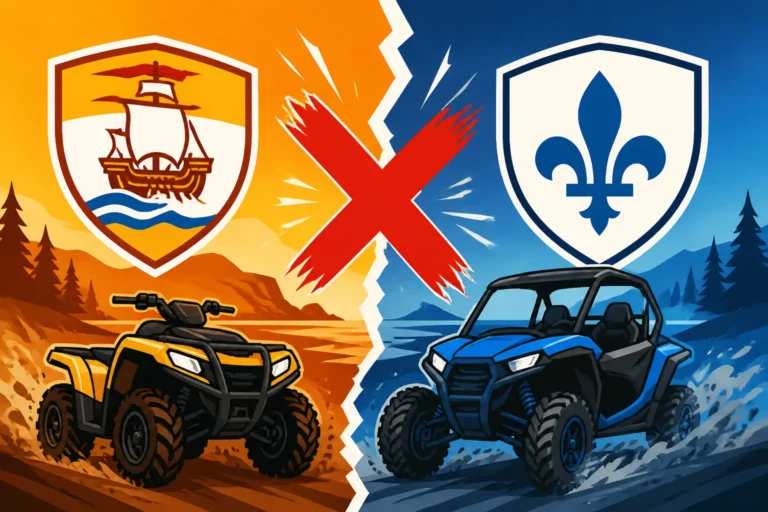
New Brunswick and Quebec no longer have the trail-permit reciprocity agreement that once allowed riders to use a New Brunswick permit for access in Quebec. As a result, a QuadNB permit should not be treated as a Quebec trail pass. The change is covered in New Brunswick Ended Quebec Reciprocity, and the practical takeaway is simple: arrange Quebec trail access separately before riding there.
Quebec trail access is managed through its own trail system. Riders commonly need a Quebec trail permit associated with the Fédération québécoise des clubs quads, or FQCQ. The permit and access conditions can depend on the trail system, the machine, and the kind of ride you have planned. Check the current requirements with the FQCQ or the local club responsible for your destination rather than relying on an old sticker, an earlier trip, or another rider’s experience.
| What you have | What it generally relates to | What to confirm before riding in Quebec |
|---|---|---|
| New Brunswick vehicle registration | Identifying the machine and its registration status | Whether your registration is accepted for the type of riding and machine you plan to do |
| New Brunswick trail permit | Access to eligible New Brunswick trails | Whether a separate Quebec permit is required; do not assume your New Brunswick permit grants access |
| Quebec trail permit | Access to participating Quebec trails under applicable conditions | Which permit applies, where it is valid, and its start and end dates |
| Insurance documents | Financial protection and proof of coverage | Whether your policy covers the machine and intended use in Quebec |
| Rider documents | Showing that you meet applicable rules | Which licence, training, identification, or other documents are required for your circumstances |
The end of reciprocity affects trail access. It does not automatically cancel your New Brunswick registration, change the rules for riding at home, or answer every question about using a New Brunswick-registered machine in Quebec. Those are separate checks. For background on the home-province side, see New Brunswick ORV Registration Explained and New Brunswick Requires Insurance on Trails.
If you are visiting a particular region, ask the local Quebec club which trails are open to visiting riders and what permit they require. A valid permit does not guarantee that every nearby route is open, appropriate for your machine, or available during your trip. Trail conditions, seasonal closures, construction, and local rules can all affect where you can ride.
Arrange your permit and check the machine’s paperwork
The easiest time to resolve permit questions is before you leave home. Do not plan on reaching a trailhead and sorting out access there: the seller or club may not be open, the trail may not allow riding without the required permit, or you may discover that your documents do not match the machine.
Start with your intended destination and ride dates. Contact the relevant Quebec club or permit provider and ask what pass a visitor from New Brunswick needs. Confirm whether the permit applies to an ATV, a side-by-side, or both, and whether it is tied to a particular machine. If you plan to take more than one machine, ask whether each needs its own permit. Avoid assuming a pass can be transferred between machines or riders.
Then check that your vehicle documents are in order. A trail permit is not a replacement for registration, proof of insurance, or any other document required for the machine. Rules can differ based on vehicle type and where you ride, so verify the current Quebec requirements for a machine registered in New Brunswick. In particular, ask whether a New Brunswick registration certificate is sufficient for your planned use and whether any additional paperwork is needed.
Use this checklist:
- Identify the trail network. Decide where you plan to ride and find the club or organization that manages access to those trails.
- Ask about the Quebec pass. Confirm the right permit for your machine and dates, how to obtain it, and whether the permit must be displayed in a particular place.
- Confirm route access. Ask which trails are open to visitors and check for closures, seasonal restrictions, or machine-specific limits.
- Check registration requirements. Verify that the machine’s New Brunswick registration is suitable for the Quebec use you have in mind.
- Confirm insurance coverage. Ask your insurer whether your policy covers the machine while riding in Quebec and whether it covers the kind of trail use planned.
- Gather rider documents. Check whether your age, licence, safety training, or other circumstances affect what you must carry or be allowed to do.
- Keep the documents accessible. Carry required documents on the machine or with the rider in the form accepted by the applicable rules.
New Brunswick riders may find New Brunswick Riders Need a Quebec Permit helpful when sorting out the specific permit question. For the New Brunswick documents side, New Brunswick Documents You Must Carry explains why it is useful to have the required papers ready rather than relying on a photo or a verbal explanation. Confirm what Quebec accepts for your situation; a document that works for a New Brunswick trail stop may not settle every question across the border.
Insurance deserves a separate check. Do not assume that a policy covers every province, every machine, or every kind of use simply because it was accepted when you registered at home. Call your insurer and describe the trip plainly: the machine type, where you intend to ride, and whether it will be used on organized trails. Ask what proof of insurance you should carry. The home-province rules are discussed in New Brunswick Requires Insurance on Trails, but your insurer can confirm the terms of your own coverage.
If a machine is borrowed, rented, financed, or registered to someone else, clarify who is responsible for the permit and documents. Get permission to take it into Quebec and check that the insurance and registration arrangements cover the actual rider. A permit purchased for one machine may not be valid for a different one, and permission to ride a machine does not necessarily mean you have permission to use it on a particular trail.
Plan the ride around Quebec’s local rules
A permit is one part of a cross-border ride, not a blanket authorization to ride anywhere. Trail access depends on the network and local conditions. Before setting out, check the route, operating dates, machine restrictions, and any local instructions. If your plan includes public roads or connections between trail sections, verify the rules for those segments separately; a trail permit does not itself authorize road use.
Quebec’s requirements may differ from the rules you know in New Brunswick. That can matter for both the machine and the rider. Confirm applicable helmet, passenger, age, training, and operating rules for your planned route. Don’t rely on a friend’s description unless it matches your machine and circumstances. The question is not only whether you can ride an ATV in Quebec, but whether you can ride that machine, on that route, under the conditions of your visit.
Allow time to deal with permit and paperwork questions before your travel day. If your first-choice club is not reachable, look for the organization responsible for the exact trail area rather than assuming another club’s guidance applies everywhere. Keep a note of the answers you receive, especially the permit type, where it must be displayed, and any documents the club says visitors should carry.
A practical pre-trip check can prevent avoidable delays:
- Match the permit to the machine. Confirm whether the permit covers your ATV or UTV and whether each machine needs an individual pass.
- Check the sticker instructions. Follow the Quebec provider’s directions for placement and display instead of copying the position used for a New Brunswick sticker.
- Check the trail status close to departure. Access can change because of weather, maintenance, closures, or seasonal operating conditions.
- Bring proof, not just assumptions. Carry your registration and insurance documents and any required rider credentials in the form accepted by the relevant authorities.
- Make a plan for limited service. Save the route information and trail contacts before heading into an area with unreliable cell reception.
- Ask about special situations. If you are bringing a borrowed machine, a rental, a youth rider, or a passenger, describe that situation when checking the rules.
It can also help to keep your New Brunswick and Quebec documents separate and easy to identify. For example, put the Quebec trail pass information with the route notes and keep the vehicle registration and insurance proof together. This reduces confusion if someone asks to see a particular document. Carrying Four Documents at Once offers a related approach for keeping trail paperwork organized.
If you regularly ride in both provinces, make a fresh check each season rather than assuming last year’s arrangements still apply. Reciprocal agreements, permit terms, trail operations, and local requirements can change. New Brunswick Riders Visiting Quebec is not a substitute for checking current instructions with the Quebec permit provider, the local trail club, and your insurer. Confirming those details before loading the machine is far easier than being turned away after you arrive.
Disclaimer
This article is for general informational purposes only and does not constitute professional advice. Laws, prices and regulations vary by location and change over time. Consult a qualified professional for guidance on your specific situation.