Where an Amphibious Machine Sits on the Fee Schedule
Riding across the muddy bogs of the Restigouche, traversing logging roads near Miramichi, or wading directly into a marshy pond on a multi-wheel amphibious machine offers unmatched versatility. However, taking an amphibious all-terrain vehicle—such as a six-wheel or eight-wheel ARGO—to a Service New Brunswick counter often leads to confusion. Owners frequently struggle to figure out whether their amphibious craft is taxed as a standard quad, categorized as a specialized utility vehicle, or subject to distinct maritime and off-road classifications.
This comprehensive guide clarifies exactly where an amphibious machine sits on the provincial fee schedule, breaks down the documentation you need before heading to a service centre, explains mandatory insurance and permit requirements, and helps you navigate private sales with absolute legal confidence.
Understanding Off-Road Vehicle Classifications in New Brunswick
Navigating provincial motor vehicle regulations can feel daunting when your vehicle does not fit the traditional mold of a four-wheeled quad or a standard side-by-side. New Brunswick establishes clear boundaries for what constitutes an off-road vehicle, but amphibious craft occupy a unique space that spans land and water operations.
The Off-Road Vehicle Act Framework
In New Brunswick, ground transit off public highways is governed primarily by provincial legislation designed to ensure safety, environmental accountability, and proper ownership records. When examining What New Brunswick’s Off-Road Vehicle Act Covers, the law defines an off-road vehicle based on its structural design, tire contact points, weight, and intended operating environment.
The primary purpose of this framework is to ensure that every motorized vehicle capable of cross-country travel is logged in a centralized registry. Whether a machine travels on low-pressure tires, continuous tracks, or a combination of both, it falls under provincial oversight the moment it operates on public lands, designated club corridors, or Crown woodlots. Understanding this legislation helps owners realize that despite their amphibious craft’s floating capabilities, its land-based movement triggers mandatory registration requirements identical to traditional off-road rigs.
Defining Amphibious Machines Under the Law
Amphibious vehicles are specialized machines engineered to drive across rough terrain and float or propel themselves through water bodies. While federal marine guidelines oversee motorized vessels navigating public waterways, provincial authorities regulate these machines as land-based off-road vehicles as long as their primary propulsion relies on wheels or tracks contacting the ground.
At the service counter, clerks look at the vehicle’s structural layout rather than its aquatic capabilities. If your machine is designed to travel off-highway and utilizes four or more wheels (or tracks) for ground propulsion, it is classified under the broad umbrella of off-road utility machines. It does not escape land-based vehicle registration simply because it possesses a sealed tub hull or an outboard motor mount.
Distinguishing Quads, Side-by-Sides, and Multi-Axle Amphibious Craft
To determine proper registration pathways, provincial agents categorize vehicles into specific classes based on axle counts, seating configurations, and overall width. Traditional quads are straddled by the operator and steered via handlebars. Side-by-sides (UTVs) feature bench or bucket seating, a steering wheel, and a rollover protective structure.
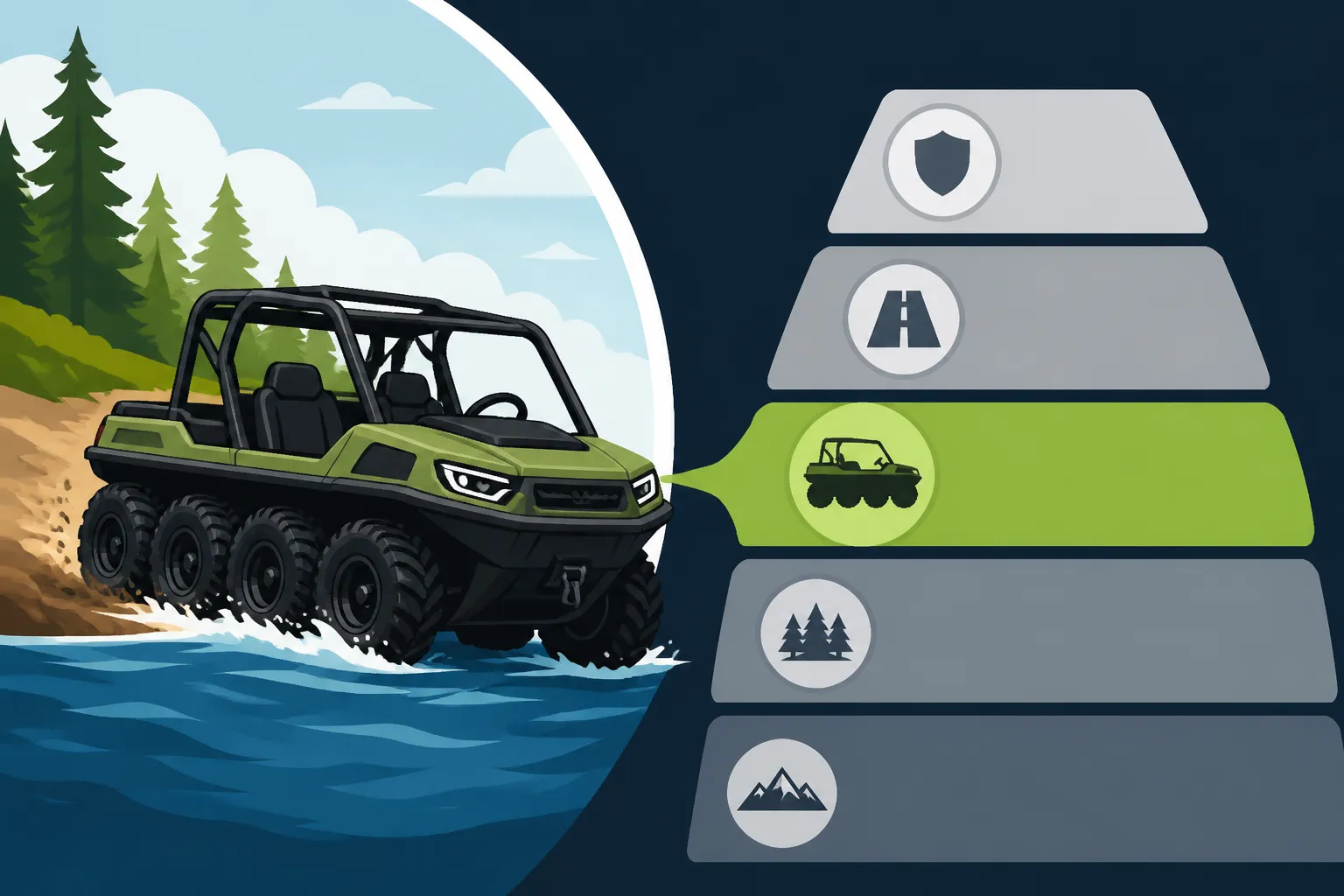
Multi-axle amphibious craft often feature skid-steering, bench seating, and six to eight drive wheels. Despite these mechanical differences, provincial fee structures group these multi-wheeled utility vehicles within the same overall fee tiers as standard quads and side-by-sides, rather than placing them into a higher, commercial-only rate class. Clarifying these distinctions early prevents administrative delays when filling out your paperwork.
Where an Amphibious Machine Sits on the Fee Schedule
Understanding where your vehicle fits financial expectations saves time and eliminates surprises at the counter. Service New Brunswick maintains a unified fee structure that categorizes non-highway vehicles based on primary vehicle class rather than engine displacement or axle count.
Comparing Registration Costs Across ORV Types
When evaluating provincial administrative costs, amphibious machines sit alongside standard quads and side-by-sides on the fee schedule. The province applies a uniform baseline registration fee for standard off-road vehicles, contrasting with lighter non-quad dirt bikes or specialized lightweight buggies which sometimes carry lower baseline costs.
Because an amphibious unit operates on multiple axles and exceeds the footprint of a light trail bike, it is rated in the standard off-road vehicle bracket. This means whether you are registering a traditional 4×4 quad or an 8×8 amphibious utility machine, your provincial registration fee remains identical. The state does not surcharge owners simply because a machine possesses eight wheels instead of four.
Initial Registration versus Annual Renewals
Your initial visit to a service counter involves several distinct cost components beyond the basic administrative fee. When completing Registering an ATV With Service New Brunswick, first-time applicants pay for the vehicle registration certificate, the physical metal license plate, and applicable provincial sales taxes based on the purchase price or fair market value.
Annual renewals, by contrast, are significantly more streamlined and affordable. Once the physical plate is assigned to the hull or frame of your amphibious craft, your recurring annual commitment consists solely of the annual renewal fee. Keeping your annual registration current is critical, as operating an expired vehicle on provincial trails or Crown land can result in steep fines.
Plate Fees and Mandatory Decal Placement
When you register your amphibious machine for the first time, you receive a physical metal license plate and a validated year decal. The physical plate fee is a one-time cost unless the plate becomes damaged, defaced, or lost during deep-water or mud outings.
Proper mounting on an amphibious vehicle requires careful planning due to the unique shape of the lower hull and amphibious body. While traditional quads mount their plates on a rear rack, amphibious craft require secure mounting high enough on the rear upper bodywork to remain visible and prevent loss when navigating deep water or dense brush. Additionally, understanding proper decal location is vital; adhering to rules like New Brunswick Permit Stickers on the Left Side ensures law enforcement officers can easily verify your machine’s compliance from the trail shoulder.
Paperwork and Document Requirements at Service New Brunswick
Before riding out to your local service center, gathering the appropriate legal documentation is essential. Missing paperwork is the single most common reason amphibious vehicle owners are turned away at the counter.
Proof of Ownership and Bills of Sale
To establish legal title, Service New Brunswick requires clear proof of ownership from the seller to the buyer. If you purchased your amphibious machine brand new from an authorized dealer, you must present the New Vehicle Information Statement (NVIS) along with the official dealer invoice showing taxes paid.
For private sales, the transaction requires a signed certificate of registration from the previous owner alongside a detailed bill of sale. When purchasing a used ARGO or multi-axle machine privately, generating a comprehensive bill of sale using customizable legal templates from LawDepot ensures all necessary details—such as full buyer and seller contact details, agreed purchase price, date of sale, and specific vehicle descriptors—are legally binding and clearly documented. Bringing a standardized bill of sale drafted through LawDepot eliminates ambiguity regarding transaction terms and tax calculations at the counter. Reviewing a complete New Brunswick Registration Paperwork Checklist before leaving home ensures you do not overlook vital signatures.
Managing VIN and Hull Identification Issues
Amphibious vehicles often present unique identification challenges. Unlike standard motor vehicles that feature a clear VIN stamped on a front frame rail, amphibious craft may feature a Vehicle Identification Number stamped onto the inner frame, stamped near the engine compartment, or etched onto a hull plate.
If you are buying an older amphibious craft where the serial number tag has suffered water corrosion or trail abrasion, you must locate and verify the number before attempting registration. Agents must verify the full serial number against provincial databases to clear stolen vehicle checks and lien records. If the serial number is completely unreadable, you may need to undergo an administrative verification process to have a secondary identification number cleared before a registration card can be issued.
Transferring Title from Private Sales or Out-of-Province
Acquiring an amphibious machine through a private transaction requires immediate administrative action. Executing a clean title transfer involves presenting the previous owner’s signed registration certificate. Following a transaction, completing New Brunswick Registration After a Private Sale within the provincially mandated timeframe protects both parties from future liability and ensures accurate tax assessment.
If you bring an amphibious vehicle into New Brunswick from another province or state, additional steps apply. You must provide the out-of-province registration card, a valid bill of sale—which can be easily drafted using LawDepot to meet cross-border documentation expectations—and proof that any applicable Harmonized Sales Tax (HST) or provincial sales tax is settled during the transfer process.
Insurance, Trail Permits, and Operating Requirements
Registering your amphibious vehicle and securing a license plate is only the first step toward legal trail riding. Provincial laws mandate specific insurance policies and trail permits before your wheels or tracks hit managed corridors.
Insurance Rules for Dual-Surface Vehicles
A common misconception among amphibious vehicle owners is that standard home or marine insurance policies provide sufficient coverage for off-road operation. Provincial legislation strictly mandates that any off-road vehicle driven off private property must carry valid motor vehicle liability insurance.
The law dictates that New Brunswick Requires Insurance on Trails, woodlots, Crown land, and public rights-of-way. Your insurance policy must specifically cover off-road vehicle third-party liability. Carrying only a marine policy meant for open-water boating will not satisfy trail wardens or police officers checking documents on a woods road. Always ensure your insurer notes the vehicle’s dual-purpose nature on the liability card kept inside the machine.
QuadNB Trail Permits and Waterway Navigability
While registration fees go directly to the provincial government to maintain the official motor vehicle registry, accessing maintained trail networks requires a separate seasonal trail permit. Managed trails throughout the province are maintained by volunteer clubs under the provincial federation umbrella.
Purchasing a valid seasonal or multi-season permit through New Brunswick ATV Trails: The QuadNB Network grants legal access to thousands of kilometers of groomed and non-groomed corridors. However, amphibious craft operators must exercise caution near waterways. While your machine can float across calm ponds or slow-moving streams, driving through sensitive fish habitats, spawning beds, or protected wetlands without explicit environmental clearance violates both provincial environmental protection acts and federal fisheries laws.
Mandatory Safety Gear and Equipment Rules
Operating an amphibious craft requires compliance with land-based safety standards as well as common-sense marine safety practices. On land, every occupant riding in or on an amphibious craft must wear an approved, properly fitted helmet meeting recognized safety standards (such as DOT, Snell, or CSA ratings).
Additionally, amphibious machines must be equipped with working headlights, taillights, and functional braking systems. When transitioning from land to open water, safety expectations double: passengers should wear approved Personal Flotation Devices (PFDs), and operators must carry basic marine safety gear, including a manual bailing device, a sound-signaling device (whistle or horn), and a watertight flashlight if operating near dusk.
Summary Matrix of New Brunswick Vehicle Registration Categories
To help you understand how amphibious machines stack up against other popular off-road vehicles on the provincial fee schedule and administrative grid, review the comparison matrix below:
| Vehicle Classification | Typical Axle / Wheel Count | Provincial Registration Category | Plate Requirement | Mandatory Liability Insurance Required Off Private Property? | Trail Permit Needed for Managed Corridors? |
|---|---|---|---|---|---|
| Standard Quad (ATV) | 2 Axles / 4 Wheels | Standard Off-Road Vehicle | Yes (Rear Mounted) | Yes | Yes (QuadNB Permit) |
| Side-by-Side (UTV) | 2 Axles / 4 Wheels | Standard Off-Road Vehicle | Yes (Rear Mounted) | Yes | Yes (QuadNB Permit) |
| Amphibious Craft (ARGO) | 3-4 Axles / 6-8 Wheels | Standard Off-Road Vehicle | Yes (Upper Rear Body) | Yes | Yes (QuadNB Permit) |
| Off-Road Dirt Bike | 2 Axles / 2 Wheels | Lightweight Off-Road Vehicle | Yes (Rear Fender) | Yes (Exemptions apply strictly on private land) | Yes (Where permitted) |
| Dune Buggy / Utility Kart | 2 Axles / 4 Wheels | Standard Off-Road Vehicle | Yes (Rear Frame) | Yes | Yes (QuadNB Permit) |
As shown in the table, amphibious machines sit directly within the standard off-road vehicle category alongside conventional quads and side-by-sides, sharing identical baseline registration structures and insurance mandates.
Common Registration Pitfalls and How to Avoid Them
Even seasoned off-road enthusiasts can encounter administrative hurdles when managing specialized amphibious craft. Being aware of these common traps saves time, money, and unnecessary legal headaches.
Buying Used Amphibious Craft Without Paperwork
One of the riskiest moves an off-road buyer can make is purchasing an old multi-axle amphibious vehicle without a clear title or prior registration card. Sellers often claim that because the machine was used exclusively on a private farm, hunting camp, or woodlot, paperwork was never needed.
Registering a machine with no paper trail requires extensive administrative background checks, bill-of-sale verifications, and statutory declarations. If you are considering a private purchase, ensure the seller provides an official bill of sale. Utilizing LawDepot to draft a legally binding purchase agreement that explicitly states the seller guarantees clear ownership free of liens protects your financial investment if registration complications arise later at the service counter.
Seasonal Renewals and Expiration Rules
Timing your registration renewal is critical to avoiding lapse penalties or getting ticketed during early-season rides. New Brunswick operates on a fixed calendar schedule for off-road registrations rather than rolling anniversary dates tied to your birthday.
Understanding Why Every ORV Plate Expires on December 31 is essential for every machine owner across the province. Regardless of whether you register your amphibious craft in January or October, the registration sticker expires on the final day of the calendar year. Renewing your registration online or at a service centre prior to ringing in the New Year guarantees continuous legal operation for early winter adventures or ice-fishing outings.
Navigating Waterways versus Crossing Crown Land
Amphibious craft excel at bridging the gap between land and water, but this dual capability creates legal grey areas if operators are not careful. Crossing Crown land on established woods trails is fully permissible provided your machine is registered, insured, and permitted. However, entering water bodies requires strict adherence to environmental regulations.
Ripping through protected riverbanks, tearing up salmon pools, or disturbing sensitive shoreline ecosystems can result in severe environmental citations that far exceed standard trail fines. When stopped by conservation officers or trail wardens, knowing What an Officer Can Ask to See on a Trail—including your registration certificate, driver’s license, proof of insurance, and trail pass—ensures a smooth interaction. Always enter water bodies at designated, hard-bottom launch points or established trail crossings to protect local waterways and preserve riding access for the entire off-road community.
Final Steps for Amphibious Vehicle Owners
Operating an amphibious machine in New Brunswick offers incredible freedom across diverse wilderness terrain. By understanding that amphibious craft sit firmly in the standard off-road vehicle category on the provincial fee schedule, you can approach the registration process prepared. Assemble your ownership documents, draft a clean bill of sale using LawDepot for private purchases, secure proper liability insurance, mount your plate high on the rear hull, and keep your QuadNB trail permit up to date. Taking these straightforward administrative steps ensures you spend less time waiting at government counters and more time exploring the province’s vast network of trails and waterways.
Disclaimer
This article is for general informational purposes only and does not constitute professional advice. Laws, prices and regulations vary by location and change over time. Consult a qualified professional for guidance on your specific situation.