First Aid on a Remote Woods Loop
A minor spill can become a serious problem when your group is miles from a road, cell service, or the nearest trailhead. A remote New Brunswick woods loop calls for more than a small first aid kit: riders need a plan, reliable location details, and a calm way to handle injuries while help is arranged.
Plan for First Aid Before You Leave
Match your plan to the ride
A short loop near a busy trailhead and a long ride through a remote stretch of the Miramichi or Restigouche region do not carry the same risks. On a more isolated route, help may take longer to reach you, and you may have limited phone service or no practical way to leave an injured rider alone. Plan for the route you are actually riding, not the route you hope to ride.
Before setting out, check the trail conditions, identify your start and end points, and agree on a turnaround time. Let someone who is staying behind know your planned route, who is riding, and when to expect you back. If the group changes plans, update that person when you regain service. New Brunswick Trail Conditions Before You Go can help you think through what may affect a ride before you leave.
It also helps to identify likely exit points in advance. A trail junction, road crossing, or nearby community may give you a clearer way to describe your location or organize a pickup. Don’t assume every woods road is open to public traffic or suitable for an ambulance. Focus on details you can confirm: a trail sign, kilometre marker, junction name, bridge, or GPS coordinates.
For navigation, use a map app such as onX Offroad as one part of your plan, not your entire safety system. Download the relevant map area before the ride, check that your device can show your position offline, and carry a backup power source. A phone with a downloaded map is useful, but it does not replace a first aid kit, a communication device, or a riding partner who knows the plan.
Prepare communication and location details
Cell coverage can change quickly between open areas and wooded or low-lying sections. A phone may show a signal at the trailhead and lose it farther into the woods. Before departure, check the route’s known coverage and plan around the possibility that you will not be able to place a call. Checking Cell Reception Before a Remote Ride and Cell Dead Zones in the New Brunswick Interior are useful reminders to treat connectivity as uncertain.
A satellite messenger or personal locator device can provide another way to ask for help when mobile service is unavailable. Learn how to use it before the ride, charge it, and keep it somewhere accessible rather than buried in a pack. If you bring a satellite device, make sure the group knows who has it and how to activate an emergency alert. Carrying a Satellite Messenger on a Long Ride covers why this matters on a remote route.
Make sure at least one rider can share a precise location. That might mean reading coordinates from a navigation device, describing a marked junction, or reporting the closest recognizable feature. With onX Offroad, download your route area before leaving coverage and practise finding your position on the map while you still have a signal. A familiar tool is much easier to use under stress than a new app opened for the first time after a crash.
Before the group moves out, agree on a few simple rules:
- Stop together after an incident; don’t send the whole group off in different directions.
- Keep one person with the injured rider whenever it is safe to do so.
- Identify who will contact emergency services or use the satellite device.
- Send one person only if someone must travel to a known location for help.
- Share the route plan and location details with the person waiting at home.
Pack a First Aid Kit You Can Actually Use
Choose supplies for likely trail injuries
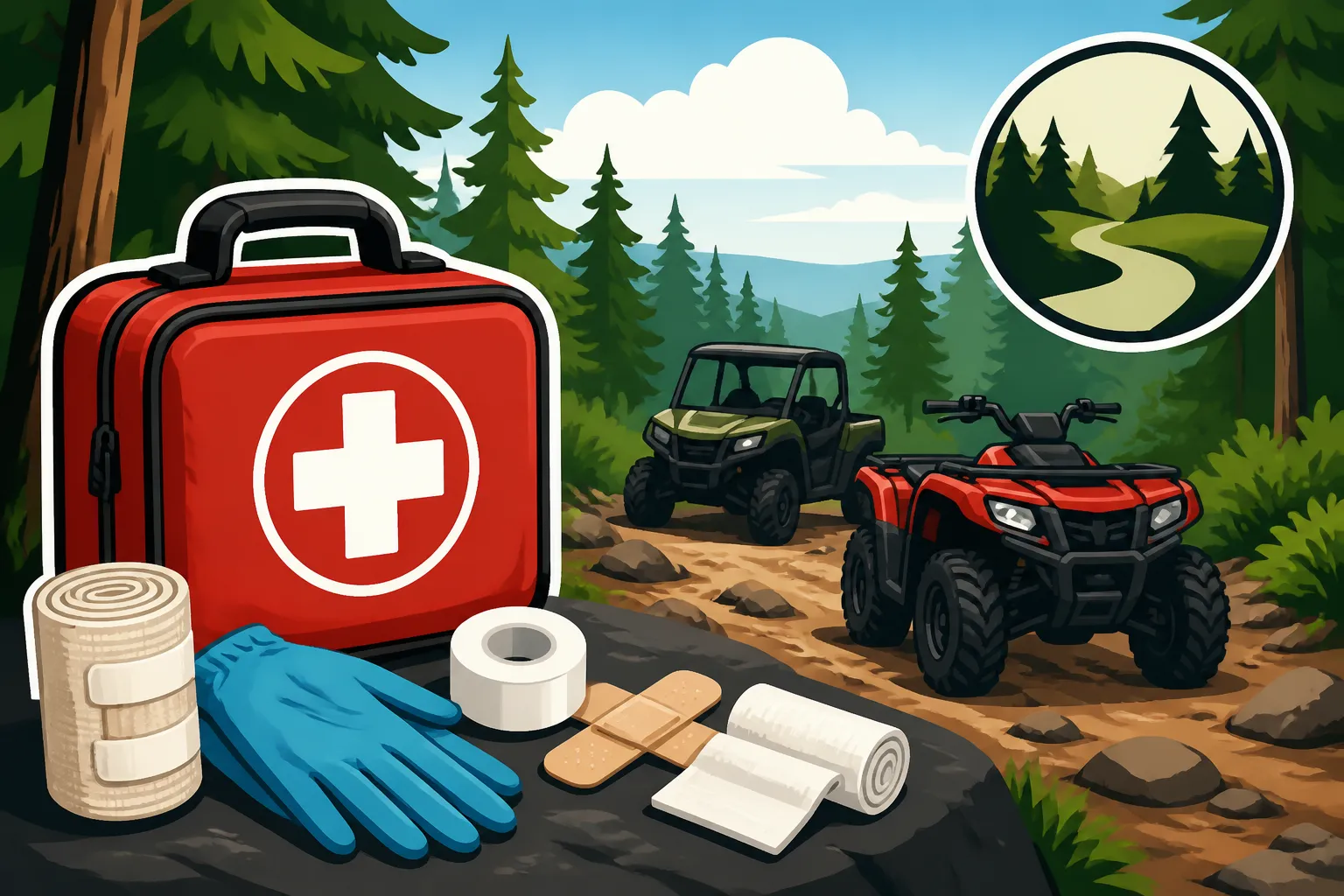
A useful ATV first aid kit is organized, protected from water, and easy to reach. It does not need to be elaborate, but it should have more than a few adhesive bandages. Cuts, scrapes, sprains, burns, and cold exposure are all realistic concerns on a woods ride. A crash can also create a more serious injury that needs professional help.
Consider packing:
- Nitrile gloves and hand-cleaning supplies
- Gauze pads, sterile dressings, and medical tape
- Bandages in several sizes
- A pressure dressing for controlling bleeding
- Antiseptic wipes or another suitable way to clean minor wounds
- Tweezers and trauma shears
- A triangular bandage or other supplies for supporting an injured limb
- An emergency blanket
- A small flashlight or headlamp with spare batteries
- Personal medication and a written list of important medical information
- A compact first aid guide, if no one in the group has current training
Choose supplies you understand how to use. A kit filled with unfamiliar tools may look reassuring but can slow you down when someone is hurt. Check it before the riding season and after each trip; replace anything used, damaged, or no longer in good condition. Store the kit where it can be reached without unloading the machine.
First aid training is valuable because it helps riders recognize what they can safely manage and when the situation needs emergency care. If your group includes children, older riders, or anyone with a known medical condition, plan around their needs and make sure their essential medication is accessible. Don’t rely on another rider remembering where something is packed.
A small kit on each machine can be helpful, but it is also sensible to have one more complete kit in the group. If a machine becomes stuck or needs to be left behind, the group should still have access to basic supplies. Keep your kit secured so it cannot become a hazard during rough travel.
Bring supplies for the conditions, not just the injury
In the woods, staying warm and dry can matter as much as cleaning a cut. A rider who is hurt may be less able to move, and a long wait can become uncomfortable or unsafe in rain, wind, or cool temperatures. An emergency blanket, spare dry layer, and rain protection can help the group manage while arranging assistance.
Water and food are also part of practical preparation. They do not treat an injury, but they help the rest of the group stay capable if the incident delays the ride. Pack enough for the planned trip with some extra margin, especially when the route is remote or the weather is unsettled. Packing for a Full Day in the Woods is a helpful companion when you’re building a complete ride kit.
Keep an eye on how supplies are packed. A first aid kit should be protected from water and mud, but not buried under tools, food, or riding gear. Tell the group where it is before you leave. If someone is hurt, searching through several storage compartments wastes time and can make an already tense situation feel more chaotic.
| Situation | Useful preparation | First response |
|---|---|---|
| Minor cut or scrape | Gloves, cleaning supplies, gauze, bandages | Clean and cover it, then watch for worsening symptoms |
| Heavy bleeding | Gloves and a pressure dressing | Apply firm direct pressure and seek emergency help |
| Possible sprain or broken bone | Support bandage or triangular bandage | Keep the rider still and comfortable; avoid forcing the limb into position |
| Cold or wet rider | Dry layer, rain gear, emergency blanket | Get them sheltered from wind and wet conditions |
| Serious crash or reduced responsiveness | Communication device, location details, first aid training | Call emergency services or activate the emergency device; follow dispatcher instructions |
This table is a planning aid, not a substitute for training or medical care. When an injury seems serious, or you are unsure what to do, contact emergency services and follow their instructions.
Respond Calmly When Someone Is Hurt
Make the scene safer before you treat the rider
A crash on a trail may leave other hazards nearby: moving machines, unstable ground, poor visibility, or another rider approaching around a bend. Before focusing on the injury, stop the group and make the area as safe as you reasonably can. Shut down machines if they are in the way, keep people out of the travel path, and make the scene visible to approaching riders without creating another hazard.
Assign jobs rather than having everyone crowd around. One person can stay with the injured rider, another can manage communication, and a third can watch for approaching traffic or gather equipment. If the group is small, prioritize staying with the injured person and contacting help. Avoid leaving a seriously injured rider alone just to collect supplies.
Check whether the rider is responsive and breathing normally, and look for severe bleeding. If the person is unconscious, has trouble breathing, has heavy bleeding, or may have a serious head, neck, or back injury, treat the situation as an emergency. Call 911 if you can, or use your satellite emergency device if mobile service is unavailable. Give the clearest location you can, then follow the dispatcher’s directions.
For heavy bleeding, use gloves if available and apply firm, direct pressure with a dressing or clean material. If blood soaks through, keep pressure on and add material rather than repeatedly lifting the dressing to check. If the bleeding is severe, get emergency help promptly. Do not try to remove an object embedded in a wound.
Keep the rider comfortable and avoid making things worse
After a crash, a rider may want to stand up quickly or insist they are fine. Encourage them to pause while you check for pain, dizziness, confusion, bleeding, or difficulty moving. Don’t pull someone up or move them unnecessarily if a head, neck, back, or major bone injury is possible. Moving the rider may be necessary if there is an immediate danger, but otherwise wait for professional guidance.
For a suspected sprain or fracture, keep the injured area supported and as still as possible. Don’t try to straighten a limb or test how much weight it can bear. If the person is cold or wet, add a dry layer or emergency blanket while keeping an eye on their condition. Reassure them, speak calmly, and explain what the group is doing.
If a rider has struck their head, seems confused, becomes unusually sleepy, vomits, or has a worsening headache, seek urgent medical help. A helmet can reduce the risk of injury, but it does not rule one out. Don’t let a rider with concerning symptoms continue the route just because they can sit on the machine.
Make a simple record of what happened if it is safe to do so: the time, the rider’s symptoms, and what first aid was provided. This can help when you speak with emergency responders. Keep the injured person under observation and follow any instructions from the dispatcher or medical professionals.
Get Help and Manage the Rest of the Group
Share a clear location and route
When calling for help, start with the most useful location information you have. Give the trail name or region, the nearest marked junction or road crossing, the direction you were travelling, and any coordinates available. If you are unsure how to read coordinates, say so and describe the map or sign in front of you rather than guessing.
A map app such as onX Offroad can help you identify where you are relative to a trail or road, particularly if you have downloaded the area in advance. Check the device’s location display and communicate the coordinates carefully. If using an offline map, remember that the map can show your position without providing a way to call for help; a separate communication method may still be needed.
One person should stay available to communicate, while another can guide responders from a known access point if that is safe and appropriate. Don’t split the group without agreeing on who is staying with the injured rider, who is travelling, and how they will reconnect. If there is no reliable way to reach responders from the trail, use your established plan and the location details you prepared before leaving.
Decide whether to continue, turn back, or end the ride
A minor incident can still change the safest plan for the day. The injured rider may be shaken, sore, or less able to control the machine. Other riders may be distracted, and the remaining route may be longer than expected. Continuing simply to finish the loop is rarely worth making a manageable situation worse.
Before moving again, consider the rider’s condition, daylight, weather, remaining distance, and whether the route offers a safe way back. If the rider has concerning symptoms or cannot operate the machine comfortably, arrange appropriate help rather than asking them to ride out. If the group does continue after a minor issue, travel at a cautious pace and stay together.
After the ride, replace used supplies and talk through what worked and what did not. Maybe the kit was hard to reach, nobody knew who had the satellite messenger, or the group could not identify its location quickly. Those are fixable problems. Update the plan before the next outing, and keep your route and offline mapping tools ready. With onX Offroad or another dependable offline navigation option, a preloaded map can make it easier to communicate where you are—but the best preparation is combining navigation, first aid knowledge, and a clear group plan.
Disclaimer
This article is for general informational purposes only and does not constitute professional advice. Laws, prices and regulations vary by location and change over time. Consult a qualified professional for guidance on your specific situation.