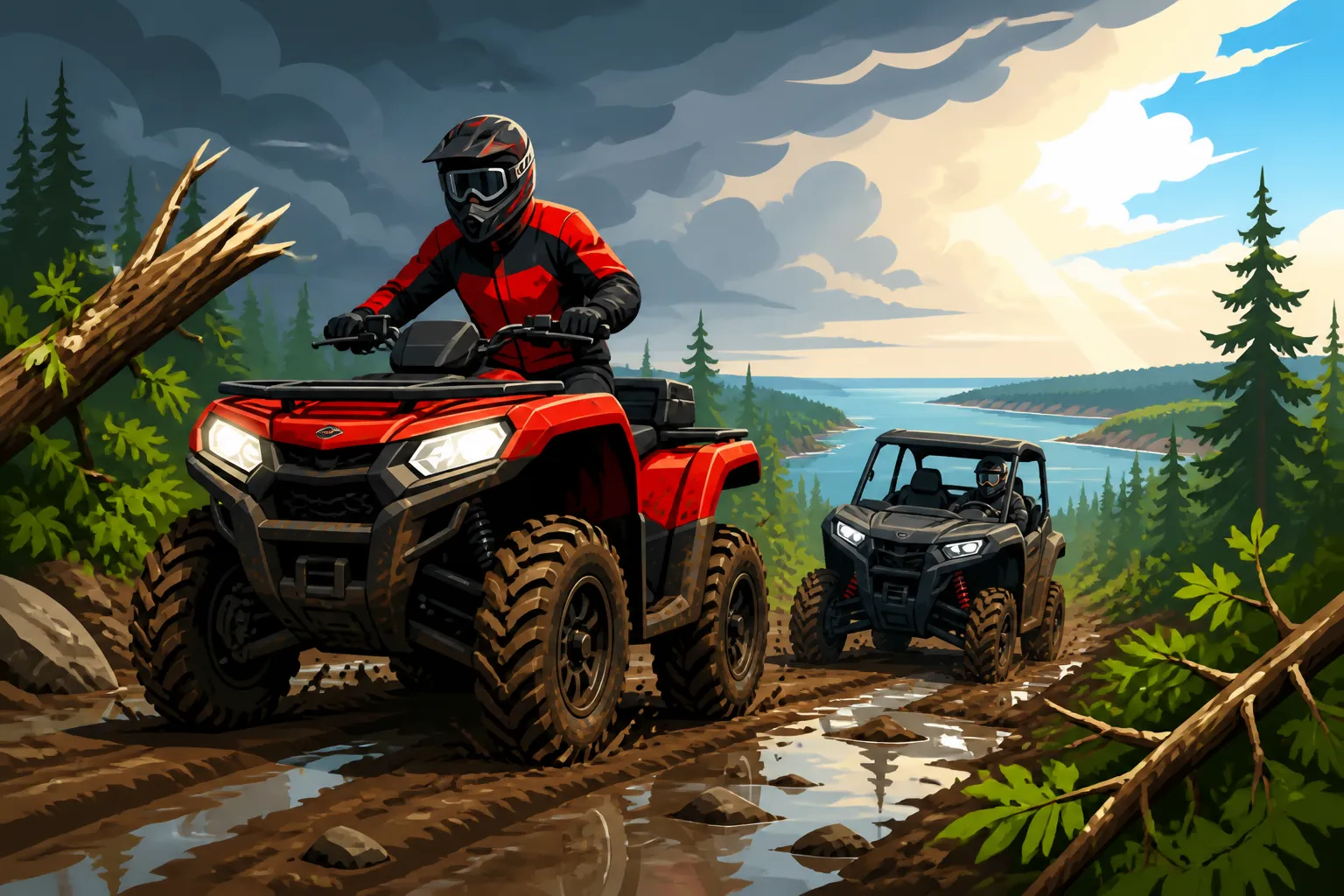
New Brunswick Trail Riding After a Storm
A trail that looked firm yesterday can turn slick, rutted, or unexpectedly flooded after a storm. In New Brunswick, rain, wind, and fast-changing conditions can affect club trails differently from one area to the next. This guide explains how to check conditions, decide whether to ride, prepare your ATV or UTV, and respond safely when you encounter damage or a closure.
Check New Brunswick trail conditions before you leave
Look for current information, not yesterday’s plan
A storm does not affect every trail equally. A route near the Miramichi may have different drainage, soil, and wind exposure from one in the Restigouche or along the Acadian Peninsula. Even within the same region, a sheltered woods road may stay passable while a low-lying section nearby collects water or develops deep mud.
Before loading your machine, check for updates from the local trail club and the trail network. Pay attention to the date and location of any notice: a report from another part of the province may not tell you what conditions are like where you intend to ride. The guide to [New Brunswick Trail Conditions Before You Go] can help you build a pre-ride routine, and [New Brunswick Trail Closures After Rain] is useful when recent rainfall has prompted local restrictions.
If you use onX Offroad to plan or follow a route, treat it as a navigation aid rather than confirmation that a trail is open or safe. Map information can help you understand where you are and what route you expected to take, but it may not reflect a fresh washout, temporary closure, or club reroute. Confirm local conditions separately before setting out.
Check for closures and follow the signs
A closure is not simply a suggestion to find a less muddy way through. Clubs may close a section because of erosion, water damage, unsafe bridges, fallen trees, or work underway. Riding around a barrier can widen damage, create a new route on land that is not part of the marked corridor, or put you in the path of equipment or crews.
When you reach a sign or barrier, stop and read it before deciding what to do. Follow marked detours and instructions from the club. If there is no clear alternative, turn back rather than improvising a route across a field, private woodlot, or unmarked woods road. Reviewing [New Brunswick Trail Signage Explained] and [Staying on a Marked New Brunswick Corridor] can help reinforce what to do when signs change your planned route.
A route shown on a device or saved before the storm does not override a posted closure. In particular, do not assume that a familiar corridor is open just because you have ridden it before. Conditions and access can change, and a closed section may be unsafe even if it looks passable from the trail entrance.
Decide whether your ride should wait
After heavy rain, the practical question is not only, “Can my machine get through?” It is also, “Can I ride without making the damage worse or putting my group at risk?” Deep standing water can hide ruts, soft shoulders, submerged debris, or a damaged culvert. A wet slope may offer little traction, and a narrow trail can leave no safe room to turn around.
A quick decision table can help you match what you see to a sensible response:
| What you find | Safer choice |
|---|---|
| An official closure or barrier | Turn around and follow the marked detour if one is provided |
| Water covering an unfamiliar section | Do not enter if you cannot judge its depth, bottom, or exit |
| Fresh washout, exposed culvert, or unstable edge | Stop well back and report the location to the club |
| Shallow wet ground on an open, marked route | Proceed slowly only if the route remains firm and safe |
| Conditions getting worse during the ride | Shorten the trip and return by a known, open route |
These are practical guidelines, not a guarantee that any specific section is safe. If the ground is giving way, visibility is poor, or the group is unsure, waiting for conditions to improve is often the better call.
Understand what storms can do to a trail
Rain can turn a small problem into a larger one
Rainwater follows the shape of the land. It may run down a slope, pool in a low spot, or collect where a ditch or culvert cannot carry it away. On a trail, that can mean slippery clay, loose gravel, soft shoulders, or a rut that was not there before the storm. A puddle can also conceal a hole or a change in the trail surface.
The condition you can see from the seat may not show what lies underneath. A puddle may look shallow but have a soft base; a muddy section may hide a firm track on one side or a sudden drop on the other. Avoid testing an unknown section by charging into it. Stop at a safe distance, look for signs of erosion or flowing water, and turn around if you cannot assess the route with confidence.
It can be tempting to go around a wet patch by driving onto the vegetation beside it. That often makes the problem broader by crushing plants and creating additional tracks. The article [Why Riding Around a Wet Section Makes It Worse] explains why staying on the established route matters, even when the marked trail is muddy.
Wind can leave hazards beyond the obvious fallen tree
Strong wind may bring branches or trees down across a trail, but overhead hazards deserve attention too. A branch caught above the route can fall after the gusts have passed. A tree leaning toward the trail or a root plate lifted from the ground may be unstable. Avoid stopping beneath damaged trees, and do not try to move a large obstruction yourself.
A fallen tree can also make the trail narrower or force riders toward a soft shoulder. Do not squeeze past if there is not enough room to do so safely. If a route is blocked and no marked detour is available, turn around. Make a note of the location so you can report it accurately, but only if you can do so without standing in a hazardous spot.
Storm damage may include broken bridges, damaged railings, exposed approaches, or water cutting through a crossing. Do not assume a bridge is sound because it looks intact from the entrance. Follow posted weight and access restrictions, and do not cross a structure that appears damaged or has been closed.
Spring thaw calls for extra patience
A storm during spring thaw can leave a trail particularly vulnerable. The surface may look firm in one place while the soil below remains soft, and repeated traffic can deepen ruts or push water and mud into surrounding areas. Local clubs may close sections to protect the corridor while it dries. Check [New Brunswick Trail Closures in Spring Thaw] before planning a ride during this period.
The same caution applies when rain follows a thaw or when temperatures shift between freezing and warmer conditions. A route can change noticeably over a short distance, especially near shaded woods, low ground, and water crossings. Do not use another rider’s report from an earlier day as proof that the trail is still in the same condition.
If you encounter a section that is visibly soft or beginning to break apart, turn back rather than trying to “help it along” with more machine traffic. A detour across the shoulder can cause lasting damage, and one group’s tire tracks may encourage other riders to follow the same path.
Prepare your ATV or UTV and riding group
Pack for a slower, less predictable trip
After a storm, travel may take longer than planned. You may need to stop for a blocked corridor, reverse direction, or wait while your group works through a safe turnaround. Bring enough food, water, warm layers, and basic first-aid supplies for a longer day than you expect. Keep your phone protected from water, and consider carrying a backup navigation option if you will be away from reliable service.
A route-planning tool such as onX Offroad can be useful for viewing your planned route and keeping track of where you are. Save or review relevant mapping before leaving, and remember that a phone’s location service does not guarantee mobile coverage. Check [Checking Cell Reception Before a Remote Ride] when planning a route through areas where communication may be unreliable, and read [First Aid on a Remote Woods Loop] for a more complete approach to preparing for an incident away from help.
Keep your plan flexible. Tell someone where you are going, who is riding, and when you expect to return. If rain is still falling or wind is picking up, agree ahead of time on a point where the group will turn back rather than debating it while cold, tired, or stuck.
Ride smoothly and give the trail space
Wet surfaces reduce traction. Use a controlled pace, leave more room between machines, and avoid sudden braking or sharp turns where the ground is slick. A UTV carrying passengers may need extra stopping room, while an ATV can lose traction quickly if the rider accelerates hard on mud or loose ground.
Stay on the established tread and avoid creating bypasses around water, ruts, or fallen branches. If the marked route is too damaged to cross safely, stop and turn around. Keep a safe gap from the machine ahead so you have time to react if it stops or slides. On a narrow trail, avoid bunching up behind another rider, especially near slopes, bridges, and blind corners.
For a muddy stretch on an open trail, a tow strap may be useful if a machine becomes stuck, but recovery should never become an excuse to enter a closed or unsafe section. Carrying a strap is not the same as being prepared for every recovery. [Tow Straps on a Muddy Miramichi Loop] offers more context on bringing and using recovery gear sensibly.
Use a clear group plan
Before starting, make sure everyone knows who is leading, who is riding at the back, and what the group will do if someone has to stop. Agree that the lead rider will not continue beyond a hazard until the group is together. On a shared ride, the person who spots a closure, washout, or unstable crossing should alert the others clearly and early.
Ask less experienced riders to speak up if they are uncomfortable with a section. It is much easier to turn around as a group before anyone enters a hazard than to recover a machine after it is stuck or damaged. A sensible group ride leaves room for different machines, experience levels, and comfort with wet conditions.
Be considerate of other trail users and maintenance crews. Slow down near people working on the corridor, give them space, and follow any directions they provide. [New Brunswick Trail Etiquette Locals Expect] is a helpful reminder that considerate riding matters especially when a storm has brought crews and riders to the same section.
What to do when you find damage or get caught out
Stop before you investigate
If you come across a washout, flooded crossing, fallen tree, or damaged structure, stop before the hazard and choose a safe place to pull over. Do not park where another rider may come around a corner and meet your group unexpectedly. If the ground is unstable, stay back from the edge instead of walking out to inspect it.
If the route is blocked, follow an official detour if one is clearly marked. Otherwise, turn around using a safe, stable area. Do not cross private land, cut through vegetation, or follow an unmarked track simply because it appears to rejoin the trail. A short detour made without permission can create access problems and additional trail damage.
When it is safe to do so, note the location and the kind of problem you found. A clear description such as “large tree blocking the marked route near the bridge approach” is more useful than a vague message saying the trail is bad. If you can safely identify a nearby sign or junction, include it. Do not put yourself at risk to take a photo or gather precise coordinates.
Report the problem and respect the repair
Use the appropriate club or trail-network contact to report damage. Share only information you can provide safely and accurately: the route or area, the nearest landmark, what is blocked or damaged, and whether you saw an immediate hazard. [Reporting Damage to a Club] provides further guidance on what makes a report useful, while [Signing a Reroute Around a Cut] helps explain why official reroutes should be followed rather than guessed.
Remember that a report does not mean a section will reopen immediately. A club may need to assess access, equipment, weather, or repair work before deciding what can safely happen next. Keep following closures and reroutes until the responsible organization says otherwise.
If you return after a storm and see a crew working, give them plenty of room. Do not ride around their equipment or enter a work area without permission. Trail maintenance is part of what keeps routes usable, and riders can support that work by respecting closures and reporting problems without adding to them.
If your machine becomes stuck
First, check that everyone is safe and move people away from moving traffic or unstable ground. Do not keep spinning the tires in an effort to power out; that can deepen the rut, bury the machine, and make recovery harder. If a safe, clear exit is not obvious, stop and assess whether you need help.
Use recovery equipment only when you understand how to use it and can keep people clear of tensioned straps and attachment points. Never attach a strap to an unsuitable part of a machine, and do not stand in the path of a loaded strap. If the ground is soft, a nearby pull may simply drag another vehicle into the same problem. When the situation is beyond the group’s ability, prioritize getting people to safety and seeking appropriate assistance rather than forcing a recovery.
Once you are moving again, reconsider the rest of the ride. A machine that has been stuck may have damage, and the weather or trail may be worsening. Turn back if conditions no longer feel manageable. The best ride after a storm is not the one that reaches the farthest point; it is the one where everyone gets home without causing avoidable damage to the trail or themselves.
Disclaimer
This article is for general informational purposes only and does not constitute professional advice. Laws, prices and regulations vary by location and change over time. Consult a qualified professional for guidance on your specific situation.