New Brunswick Riding Season Month by Month
New Brunswick riding plans can change quickly when spring thaw, heavy rain, hunting activity, or winter trail use affects access. A route that was firm last weekend may be muddy or closed today. This guide explains what ATV and UTV riders can generally expect month by month, how conditions differ around the province, and what to check before setting out.
New Brunswick ATV and UTV riding season month by month
The riding calendar is shaped less by a fixed start date than by weather, ground conditions, and the rules for the trail you want to use. A maintained club trail, a woods road, and a route across private land can all have different access conditions at the same time of year. Treat the descriptions below as planning guidance, not confirmation that a particular trail is open.
| Month | What riders may encounter | Useful planning approach |
|---|---|---|
| January | Snow and ice; some corridors may be used or managed for winter recreation | Confirm that the specific route is open to ATVs or UTVs |
| February | Deep winter conditions, with changing snow cover and possible shared use | Check current local trail information and ride prepared for cold |
| March | Freeze-thaw cycles and softening ground | Avoid riding on soft or saturated trails |
| April | Spring thaw, mud, washouts, and closures may affect access | Check before leaving and respect closures |
| May | Conditions can improve unevenly as ground dries | Start with a short route and verify local access |
| June | Longer days and generally more summer-style riding opportunities | Carry water, rain gear, and a route plan |
| July | Busy summer recreation and dry, dusty stretches may occur | Ride considerately and watch for other trail users |
| August | Warm weather, dust, storms, and changing fire conditions are possible | Check trail notices and local restrictions |
| September | Cooler days and changing foliage; hunting activity may begin in some areas | Confirm access and use extra caution around other land users |
| October | Fall weather, wet leaves, and shorter daylight hours | Plan a conservative route and finish before dark |
| November | Rain, cold, and early winter conditions can arrive quickly | Check closures and avoid assuming summer access continues |
| December | Snow and winter trail use may change which routes are available | Confirm allowed machine use on the exact corridor |
January through March
January and February are winter-planning months, not automatic ATV months. Snow cover, ice, and winter trail management can affect where a quad or side-by-side may legally and safely travel. Some corridors may be used by snowmobilers or maintained for a different activity. A trail’s appearance on a map does not by itself establish that it is open to your machine.
Before leaving, check the route’s current status, permitted vehicle use, and any relevant club or landowner notices. Winter also changes the practical demands of a ride: daylight is limited, cold drains energy, and a stuck machine can become a more serious problem than it would be on a warm afternoon. Bring suitable layers, a charged phone, and a plan for turning back if conditions deteriorate.
March can be especially frustrating because one day may feel like the beginning of spring while shaded ground and low areas remain frozen. A warm afternoon can soften exposed sections, while a cold night may firm them again. That cycle can make a trail look passable at the start and vulnerable by the time riders return. Avoid treating a frozen morning as permission to ride a route that becomes soft later in the day.
April through June
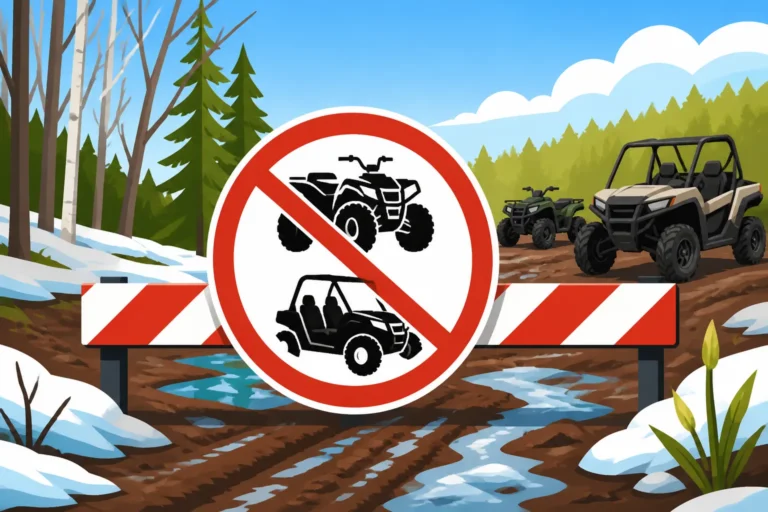
April is often the month when patience matters most. Spring thaw can leave trails waterlogged, muddy, or vulnerable to damage. A closure is not simply an inconvenience: riding around a barrier or bypassing a muddy section can widen the damaged area and create more work for clubs and landowners. Check [New Brunswick Trail Closures in Spring Thaw] and take [New Brunswick Trail Closures After Rain] seriously when a route has been saturated.
May is a transition month. Conditions can improve at different speeds across the province, and a dry stretch near Fredericton does not guarantee that a northern or shaded trail has dried out. If you are unsure, choose a shorter route, ask the local club, and be willing to change plans. [New Brunswick Riding in Spring] is a useful companion when you are weighing early-season conditions against the urge to get back out.
By June, longer days can make it easier to plan a full ride, but summer-like weather does not mean every trail is suitable for every machine. Look out for rough or rutted sections, standing water, and other users. If you are heading into an unfamiliar area, plan fuel, breaks, and a return route rather than assuming you can improvise once you are far from a main road.
July through September
July and August often bring the easiest conditions for a long day in the woods, but they can also bring busy trails, dust, sudden storms, and dry-weather restrictions. Slow down when visibility is reduced by dust, keep space between machines, and avoid following so closely that you cannot see a turn or obstacle in time. On narrow corridors, be ready to meet hikers, cyclists, logging traffic, or another group of riders.
Hot weather creates its own planning problems. Riders can underestimate how quickly a long route becomes tiring, particularly when the machine is working hard on rough ground. Carry water, take breaks, and keep rain gear accessible even when the forecast looks settled. [New Brunswick Riding in Summer] offers more seasonal context, while [Packing for a Full Day in the Woods] can help you think through what to bring beyond the essentials.
September is a good month for riders who enjoy cooler temperatures and fall colour, but access and trail use can become more complicated as hunting seasons and other outdoor activities get underway. Do not assume a familiar woods road is being used only by recreational riders. Confirm access, respect posted signs, and be visible. On private land, permission matters regardless of how often you have ridden there before.
October through December
October brings shorter days and changing surfaces. Wet leaves can hide holes, rocks, or ruts, and a route that felt straightforward in summer may be harder to read. Start early enough to finish before dark, especially if the route is unfamiliar or cell coverage is limited. Check the weather again before departure rather than relying on a forecast you saw several days earlier.
November can be a difficult in-between period. Rain, wind, cold, and early snow can alter trail conditions quickly, while some corridors may close or shift to winter management. Verify the status of the specific route and machine type before setting out. If the trail information is unclear, contact the club or land manager instead of guessing from a map.
December is not simply the summer season with snow added. Some trails may be used by snowmobiles, and access for ATVs or UTVs may differ by corridor. Check local notices and avoid assuming that a route open in October remains open in December. [New Brunswick Trail Closures in Winter] and [New Brunswick Groomed and Non-Groomed Trails] can help explain why winter access is not uniform across the province.
What changes trail conditions across the province
Weather, soil, and elevation
New Brunswick is large enough that conditions can differ substantially between regions. A sunny spell around Moncton does not tell you whether a route near Bathurst, Edmundston, or Campbellton is dry. Even within one riding area, low ground, shaded forest, exposed ridges, and water crossings can behave differently after the same rainfall.
Soil and drainage matter just as much as the temperature. Clay can stay slippery after rain, while a rocky section may drain more quickly but still demand careful riding. Low-lying trail sections can remain wet after higher ground looks firm. If you encounter a soft patch, do not assume that powering through is harmless. Repeated wheel spin can deepen ruts and make the section worse for everyone.
A useful habit is to check conditions at the local level rather than making a province-wide assumption. Look for a club update, a trail notice, or a direct answer from someone familiar with that corridor. [New Brunswick Trail Conditions Before You Go] is a good starting point when your plans depend on a particular route being passable.
Trail type and seasonal use
A club-managed ATV corridor, a private woods road, a Crown land access road, and a public road are not interchangeable. Each can have different rules, permissions, and seasonal restrictions. A track shown in a mapping app is not proof that motorized access is allowed, and a route used last year may have changed because of maintenance, land access, or a temporary closure.
Seasonal use can also change the kinds of people and machines you meet. In winter, a corridor may be groomed or otherwise managed for snowmobile use. During warmer months, the same area may be used by ATV riders, hikers, cyclists, hunters, or workers. Slow down where sightlines are short, follow signs, and leave gates as you found them.
Mapping tools can make route planning easier, particularly when you are unfamiliar with the area. Some riders use onX Offroad to organize routes and orient themselves, but treat any app as a planning aid rather than final confirmation of access. Pair it with club information, posted signs, and landowner permission where required. For more on route preparation, see [New Brunswick Trail Maps and the MapGear App] and [New Brunswick Cellular Reception Maps].
Rain, closures, and responsible riding
Rain can turn an otherwise enjoyable ride into a damaging one, especially on soft or poorly drained trails. A light shower may not affect every route, but prolonged rain can leave low sections saturated and increase the risk of erosion. If a trail is closed, stay out—even if the surface looks firm from the entrance or another rider says they went through earlier.
Closures can be temporary, local, and easy to miss if you check only one source. Look for information from the club responsible for the trail, pay attention to barriers and signs on the ground, and ask before riding a route that crosses private property. If you encounter fresh damage or a blocked corridor, do not create a new path around it. Report the issue to the appropriate club or land manager.
Respectful riding helps protect access for future seasons. Keep to the marked corridor, avoid spinning tires for fun, and lower your speed near homes, livestock, and other trail users. A little restraint during wet conditions can prevent a short-term closure from becoming a longer repair project.
Plan a ride around the month you are in
Choose a route that matches the day
A route that is right for a dry July afternoon may be a poor choice in April or November. Match the length and difficulty of your ride to the surface, daylight, weather, and experience of everyone in your group. For a first outing of the season, a familiar loop close to your starting point is often wiser than a long remote route.
Before you go, identify a sensible turnaround point. If the trail is wetter, rougher, or more obstructed than expected, you can shorten the day without turning the decision into a debate. This matters on group rides, where the most experienced rider may be comfortable continuing while a newer rider is already tired.
For a trip around Miramichi, Woodstock, or the Acadian Peninsula, plan the route around the trail network and local access information rather than simply drawing the shortest line between two points. If you use onX Offroad to help organize a route, compare that plan with current local trail information and follow signs on the ground. Keep an alternative route in mind in case a section is closed.
Check access, permits, and equipment
A successful ride starts with confirming that you have permission to use the route and that your machine meets the requirements for the area. Trail access, registration, insurance, and permits are separate considerations, so do not assume that one document replaces another. If you are new to the province or visiting from elsewhere, check the applicable rules before you travel to a trailhead.
Use this short checklist before each outing:
- Confirm that the trail is open to your type of machine.
- Check for weather-related closures, washouts, or local notices.
- Verify that required registration, insurance, and trail documents are in order.
- Tell someone where you plan to ride and when you expect to return.
- Bring water, basic repair supplies, suitable clothing, and a first-aid kit.
- Download or save route information before entering an area with unreliable reception.
- Reassess conditions at the trailhead and turn back if the route is unsafe or closed.
The best month for a ride depends on what you value. Summer generally offers longer daylight and easier planning for a full day, while fall can be appealing for cooler air and changing colours. Spring rewards patience, and winter requires careful attention to which routes are available to your machine. Whenever you go, current local information and respect for closures matter more than a calendar date.
Disclaimer
This article is for general informational purposes only and does not constitute professional advice. Laws, prices and regulations vary by location and change over time. Consult a qualified professional for guidance on your specific situation.