New Brunswick Riding in Fall
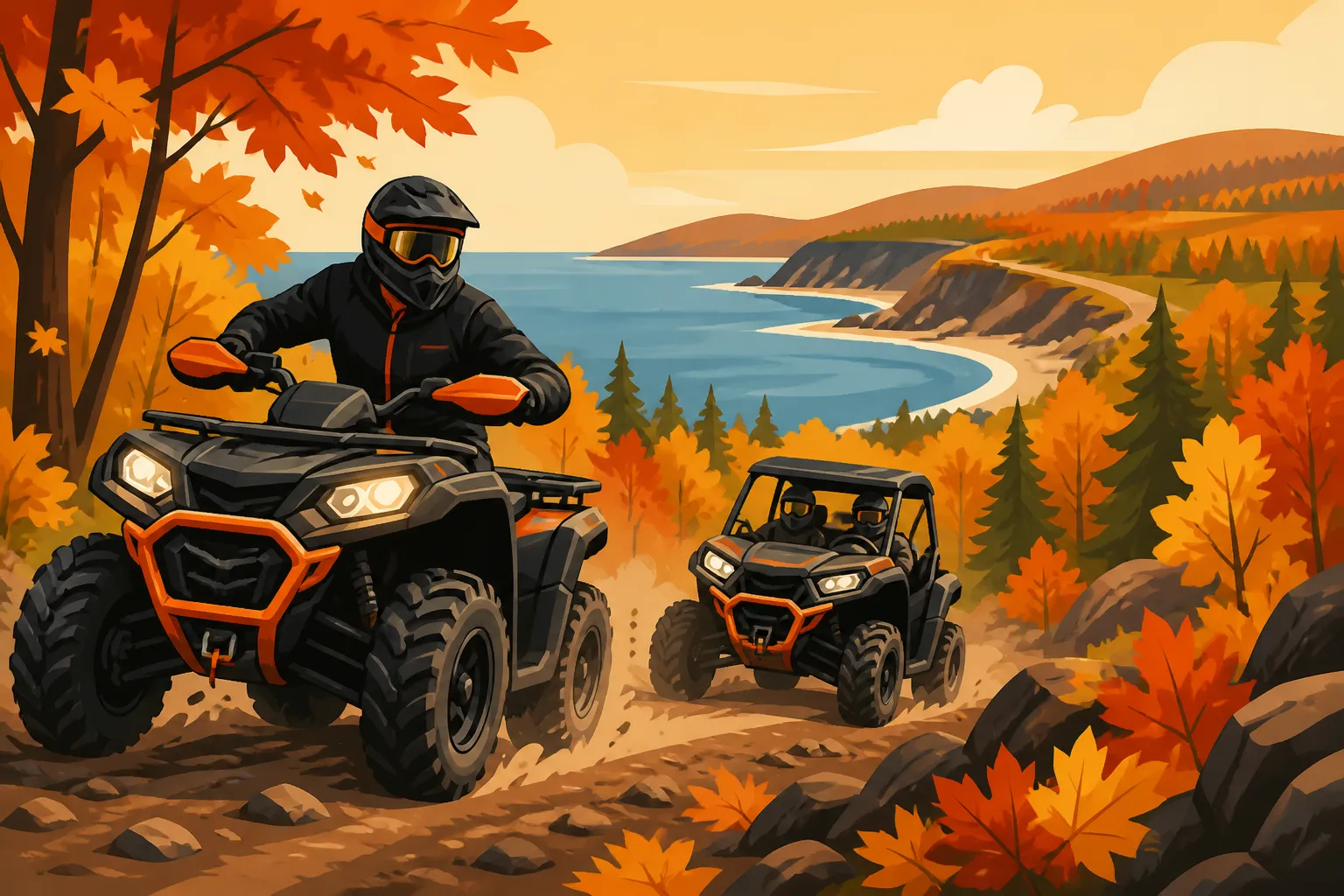
Fall riding in New Brunswick can mean crisp air, vivid colour and long stretches of quiet trail—but it can also bring shorter daylight, wet leaves, changing conditions and seasonal closures. This guide helps you plan a safer, more comfortable autumn ATV or UTV ride, choose appropriate routes, prepare your machine and check the details that can change from one trail area to another.
Plan your New Brunswick fall ride around trail conditions
Check access and closures before you leave
A trail that was open last weekend may not be open today. Fall brings changing ground conditions, maintenance work and seasonal transitions, so check the trail status before loading your ATV or UTV. Look for updates from the local club or trail organization responsible for the route, and confirm that your intended section is open to your type of machine.
This matters especially when your route passes through a mix of club trails, woods roads and private property. A line on a phone map does not necessarily mean you have permission to ride there. Stay on marked corridors, follow posted signs, and respect gates and closure notices. If you are unsure whether a route is part of the managed trail network, pause and check rather than assuming it is available.
Trail access can differ between areas near Woodstock, the Miramichi, Bathurst and the Restigouche. Don’t rely on a friend’s report from another region as a substitute for checking your own route. For local trail information and mapping, see [New Brunswick Trail Conditions Before You Go] and [New Brunswick ATV Trail Map Downloads]. If you use onX Offroad to plan or follow a route, treat it as a navigation aid—not as confirmation that a trail is open or that you have access rights.
Understand the seasonal difference between trail types
Fall rides can take place on different kinds of routes, and the rules or season may vary. New Brunswick has groomed and non-groomed trail networks, and their operating seasons are not necessarily identical. Check the details that apply to the specific trail and permit you intend to use. [New Brunswick Groomed and Non-Groomed Trails] explains why the distinction is useful when you’re planning.
Pay attention to trail conditions as well as the posted season. Rain can soften the ground, hide ruts beneath leaves and make a normally manageable section slippery. If a club has closed a route or posted a warning, take it seriously. Riding around a muddy or damaged section can widen the corridor and cause further harm. [New Brunswick Trail Closures After Rain] and [New Brunswick Trail Closures in Spring Thaw] offer useful context for why temporary closures matter, even if you’re planning an autumn outing.
A practical fall plan includes a backup route. If a bridge, washout or wet section makes your planned loop unsuitable, you don’t want to be improvising on unfamiliar roads as daylight fades. Save a shorter alternative, identify a safe turnaround point and tell someone which general area you expect to ride.
| What to check | Why it matters in fall | A sensible plan |
|---|---|---|
| Trail status | Conditions and access can change quickly | Check with the responsible club shortly before departure |
| Route type | A mapped line may not be an open club trail | Follow marked, authorized corridors |
| Daylight | Autumn days are shorter than summer days | Set a turnaround time that leaves a daylight buffer |
| Weather | Rain, wind and temperature can shift during a ride | Check the forecast for the whole route, not just the starting point |
| Fuel and distance | A detour can add unexpected mileage | Leave with enough fuel for your route and a reasonable contingency |
| Hunting activity | Fall can bring more people into woods and rural areas | Be visible, stay alert and check local notices |
Prepare your ATV or UTV for autumn conditions
Check the machine before the ride
A quick pre-ride inspection is easy to skip when you’re eager to catch a clear fall day. It’s also one of the simplest ways to avoid turning a pleasant outing into a long wait beside a trail. Check tire condition and pressure, brakes, steering, lights, battery, fluid levels and visible leaks. Look for loose fasteners or damage from the previous ride, especially around the tires, suspension and undercarriage.
Leaves and wet ground can make traction unpredictable, so don’t assume that a familiar trail will feel the same in autumn. If your machine has selectable drive modes or four-wheel drive, know how to use them before you reach a slippery climb or muddy patch. Keep your speed controlled, leave room to stop, and avoid sudden steering or throttle inputs on wet leaves, roots or rocks.
For longer rides, bring the basic equipment you’d need to handle a minor issue without relying on cell service: a tire repair kit suited to your machine, basic tools, a tow strap and a charged phone. Your exact kit depends on your machine and the remoteness of the route. For more planning ideas, see [Packing for a Full Day in the Woods] and [First Aid on a Remote Woods Loop].
Dress for changing temperatures and wet ground
A fall morning can feel cold at the trailhead and much warmer once you’re moving. Conditions may also change as you ride through exposed areas, shaded woods or higher ground. Dress in layers so you can adjust without getting chilled or overheated. A base layer, insulating layer and weather-resistant outer layer are often more practical than one bulky garment.
Carry rain gear even when the forecast looks promising. Wind and moisture can make a cool ride uncomfortable quickly, and wet gloves or socks can become a problem long before the end of the route. Choose footwear that offers support and grip, and consider packing spare gloves and socks in a dry bag. If you ride a UTV with a cab, remember that a sheltered cabin doesn’t eliminate the need to prepare for stops, breakdowns or time outside the vehicle.
Visibility deserves extra attention in autumn. Dark clothing can blend into shaded trails, while low sun may make it harder for other riders or road users to see you. Use your machine’s lights when appropriate, keep lenses and lights clean, and consider reflective elements on clothing or gear. For more ideas, see [Layers for a Cool Morning on the Trail] and [Rain Gear on the Acadian Coast].
Ride with care as daylight and trail use change
Give yourself more time than the map suggests
A route that feels easy in summer can take longer in fall. Wet surfaces, leaf cover, trail work and frequent stops to check directions can all slow a group down. Plan your day around a conservative pace rather than the distance you hope to cover. Agree on a turnaround time before you start, and stick to it even if the group is enjoying the ride.
Shorter daylight makes it especially important not to stretch a route late into the afternoon. A delayed start, unexpected detour or machine issue can use up the daylight buffer. Before leaving, share your general route and expected return time with someone who isn’t riding with you. If plans change substantially, let them know when you can.
Navigation apps can help you keep track of a route, but phones may lose service in remote areas. Download or save the information you need before you leave, carry a charged power bank and consider bringing a paper map as a backup. onX Offroad can be one part of that preparation, but don’t let a screen distract you from signs, trail conditions or other users. For more on navigating outside reliable coverage, read [Using the MapGear App With No Signal] and [New Brunswick Cellular Reception Maps].
Be especially alert around hunters, wildlife and other trail users
Fall brings more activity into woods and rural areas. You may meet hunters, logging trucks, hikers, cyclists, other ATV or UTV riders, or people accessing private land. Slow down near blind corners, trailheads, gates and places where sightlines are limited. If you encounter a work vehicle or another user on a narrow trail, stop somewhere visible and give them room to pass safely.
Wildlife can also appear suddenly, particularly where a trail crosses a clearing or follows a wooded edge. Don’t try to chase or approach an animal. Reduce speed where visibility is restricted, keep a safe distance and avoid blocking its path. A calm, predictable response gives you more time to react and helps prevent a close encounter from turning into a collision.
Respect property boundaries and posted restrictions. A trail experience is only sustainable when riders leave land and trail infrastructure in good condition. Don’t widen a wet route by riding around a puddle, and don’t enter a closed area because the ground looks firm. [New Brunswick Trail Etiquette Locals Expect] and [New Brunswick Trails That Cross Private Woodlots] are helpful reminders for riding responsibly through shared landscapes.
A practical fall-ride checklist
Before loading the machine
Use this checklist the day before and again before departure:
- Confirm that the trail sections you plan to use are open and suitable for your machine.
- Check the weather for your riding area and prepare for rain, wind and temperature changes.
- Tell someone your general route, group details and expected return time.
- Inspect the machine, including tires, brakes, lights, steering and fluid levels.
- Pack water, food, first-aid supplies, rain gear, warm layers and a basic repair kit.
- Charge your phone and navigation devices, and save route information for offline use.
- Bring the required documents and equipment for your ride, and make sure your permit and registration details are in order.
- Agree on group signals, a comfortable pace, a regrouping point and a firm turnaround time.
If you’re riding with someone new to the area, explain that the group should stay together and regroup after confusing junctions. Don’t assume everyone has the same map, phone battery or experience level. A quick conversation at the trailhead can prevent a stressful separation later.
When to shorten or cancel the ride
It’s reasonable to change plans when the conditions don’t match your preparation. Consider choosing a shorter route or postponing if visibility is poor, heavy rain has affected the trail, a closure is in place, your group is running behind schedule or anyone is cold, tired or uncomfortable. The goal isn’t to complete every planned kilometre; it’s to get everyone home safely.
That judgment can be harder when you’ve driven a long way to ride or arranged a group day. Still, turning around is better than pressing on into fading light or unfamiliar terrain. Keep a simple alternative in mind before you start—such as returning along the same known route or heading back to the trailhead—so the decision doesn’t become a debate when everyone is tired.
Fall riding in New Brunswick can be memorable when the route, machine and group are prepared for the season. Check local trail information, respect closures, allow extra time and stay ready to adjust your plan as conditions change.
Disclaimer
This article is for general informational purposes only and does not constitute professional advice. Laws, prices and regulations vary by location and change over time. Consult a qualified professional for guidance on your specific situation.