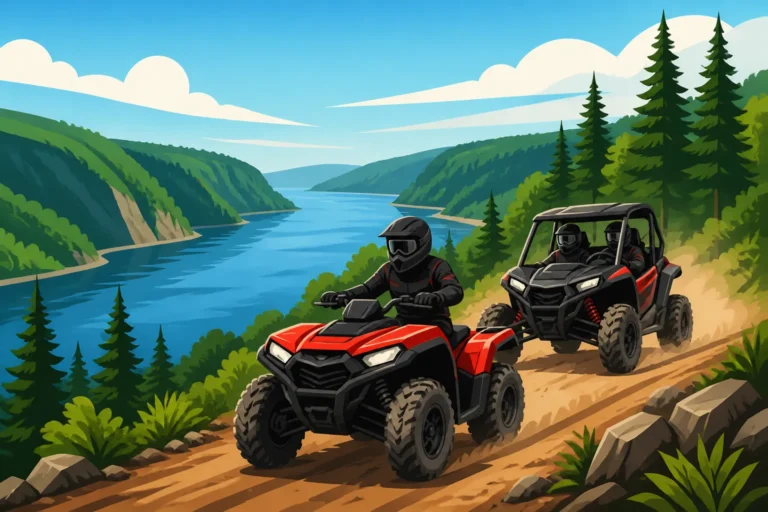
New Brunswick Riding in Spring
A warm afternoon can make a New Brunswick trail look ready, while shaded sections a few kilometres away are still soft, rutted, or waterlogged. That mismatch is frustrating—and riding too early can damage the trail or put you in a bad spot. This guide explains how to judge spring conditions, check access, prepare your ATV or UTV, and make a safer ride plan.
Why spring ATV riding in New Brunswick needs extra planning
The calendar does not tell you whether a trail is ready
Spring conditions can change quickly across New Brunswick. A route near Fredericton may be drying while a shaded stretch in the Restigouche or a low section near Miramichi remains saturated. Even on one ride, exposed gravel can feel firm before the trail drops into soft ground, standing water, or thaw-weakened edges.
That’s why a date on the calendar is a poor substitute for a local trail check. Recent rain, overnight temperatures, shade, drainage, and the amount of snowmelt all matter. A trail that was passable last weekend may be much softer after a wet spell, while a dry stretch can still conceal a waterlogged low spot.
Spring is also when small problems can become lasting damage. Spinning tires can deepen ruts, widen a muddy section, and push riders onto fragile shoulders or vegetation. If a trail looks vulnerable, turning around is often the most considerate choice, even when your machine could make it through. See [New Brunswick Trail Closures in Spring Thaw] and [New Brunswick Trail Closures After Rain] for more on why conditions can call for a temporary change of plan.
Different trail sections thaw at different rates
Low-lying ground, shaded woods, wetland approaches, and places where water crosses the trail are often slower to dry than exposed, well-drained stretches. A sunny open section can give a misleading impression of how the rest of a route will be. Likewise, a trail that feels firm under one tire may have a soft shoulder that gives way when a wider UTV passes.
This variation is worth considering when you choose a route. A short, familiar loop near Woodstock or Bathurst may be a better early-season outing than a long remote ride with several crossings and few easy exit points. Familiarity helps you recognize where water usually collects and where a turnaround is practical.
Follow any posted closure or reroute, even if another rider says the section was fine earlier. Conditions can change, and a closure may protect a particular wet area, bridge approach, or trail surface rather than signal that the entire region is unavailable. For a fuller picture before leaving, consult [New Brunswick Trail Conditions Before You Go].
How to choose and check a spring route
Start with local trail information, not an old saved route
Before heading out, check the trail information provided by the relevant club or trail organization. Look for closures, reroutes, advisories, and any notes about muddy or damaged sections. When information is unclear, contact a local club or the organization responsible for that trail rather than assuming it is open.
Maps are useful for planning, but a line on a map does not guarantee that a trail is currently passable or open to your machine. A downloaded route may be old, and a track recorded in better weather does not reflect spring conditions. Use a map to understand the general layout, then confirm current access separately. [New Brunswick Trail Maps and the MapGear App] can help you think through the difference between navigation tools and current trail-status information.
Some riders use onX Offroad as an additional planning and navigation tool, especially when they want to review a route before reaching a trailhead. If you use it, check the map coverage and features for the specific area, and compare the route with local trail information. Treat any navigation app as a supplement—not as confirmation that a corridor is open or suitable for riding.
Build a route with easy turnarounds
For an early-season ride, plan a route that gives you options. A loop with multiple exits or a familiar out-and-back route is easier to shorten than a long one-way leg deep in the woods. Before setting out, identify likely turnaround points, nearby roads or trailheads, and stretches where a closure would leave you with a longer return.
It also helps to decide in advance what conditions will make you turn back. For example, you might agree that persistent standing water, deep tire ruts, a soft bridge approach, or a posted closure ends the ride on that section. Making that decision before anyone is tired or eager to continue can prevent a group from debating it in the middle of a muddy stretch.
| Spring trail condition | Practical response |
|---|---|
| Firm surface with no closure notice | Proceed cautiously and keep checking conditions as the route changes |
| Standing water or a soft trail edge | Avoid driving around it; turn back if the section is not safely passable |
| Deep, fresh ruts or visible trail damage | Stop before adding to the damage and report the issue to the responsible club |
| Posted closure or reroute | Follow the notice and do not ride around barriers |
| Unknown route status | Confirm with local trail information before leaving |
Prepare your ATV or UTV for wet, changing conditions
Check the machine before the first ride
A spring inspection is worthwhile even if the ATV or UTV ran well when you stored it. Check tire condition and pressure, brakes, lights, steering, throttle response, battery, and fluid levels. Look for cracked hoses, loose fittings, damaged wiring, or signs of rodents around stored equipment. On a UTV, make sure seat belts and doors or nets work as intended.
Pay special attention to the areas that will meet mud and water. Confirm that the air intake and electrical components are in good shape, and know the machine manufacturer’s limits for water crossings. A shallow-looking puddle can hide a hole or a washed-out edge. If you cannot see the bottom or judge the current safely, do not assume the crossing is harmless.
Tire choice matters, but aggressive tires are not a reason to push through a fragile trail. They may help with traction in some conditions, yet wheelspin can still tear up soft ground. For a deeper look at setup and local surfaces, read [Tires for New Brunswick Clay]. A winch or tow strap can be useful equipment, but needing one repeatedly is a sign that the route may be too soft for the day.
Pack for a slower ride and a possible delay
Spring outings can take longer than the same route in dry weather. Mud, careful navigation, a turnaround, or a minor machine issue can all stretch the day. Bring water, food, basic first aid, suitable layers, rain gear, and tools appropriate to your machine. A charged phone is useful, but do not assume you will have dependable reception throughout a remote ride.
If you are using a navigation app, download or prepare what you need before leaving a service area, and carry a backup way to understand your route. onX Offroad may be one option for reviewing maps and navigating, but check its offline functionality and regional coverage before relying on it away from cell service. A paper map or a second device can be a sensible backup for a remote ride.
Tell someone where you are going, who is with you, and when you expect to return. Share a plan that includes the trailhead or general area and the route you intend to take. For more detailed packing ideas, see [Packing for a Full Day in the Woods]. Carrying a few extra essentials is easier than trying to improvise if a wet ride becomes a long one.
Ride responsibly and adapt as conditions change
Protect the trail rather than riding around trouble
If a muddy section is not safely passable, do not widen it by driving onto the shoulder or through nearby vegetation. Going around a puddle can turn one narrow wet spot into a much broader damaged area. Avoid repeated attempts that spin the tires and deepen ruts. If you cannot pass without causing damage or risking a stuck machine, turn around.
Stay on the marked corridor and obey barriers, signs, and reroutes. A closed section may not be obvious from the trailhead, so remain alert as you ride. [Staying on a Marked New Brunswick Corridor] and [New Brunswick Trail Etiquette Locals Expect] offer useful reminders about respecting shared routes and the people who maintain them.
If you encounter damage, a washout, or a hazard, make a note of the location and report it to the responsible club or trail organization. A clear description helps: identify the nearby trail or landmark, explain what you saw, and mention whether the issue blocks passage. Avoid posting a route around a closure as if it were an approved detour.
Keep the group together and be willing to shorten the day
Spring trail surfaces can change faster than a group’s pace. Give riders space, avoid rushing through blind turns, and stop somewhere safe if the group becomes separated. A lead rider can watch for changing ground, while a sweep rider helps make sure nobody is left behind. Agree on a simple way to communicate a stop or turnaround before leaving the trailhead.
Be patient around other trail users and work crews. Spring may bring maintenance activity, damage checks, or temporary reroutes. Slow down when visibility is limited, keep noise and speed considerate near homes, and leave gates as you found them. If a section feels worse on the return trip, reassess rather than assuming it will be easier because you have already crossed it once.
Your best spring ride may be shorter than planned. That is not a failed outing. Turning back before the trail is damaged, the machine is stuck, or daylight becomes a concern is good judgment—and it leaves the route in better shape for the next ride.
Disclaimer
This article is for general informational purposes only and does not constitute professional advice. Laws, prices and regulations vary by location and change over time. Consult a qualified professional for guidance on your specific situation.