New Brunswick Riding in the Restigouche
The Restigouche region’s woods roads, changing weather and patchwork of public, private and club-managed routes can make ride planning feel less straightforward than it looks on a map. This guide explains how to prepare for an ATV or UTV ride around Campbellton, Dalhousie and nearby communities, check access responsibly, and make a safer day of it.
What to Expect When Riding in the Restigouche
A region of communities, woods roads and changing terrain
Restigouche is not one compact riding area with a single trailhead and a uniform surface. It is a broad region in northern New Brunswick, with communities such as Campbellton, Atholville, Dalhousie, Balmoral, Kedgwick and Saint-Quentin serving as useful reference points when you are planning where to stay, fuel up or meet your group. The ride itself may involve marked club trails, woods roads or other permitted routes, and those are not automatically interchangeable.
That distinction matters. A road that appears to continue through the forest may be private, closed to recreational vehicles or unsuitable for the machine you are riding. A line visible in a mapping app does not, by itself, confirm that ATVs or UTVs have permission to use it. Before heading out, check the relevant trail information and make sure the route is open to your type of machine.
The region’s landscape also means conditions can change as you travel. A route that feels firm near town may become rougher or wetter farther into the woods, and a long loop can take more time than its map distance suggests. Rather than treating a ride as a race from one community to another, leave room for stops, route checks and a change of plan.
Marked trails and woods roads are not the same thing
A marked club trail is part of a managed riding network, subject to trail access rules and seasonal conditions. Woods roads may be used for forestry, property access or other local purposes. Some may be open to riders under certain circumstances, while others may not be. Do not assume that a woods road is a legal connector just because it is physically passable or has tire tracks.
This can be especially important around working forest areas. Logging trucks and other work vehicles may use roads that look quiet when you first arrive. A route can also be affected by forestry activity, maintenance, a washout or a temporary closure. If signs indicate restricted access, a reroute or a closure, respect them rather than trying to ride around the restriction.
For a first visit, build the day around confirmed trail access rather than drawing the longest possible line on a map. Use official trail information to establish the route, then treat any secondary road as a separate access question. Guides to [New Brunswick Trails That Cross Crown Land] and [New Brunswick Trails That Cross Private Woodlots] can help clarify why land status and trail permission should not be guessed.
How to choose a ride that fits your group
Think about the least experienced rider in the group, not just the machine with the biggest tires. A relaxed outing near your accommodation may be a better first day than a long, remote loop. New riders may appreciate a shorter route with easy places to regroup, while experienced riders might be comfortable planning a full day if they have reliable navigation, adequate fuel and a clear backup plan.
UTVs and ATVs can have different handling characteristics, dimensions and passenger arrangements, so confirm that a route is suitable for the machines in your group. Narrow or rough sections can be less comfortable in a wide side-by-side, while a long day on an ATV may be tiring for riders who are not used to the seat, vibration or changing trail surface. Group members should discuss these details before setting off.
It also helps to agree on a simple pace and regrouping routine. Decide where the lead rider will stop, who rides at the back and what everyone should do if they lose sight of the group. A slower rider should not feel pressured to keep up by taking risks, and a faster rider should not disappear ahead without checking that the others are still following.
Planning a Route and Confirming Access
Start with current trail information
Before the ride, look for trail maps and updates from the organizations responsible for the route you intend to use. A map can help you understand the general network, but closures, seasonal limits and reroutes may change what is usable on a particular day. Check [New Brunswick Trail Conditions Before You Go] as part of your planning, and confirm any uncertainty with the relevant club or local contact.
The QuadNB network is divided across clubs and regions, so local knowledge can be valuable. If you are not sure which club manages the trail near your intended starting point, [Finding a New Brunswick Club Near Your Town] is a helpful next step. Ask clear questions: Is the route open today? Is it open to my machine type? Is a permit required? Is there a current detour or work operation I should know about?
Do this before you load the machines or drive out to a remote access point. It is frustrating to arrive ready for a ride and discover that the route is closed or that the place you planned to park is not a permitted trailhead. A quick check can save a long detour and help protect access for the next rider.
Use digital maps as planning aids, not permission slips
Digital navigation tools can be useful for orientation, recording a track and keeping your group aware of its position. A tool such as onX Offroad may be useful as one layer of your planning, especially when you want to compare your location with mapped roads or features. Still, a displayed line is not proof that the route is open, maintained or legal for an ATV or UTV.
Use more than one source where possible. Compare your digital map with official trail information, posted signs and local guidance. If the sources conflict, do not assume the app is the deciding authority. Turn around or choose a confirmed route rather than riding through a gate or continuing onto a road with unclear access.
Download or prepare the information you need before leaving reliable service. A phone’s map display may not be enough if the battery runs down, the screen is difficult to read in bright conditions or the device loses reception. Keep a route overview available offline where possible, carry a charged backup power source and make sure someone in the group knows how to navigate without relying on one rider’s phone.
Build a route with decision points
A practical route plan includes more than a starting point and destination. Identify places where the group can stop, check its position and decide whether to continue. Mark likely turnarounds, fuel or service options where confirmed, and any sections that may require extra time. Avoid creating a route that depends on one uncertain connector; if that link is closed, the whole day should not fall apart.
A simple planning table can help your group talk through the ride before everyone is dressed and ready to leave.
| Planning question | What to confirm | Why it matters |
|---|---|---|
| Is the trail open? | Check current notices and local updates | Closures and reroutes can change your plan |
| Is access permitted? | Confirm the trail status and any land restrictions | A visible road is not automatic permission |
| Does the route suit the machines? | Consider width, surface, clearance and group experience | A route that works for one machine may not suit another |
| Can the group navigate offline? | Prepare maps, a backup device or a printed overview | Reception may be limited away from communities |
| What is the turnaround plan? | Agree on time, fuel and regrouping points | It keeps the ride manageable if conditions change |
If your group is visiting from outside the region, keep the first ride conservative. A shorter loop gives you time to learn how the local network is signed and how quickly trail conditions can change. Once you understand the area and your group’s pace, you can plan a more ambitious day with better confidence.
Weather, Terrain and Riding Conditions
Check the ground before committing to a long loop
Weather can affect a route well beyond the place where you parked. Rain may soften exposed soil, create standing water or make a hill more difficult to climb. A sunny morning does not guarantee that a shaded or low-lying section will be dry. Conversely, a route that looks muddy on a map or in an old photo may have changed since it was recorded.
Do not try to prove that your machine can push through a wet section. Riding around a puddle or soft patch can widen damage and create a larger problem for other trail users. If a section looks unsafe or is visibly deteriorating, turn back or follow an authorized detour. [New Brunswick Trail Closures After Rain] offers useful context for why wet-weather decisions matter to trail users and the clubs maintaining the network.
Talk through the decision before you reach a difficult spot. Agree that any rider can call for a stop without being mocked or rushed. This is particularly helpful when one person in the group is new, riding a different machine or carrying a passenger. A few minutes spent assessing the ground is far better than a recovery that leaves the group stranded.
Plan for rough surfaces, changing visibility and wildlife
Even when a route is open, its surface may vary. Expect some combination of packed trail, loose material, ruts, stones, roots or wet patches depending on the route and recent conditions. Keep a pace that gives you time to react, maintain space between machines and slow down when visibility is limited around a bend or rise.
In forested areas, wildlife may appear with little warning. Keep your eyes up, avoid speeding through blind corners and give animals room to move away. If you encounter another trail user, approach cautiously and make space for a safe pass. Be especially attentive near intersections, work areas and places where a trail meets a road.
Dust, rain and low light can also change how well the group sees one another. Leave enough room to avoid riding in the dust cloud of the machine ahead. If conditions worsen, stop somewhere safe and regroup rather than trying to maintain the original schedule. Good trail manners are not just about courtesy; they reduce the chance of a collision or a confused rider taking a wrong turn.
Know when to shorten or postpone the ride
A change of plan is not a failed outing. If a storm is approaching, the group is running low on fuel, a rider is tired or the route is taking longer than expected, shorten the loop while you still have options. Remote stretches can make small problems harder to solve, so it is sensible to turn toward a familiar exit before everyone is worn out.
Set a latest turnaround time before the ride begins. That gives the group a shared reference point if the route is slower than expected or a stop takes longer than planned. It is also worth agreeing on a simple check-in procedure if machines become separated. For example, the lead rider waits at a predetermined safe junction rather than continuing onward, and the last rider does not try to catch up by travelling too fast.
Before starting, consider whether the forecast and trail notices support the kind of outing you have planned. If not, pick a shorter confirmed route, stay closer to a community or choose another day. [New Brunswick Trail Etiquette Locals Expect] is a useful companion read for understanding how considerate decisions help keep shared trails enjoyable.
Preparing Your ATV or UTV and Your Group
Check the machine before leaving town
A pre-ride inspection is simple insurance against avoidable trouble. Look over tires, wheels, brakes, lights, steering and visible fluid leaks. Confirm that the machine is carrying the tools and recovery items appropriate to the route, and that any cargo is secured so it cannot shift on rough ground. For a UTV, make sure everyone understands how to use its seat belts and other occupant restraints.
The right gear depends on the ride, but basic preparation should cover weather, visibility, hydration and minor repairs. A change of gloves or outer layer can matter when a warm start turns into a cold, wet afternoon. Bring water and enough food for the planned time outside, plus a first-aid kit and a way to contact help if ordinary phone service is unavailable.
Use [Packing for a Full Day in the Woods] as a practical checklist, then adjust it to the season, route length and group. A short ride near town has different needs from a long outing far from services. Either way, do not rely on another rider to carry every essential item; each machine should have a sensible minimum of supplies.
Carry the documents and permits you need
Before riding, confirm the registration, insurance, trail permit and other requirements that apply to your machine and route. Requirements can depend on the vehicle, the land being used and the kind of riding planned, so do not assume that one document replaces another. Keep required papers accessible and protected from mud or water.
Riders often think about paperwork only after an officer or trail volunteer asks to see it. It is less stressful to check everything at home, especially if the machine has recently changed hands or has been stored through the winter. The guides to [New Brunswick Documents You Must Carry] and [New Brunswick Proof of Insurance on the Machine] can help you make a practical pre-ride checklist.
If the group includes visitors, confirm that each rider understands the applicable local rules and permit arrangements. Do not assume that a permit or registration from another jurisdiction automatically covers every situation in New Brunswick. When a detail is unclear, verify it before the ride rather than trying to resolve it at a trail entrance.
Make a group plan before engines start
A short briefing can prevent confusion once the group is moving. Identify the lead and sweep riders, decide how often to regroup and establish what to do if someone stops unexpectedly. Agree on how the group will handle a wrong turn: stop at a safe place, avoid splitting up further and use the map or agreed meeting point to reconnect.
Discuss passengers, children and less experienced riders frankly. Everyone should be comfortable with the machine, the route and the expected pace. If a rider is uneasy about a steep, wet or narrow section, treat that as useful information for planning rather than a reason to pressure them. A route that the whole group can ride safely is usually more enjoyable than a difficult route that divides the group.
Finally, tell someone who is not riding where you expect to go and when you expect to return. Share a basic route or destination and let them know what to do if you are overdue. For more ideas about planning around reception gaps and remote areas, see [New Brunswick Cell Coverage on Remote Trails]. A dependable plan matters because a phone signal should never be treated as guaranteed.
Responsible Riding and Local Courtesy
Stay on routes you are allowed to use
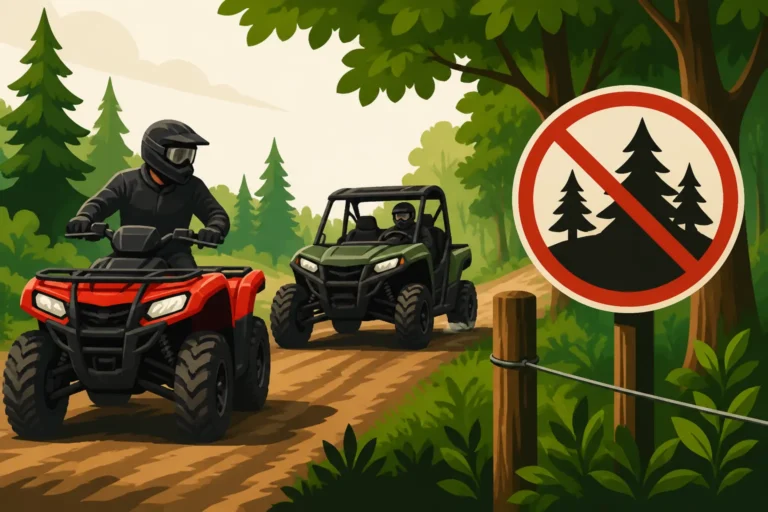
Trail access depends on permission, signage and the status of the route. Do not cut through a private driveway, field or woodlot to save time. Avoid gates, barriers and marked closures, and leave them exactly as you found them when access is permitted. If you cannot tell whether a road is open to your machine, stop and confirm rather than riding on the assumption that no sign means permission.
This is especially important in a region where recreational riding shares space with working forests, rural residents and other outdoor users. A noisy or unexpected pass near a home can affect how neighbours feel about trail access. Slow down near buildings, be considerate with exhaust and avoid revving unnecessarily, especially early or late in the day.
When a club route crosses or runs near private land, staying on the marked corridor helps preserve the relationship that makes access possible. A shortcut through the trees may look harmless to one rider but can create damage, complaints or future restrictions. Respecting boundaries is part of being a welcome visitor in Restigouche.
Share the trail without making it a contest
Expect to meet other people using the area, including other riders, hikers where permitted, workers and people accessing nearby properties. Slow down when approaching them and give them room. Avoid kicking up dust or mud, and do not assume that another person has heard your machine coming around a bend.
Group rides need extra care because a line of machines takes longer to pass and may block sightlines. Keep the group compact enough to stay connected but spaced enough to stop safely. At junctions, make sure the last rider knows which direction the group has taken. If you stop, choose a place where others can still see the trail and pass without being forced into an unsafe position.
Courtesy is practical, not ceremonial. A wave, a slower approach and a clear gap can prevent conflict and make the outing more pleasant for everyone. If you encounter road work, logging activity or a local access concern, follow directions and give workers the space they need.
Leave the trail and community in good shape
Carry out everything you bring in, including food wrappers, broken straps and disposable items. Do not leave damaged parts or abandoned gear beside the trail. If you notice a hazard such as a washout, fallen branch or damaged sign, report it to the appropriate club or land manager when you can do so safely.
Be thoughtful when choosing where to park, fuel or gather. Use designated or clearly permitted areas, keep access clear for residents and work vehicles, and avoid blocking gates or driveways. If you are staying in Campbellton, Dalhousie or a smaller community nearby, remember that a trail ride is only one part of the local day. Residents may be heading to work, moving equipment or simply trying to enjoy a quiet evening.
A good visit is one that leaves the route usable and the community glad to see riders return. Plan carefully, follow the signs, accept a change of route when conditions require it and treat access as something worth protecting. Those habits make a Restigouche ride safer for your group and more considerate of the people who live and work there.
Disclaimer
This article is for general informational purposes only and does not constitute professional advice. Laws, prices and regulations vary by location and change over time. Consult a qualified professional for guidance on your specific situation.