New Brunswick Rules for Riding a Bridge
There's nothing quite like the thrill of exploring New Brunswick's vast network of trails on your ATV or UTV. But let's be honest, navigating the rules, especially when it comes to seemingly simple things like bridges, can feel like trying to untangle a particularly stubborn knot. You're out there, enjoying the ride, and suddenly you encounter a bridge – is it allowed? Is it part of the trail or part of a highway? This guide is here to clear up that confusion, helping you understand the nuances of New Brunswick's rules for riding a bridge so you can ride safely and legally.
Understanding New Brunswick's Off-Road Vehicle Act and Bridges
It’s easy to think of a bridge as just a way to get from one side of a river or ravine to another. But in the eyes of the law, a bridge often carries more significance than just its structural purpose. It's frequently an integral part of a larger transportation network, and understanding that context is key to knowing where you can and cannot ride your off-road vehicle (ORV).
The General Principle: Staying Off Public Roads
At its core, New Brunswick's Off-Road Vehicle Act is designed to keep ATVs and UTVs off public highways. This is a crucial distinction, and it's where much of the confusion around bridges begins. Imagine you're riding a fantastic wooded trail, and suddenly you come to a river crossing. There's a bridge, but it looks an awful lot like a bridge designed for cars, a bridge that's part of the provincial road network. Your instinct might be to just cross it and continue the trail on the other side. However, if that bridge is legally considered part of a public highway, then riding your ORV across it is likely illegal.
This fundamental rule exists for safety reasons, primarily to separate slower-moving, open-air ORVs from faster, enclosed highway traffic. It's a huge frustration for riders because sometimes the most direct path, or what seems like a natural continuation of a trail, might involve a bridge that's off-limits. You're out in nature, far from city streets, and suddenly you're faced with what feels like a technical legal quandary. It’s important to remember that the intent is to protect everyone, even if it occasionally means taking a longer, more circuitous route. You wouldn't want to inadvertently cause an accident or put yourself in harm's way simply because a bridge looked convenient.
What Defines a "Bridge" in the Context of ORVs?
The term "bridge" itself can be a bit ambiguous. When we talk about ORV rules, it's not just about the structure's physical characteristics, but its legal classification and ownership.
For instance, a massive, multi-lane concrete bridge spanning a major river on a provincial highway is clearly a no-go zone for ORVs unless specifically designated otherwise. These are high-traffic areas, designed for vehicles moving at highway speeds. Then there are smaller, often unmarked, wooden bridges deep in the woods. These could be culverts on an old logging road, or they could be structures specifically built and maintained by ATV clubs.
The distinction often comes down to ownership and designation. Is it a provincial highway bridge maintained by the Department of Transportation and Infrastructure? Or is it a bridge on a privately owned woodlot, or perhaps a structure that's part of the [New Brunswick ATV Trails: The QuadNB Network]? Knowing who owns and maintains the bridge is often the clearest indicator of whether it's legal to cross. A bridge that’s part of a private farm lane, for example, is entirely different from one carrying Route 1. Even if they look similar, their legal status for ORV use is worlds apart. It highlights why relying on trail maps and local knowledge is so important, rather than just assuming every bridge is fair game.
Navigating Highway Bridges: When Crossing is Permitted
While the general rule is to keep ORVs off public highways, New Brunswick recognizes that sometimes, highway infrastructure, including bridges, provides the only feasible way to connect otherwise separate trail systems. In these specific, controlled circumstances, there are provisions that allow for ORV crossings.
Designated Crossing Points and Ministerial Orders
It’s a huge relief when you're out riding and see a sign that actually says "ATV Crossing." These signs are your best friends on the trail because they indicate a designated crossing point, often approved by a ministerial order. This means the provincial government has specifically authorized ORVs to cross a particular section of highway, which can include a bridge. These are not common, but they are absolutely essential for linking up various parts of the trail network.
When you encounter such a sign, it's crucial to understand that you're only permitted to cross the designated section. You cannot, for example, ride down the shoulder for a kilometre to the next turn, even if you’ve just crossed a bridge. These crossings are designed for direct transit from one side of the highway (or bridge) to the other. You’ll typically see clear signage marking both the entry and exit points. The expectation is that you will cross safely and quickly, exercising extreme caution and yielding to all highway traffic. This isn't an invitation to ride on the highway, but rather a carefully managed exception to facilitate trail connectivity. Always look for these official markers; they are your signal that you're operating within the legal framework for that specific location. [New Brunswick Rules for Crossing a Highway] cover these situations in more detail.
Using Highway Usage Permits for Specific Sections
Another way ORVs can legally traverse short sections of public road, including bridges, is through a Highway Usage Permit (HUP). These permits are typically applied for by organized groups, like local ATV clubs, rather than individual riders. The provincial government can issue a HUP for specific, limited sections of highway to allow ORVs to travel between trail segments. This often happens when a bridge is the only viable option to cross a natural barrier or connect two parts of a club’s trail system.
A HUP will specify exactly which road sections are open, the duration of the permit, and any conditions that must be met, such as reduced speed limits, specific times of day for travel, or the requirement for riders to have valid trail permits. As a rider, you likely won't be applying for these yourself, but you will benefit from them. If your local club has secured a HUP for a bridge crossing, you'll generally find signage indicating this. It's a testament to the hard work of volunteer clubs that these connections exist, allowing for longer and more diverse rides. Always respect the conditions associated with these permits – they are a privilege, not a right, and misusing them could jeopardize future permits for everyone. For more on this, check out [New Brunswick Highway Usage Permits].
The 7.5 Metre Rule and Bridges
This is where things can get particularly confusing. New Brunswick has a rule stating that an ORV must not be operated within 7.5 metres (approximately 25 feet) of the travelled portion of a highway. The travelled portion is essentially where vehicles typically drive. Now, think about a bridge on a public road – the entire width of that bridge is often considered the travelled portion, or at least very close to it.
Therefore, this 7.5-metre rule effectively prohibits ORVs from riding on most public highway bridges unless there's a specific, designated crossing or a valid HUP in place. It's easy to look at a bridge and think, "It's just a narrow crossing, what's the harm?" But if that bridge is part of a highway and there are no signs indicating ORV access, then the 7.5-metre rule usually applies, making it illegal to ride across. This rule is a major contributor to the challenges riders face when encountering waterways or large ravines that are often crossed by public road bridges. It validates that feeling of frustration when you hit a dead end on a trail because the road crossing is too close or the bridge is simply off-limits. Understanding [7.5 Metres From the Travelled Portion] is critical for legal riding.
Club Trails and Dedicated ORV Bridges
Thankfully, not all bridges present a legal headache for ORV riders. Many of New Brunswick's extensive trail networks incorporate bridges that are specifically designed, built, and maintained for off-road vehicle use. These are the bridges that truly connect our riding community.
Bridges as Part of the QuadNB Network
The QuadNB network, managed by the New Brunswick All-Terrain Vehicle Federation, is a fantastic resource for riders, boasting thousands of kilometres of managed trails across the province. A significant part of maintaining this network involves ensuring safe and legal crossings over natural obstacles like rivers and streams. This is where dedicated ORV bridges come into play. These bridges are often former railway bridges that have been repurposed, or new structures built specifically for ATVs and UTVs.
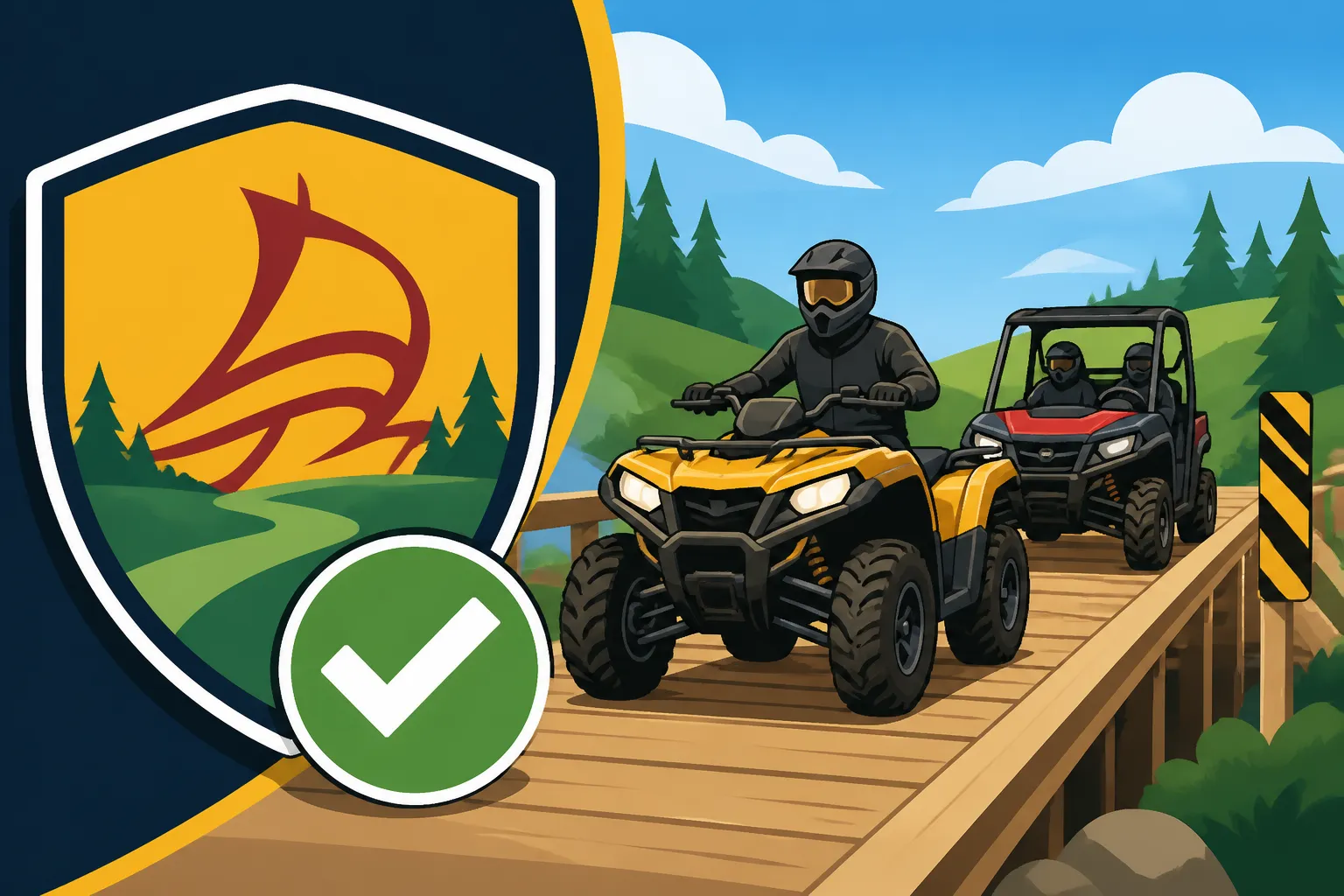
These bridges are integral to the continuity of the trail system. When you're riding a QuadNB trail, and you come to a bridge that looks well-maintained and clearly part of the marked trail, you can generally ride across it with confidence. These structures are built to ORV standards, and their presence is a direct result of the hard work and dedication of the [New Brunswick's 57 Member Clubs]. Membership in these clubs and having a valid [New Brunswick Trail Permit] is essential, as these fees contribute directly to the construction, maintenance, and insurance of these valuable trail assets, including the bridges. It's a collective effort that ensures we all have safe and accessible places to ride.
Safety and Maintenance on Club-Maintained Bridges
While club-maintained bridges offer legal passage, they still demand respect and caution. These structures, whether made of wood, metal, or a combination, are exposed to the harsh New Brunswick weather – frost heaves in spring, heavy rain in summer, and ice in winter. This means they require ongoing inspection and maintenance by club volunteers.
When you approach a club bridge, it’s always wise to slow down. Look for any signs of disrepair: loose planks, missing railings, or excessive mud and debris. Pay attention to any posted weight limits, especially if you're riding a heavier side-by-side or towing a small trailer. Some older bridges might have narrow passages or sharp turns leading onto them, requiring extra care. [New Brunswick Bridges on Club Trails] are generally well-kept, but conditions can change rapidly due to weather or heavy use. If you notice a serious issue, like a washed-out section or structural damage, it’s incredibly helpful to report it to the local ATV club responsible for that section of trail. Your vigilance helps keep the trails safe for everyone. After all, we're all part of the same riding community.
Other Types of Bridges and Special Considerations
Beyond public highway bridges and dedicated club trail bridges, you might encounter other types of crossings during your adventures. Each comes with its own set of rules and considerations, and it’s vital to understand these to avoid legal trouble or dangerous situations.
Private Property Bridges (Logging Roads, Farm Lanes)
New Brunswick has vast tracts of private land, much of it owned by forestry companies or individual landowners. These properties often contain their own networks of roads, complete with bridges over streams and small rivers. If you find yourself on a private logging road or a farmer’s lane, and you come across a bridge, the rule is simple: you must have explicit permission from the landowner to be there. This applies not just to the bridge, but to the entire property.
Riding on private land without permission is trespassing, and it can lead to fines, your machine being impounded, and a lot of ill will towards ORV riders in general. Many private landowners are gracious enough to allow respectful riders on their land, but you must ask first. This is especially true if a bridge appears to be new, well-built, or specifically designed for heavier loads; a landowner might have invested significantly in building or reinforcing it for their own operations. Some landowners even invest in robust bridge solutions, perhaps using specialized components like those offered by companies like SuperATV, to ensure their private crossings are durable and safe for their heavy equipment. Respecting their property, including their bridges, is paramount. Before you even think about crossing a bridge on land that isn't clearly marked as a public or club trail, make sure you have that permission. For more on this, see [New Brunswick Private Woodlot Permission].
Rail Bridges and Abandoned Infrastructure
This is a non-negotiable warning: never, ever ride your ORV on active or abandoned railway bridges. This is incredibly dangerous and illegal. Active rail bridges carry trains that move quickly and quietly, and there's absolutely no safe way to share that space. Even "abandoned" rail bridges pose extreme risks. Their structural integrity can be severely compromised by age, weather, and lack of maintenance. They might have missing ties, rotten planks, or dangerously corroded metal. A fall from a rail bridge can be fatal.
While many former rail beds have been successfully converted into multi-use trails, including parts of the QuadNB network, the bridges are a different story. If a rail bridge has been properly decommissioned and adapted for ORV use, it will be clearly marked as part of a sanctioned trail. Otherwise, stay far away. Even if it looks like an easy shortcut, the risks far outweigh any potential convenience. Remember, [An 850 Kilometre Rail Trail] refers to the path itself, not necessarily every historical bridge along its route.
Environmental Impact and Water Crossings
While not a "rule for riding a bridge" directly, it's important to consider the environmental impact of how we cross waterways. Using designated bridges, even when allowed, is crucial for environmental stewardship. Riding directly through streams or rivers (unless it's a clearly designated, purpose-built water crossing) can cause significant erosion, disturb aquatic habitats, and spread invasive species. It also stirs up sediment, degrading water quality for everyone downstream.
Bridges, by design, help mitigate these impacts by keeping machines out of the water. Even when riding on bridges, be mindful of any spills or leaks from your machine that could contaminate the water below. Our privilege to ride these beautiful trails comes with a responsibility to protect the natural environment that makes New Brunswick such a fantastic place for ORV adventures.
What to Do When You Encounter a Bridge
Encountering a bridge on your ride can feel like a pop quiz, but with a bit of preparation and a few key habits, you can confidently make the right decision every time.
Always Look for Signage and Markings
This is your number one rule: read the signs! Official signage is the clearest indicator of whether a bridge is open for ORV traffic. Look for specific "ATV Crossing Permitted" signs, which indicate a legal, designated route. Conversely, signs like "No ORVs," "Private Property," or "Road Closed to ORVs" are equally important and must be obeyed.
If you encounter a bridge that is clearly part of a public highway and there are no signs indicating ORV access, then you should always assume it is off-limits. The absence of a "No" sign does not automatically mean "Yes." It's far better to turn around, find an alternative route using your map, or even inquire with a local club, than to risk a fine or, worse, an accident. This cautious approach saves you headaches and keeps you safe.
Planning Your Route and Using Maps
One of the best ways to avoid unexpected bridge dilemmas is to plan your route in advance. Utilize up-to-date [New Brunswick ATV Trail Map Downloads] or apps like MapGear, which show the official QuadNB trail network. These resources often indicate designated crossings and sections where ORVs are allowed. A quick glance at a map can prevent you from riding for miles only to find an impassable or illegal bridge.
Before embarking on a long ride, especially in unfamiliar territory, take the time to trace your intended path. Identify major waterway crossings and check their status. If you're unsure about a particular bridge, contact the local ATV club in that region or Service New Brunswick for clarification. A little bit of homework before you hit the trail can save you a lot of time and frustration, ensuring a smooth and legal ride.
Penalties for Non-Compliance
Riding an ORV where it's not permitted, especially on public highway bridges, can lead to significant penalties. These can include fines, which are often substantial, and in some cases, your machine could even be impounded. An officer on patrol, whether from the RCMP or a local enforcement agency, is well within their rights to stop you and ask for your documents, including your registration, proof of insurance, and trail permit. If you're caught riding illegally on a bridge that's part of a highway, you could face fines related to operating an ORV on a public road, which can be quite steep.
These penalties are in place not just to punish, but to deter dangerous behaviour and protect the integrity of the trail system and public safety. Ignoring regulations undermines the efforts of all the dedicated volunteers and organizations working hard to maintain and expand legal riding opportunities. Understanding the potential consequences, such as those outlined in [New Brunswick Fines for Riding Near a Road], can be a strong motivator to always err on the side of caution when approaching an unknown bridge. It's simply not worth the risk.
| Bridge Type | General Rule for ORVs | Key Indicator/Action |
|---|---|---|
| Public Highway Bridge | Generally NOT permitted | Look for "ATV Crossing Permitted" signs. Assume no access otherwise. |
| Designated Crossing | Permitted for direct crossing | Clear official signage (Ministerial Order, HUP). Cross safely and quickly. |
| QuadNB Trail Bridge | Permitted (with valid trail permit) | Part of marked QuadNB network. Maintain awareness of conditions. |
| Private Property Bridge | Only with explicit landowner permission | Always ask first. Trespassing laws apply. |
| Rail Bridge (Active/Abandoned) | ABSOLUTELY NOT permitted | Extreme danger, illegal. Stay far away. |
Disclaimer
This article is for general informational purposes only and does not constitute professional advice. Laws, prices and regulations vary by location and change over time. Consult a qualified professional for guidance on your specific situation.