An MSO at a Service New Brunswick Counter
It can be incredibly exciting to finally pick up that brand-new ATV or side-by-side from the dealership, but then you're handed a stack of papers, including something called an MSO, and told you need to register it at Service New Brunswick. For many riders, this can feel like stepping into a bureaucratic maze, especially when you're just eager to hit the trails. This guide is here to demystify the Manufacturer's Statement of Origin (MSO) and walk you through exactly what to expect when you present it at a Service New Brunswick counter, ensuring your registration process is as smooth as possible.
Understanding Your MSO: The Birth Certificate of Your ATV or UTV
When you purchase a brand-new off-road vehicle in New Brunswick, whether it's an ATV, UTV, or even a dirt bike, you're not typically given a "title" in the same way you would for a car or truck. Instead, the primary document establishing its origin and first ownership is called a Manufacturer's Statement of Origin, or MSO. This document is absolutely critical, and understanding its purpose will help you navigate the registration process with confidence.
What an MSO Is and Isn't
Think of the MSO as your off-road vehicle's official birth certificate. It's issued by the manufacturer and certifies that the vehicle is new, identifies its specific characteristics like the Vehicle Identification Number (VIN), make, model, and engine size, and states that it has been transferred from the manufacturer to the dealership (or directly to you, in very rare cases). This document is the first legal proof of ownership for a brand-new machine.
It's important to differentiate an MSO from a vehicle title. While an MSO serves a similar function for new vehicles by establishing the first legal owner, it doesn't always operate as a transferable title in subsequent sales, particularly in provinces like New Brunswick where ORV registrations are handled differently from road vehicles. Once you register your machine with Service New Brunswick, they record the ownership information, and your registration certificate essentially takes the place of a traditional title for tracking ownership within the province's system. The MSO's job is largely done after that initial registration.
Why Service New Brunswick Needs It
Service New Brunswick requires the MSO primarily to confirm that your ATV or UTV is a new machine being registered for the very first time. This document verifies the vehicle's authenticity and ensures that it hasn't been previously registered in another jurisdiction or involved in any sort of questionable transaction. It's a crucial step in preventing fraud and ensuring that accurate records are maintained for all off-road vehicles operating in the province.
Without a valid MSO for a new machine, Service New Brunswick would have no way to officially record the original details of the vehicle or its first owner. It forms the foundational record for your machine within the provincial system. It also ensures that the proper Harmonized Sales Tax (HST) is collected on the initial purchase, as the MSO provides the official purchase details. Essentially, the MSO acts as the definitive source document for all the pertinent details that will go onto your official New Brunswick ORV registration certificate. It establishes the machine's legal identity before it's entered into the provincial database.
Navigating the Service New Brunswick Counter with Your MSO
Once you have your MSO in hand, along with your other purchase documents, your next step is to head to a Service New Brunswick centre. While the idea of government bureaucracy might sound daunting, the process for registering a new ORV with an MSO is fairly straightforward if you come prepared.
The Documents You'll Need to Bring
To ensure a smooth visit, gathering all your required documents before you leave home is key. First and foremost, you'll need the original Manufacturer's Statement of Origin. This should be a physical document, often on special paper, given to you by the dealer. You'll also need your bill of sale from the dealership. Even though the MSO proves the machine's origin, the bill of sale confirms your purchase price and acts as proof that you bought it from the dealer. For private sales of used machines, a comprehensive bill of sale, perhaps drafted using a template from a service like LawDepot, would be crucial.
Beyond these vehicle-specific documents, you'll need personal identification, such as your valid driver's license, and proof of your New Brunswick address (a utility bill or rental agreement usually works). Finally, you absolutely must have proof of valid off-road vehicle insurance for your machine. In New Brunswick, insurance is mandatory if you plan to ride on managed trails. [New Brunswick Requires Insurance on Trails] before you can complete the registration. You can check out our article on [New Brunswick Registration Paperwork Checklist] for a full rundown of what to bring.
The Step-by-Step Registration Process
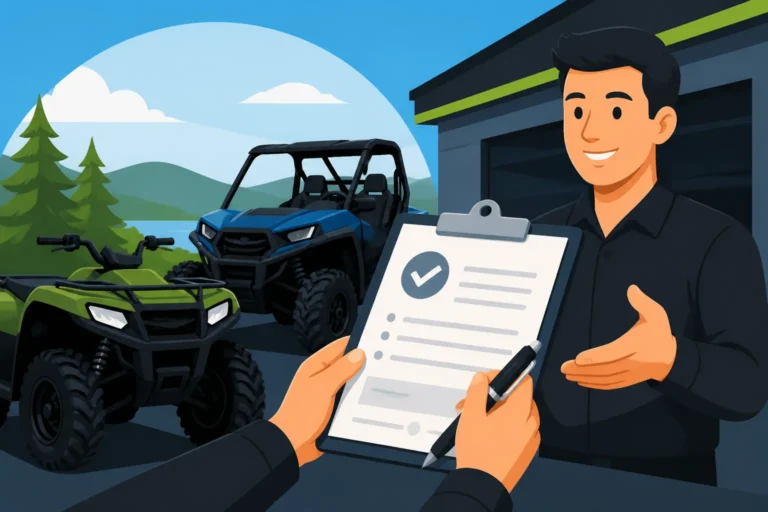
Once you arrive at Service New Brunswick, you'll typically take a number and wait for your turn. When called to the counter, simply present all your prepared documents to the representative. They will review your MSO, bill of sale, personal ID, and insurance information. The MSO will be used to input the machine's details, such as the VIN, make, model, and year, into the provincial registration system. They'll confirm your ownership based on the MSO and your bill of sale.
After reviewing everything, the Service New Brunswick representative will calculate the applicable registration fees and any outstanding HST, which you will then pay. [New Brunswick Registration Payment Methods] usually include debit, credit card, or cash. Once payment is processed, they will issue you a temporary registration certificate and, in most cases, your physical license plate right there on the spot. This temporary certificate is valid immediately, allowing you to legally operate your ORV. Your official, more durable registration certificate will usually be mailed to you within a few weeks. For more details on the general process, see our guide on [Registering an ATV With Service New Brunswick].
Common MSO-Related Challenges and Solutions
While the process is generally straightforward, sometimes riders encounter hiccups with their MSO. Knowing what to do in these situations can save you a lot of stress and ensure you get your machine registered without unnecessary delays.
Lost or Damaged MSO
Imagine the sinking feeling of realizing your MSO is nowhere to be found, or perhaps it's been damaged beyond recognition. This can definitely throw a wrench in your plans to register your new ATV or UTV. If your MSO is lost or severely damaged, your first point of contact should always be the dealership where you purchased the machine. They often keep copies or have a direct line to the manufacturer to request a duplicate.
Be prepared that obtaining a duplicate MSO can take some time, potentially several weeks, as it often needs to come directly from the manufacturer. It's not usually something a dealership can print on demand. It might also involve a fee. While waiting, ensure you keep all other purchase documents, especially your bill of sale, safe. Having a robust bill of sale, perhaps one you secured using a reliable template from LawDepot, can also help solidify your purchase claim if further questions arise. The key is patience and persistent communication with your dealer and, if necessary, the manufacturer.
Discrepancies on the MSO
Accuracy is paramount when it comes to official documents like the MSO. Discovering a typo in your name, an incorrect VIN, or a wrong model year on your MSO can cause immediate red flags at Service New Brunswick. It's crucial to inspect your MSO carefully at the time of purchase to catch any errors before you even leave the dealership.
If you find a discrepancy, do not try to alter the MSO yourself. Immediately contact your dealership and explain the issue. They are responsible for ensuring the MSO is accurate and should facilitate the correction. This might mean issuing a new MSO, which again, can take some time. Service New Brunswick cannot register a vehicle with conflicting or incorrect information on its foundational document, so getting it corrected by the issuing entity (the manufacturer, through the dealer) is the only acceptable solution. Proper documentation from the outset, like a meticulously prepared purchase agreement, can reduce the likelihood of such errors.
MSO vs. Bill of Sale in Different Scenarios
It's common for new riders to confuse the MSO with the bill of sale, or to wonder which one holds more weight. For a brand-new machine, the MSO is the definitive proof of origin and original transfer from the manufacturer. It's irreplaceable in establishing the machine's initial identity. The bill of sale, while equally important, primarily serves as proof of your financial transaction with the dealership, detailing the purchase price, taxes, and any trade-ins. Both are vital for that initial registration.
However, if you're buying a used machine, an MSO is generally not part of the equation. In that scenario, the previous owner's valid New Brunswick registration certificate (which they transfer to you) and a clear, detailed bill of sale are the essential documents. The bill of sale for a private sale should clearly state the buyer, seller, date, purchase price, and the machine's VIN. Services like LawDepot offer excellent templates for creating legally sound bills of sale for private transactions, which can prevent disputes and ensure a smooth transfer of ownership. Understanding this distinction is vital, especially when considering [New Brunswick Registration After a Private Sale] versus a brand-new purchase.
What Happens After Your MSO is Processed
Once you've successfully presented your MSO and completed the registration process at Service New Brunswick, you're almost ready to hit the trails! However, there are a few important steps and considerations that follow this initial registration.
Receiving Your Registration Certificate and Plate
As mentioned, after your MSO is processed and fees are paid, Service New Brunswick will typically hand you a temporary registration certificate and your new license plate right away. This temporary document is your proof of registration until the official, more durable certificate arrives in the mail, usually within a few weeks. The license plate should be affixed to your ATV or UTV as required by law. If you're wondering about the precise placement, our article on [New Brunswick Plate Placement on a Quad] offers specific guidance.
It's a huge relief to walk out with that plate and temporary paper, knowing you're legally squared away to ride. This initial registration is a critical milestone, setting up all future interactions with the provincial system regarding your off-road vehicle. For a broader overview, you can read more about [Getting a Plate the First Time You Register].
Understanding Annual Renewal
Your first registration, facilitated by your MSO, establishes your machine's presence in the New Brunswick ORV database. What's crucial to remember is that all New Brunswick ORV registrations expire on December 31st of each year, regardless of when you initially registered it. So, if you register your new ATV in July, that registration will still expire on December 31st of the same year. This universal expiry date simplifies the renewal process for the province.
You'll receive a renewal notice in the mail well in advance, typically in late fall. It's imperative not to ignore this notice, as riding with an expired registration can lead to fines. [New Brunswick Registrations Expire December 31] is a fact every rider in the province learns quickly. The annual renewal process is generally much simpler than the initial registration, often doable online or by phone. Our guide on [New Brunswick ATV Registration Renewal] offers practical steps for keeping your registration current. You'll want to remember the [New Brunswick Annual Registration Rule] going forward.
The Importance of Keeping Your Documents Safe
Even after your MSO has served its primary purpose, and you've received your official registration certificate and license plate, the responsibility of document management continues. Your registration certificate, proof of insurance, and potentially your driver's license (or Class 9 if you're a young rider) are all documents you must carry when operating your ORV on public trails.
While it's essential to have these documents readily available, many experienced riders advise against carrying the original registration certificate on your machine due to the risk of loss or damage. Instead, carry a clear, legible photocopy in a waterproof bag or container in a secure compartment on your ATV or UTV. Keep your original certificate in a safe place at home. This practice ensures you can provide proof of registration if requested by an officer, while protecting the irreplaceable original. For more detailed advice on what to carry and how, refer to [New Brunswick Documents You Must Carry].
Comparing Registration Requirements: New vs. Used ORV
To help clarify the differences, here's a quick comparison of the key documents needed when registering a brand-new machine versus a used one in New Brunswick.
| Document Type | Brand New Machine (with MSO) | Used Machine (no MSO) | Notes |
|---|---|---|---|
| Manufacturer's Statement of Origin (MSO) | Required | Not Applicable | Proof of first ownership; confirms machine is new. |
| Bill of Sale | Required (from dealer) | Required (from private seller) | Shows purchase price and transfer details. Consider LawDepot for private sales. |
| Proof of Insurance | Required | Required | Must be valid for the machine before registration can be finalized. |
| Personal Identification | Required | Required | Valid driver's license or other government-issued photo ID. |
| Proof of New Brunswick Address | Required | Required | Utility bill, lease agreement, etc., verifying residency. |
| Previous Registration | Not Applicable | Required (if available) | Helps confirm transfer details and machine history, especially for tax. |
Disclaimer
This article is for general informational purposes only and does not constitute professional advice. Laws, prices and regulations vary by location and change over time. Consult a qualified professional for guidance on your specific situation.