New Brunswick Member Insurance Savings
A QuadNB membership may help reduce the cost of insuring an ATV or side-by-side, but the discount is only one part of the calculation. The useful question is whether your policy qualifies, how much the saving actually changes your bill, and what you need to confirm before relying on it. Here’s how to check the benefit without confusing membership with insurance coverage.
What the New Brunswick member insurance saving means
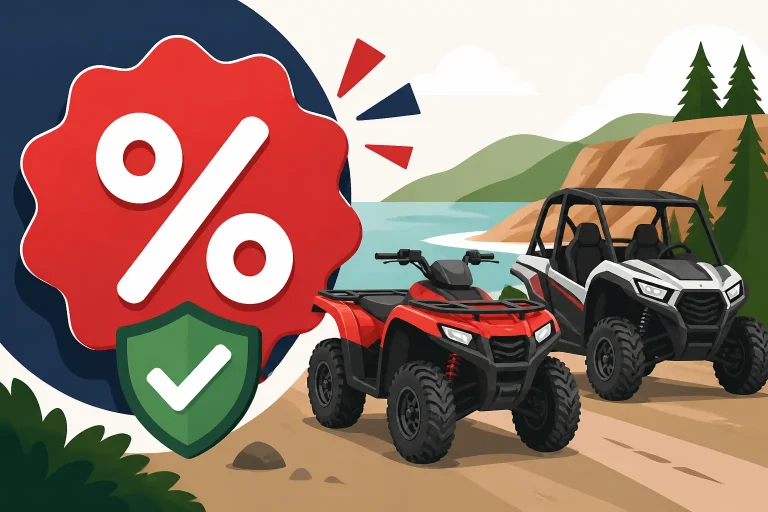
QuadNB membership is associated with an insurance saving described as 5% off a policy. Treat that figure as a potential discount to confirm with the insurance provider, not as a guaranteed reduction on every ATV or UTV insurance bill. Eligibility, participating providers, eligible policies and the way a discount is applied can change.
A percentage discount does not necessarily apply to every charge on an invoice. Depending on the provider’s rules, it may apply only to eligible premium amounts rather than taxes, administrative charges or other fees. Ask the insurer to show you the amount before and after the discount so you can compare the actual cost.
A membership benefit also does not mean the federation is insuring your machine. You still need an insurance policy that meets your needs and New Brunswick requirements. Membership and a trail permit are separate from proof of insurance: having one does not automatically provide the other. For background on what membership can include, see New Brunswick Membership Benefits and New Brunswick Permit Equals Membership.
It helps to distinguish three things:
- Membership: A connection to the federation that may make you eligible for certain member benefits.
- Insurance: A contract with an insurer that sets out your coverage, exclusions, limits and responsibilities.
- Trail permit: Permission to use the relevant managed trail network under its rules. A permit is not an insurance policy.
The 5% figure is best understood as a possible member discount, not a promise that your total insurance bill will fall by exactly 5%. For instance, if a discount applies to only part of the premium, the reduction on the full invoice may be smaller. The insurer can explain which parts qualify and how it calculates the total.
| Question | What to confirm |
|---|---|
| Does membership qualify? | Whether your current membership status meets the insurer’s eligibility rules |
| Which policy qualifies? | Whether the benefit applies to an ATV, a side-by-side, or both |
| What does the discount cover? | Which premium components are eligible and whether fees or taxes are excluded |
| How is it applied? | Whether the insurer applies it automatically or requires proof of membership |
| When does it take effect? | Whether it applies at purchase, renewal or another point in the policy term |
| What happens after a change? | Whether the discount continues if you change machines, coverage or policy details |
These details matter because insurance arrangements are specific to the policy and provider. A benefit that applies to one person’s ATV policy may not automatically apply to a household member, a second machine, a rental or a business-owned vehicle. Confirm the rules for your situation rather than assuming the same discount carries over.
How to verify eligibility and compare the real saving
Start with the insurer, not an estimate based only on the membership benefit. Ask whether it currently offers the member discount for your type of machine and whether the discount applies to your particular policy. If you are shopping for coverage, raise the question while requesting quotes. If you already have a policy, ask before renewal so you have time to check alternatives.
Use a short checklist when you contact the provider:
- Identify the machine and its use. Say whether it is an ATV or side-by-side, who owns it and how it is used. Personal recreation, regular trail riding, farm use, rental use and business use may not be treated the same way.
- Ask whether your membership qualifies. Confirm what proof is acceptable and whether the membership must be active on the date the policy is issued or renewed.
- Ask what the discount applies to. Request the dollar amount of the saving and whether it is calculated on the premium, selected coverages or another eligible portion.
- Compare equivalent quotes. Make sure the policies use the same machine details, drivers, coverage limits, deductibles and intended use. A lower quote is not a useful comparison if it provides less coverage.
- Check how long the discount lasts. Find out whether it applies only for the current term or can continue at renewal, and whether you need to provide updated membership proof.
- Get the details in writing. Keep the quote, confirmation or policy documents showing the discount and the coverage it applies to.
You can also ask whether a discount affects other pricing factors. Insurance premiums can depend on information such as the machine, its use, the people operating it, the selected coverage and the insurer’s underwriting rules. A membership discount may reduce an eligible amount, but it does not necessarily override those factors.
When comparing policies, do not look only at the final premium. Check what liability coverage is included, whether damage to your own machine is covered, what exclusions apply and how the deductible works. Ask how the policy responds if the machine is damaged while being transported, stored or used away from a managed trail. The answer depends on the policy wording, so request a clear explanation from the insurer.
If you ride a side-by-side, ask about it by name rather than assuming an ATV discount or policy description covers it in the same way. The machine’s design, passenger capacity and use may affect how a policy is written. New Brunswick Insurance for a Side-by-Side covers the separate questions to consider when insuring that type of machine.
It is also useful to compare the saving with the cost and usefulness of membership as a whole. Do not join solely on the assumption that an insurance discount will make membership pay for itself. The discount may be unavailable for your policy, may apply only to part of the bill, or may be outweighed by other differences between quotes. Consider the other membership benefits you would actually use, and verify all current membership and insurance terms before deciding.
For a broader view of coverage costs and what influences them, see New Brunswick Insurance Cost for an ATV. If you are insuring more than one machine, ask whether each one must be listed separately and whether the benefit applies to each eligible policy. New Brunswick Permit for a Second Machine can help with the separate permit question, but a permit and an insurance discount should not be treated as interchangeable.
Keep the discount separate from required coverage
A lower premium is useful only if the policy still provides appropriate protection and meets the rules that apply to your riding. New Brunswick trail use has insurance requirements, and your machine’s registration, trail access and insurance each need to be checked on their own. Read New Brunswick Requires Insurance on Trails alongside New Brunswick ORV Registration Explained if you are sorting out the paperwork before riding.
Do not assume that a membership card, permit sticker or registration certificate proves that you have valid insurance. Keep the insurer’s proof of coverage available in the form required for your use, and check that the policy information matches the machine you are riding. If the ownership, machine or intended use changes, tell the insurer and ask whether the policy remains suitable.
A discount should not be the only reason to choose an insurer. Review the policy’s coverage limits, exclusions and claims process, and ask what you would need to do after an incident. A discount can lower an eligible premium, but it does not improve the coverage itself or guarantee that a particular claim will be paid. For questions about what to expect after a claim, see New Brunswick Insurance After a Claim.
Pay particular attention when changing machines, changing how you ride, adding another operator or moving a machine between personal and commercial use. Tell the insurer about relevant changes rather than relying on the membership discount to carry through automatically. The policy wording and the provider’s eligibility requirements control how the benefit works.
If you ride outside New Brunswick, check insurance and trail-access rules for that destination as well. A New Brunswick membership or permit does not necessarily settle requirements in another province. Reciprocity arrangements concern trail access and permit recognition; they do not automatically replace the insurance terms set by your provider. See New Brunswick Reciprocity With Nova Scotia for a separate discussion of riding across the provincial border.
Before you rely on the member saving, get clear answers to these questions:
- Is the discount currently available to members for my machine and policy?
- What proof of membership does the insurer need?
- How much will the discount reduce my quoted premium in dollars?
- Does it apply to each machine or only to a specific policy?
- What coverage, deductible and exclusions are included in the quote?
- When does the discount start, and what do I need to do at renewal?
- Will a change in ownership, use or operator affect eligibility?
The practical takeaway is simple: treat the member insurance saving as a quote to verify, not a fixed reduction to budget around. Confirm eligibility with the insurer, compare policies on equal coverage, and keep insurance, registration and trail-permit requirements distinct. That approach makes it easier to see whether the discount is meaningful for your machine without sacrificing coverage to chase a lower bill.
Disclaimer
This article is for general informational purposes only and does not constitute professional advice. Laws, prices and regulations vary by location and change over time. Consult a qualified professional for guidance on your specific situation.