Four Things to Carry on a New Brunswick Trail
A trail ride can turn into a frustrating stop if you cannot show the documents an officer asks for—or if your permit or insurance proof is back at camp. Pack four essentials before you leave: registration, insurance evidence, trail-permit proof and any rider qualification documents that apply. A little preparation helps you handle a check, a breakdown or a change of plan without searching through the machine.
Why documents belong in your trail kit
New Brunswick riders need to think about paperwork as part of the machine’s equipment. Registration, insurance and trail access are separate matters. Having one does not automatically prove the others, and a sticker on the machine may not answer every question during a roadside or trail check.
The practical goal is to have the machine’s required papers and the rider’s applicable credentials available while riding. Keep them somewhere protected from rain, mud and vibration, but easy to reach. You do not want to empty a wet cargo box on the trail just to find a certificate.
Requirements can depend on the machine, where you ride and who is operating it. For example, riding on a designated trail is different from using a road, and rules for younger riders may include additional training or supervision requirements. Check the current rules for your situation before a trip, especially if you plan to cross a road or enter an unfamiliar area.
The four items below are a sensible baseline. Some are documents you may be asked to produce; others are proof that the machine has the required permission to be on the route. For a fuller checklist, see New Brunswick Documents You Must Carry and Producing Four Documents at Once.
The four things to carry
1. The vehicle registration certificate
Carry the registration certificate for the ATV or UTV you are riding. It connects the machine to its registered owner and gives an officer a way to check that the vehicle’s details match the records. A plate or registration sticker on the machine is useful, but it is not a substitute for keeping the certificate available when it is required.
Before heading out, check that the certificate belongs to that machine and that the identifying details are readable. If you have more than one quad or side-by-side, take a moment to confirm you have not packed the paperwork for the wrong one. This is particularly easy to mix up when the machines look alike or are kept at different camps.
Keep the certificate in a waterproof sleeve or pouch rather than loose in a pocket or open storage compartment. Avoid leaving it where it can rub against tools, become soaked, or disappear under gear. If you carry a copy instead of the original, confirm whether that form is accepted for your circumstances; do not assume that a photograph on a phone will be treated the same way as the document.
If you have recently bought the machine, inherited it, or moved to New Brunswick, make sure its registration is actually in order before relying on paperwork from the previous owner. The process can differ depending on how you acquired it. See New Brunswick ORV Registration Explained for an overview, or New Brunswick Registration After a Private Sale if the machine changed hands privately.
2. Proof of insurance
Carry proof that the machine has the required insurance for the riding you plan to do. New Brunswick requires insurance on trails, and a policy document or insurance card can help demonstrate coverage if you are asked. Check that the information identifies the correct machine and that the coverage is current.
Do not assume that a policy covering a different ATV also covers the one you brought, or that permission to ride someone else’s machine means their insurance automatically answers every question. If you borrow a machine, ask the owner to confirm its coverage and make sure you understand any limits or conditions that affect your use.
A digital insurance card may be convenient, but a phone can run out of battery, lose reception or get damaged. If your insurer provides a printable proof document, carrying a protected paper copy is a useful backup. Ask your insurer which proof it accepts and what information must be available. For the broader rule, see New Brunswick Requires Insurance on Trails.
Insurance is not simply a box to tick before leaving the driveway. It can be important after a collision, damage to another person’s property or an injury. Do not treat a trail permit as insurance, and do not assume that registration provides insurance coverage. They serve different purposes.
3. Trail-permit proof
A valid trail permit is a separate item from vehicle registration. On a permitted trail network, the machine needs the appropriate permit, displayed as required. Carry any receipt, confirmation or other supporting proof you received when buying the permit, especially if the sticker is missing, damaged, difficult to read or recently replaced.
Before riding, verify that the permit belongs on the machine you are taking. A permit associated with another vehicle may not transfer automatically. If you are riding a rental or borrowed machine, ask the owner or operator who is responsible for obtaining the permit and check that the required sticker is in place. Do not rely on a casual assurance if you cannot see that the machine is properly prepared.
Placement matters, too. A sticker hidden by a bag, covered in mud or mounted in the wrong spot may be hard to inspect. Check the current placement instructions rather than copying what another rider has done. [New Brunswick Permit Placement on a Machine] explains why sticker position matters, while New Brunswick How to Buy a New Brunswick Trail Permit can help with the purchase process.
A trail permit does not replace registration or insurance. It gives access under the trail system’s rules; it is not proof that the vehicle is registered or insured. If you are unsure which permit applies, review [New Brunswick Groomed vs Non-Groomed Permits] before setting out.
4. Proof of rider qualification, when it applies
The rider may need to show a safety-course certificate, a licence or another document depending on age, experience and where the machine is being operated. Requirements can differ for a younger rider and for someone using a road or a road section where additional rules apply. Carry the relevant credential whenever it applies to your ride.
For a family outing, check each young rider’s situation separately. Do not assume one adult’s licence or training certificate covers a child, or that the rules are identical for every age. An adult supervising a younger rider may also have responsibilities. If the trip includes a road crossing, a village street or a designated road section, review the requirements for that specific part of the route before leaving.
A phone photo of a certificate may be helpful as a backup, but it is worth carrying the actual certificate or a clearly readable copy if available. Store it with the machine papers, not in a different vehicle or at home. New Brunswick Quad Safety Course Explained covers the training requirement, and New Brunswick Equipment a Rider Must Carry is useful for considering the wider set of riding obligations.
Not every rider will have the same qualification document to carry. Treat this as a check-before-you-go item: identify the rider, the machine and the planned route, then confirm which credentials apply. If none are required for your particular ride, you still need the other three essentials.
| Item | What it helps show | Before you leave |
|---|---|---|
| Registration certificate | The machine’s registration details | Match it to the machine and keep it readable |
| Insurance proof | Evidence of coverage for the machine | Confirm the correct vehicle and current coverage |
| Trail-permit proof | Evidence of trail access, alongside the required displayed sticker | Check the permit, sticker and machine match |
| Rider qualification document | Evidence of training or licence where required | Confirm the rider and route-specific requirements |
Store the papers so they stay usable
A document that has turned to pulp in a wet cargo box is not much help. Choose a storage method that protects papers from water, grit and abrasion while keeping them accessible. A small waterproof document pouch can work, provided it closes securely and does not interfere with riding controls or safety equipment. A simple pouch from a local outdoor or powersports shop is fine; if you shop online, Amazon is one place to compare waterproof options, but check the closure and dimensions rather than relying on the product name alone.
Place the pouch in a stable compartment that stays closed over rough ground. Avoid attaching paperwork to a spot that gets hot, vibrates heavily or is exposed to repeated splashes. Do not keep all your documents in a loose pocket that could fall out when you climb on or off the machine.
It can help to separate originals from backup copies. Keep required papers accessible, and store a second copy in a different secure place if that suits your situation. A digital copy can be useful if a paper copy is lost, but it should be treated as a backup, not as a guaranteed replacement. Screens crack, phones lose power, and reception can be unreliable away from towns.
Before each ride, take a quick look at the contents. Check that the documents are still legible and that the pouch has not opened or filled with water. Replace a damaged certificate through the appropriate service provider rather than trying to make unreadable information work at a checkpoint.
Make a quick pre-ride check
Use the same routine each time, particularly when switching machines:
- Match the registration certificate and insurance proof to the machine.
- Confirm that the trail permit is valid for that machine and that the sticker is properly displayed.
- Check which rider credentials apply to the people and route.
- Put the papers in the same protected storage spot.
- Confirm your phone is charged if you use digital backups or navigation.
This routine is especially useful when several people share machines, or when one person packs gear for the whole group. A two-minute check can catch a missing certificate before the group leaves the parking area.
Paperwork is only part of a prepared ride
The four items above cover key proof and access questions, but they are not a complete trail kit. A rider should also consider the machine’s condition, the weather, the route and how far the ride is from help. Carrying paperwork will not prevent a mechanical problem or make an unsuitable route safe.
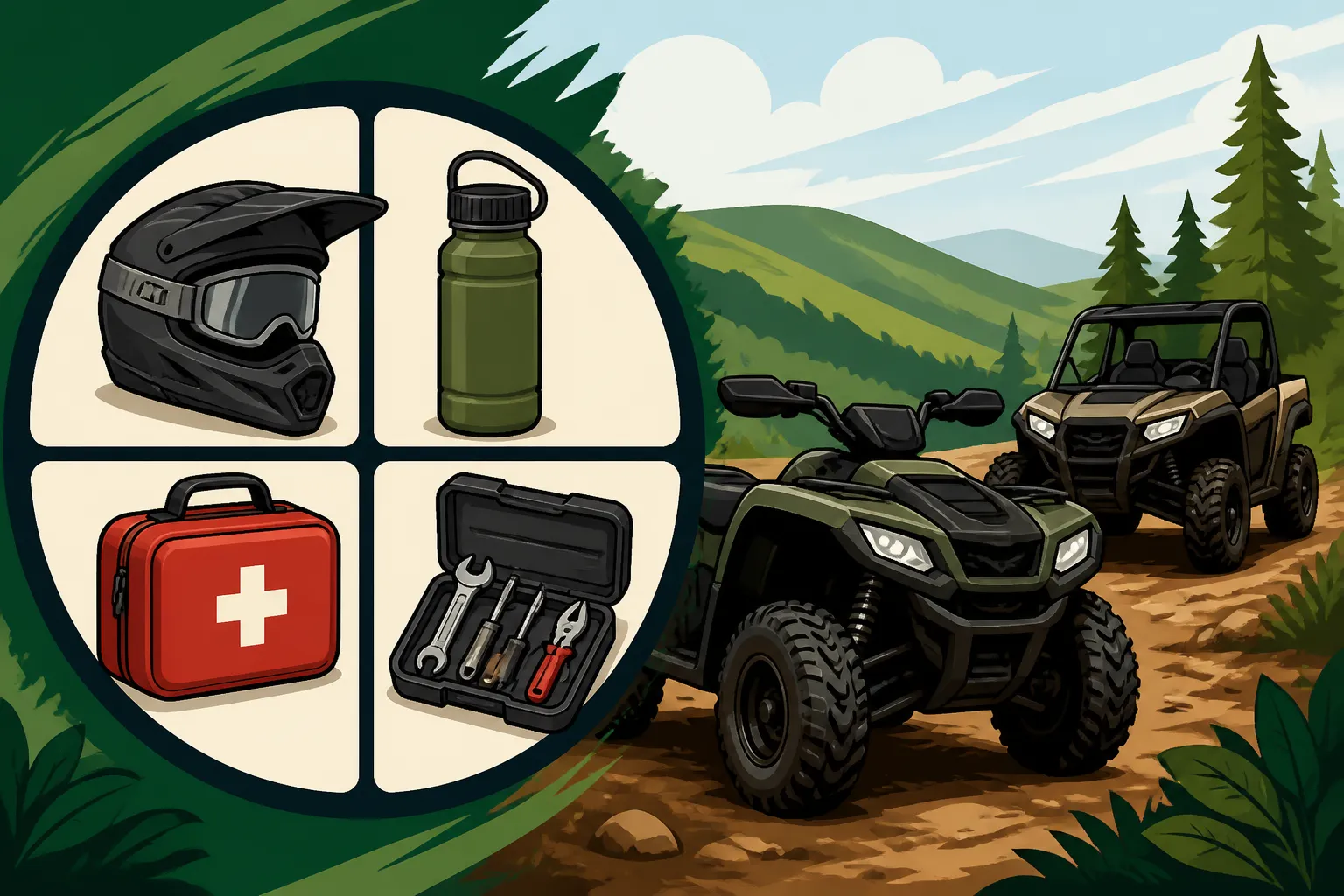
At minimum, plan for navigation, communication and basic repair needs appropriate to the trip. Download or save route information before entering an area with weak cell service. Tell someone where you are going and when you expect to return, particularly for a remote ride. Take suitable clothing, water and basic first aid supplies, and carry tools or recovery equipment that match the machine and terrain.
The documents and the emergency kit should have different storage priorities. Papers need to stay dry and easy to find. Tools and recovery gear need to be secured so they do not shift or become hazards. Do not bury the registration and insurance proof beneath heavy equipment, and do not place a document pouch somewhere that must be unloaded in order to reach a first-aid kit.
If an officer stops you, stay calm, follow instructions and retrieve the requested papers without making sudden movements. If you cannot immediately locate one, explain where you have stored your documents and ask what the officer needs to see. Keeping the four items together makes the interaction simpler and reduces the chance of leaving a paper behind after the check.
A group leader can make the process smoother by checking the basics before everyone starts. Confirm that each machine has its own registration and insurance proof, that required trail stickers are visible and that each rider has any credentials that apply. One machine’s documents do not establish that every machine in the group is properly covered.
Finally, plan for the route you will actually ride. A trail ride may include a road crossing or a section subject to additional conditions. A rider who is prepared for a club trail may still need to check separate rules before entering a road or another restricted area. Do not treat “we have the papers” as a complete answer to whether a particular route is open or lawful.
Frequently Asked Questions
Do I need to carry the original registration certificate?
Carry the registration document in a form accepted for your situation. A phone photo may be useful as a backup, but do not assume it replaces the required document. If you are unsure whether a copy is acceptable, confirm with the relevant registration authority before riding.
Is a trail-permit sticker enough by itself?
The sticker is an important display requirement, but it does not replace registration or insurance. Carry supporting permit proof if you have it, and check that the sticker is valid, visible and associated with the machine you are riding.
Does every rider need a safety-course certificate?
Requirements depend on the rider and the circumstances, including age and where the machine will be operated. Check the rules for each rider and route rather than assuming the same requirement applies to everyone.
Can I keep all four items on my phone?
A phone can store useful backup images, but it may lose power, break or be unusable in wet conditions. Keep required documents in a protected format that will be available during the ride, and confirm whether digital proof is accepted for your circumstances.
Disclaimer
This article is for general informational purposes only and does not constitute professional advice. Laws, prices and regulations vary by location and change over time. Consult a qualified professional for guidance on your specific situation.