New Brunswick Non-Groomed Trails Run Three Seasons
A three-season trail can sound like an invitation to ride whenever the ground looks dry, but New Brunswick conditions do not follow a neat calendar. Spring thaw, heavy rain, forestry work and local closures can change what is safe or permitted from one ride to the next. This guide explains what “three-season” means, how to plan a responsible ATV or UTV outing, and what to check before unloading your machine.
What a three-season trail means in New Brunswick
The label describes a riding window, not a promise of access
A non-groomed, three-season trail is generally intended for use outside the winter grooming season. In practice, that often means riders plan for spring, summer and fall rather than assuming the trail is available for winter riding. The label is useful, but it does not guarantee that every section will be open throughout those seasons.
Conditions and access can vary along a route. One stretch may be dry and firm while another crosses a wet low spot, a damaged culvert or a section that a club has temporarily closed. A route shown on a map is a planning aid, not proof that it is open today. Before leaving, check current trail information and follow any signs or barriers you encounter.
This difference between a trail’s general season and its day-to-day status is easy to miss, especially if you are travelling from another part of the province. For a closer explanation of the designation, see [What a Three-Season Trail Means in Practice]. It is also worth comparing the designation with [New Brunswick Groomed and Non-Groomed Trails], because grooming, maintenance and permitted use can differ.
Non-groomed does not mean unmanaged
“Non-groomed” describes a trail that is not prepared for winter riding in the same way as a groomed route. It does not mean the corridor is abandoned, open to every vehicle or suitable for riding in any condition. Clubs and other trail managers may still maintain, sign and monitor routes, and may close sections when conditions or work require it.
That matters when riders encounter a rough patch or a detour. It can be tempting to ride around a muddy spot through the brush or to follow tire marks that seem to continue beyond a sign. Those choices can widen damage, create a new route and put riders somewhere they are not authorized to be. Stay on the marked corridor and respect closure signs even if the trail looks passable.
A non-groomed trail can also feel very different from one ride to another. A dry, firm stretch may be straightforward for a newer rider, while the same section after prolonged rain may develop deep ruts or standing water. The trail category alone does not tell you the difficulty level for your machine, experience or the day’s weather.
The three-season label does not replace a permit check
Seasonal access and trail permits are separate questions. Before riding, confirm the permit requirements for your machine and the route you intend to use. Do not assume that a registration plate, private-land permission or an out-of-province permit automatically provides access to a club trail.
If you are planning a ride with friends, check every machine rather than assuming one rider’s permit covers the group. A passenger, a borrowed ATV or a second machine may bring its own paperwork and permit questions. The practical details are covered in [New Brunswick Trail Permit Cost in 2026] and [New Brunswick Permit Placement on a Machine]. Confirm current requirements with the relevant organization before setting out.
How weather and ground conditions change a ride
Spring thaw calls for extra caution
Spring can be especially unpredictable. The ground may look dry from a road or parking area while shaded sections remain soft, frozen or saturated. Water runs off higher ground into dips and low areas, and repeated tire traffic can quickly turn a damp trail into a deeply rutted one.
A machine that can power through a wet section is not necessarily helping the trail—or making a safe choice. Spinning tires can dig holes, damage drainage and make the route harder for the next rider. If you see water covering the trail, fresh damage, a closure sign or conditions that seem likely to worsen with traffic, turn around rather than trying to push through. Check [New Brunswick Trail Closures in Spring Thaw] before planning an early-season outing.
Spring conditions also make it harder to judge what is under the surface. A puddle can hide a rut, a rock or a washed-out edge. Keep a pace that gives you time to read the ground, and avoid following closely behind another machine where dust, spray or a sudden stop can reduce your visibility.
Heavy rain can change a trail in a few hours
Rain can make familiar ground slippery and obscure hazards. Clay may become slick, loose soil can wash across the trail, and water can collect in places that were dry during your last visit. Even when the route remains open, the conditions may be poor enough that changing your plan is the sensible choice.
Do not treat a forecast as the only source of information. Rainfall can vary across the province, and a storm near Fredericton may not match conditions near Bathurst or Miramichi. Look for recent local trail updates, contact a club if needed and be prepared to turn back if you find a closure or unsafe section. [New Brunswick Trail Closures After Rain] offers a useful reminder that post-storm access is not simply a matter of whether the rain has stopped.
If you do ride after rain, use gentle throttle and avoid making a new line around a muddy patch. Riding around a wet section can damage vegetation and create parallel tracks that broaden the corridor. A careful turnaround may feel disappointing after a long drive, but it is better than leaving damage that others will have to navigate or repair.
Match the route to the machine and the riders
A route that is manageable for an experienced rider on a well-equipped quad may be stressful for a new rider, a family group or a larger side-by-side. Consider the narrowest or roughest section on the planned route—not only the easy first few kilometres. Check the machine’s ground clearance, tires, fuel range and any limitations that matter for the terrain.
Tires deserve particular thought in New Brunswick, where riders may encounter a mix of hard-packed surfaces, rock, loose material and clay. Aggressive throttle is not a substitute for suitable tires or good judgment. If your route is known for sticky ground, read [Tires for New Brunswick Clay] and make a realistic decision about whether your setup and experience are appropriate.
A useful rule is to choose a route that leaves room for conditions to be worse than expected. If a novice rider is joining, plan a shorter outing with an easy exit rather than a long loop with no convenient way back. If the trail becomes rougher than expected, turn around before anyone feels pressured to keep going.
| Planning question | What to check | Why it matters |
|---|---|---|
| Is the trail open? | Current club or trail-manager updates and signs at access points | A mapped route may have a temporary closure or detour |
| Is the ground suitable? | Recent rain, spring thaw, standing water and visible trail damage | Wet ground can increase risk and cause lasting trail damage |
| Is the route suitable for the group? | Rider experience, machine size, clearance and comfort | A difficult section can become a problem for the whole group |
| Can you navigate without service? | Downloaded maps, a charged phone and a backup plan | Cellular coverage can be unreliable in remote areas |
| Is the ride properly prepared? | Permit, registration, insurance and required documents | A recreational ride still comes with access and paperwork responsibilities |
How to plan a non-groomed trail ride
Check trail information close to departure
A map helps you choose a route, but conditions can change after you have planned it. Check the trail status as close to departure as practical, particularly after heavy rain, during spring thaw or when you know maintenance work may be taking place. Look for closures, reroutes, damaged bridges and notices that affect the section you plan to ride.
When the information is unclear, contact the club or organization responsible for that corridor rather than guessing. A route can cross more than one managed area, so a single update may not answer every access question. Keep the exact trail or region name handy when you ask, and clarify whether the advice applies to your intended machine and date.
For a broader checklist, see [New Brunswick Trail Conditions Before You Go]. It is also helpful to review [New Brunswick Trail Maps and the MapGear App] for map-planning context, while remembering that a map and a live trail update serve different purposes.
Plan around navigation and dead zones
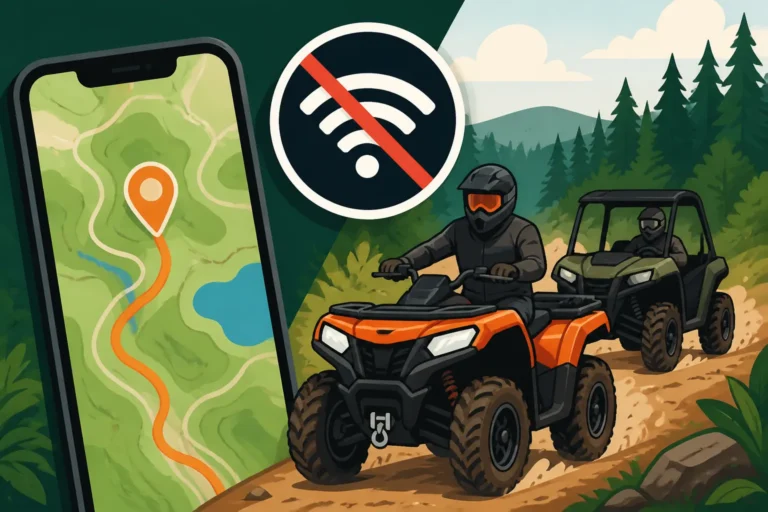
Cellular reception can disappear once you leave a town or main road. Do not wait until the signal drops to work out where you are. Before leaving home, review the route, identify likely turnarounds and download any map data you may need. Tell someone where you plan to ride and when you expect to be back.
Apps such as onX Offroad can be one part of a navigation plan, but do not assume that a particular app shows every New Brunswick club trail, closure or permission boundary. Check the app’s coverage for your intended area and compare it with trail information from the people responsible for the route. Download maps for offline use if the feature is available and test that you can open them before you lose service.
A phone can be useful, but it should not be the only plan. Keep it charged, protect it from water and carry a backup navigation option suited to your ride. For a practical primer, read [New Brunswick Cellular Reception Maps] and [New Brunswick GPX Downloads for Riders]. If you use onX Offroad alongside another map source, treat it as a planning aid and confirm local access independently.
Build a realistic itinerary with a turnaround point
A route that looks short on a screen can take longer than expected once you account for stops, rough ground, navigation and changing weather. Give yourself enough time to ride at a safe pace and return before fatigue or fading light becomes an issue. Avoid planning the day around the fastest possible travel time.
Choose a point where the group can pause, check conditions and decide whether to continue. For a new group, a short out-and-back route can be easier to manage than a loop with uncertain branches. If a section is blocked, you can return the way you came rather than trying to find an improvised alternative through unfamiliar territory.
Before leaving, agree on how the group will handle a breakdown, separation or unexpected closure. Keep the group together at turns, stop in a safe place before checking a map and make sure everyone knows the intended route. These simple agreements prevent the common frustration of one rider moving ahead while another is still trying to work out which track to follow.
Riding responsibly on seasonal trails
Stay on the marked corridor
Marked routes are there to guide riders and help keep use within the permitted trail. Follow signs, respect gates and do not create a shortcut when a route bends around a wet area or other obstacle. If you are uncertain whether a track is part of the trail, stop and check rather than assuming that tire marks mean permission.
This is particularly important where a corridor passes through a working landscape or near private property. A visible woods road, farm track or open gate is not automatically an ATV trail. Ask permission where required and stay on the route you are authorized to use. The article [Staying on a Marked New Brunswick Corridor] explains why following the designated route matters beyond simple navigation.
On a shared trail, ride in a way that leaves room for others. Slow down when visibility is limited, approach bends and narrow sections cautiously, and give other users time to pass safely. If you encounter maintenance workers or a forestry operation, follow their directions and do not assume the corridor is clear just because no work vehicle is immediately in view.
Avoid turning a poor section into a bigger problem
The choice to ride around a muddy or damaged section can seem harmless in the moment. But a line through the brush may become a second track, and the next group may widen it further. The original damage can then be harder to repair, while vegetation and drainage along the route are disturbed.
If the trail is passable but rough, use care and avoid wheelspin. If it is unsafe or closed, turn back. Do not push branches aside, move a barrier or cross a marked closure to save time. If you find a washout, damaged sign or other concern, report it to the trail manager with a clear location and a brief description.
The same principle applies to water crossings. Do not enter water if you cannot judge its depth, current, bottom or exit. A crossing that looks shallow from the bank can conceal a hole or unstable footing. When the route is uncertain, stop and choose a safer option rather than relying on momentum.
Carry the basics without overloading the machine
Even a short local ride can become a long one if weather changes or a machine develops a problem. Bring water, suitable clothing, a basic first-aid kit, a charged phone, navigation and any tools or recovery items appropriate for your machine and group. A tow strap can be useful, but only if riders know how to use it safely and have appropriate recovery points.
Dress for the conditions at the trail, not just the temperature in the parking lot. A cool start, rain or a shaded section can feel very different once you are moving. Keep essential items accessible, secure loose gear and avoid packing in a way that affects the machine’s handling.
Before heading out, check your machine and paperwork. Make sure the tires and controls look sound, fuel is sufficient for the route, and required documents are available. If you are unsure what you should carry, [Four Things to Carry on a New Brunswick Trail] is a useful companion. A little preparation can save a group from having to cut its day short over a preventable issue.
Choosing between a three-season and groomed route
Think about the kind of outing you want
A non-groomed, three-season route may suit riders planning a warm-weather outing who are comfortable checking conditions and adapting when the route changes. It may be a good fit for a shorter exploratory ride, a local day trip or a group that prefers to plan around seasonal access rather than winter grooming.
A groomed route may better suit riders planning for winter use where the route is maintained for that purpose and access is available. The distinction is not simply “easy versus difficult.” A non-groomed trail can be challenging in summer, while a groomed trail can still require careful riding and preparation. Choose according to season, current conditions, rider experience and the route’s rules.
If you are deciding between trail types, compare the route information and permits rather than relying on the label alone. [New Brunswick Groomed and Non-Groomed Trails] provides additional context. The right choice is the one that matches your plans and the trail’s actual status—not the one that appears shortest on a map.
Make a plan that can change
The best seasonal ride plan includes a backup. Pick an alternate route, identify an early exit and agree that the group can turn around without treating it as a failure. When conditions are uncertain, that flexibility is more valuable than trying to complete a particular loop.
If you are visiting a new area, start with a conservative route and build familiarity over time. Around Miramichi, Bathurst, Woodstock or other regions, do not assume that trail conditions are identical from one place to another—or even from one side of a local route to the other. Check local notices and ask people who know the corridor.
A flexible plan also helps riders avoid pressure. If the weather turns, a bridge is closed or someone is uncomfortable with the terrain, the group can adjust without arguing at a junction. That is good planning, not overcaution.
Leave the trail ready for the next group
At the end of the ride, take all belongings and litter with you, leave gates as you found them and report problems through the appropriate channel. Do not mark an unofficial detour for other riders or post directions that encourage people to bypass a closure. When you share information, make clear whether it is a recent observation or an older route note.
For a machine that has tracked mud onto a trailer or road, clean it in a way that does not wash soil or debris into a watercourse. Small habits matter on heavily used corridors, especially when ground conditions are already soft. Riders who leave a trail in good shape help preserve access for the next visit.
A three-season trail is best enjoyed with a little humility: conditions can change, maps have limits and turning back is sometimes the right call. Check the route, prepare for poor reception, follow local directions and ride within the group’s comfort level. That approach makes a seasonal New Brunswick outing safer and more considerate for everyone using the corridor.
Disclaimer
This article is for general informational purposes only and does not constitute professional advice. Laws, prices and regulations vary by location and change over time. Consult a qualified professional for guidance on your specific situation.