Registration Mistakes New Brunswick Riders Make
It's incredibly frustrating when you're all geared up, ready to hit the amazing trails New Brunswick has to offer, only to realize you've stumbled into a paperwork pitfall with your ATV or UTV registration. So many riders get caught off guard, facing delays or even fines, simply because the process isn't always as straightforward as it seems. This guide is here to walk you through the most common registration mistakes New Brunswick riders make, so you can avoid the headaches and spend more time riding.
Neglecting the Initial Paperwork for Your ATV or UTV
One of the biggest hurdles many new (and even some experienced) ATV and UTV owners face is gathering all the correct documents right from the start. Whether you've just bought a brand-new machine from a dealer or found a sweet deal from a private seller, the paperwork required by Service New Brunswick can feel like a maze. Skimping on this initial step is a surefire way to delay your registration and get you off to a bumpy start.
Missing or Incomplete Bills of Sale
When you purchase an off-road vehicle, especially from a private seller, the bill of sale is your golden ticket. It’s proof of ownership, and without it, you can hit a brick wall at Service New Brunswick. I’ve heard countless stories of folks showing up, excited to register their new quad, only to be turned away because their bill of sale was handwritten on a napkin, or worse, didn't exist at all. This isn't just about showing you paid for it; it's about establishing a clear chain of ownership.
For a private sale, the bill of sale needs specific details. It's not just "I sold this quad to Joe for $X." It needs the full names and addresses of both buyer and seller, the date of sale, the purchase price (this is crucial for calculating HST), and most importantly, the vehicle identification number (VIN) of the machine. Without the VIN, how can Service New Brunswick verify what was sold? If you're a seller, creating a comprehensive bill of sale protects you, too. You can find templates online, or even use a service like LawDepot to ensure your documentation is ironclad, clearly stating the terms and conditions of the sale and absolving you of future liability once the machine is out of your hands. Don't forget, if the machine has accessories, make sure they are either included or explicitly excluded in the sale terms.
Overlooking the Manufacturer's Statement of Origin (MSO)
If you're buying a brand-new ATV or UTV from a dealership, you'll receive a Manufacturer's Statement of Origin, or MSO. This document essentially proves the machine is new and has never been registered before. Think of it as the vehicle's birth certificate. Many new owners, especially first-timers, might not realize its importance and accidentally misplace it among a stack of dealership papers.
When you go to register, Service New Brunswick needs that MSO to confirm the vehicle's origin and to correctly record the first ownership. Without it, they can't establish a clean title history, which means no registration for you. Always double-check your dealer paperwork to ensure the MSO is present and accounted for. If you're buying a used machine that's never been registered (a rare but possible scenario), make sure the previous owner provides the MSO to you. A good practice is to make a copy of all important documents the moment you get them and keep the originals in a safe, designated place until you visit Service New Brunswick.
Botching the Ownership Transfer Process
Buying a used ATV or UTV from another person is often where New Brunswick riders encounter the most snags. The transfer of ownership isn't just a handshake and cash; it involves a specific process that, if not followed correctly, can leave you riding an illegally registered machine, or worse, unable to register it at all.
Failing to Transfer Registration in a Timely Manner
After purchasing a used machine, there's a certain expectation for you to transfer the registration into your name promptly. While New Brunswick doesn't have an exact "7-day rule" like some provinces for cars, it's generally understood that you should initiate the transfer as soon as possible. Delaying this process can lead to problems, especially if the previous owner decides to cancel their registration. If you're caught riding a machine that's still registered in someone else's name, or worse, unregistered entirely, you could face fines. This is a common mistake that can easily be avoided by making an appointment at Service New Brunswick shortly after the purchase.
Furthermore, if there's an issue with the previous owner's paperwork, like an outstanding lien or a discrepancy in the VIN, delaying the transfer only gives those problems more time to fester and become harder to resolve. Be proactive. The moment you've got the machine and the signed bill of sale, start planning your trip to get it officially transferred. For advice on what to look out for, check out [New Brunswick Transfer of Ownership Explained] and [Buying From a Private Seller in New Brunswick].
Incorrectly Handling Harmonized Sales Tax (HST) on Private Sales
Ah, the dreaded HST. Many riders mistakenly believe that when you buy a used ATV or UTV from a private seller, you don't have to pay sales tax. This is a common misconception that will definitely catch you by surprise at Service New Brunswick. In New Brunswick, even on a private sale, HST is applied to the purchase price of the off-road vehicle. This means you’ll pay HST on the agreed-upon price when you register the machine in your name.
The mistake often happens when the buyer or seller tries to reduce the declared sale price on the bill of sale to lower the HST amount. Service New Brunswick has mechanisms to flag unusually low sale prices for common models and may assess the tax based on the vehicle's market value, not your declared price. This can lead to unexpected costs and potentially questions about the legitimacy of your transaction. Always be honest about the purchase price on your bill of sale. It might seem like a small amount, but trying to skirt this can create bigger issues down the road. For more details on this, see [New Brunswick Tax on a Private ATV Sale].
Not Verifying the VIN or Previous Owner's Information
Before you hand over any money, always, always verify the Vehicle Identification Number (VIN) on the machine matches the VIN on the seller's registration certificate and any bill of sale. It sounds basic, but in the excitement of a purchase, it's easily overlooked. An incorrect VIN can render your bill of sale useless and prevent you from registering the machine. This is one of the most fundamental steps to prevent issues when you're looking at [What a Record Search Shows Before You Buy Used].
Also, make sure the seller is indeed the registered owner. Ask to see their current registration certificate and their driver's license to confirm their identity. If the names don't match, or if there's a lienholder listed on the certificate and you're not getting a lien release, walk away. Using a reliable document preparation service or getting a template from something like LawDepot can help ensure you don't miss these critical details when drawing up your purchase agreement or bill of sale. It's a small step that can save you a huge amount of grief.
Forgetting About Annual Renewals and Plate Placement
Once you've successfully registered your ATV or UTV, you might think you're home free. Not quite! There are ongoing responsibilities that, if forgotten, can quickly lead to an unregistered machine and potential fines.
Missing the December 31st Renewal Deadline
This is perhaps one of the most frequent registration mistakes in New Brunswick. Many riders forget that all ORV registrations, regardless of when you initially registered them during the year, expire on December 31st. It doesn't matter if you registered your machine in July; it still expires at the end of December. Come January 1st, if you haven't renewed, your machine is technically unregistered.
It’s easy to get caught up in holiday festivities and let the renewal slip your mind. But riding an unregistered machine can result in fines, and it also means you won't be in compliance for your trail permit. Service New Brunswick usually sends out renewal reminders, but these can get lost in the mail or overlooked. Mark your calendar, set a reminder on your phone, or better yet, make it a habit to renew your registration and trail permit together in November or early December each year. For a full rundown, check out [New Brunswick Registrations Expire December 31] and [Why Every ORV Plate Expires on December 31].
Incorrect Plate and Sticker Placement
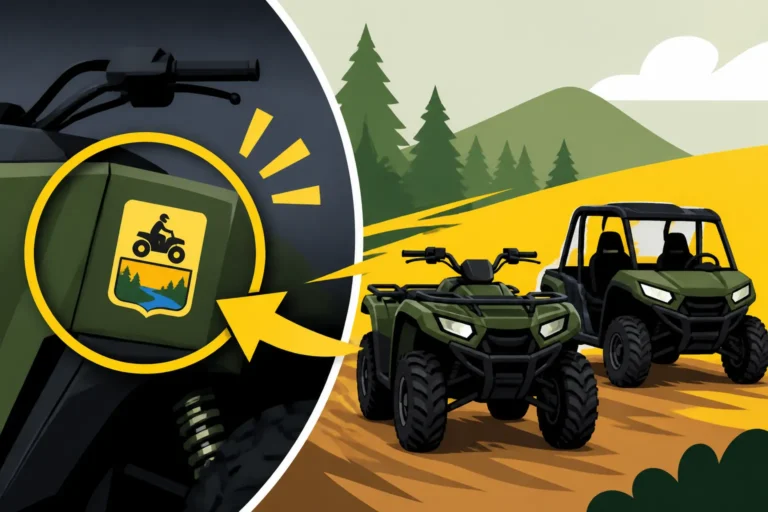
Even once your machine is registered and renewed, the battle isn't over if your plate and sticker aren't displayed correctly. New Brunswick has specific rules about where your ORV plate and registration sticker need to be placed. The plate must be clearly visible, typically on the rear of the machine. The registration sticker, that small, colourful decal that signifies your registration is current, must be affixed to the upper left side of the front fender, or as close to that position as practical.
I’ve seen riders with plates tucked under the seat, or stickers peeled off and stuck to their helmet, thinking it’s good enough. It's not. Law enforcement officers are trained to look for these specific placements. An incorrectly displayed plate or sticker is essentially the same as not having one at all in the eyes of the law, and it could lead to an unfortunate conversation and a ticket. Make sure your plate is securely mounted and clean, and that your sticker is clearly visible and not obscured by mud or accessories. When you get your new sticker each year, take the time to scrape off the old one cleanly before applying the new one. You can find out more about proper placement in [Why the Registration Sticker Goes on the Left Fender].
Overlooking Insurance Requirements for Trails
This mistake doesn't always prevent registration, but it's a critical oversight that can have severe financial consequences for New Brunswick riders, especially those who enjoy the vast network of trails.
Riding Without the Required Insurance on Designated Trails
In New Brunswick, if you plan on riding your ATV or UTV on a designated trail managed by a club, you are legally required to carry liability insurance. This isn't just a suggestion; it's the law. Many riders, particularly those who primarily ride on their own land or private woodlots, mistakenly believe they don't need insurance at all. However, the moment you venture onto a QuadNB trail or any other designated off-road vehicle trail, that insurance becomes mandatory.
The fine for riding uninsured on a designated trail can be substantial, and that's just the tip of the iceberg. Imagine being involved in an accident where you're at fault, causing injury to another rider or damage to their machine, or even property. Without liability insurance, you would be personally responsible for all those costs, which could quickly amount to tens or even hundreds of thousands of dollars. Always confirm your insurance coverage before heading out, especially if you plan to use club trails. Your home insurance might offer limited coverage, but dedicated ORV insurance is usually the safest bet. For more on this, check out [New Brunswick Requires Insurance on Trails] and [New Brunswick Insurance Cost for an ATV].
Common Registration Pitfalls and Solutions
To help summarize some of the most common registration mistakes and how to avoid them, here’s a quick overview:
| Mistake Type | Common Error | How to Avoid It | Key Document/Action |
|---|---|---|---|
| Initial Registration | Missing Bill of Sale or MSO | Always ensure you receive a complete, signed bill of sale (private sale) or the MSO (new purchase) with all details, including VIN. Consider using a template from LawDepot. | Bill of Sale / Manufacturer's Statement of Origin |
| Ownership Transfer | Delaying transfer / Incorrect HST declaration | Transfer registration promptly after purchase. Declare actual purchase price for HST. Verify seller identity and VIN against their registration. | Application for Vehicle Registration, Proof of Sale |
| Annual Compliance | Forgetting Dec 31st expiry / Incorrect plate placement | Mark your calendar for annual renewal. Affix plate securely to the rear and sticker to the front left fender. | Current Registration Certificate, Plate, Sticker |
| Trail Use | Riding designated trails without liability insurance | Secure dedicated ORV liability insurance if you plan to ride on any club-managed or designated trails. Carry proof of insurance. | Proof of Insurance (digital or physical) |
Not Carrying Your Documents While Riding
This mistake often goes hand-in-hand with registration issues, but it's a separate point of enforcement. Even if your ATV or UTV is perfectly registered and insured, if you don't have proof of these things with you when riding, you're still asking for trouble.
Failing to Carry Required Documents on the Trail
New Brunswick law states that when you're operating an off-road vehicle, you must carry your certificate of registration, proof of insurance (if riding on designated trails), your safety training certificate (if applicable), and your driver's license (or Class 9 license for teens). It's easy to leave these at home, thinking you won't get stopped, or that a photo on your phone will suffice. However, an officer can ask to see these physical documents.
Getting stopped on a trail and being unable to produce your papers can lead to fines, even if everything is otherwise in order. It’s not just about the monetary penalty; it can ruin your day and give you a black mark. Invest in a small, waterproof pouch that can be securely kept on your machine (like in a glove box or saddlebag) or on your person. Make sure the documents are protected from the elements. Before every ride, do a quick checklist: [Carrying Four Documents at Once]. That way, you’re always prepared and can enjoy the ride without the worry of an avoidable citation.
Conclusion
Avoiding these common registration mistakes for your ATV or UTV in New Brunswick really boils down to a few key principles: be meticulous with your paperwork from the start, understand the ongoing responsibilities of ownership, and always be prepared when you hit the trails. Taking the time to get your registration right, from the initial purchase to annual renewals and proper document carriage, ensures you can enjoy the stunning New Brunswick backcountry without unnecessary stress or fines. Don't let a simple oversight turn your riding adventure into a bureaucratic nightmare. Stay informed, stay prepared, and have fun out there!
Disclaimer
This article is for general informational purposes only and does not constitute professional advice. Laws, prices and regulations vary by location and change over time. Consult a qualified professional for guidance on your specific situation.