New Brunswick Visitors From Nova Scotia
Coming from Nova Scotia to ride in New Brunswick? The border crossing is easy; working out which permit, registration and insurance rules apply can be less straightforward. Reciprocity may save you from buying a second trail permit, but it does not automatically cover every machine or make every road legal to ride. Here’s what to check before you load up.
How Nova Scotia and New Brunswick trail reciprocity works
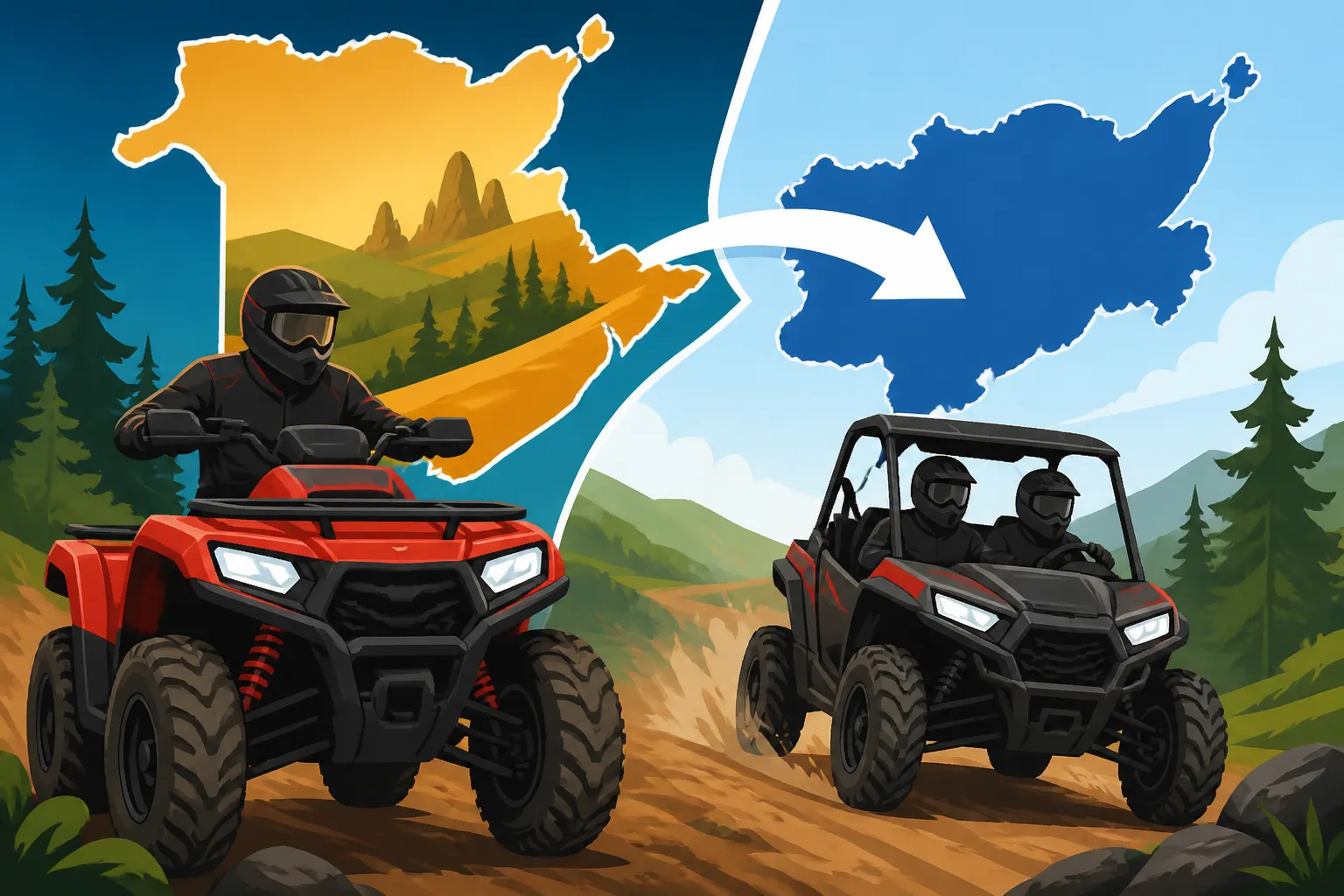
New Brunswick and Nova Scotia have a reciprocal trail-access arrangement for eligible riders. In general, it can allow a Nova Scotia rider with a valid home-province trail permit to use participating New Brunswick trails without buying a duplicate New Brunswick permit.
The important word is eligible. Reciprocity is not a blanket pass for every rider, vehicle or place. The permit must be current and recognized under the arrangement, and the trail you plan to ride must allow your type of machine. Rules and arrangements can change, so confirm the current details with QuadNB, the relevant local club or the permit issuer before travelling. New Brunswick Reciprocity With Nova Scotia
A reciprocal trail permit is also different from vehicle registration and insurance. Having a valid Nova Scotia trail sticker does not, by itself, prove that your ATV or UTV is properly registered or insured for riding in New Brunswick. Treat each requirement as a separate check:
- Trail permit: Does your valid Nova Scotia permit qualify for access to the New Brunswick trail network you plan to use?
- Registration: Is the machine registered as required, and can you show proof?
- Insurance: Does the policy provide the coverage required for the planned riding?
- Trail access: Is the route open to ATVs or side-by-sides, and are there local restrictions?
- Road access: If a route uses a road, is riding there permitted under the rules for that specific stretch?
| What you have | What it may help with | What it does not automatically establish |
|---|---|---|
| A valid Nova Scotia trail permit | Eligibility for reciprocal access on participating New Brunswick trails | Permission to ride every trail, road or private property |
| Nova Scotia vehicle registration | Proof that the machine is registered in its home province | That the machine meets every New Brunswick riding requirement |
| An insurance policy | Coverage under the policy’s terms | That coverage applies to every activity or location |
| A club trail map | Finding routes and checking trail information | That a trail is open today or suitable for your machine |
| A group leader’s permit | Helping coordinate a ride | That each additional machine is covered |
Before you travel, check that your permit is still valid for the dates of the trip and that you have the correct permit for each machine. If you have a UTV, a youth machine or more than one ATV, ask specifically whether the reciprocal arrangement applies to that vehicle and whether a separate permit is needed. Do not assume one sticker covers a whole group.
For the permit categories and what they cover, see New Brunswick Groomed vs Non-Groomed Permits. If you are deciding whether to buy a separate permit for an extra machine, New Brunswick Permit for a Second Machine explains the issue to check.
What to carry and confirm for each machine
A smooth trip starts with matching the paperwork to the vehicle. Make a separate checklist for every ATV or UTV coming across the border. That matters when a group includes machines owned by different people, a borrowed vehicle, or a side-by-side alongside quads.
Registration and proof of ownership
Bring the machine’s registration document and make sure the details are easy to read. If the vehicle is borrowed, rented or owned by someone else in the group, check that the rider has permission to use it and can produce the relevant documents. For a visiting rider, New Brunswick Registration for a Visiting Rider is a useful overview of the registration question.
A registration certificate is not the same as a trail permit. Keep both available if both apply. Likewise, a photo of paperwork may be a useful backup, but do not assume it will replace the original document if an officer or event organizer asks to see it. Check what is accepted before leaving home. New Brunswick Documents You Must Carry covers the documents riders may need to have with them.
Insurance
Confirm with your insurer that the policy covers the machine for the kind of riding you plan to do in New Brunswick. Ask about trail use, travel outside Nova Scotia, the specific vehicle type and any exclusions that could matter. A policy that covers one machine or use may not cover another.
New Brunswick requires insurance for riding on trails, so do not treat a reciprocal trail permit as a substitute for insurance. Carry proof that you can produce on the trail, and make sure it identifies the vehicle or otherwise clearly applies to it. See New Brunswick Insurance Requirements for Riders for the provincial requirement, and contact your insurer if the wording of your policy is unclear.
If you are travelling in a side-by-side, ask the insurer about that machine specifically. Do not assume that ATV coverage applies in the same way to every UTV or that the policy’s passenger coverage, permitted use and territory are identical. New Brunswick Insurance for a Side-by-Side looks at those questions in more detail.
Permit sticker and machine details
Check that the permit sticker is present, current and attached as required. Keep a clear record of the permit information before the ride, but do not rely on a photograph to make an improperly displayed or expired sticker acceptable. If you are unsure about where a sticker belongs on the machine, check New Brunswick Permit Placement on a Machine.
Before setting off, compare the vehicle identification number or serial information on the machine with the paperwork. That simple check can catch a mix-up when several similar machines are being transported together. If documents refer to a different machine, sort it out before riding rather than trying to explain it at a trailhead.
If you cannot establish whether the permit, registration or insurance applies to a particular vehicle, pause and ask the relevant issuer or authority. A quick confirmation before the trip is easier than discovering a problem after arriving at a remote trail access point.
Plan your route around trail access, not just the map
A trail map helps you plan, but it does not grant access by itself. Trails may be closed, rerouted, restricted to certain machine types or affected by local conditions. Check the latest information from the trail operator or club before travelling, particularly if your plan depends on one bridge, road connection or fuel stop.
New Brunswick’s trail system includes groomed and non-groomed routes, and not every route has the same operating conditions. A UTV may also have different practical limits from a smaller quad: width, turning space, bridge restrictions and surface conditions can all affect whether a route is suitable. Confirm that your specific machine can use the intended trail rather than assuming that an ATV route accommodates every side-by-side.
Use a current map and save the route information before leaving an area with reliable cellular service. If you use a phone for navigation, download the information for offline use where possible and bring a power source. Do not depend on a phone signal to find a reroute or call for help in a remote area. New Brunswick Trail Conditions Before You Go offers a useful planning checklist.
A sensible pre-ride routine is:
- Confirm that the Nova Scotia permit qualifies for reciprocal access and is valid for the planned dates.
- Check that each machine has the correct registration and insurance documents.
- Confirm that the trail is open and permits your machine type.
- Save the route and any club or closure information before you lose service.
- Tell someone outside the group where you plan to ride and when you expect to return.
- Carry basic tools, water, suitable clothing and a way to deal with a breakdown or delay.
If you are riding with a club or joining a local group, ask whether the route includes any restrictions, closures or special event requirements. The person leading the ride may know current local conditions, but each visitor remains responsible for meeting the rules that apply to their own machine.
Road riding, local rules and a final trip checklist
Reciprocity for trails does not mean you can ride an ATV or UTV on any New Brunswick road. Road use is governed separately and can depend on the road, the municipality, posted signs and any applicable permit or designation. A route shown on a map may use a road connection, but that does not make that connection legal for every rider.
Check the rules for each road section before using it. Do not copy another group’s route simply because you see machines travelling there, and do not assume a trail permit authorizes road riding. New Brunswick ATV Road Rules Explained outlines the distinction. If you need to use a specific road stretch, verify that it is open to your machine and that you meet the requirements for that stretch.
Local conditions matter, too. A town or trail operator may have restrictions that affect access, and a route can change because of maintenance, weather or land-use issues. Keep to marked corridors, respect gates and signs, and avoid creating a new route around a closure. If you encounter a closed section, follow the posted detour or turn back.
Before leaving Nova Scotia, use this final checklist:
- Confirm the reciprocal permit arrangement and its current terms with a reliable official or trail source.
- Check that every machine has a valid permit or other required authorization.
- Carry the machine’s registration and proof of insurance.
- Ask your insurer about coverage for your exact machine and planned use.
- Confirm that the planned trails are open and suitable for your ATV or UTV.
- Check road connections separately; a trail permit is not a road-use permit.
- Make sure permit stickers and vehicle details match the paperwork.
- Carry documents in a way that keeps them readable and accessible. A waterproof document pouch, including one available from retailers such as Amazon, can help protect papers from rain and mud.
- Save maps and emergency details before heading into areas with limited service.
If anything is unclear, get a direct answer before riding. Ask about the exact machine, permit type, dates and trail area rather than relying on a general statement that “Nova Scotia permits are accepted.” That gives you a much better chance of arriving ready to ride, without a paperwork surprise at the trailhead.
Disclaimer
This article is for general informational purposes only and does not constitute professional advice. Laws, prices and regulations vary by location and change over time. Consult a qualified professional for guidance on your specific situation.